As countries around the world roll out their vaccine plans, we can see different industries and different countries recovering at different rates.
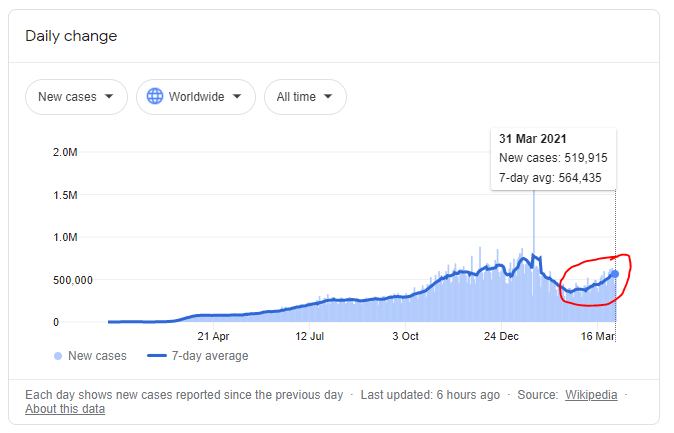
However, only a small percentage (about 5%) of the global population is vaccinated, so it might take a while before we start to see the results of the vaccines kick in to reduce new Covid cases.
If you look at the graph of new cases, it is still on the rise.
Given such a scenario, how does this affect the financial markets, and what are some of the investment opportunities we can look at?
Stock Market Surge
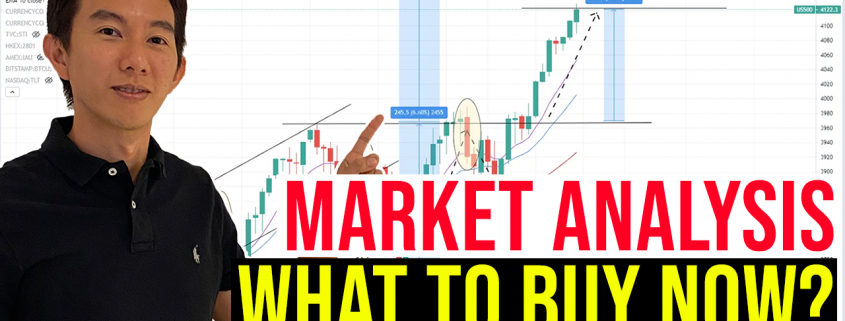
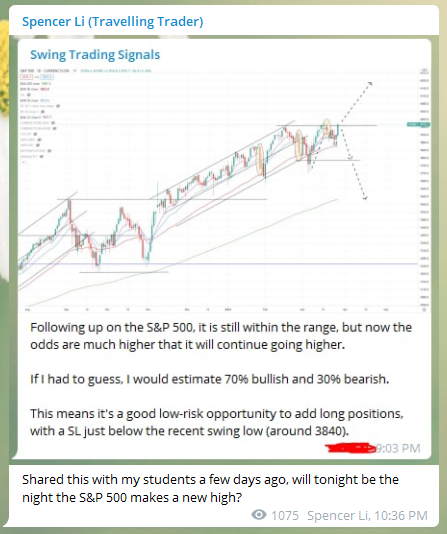
On 31 March 2021, I shared this important snippet in the public Telegram channel, because I felt that S&P 500 was going to have a breakout.
“Following up on the S&P 500, it is still within the range, but now the odds are much higher that it will continue going higher.
If I had to guess, I would estimate 70% bullish and 30% bearish.
This means it’s a good low-risk opportunity to add long positions, with a SL just below the recent swing low (around 3840).
Shared this with my students a few days ago, will tonight be the night the S&P 500 makes a new high?”
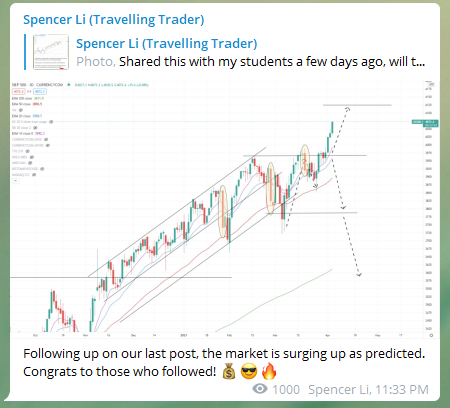
That very night, stocks broke to a new high, and has been steadily heading up for the past 1-2 weeks.
“Following up on our last post, the market is surging up as predicted. Congrats to those who followed! ???“
As of Friday last night (9 April 2021), the S&P 500 has hit our first price target of 4125, giving us close to 4% gain so far.
We have taken half profits, and there might be small pullback where we can add positions before gunning for the next price target.
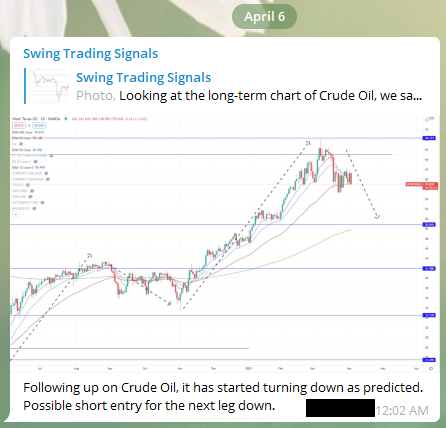
Not Much Upside for Oil Markets
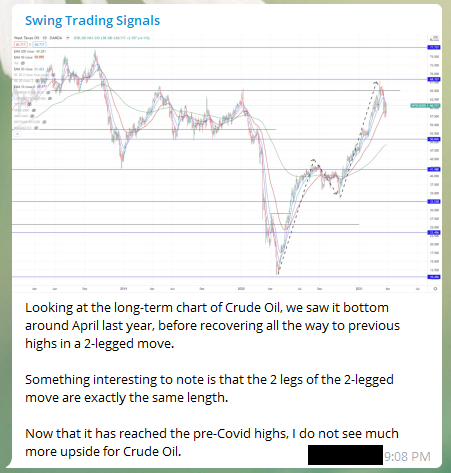
On 27 March 2021, I shared a chart on the long-term outlook of the Crude Oil market, and I felt that that most of the post-Covid recovery has been priced into oil, and since it won’t be going up much, I suggested taking a long-term short position on it.
“Looking at the long-term chart of Crude Oil, we saw it bottom around April last year, before recovering all the way to previous highs in a 2-legged move.
Something interesting to note is that the 2 legs of the 2-legged move are exactly the same length.
Now that it has reached the pre-Covid highs, I do not see much more upside for Crude Oil.”
“Following up on Crude Oil, it has started turning down as predicted. Possible short entry for the next leg down.”
Since then, prices have started to turn down a little, and I will continue to hold my short positions for another possible leg of price movement downwards.
Will USD Become Bullish?
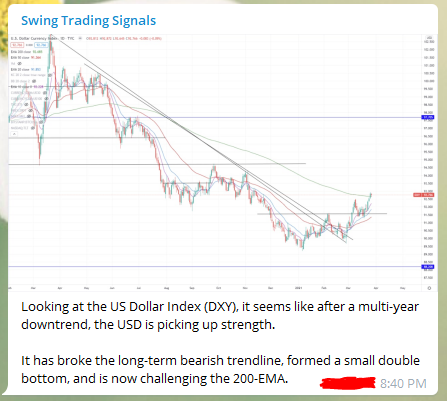
On 27 March 2021, I noticed that the USD was picking up strength, which was surprising, considering how much money the US has been printing.
My guess is that currently, the US is recovering faster from Covid as compared to many of the less developed countries.
“Looking at the US Dollar Index (DXY), it seems like after a multi-year downtrend, the USD is picking up strength.
It has broke the long-term bearish trendline, formed a small double bottom, and is now challenging the 200-EMA.”
Looking at the larger chart of the US Dollar Index (DXY), you can see that price has formed a double bottom, however the size of this pattern is not that convincing since it is comparatively small.
Price is now fighting in the middle of the EMAs, and we will need to see if it can emerge victorious and stay above all the EMAs.
Relative Strength of Forex Pairs
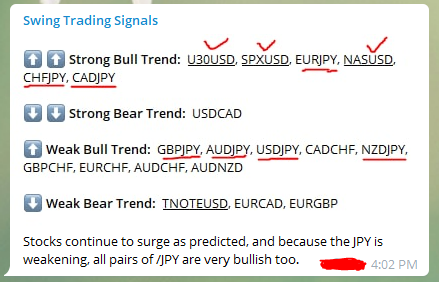
Let’s take a look at the other currencies and their relative strength.
This shows the current ranking of different currencies, from strongest to weakest.
“Stocks continue to surge as predicted, and because the JPY is weakening, all pairs of /JPY are very bullish too.”
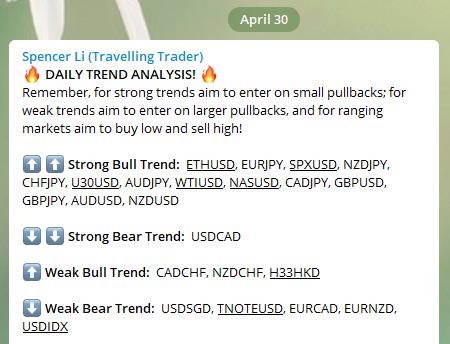
This shows the trends of the different currency pairs, stocks indices, commodities and bonds.
From these 2 tables, we can see that JPY & GPY are bearish, while USD & CHF are bullish.
Crypto: Bitcoin & Ethereum
Cryptocurrencies are really heating up right now, and I’ll be focusing on the 2 major ones – Bitcoin (BTC/USD) and Ethereum (ETH/USD).
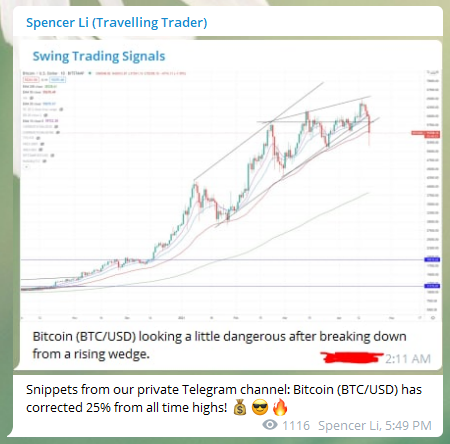
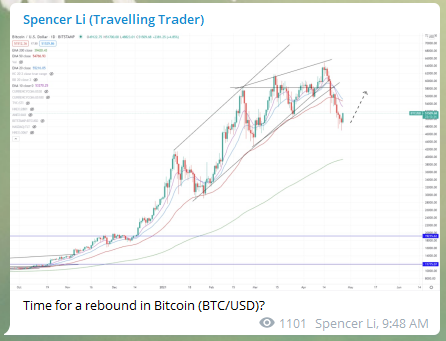
Looking at the chart of Bitcoin (BTC/USD), it is still staying nicely within the uptrend channel, with a nice ascending triangle building up for more bullish pressure.
It is very likely that it will break new highs this weekend.
Looking at the chart of Ethereum (ETH/USD), it is possibly even more bullish than Bitcoin, after a breakout of a ascending triangle, a pullback to test the breakout, which also formed a bull flag.
That is already a confluence of 3 bullish factors.
Needless to say, I will be holding on to this as well.
Market Summary
In this post, I have covered many markets, and the key things to note are:
Bullishness of the stock market
Long-term bearishness of Crude Oil
Potential bullish reversal of the USD
Bearishness of JPY & GPY
Bullishness of USD & CHF
Bullishness of cryptocurrencies
Now that I have shared my views on the various markets, what do you think is the best investment at this point of time?
https://synapsetrading.com/wp-content/uploads/2021/04/draft-2-market-analysis-what-to-buy-now-e1618222224862.jpg6081080Spencer Lihttps://synapsetrading.com/wp-content/uploads/2019/10/logo.jpgSpencer Li2021-04-10 18:51:112022-03-08 11:56:07Stock Market Surges As Predicted – What to Buy Now?
Would you pay millions of dollars for digital artwork?
Welcome to the world of NFTs, or non-fungible tokens.
Just this year so far, about $1.3 billion of NFTs have traded through Ethereum network, dwarfing the activity last year.
The biggest transaction was an NFT purchased for $69.3m dollars.
At this point, you might be wondering, what is a NFT, and whether it’s even a real thing.
Sounds unbelievable? Let’s find out more about this hottest new asset class.
What is a NFT? (Non-Fungible Token)
So, what exactly is a NFT, or non-fungible token?
Firstly, to understand what fungible means, let’s look at the concept of normal fiat currency.
If you have a $10 bill, that bill is fungible, because it is completely interchangeable with any other $10 bill. Every bill has the same value, and there is nothing unique about it.
Similarly, cryptocurrencies like Bitcoin are also fungible, meaning 1 Bitcoin (BTC) is interchangeable for any other Bitcoin and has exactly the same value.
On the other hand, NFTs, which rely on special token standards like ERC-721 (using blockchain technology) to ensure uniqueness, are non-interchangeable and each token is unique.
In this way, NFTs are like digital artwork or collectibles because they are one-of-a-kind, and ownership is locked to one particular person (the owner/buyer), making every piece a unique and limited-edition piece of work.
“Think of it like a digital passport that comes with an asset,” said Nadya Ivanova, chief operating officer of BNP Paribas-affiliated research firm L’Atelier. “They allow for this trust and authenticity to be established in a way that we haven’t been able to do before, whether it’s with physical assets or digital assets.”
Now that we have some understanding of “what is a NFT?”, let’s go more in-depth to see how they work.
How do NFTs Work?
What is a NFT token?
Non-fungible tokens are actually cryptographic tokens with unique identification codes and metadata that make them unique.
Created on a smart contract platform such as Ethereum, these tokens are unique and cannot be replicated.
This means that when you buy an NFT, you are essentially buying lines of code on a blockchain.
But these lines of code do have value.
They represent proof of ownership and authenticity of these digital artworks and assets, that this asset you own is uniquely and authentically yours.
This blockchain, which is a type of decentralized record-keeping on a public ledger of blocks, means that the whole world knows who officially owns the NFT.
And because it is decentralized, multiple records are stored all over the place, so it is impossible to hack the network to “steal” ownership of the NFT.
Since an NFT’s uniqueness and ownership can be easily verified, and they ensure strong property rights which cannot be stolen, they can be efficiently traded on the secondary market.
As a result, this new asset class can empower creators, such as artists, developers, in a variety of new ways that weren’t possible before, allowing them to monetise their creations more directly.
The Different Types of NFTs
What are NFT applications?
Back in 2017, we saw the first NFTs in projects such as CryptoPunks and CryptoKitties, where blockchain technology was used to sell online collectibles.
Since then, the industry has bloomed into a wide variety of new use cases and industries, with a market exceeding $1b dollars.
Non-fungible tokens can be used to tokenize just about anything, and so far some of the most popular NFT use cases have been:
Here are some recent samples of NFT artworks and related products that have been sold, proving that this is a potential multi-billion dollar or trillion-dollar market.
NBA’s Top Shot NFT-based trading card system – $230m in sales
“Everydays: The First 5,000 Days” by Beeple – $69.3m
CryptoPunks #7804 and #3100 – $7.6m each
CROSSROAD by Beeple – $6.66m
Collection of 10 digital artworks by Grimes – $6m
First Tweet by Jack Dorsey – $2.5m
Exclusive NFT version of their latest album by Kings of Leon – $2m
CryptoPunk #6965 – $1.54m
Auction Winner Picks Name by SSX3LAU – $1.33m
Not Forgotten, But Gone by WhIsBe – $1m
Hairy by Steve Aoki – $888,888.88
THE COMPLETE MF COLLECTION by Beeple – $777,777.77
Nyan Cat by Chris – $590k
The founder of Twitter, Jack Dorsey, recently auctioned his first tweet ever on the Twitter platform to raise money for charity.
The tweet, which said “just setting up my twttr,” was first published on March 21, 2006 and was sold for $2.9m.
What is a NFT Artwork? Is it a Scam?
So, what is a NFT artwork and how it is different from normal artwork?
When you buy a non-fungible token, what you are getting is a unique cryptocurrency token on the blockchain.
Some NFTs have only one version, so it is like owning the authentic version of a famous artwork such as the Mona Lisa.
However, things can get a little confusing here.
Because there are also NFTs which are digital versions of the reprints, kind of what you see in Pokemon cards where each card is printed multiple times.
But for each NFT, there is still a unique “watermark”, which is the code, so if yours is the original or limited edition, then the property rights or IP of the digital asset belongs to you.
For example, the “Nyan Cat” meme is freely available to anyone who wants to download a copy of it, but none of these downloads are the ‘real’ Nyan Cat NFT worth 300 ETH.
In the jargon of the art world, the difference is like owning an original versus owning a replica.
In the art world, one of the biggest problems is fake artworks.
However, because of blockchain technology, it is impossible to sell “fakes” of NFTs, because anyone can easily check the online public ledger to see who owns the real original NFT.
So in a sense, it is actually safer than physical artworks.
How Much is an NFT Worth? What Are the Risks?
How much should you pay for an NFT, or how much should you sell one for?
Just like dealing in valuable art pieces or collectibles, this answer is tricky because the value is totally dependent on supply and demand.
An art piece or collectible is only worth as much as what the next person is willing to buy it for.
So using that as a benchmark, you want to look out for things like artist reputation, scarcity, and provenance, including the origin and past transactions.
You can try to benchmark it against other similar pieces by the same artist, or other products in the same genre, but at the end of the day, the worth is determined by the market.
Hence, you want to make sure there is still interest and other buyers for your NFT, should and when you decide to sell it in the future.
The biggest risk is that should the NFT craze turn out to be a bubble, kind of like a game of “pass the bomb”, then you don’t want to be the fool left a bunch of worthless NFTs which you paid a lot for.
Since this is still the early phase, the risk of this is less, but the risk of a potential bubble increases if prices for popular NFTs keep increasing exponentially, akin to the Tulip Mania.
Another risk is that because NFTs are transacted in cryptocurrencies (ETH), the prices of NFT are very likely tied to the price fluctuations of cryptocurrencies.
So if you have noticed, there are sort of 2 different segments of NFTs. One is the super expensive NFTs of rare digital artworks or collectibles, while the other is the more “down-to-Earth” retail market for common folks to sell or access useful products and services.
For the former, just like the market for valuable artworks and collectibles, I feel that it is somewhat of a playground for rich investors to speculate, and not really meant for the typical retail investor.
How to Create & Mint NFTs
However, even though you don’t have millions of dollars to speculate on non-fungible tokens, you can still take advantage of this trend by creating and selling your own NFTs.
If you have already tried uploading photos or videos on social media platforms like Facebook, Instagram, or Tik Tok, then you already know how to create “digital artwork”.
The difference is that after creating your artwork, there is one extra step called “minting” to turn your creation into an official NFT.
To do that, you can use one of the many NFT minting platforms around the Ethereum ecosystem. Each has its own pros and cons, and different fees.
DIY (do-it-yourself) minting platforms like OpenSea, Rarible, InfiNFT, Mintbase, and Cargo let creators easily and permissionlessly mint their own NFTs.
On the higher end, there are some exclusive membership-only NFT minting platforms to which creators have to apply and be accepted before they can mint through these platforms, such as SuperRare and Async Art.
Once you have decided on your platform, you will need to upload your artwork, fill in a description, and decide whether you want to create a standalone or edition-based piece, your asset’s royalty percentage, unlockable content, etc.
Finally, you will need to make payment via ETH (Ethereum) for the approval and minting process to commence.
How to Buy and Sell Non-Fungible Tokens (NFTs)
Now that you have created your own non-fungible token, the next step is to find a marketplace to sell it.
You might be wondering, what is a NFT marketplace?
Thankfully, there is already such ecosystem set up, with open marketplace platforms like OpenSea, Nifty Gateway (art), Decentralland, Enjin (games), Yellowheart (concert tickets), NBA Top Shot (NBA collectibles), SuperRare (art) and Rarible where you can list your NFTs for sale easily, depending on which category your NFT falls under.
Payments are done via Ethereum (ETH) as well, so you will need to connect your wallet to the platform, in order to buy or sell any NFTs.
Criticism of NFTs
What are some of the current drawbacks of this non-fungible tokens system?
High Transaction Fees (Ethereum Gas Price)
If you recall in the previous segments when we talked about minting, buying and selling NFTs, there were transaction fees involved.
One problem is that these transactions fees can be quite high.
As most NFTs are on the Ethereum blockchain platform, each transaction requires the payment of Gas: the fee charged for processing a transaction or contract on the Ethereum blockchain network.
This fee is denominated in gwei: a small fraction of ETH.
Hopefully, as the market matures, and more competition comes in, the fees for these transaction costs will fall as well.
Environmental Impact
Currently, Ethereum still operates on the “Proof of Work” architecture that requires mining, which consumes a large amount of electricity and leaves a large carbon footprint.
To put this into context, the amount of electricity that the Ethereum network consumes rivals that of countries like Ecuador with a population of about 17.4 million.
Since almost all NFT transactions involve ETH, this will undoubtedly contribute to the usage of the network and electrical consumption.
Hopefully, Ethereum will be transitioning to a more eco-friendly “Proof of Stake architecture” soon, although progress has been slow since this idea was first put forth years ago.
Concluding Thoughts on NFTs
Currently, the NFT transactions attracting all the hype are the super expensive transactions similar to valuable artworks or rare collectibles.
While these garner the headlines, the more relevant applications NFTs could lie in empowering independent creators such as artists and developers to directly monetise their creations.
The huge potential also lies in the myriad of products and services which businesses (both small and large) can create or tie-in with their existing offerings in the offline world.
This means that in a couple of years, many of these products and services could become commonplace in our lives, unlocking a trillion-dollar market opportunity.
Now that I have shared all you need to know about NFTs, what do you think of this new asset class? Is it a bubble or is it here to stay? And if someone asks you “what is a NFT?”, will you be able to explain it to them?
https://synapsetrading.com/wp-content/uploads/2021/04/Why-are-NFTs-non-fungible-tokens-worth-millions.jpg7201280Spencer Lihttps://synapsetrading.com/wp-content/uploads/2019/10/logo.jpgSpencer Li2021-04-08 20:22:302022-12-21 02:58:58What is a NFT (Non-Fungible Token) and Why are They Worth Millions?
Is trading gambling? No, not if you have an edge. The single difference between the two is the mathematical edge, which is whether probability is on your side over many repetitions. A casino has the edge over its players, so it wins in the long run. A professional trader builds the opposite: a strategy with a positive expected outcome, so the trader wins in the long run. They can look identical from the outside (both involve luck, skill, probability, and the chance to win or lose big quickly) but the math points in opposite directions. Personally, I would estimate trading is roughly 80% skill and 20% luck, and gambling is the reverse, 20% skill and 80% luck. The catch is that an edge on paper is not enough. You also have to spread your money over many trades and actually follow your plan, because emotions like greed and hope quietly erode the edge you worked to build.
Here is how the edge works, how to measure it, and why the real risk is the player, not the activity.
What is the difference between trading and gambling?
At first glance, trading looks a lot like gambling. That is why most people lump them together and assume both are intrinsically risky with a high chance of a huge loss. The similarities are real:
Both involve a mix of luck and skill.
Both run on probabilities and uncertainty.
Both can make or lose large amounts of money in a short time, depending on your skill level.
But there is one big difference, and it changes everything: the mathematical edge.
Simply put, the edge refers to whether probability is on your side. If you are a professional trader or a professional gambler and you have the edge, you will likely be profitable in the long run. If you have no idea what you are doing, you do not have the edge, and you will most likely lose in the long run.
In a casino, most people have no idea what they are doing, and most are there to have fun. So the casino has the edge, and hence it wins most of the time. To beat the casino, or to beat other players in the financial markets, you need an edge of your own. Your trading plan and your trading journal are how you build it.
Trading (with an edge)
Gambling in a casino
Skill vs luck (my estimate)
~80% skill, 20% luck
~20% skill, 80% luck
Who has the edge
You, if you have a tested method
The house, almost always
Expected outcome E(X)
Positive, if your method is sound
Negative for the player by design
Right way to bet
Many small trades (law of large numbers works for you)
A handful of large bets, then quit while up
Long-run result
Profitable, if you follow the plan
The house wins
Notice the bottom two rows. The correct strategy for trading and the correct strategy for gambling are exact opposites. More on that below.
What is expected outcome in trading?
Before going further, let me explain what this edge actually is.
The important concept here is the “expected outcome”, written E(X). Without going into the detailed math (I have covered that in another post), the expected outcome tells you whether your strategy is profitable over the long run.
If your expected outcome is positive (more than zero), it means that over time your strategy has the edge, and you will be profitable. If your expected outcome is negative (less than zero), it means that over time you will lose money. That single number is the whole game.
How is expected outcome calculated?
Expected outcome depends on two main factors:
Your hitrate (or winrate), which is your winning percentage. A 70% hitrate means you win 70% of the time and lose 30% of the time.
Your reward-to-risk ratio (RRR for short), which is how much you make when you win versus how much you lose when you are wrong.
Combine these two and you can calculate your expected outcome, which tells you whether you have the edge. In trading, doing your analysis and taking a calculated risk tilts probability in your favour. In gambling, the odds are always against you.
Can you be profitable if you only win 40 to 50% of the time?
Yes. You do not need a high hitrate to make money. You need a positive expected outcome, and there is more than one way to get there.
You can win less than half the time and still profit, as long as you make more when you win than you lose when you are wrong. For example, if you make 2 to 3 times your risk whenever you win, but only lose 1 times your risk when you are wrong, and you win 50% of the time, your expected outcome is still positive.
So it depends on the strategy. There are many combinations of hitrate and RRR that all give a net positive outcome. You could run a low hitrate with a high RRR (the example above), or a high hitrate with a low RRR. In a sense it is a trade-off. You just need to find the balance of hitrate and RRR that gives you a positive expected outcome.
How do you beat the casino? The law of large numbers
Here is the concept that ties it together: the law of large numbers.
We established that if you have the edge, your expected outcome is positive, and you will be profitable over the long run. But how do you make sure you last long enough to reach that long run? In other words, how do you avoid blowing up your account (losing all your capital) before your edge has time to play out?
In statistics, the law of large numbers states that the larger your sample size (the number of times you trade or gamble), the closer your actual outcome will be to the expected outcome. So the solution is simple.
Spread your money over many trades. The more trades you take, the more likely your results match your expected outcome, which is positive.
In gambling, you do not have the edge, so your best bet is the opposite: take a handful of large bets, and quit the moment you are up, because the longer you play the more likely you lose. By keeping the sample size small, you take away the edge the casino has over you.
The same logic cuts the other way for you as a trader. If you have the edge but you do not manage your money well, and you bet too big on too few trades, you hand back the edge you built. The activities look the same, but the optimal strategies are mirror images.
Can you actually follow the plan?
There is one more factor, and it is the one that quietly sinks most traders: the psychological and emotional side.
Because real money is at stake, many people cannot make logical decisions or execute their strategy systematically. If you have a strategy with an edge but you execute it differently, you are either giving up that edge or, worse, turning your strategy into one with a negative expected outcome.
For example, if you take profit too early, you do not fully capture your winning trades. If you do not cut losses, your risk runs larger than planned. Either habit changes your RRR for the worse. Your reward comes in lower than expected and your risk comes in higher than expected, so your real RRR is much worse than the one on your spreadsheet. That alone can be enough to flip your expected outcome from net positive to net negative.
It makes no sense to build a great strategy and trading plan, then refuse to follow it because of conflicting emotions. So before every trade, the real question is this: are you making a decision, or are you just guessing?
The real risk is the player, not the activity
In conclusion, the greatest risk is not trading or gambling itself. It is the player.
The risk is not in the activity. It is in the expertise and experience of the person doing it. Professional poker players are not gamblers. They win because they do not play by pure luck. They use a system that gives them an edge over other players in the long run.
People lose big in trading for one of two reasons. Either they trade with no method or system that gives them an edge, or they have an edge but fail to use it properly, taking single large bets instead of many small ones. This is exactly why position sizing, capital allocation, and risk management are such essential concepts in trading.
Emotions like greed and hope cloud judgment even when you know better, and they erode the edge in your strategy. Most traders see only the upside in their trades and not the downside, so they sell quickly to lock in a profit but hold on to losses, hoping they turn around. This is the main reason many traders who genuinely have an edge still cannot grow their accounts.
So if you want to be profitable in trading, keep these three things in mind:
Have a trading plan and strategy that gives you an edge.
Spread your capital over a large number of trades.
Manage your emotions and execute your trading plan.
Where the human edge comes in
A model can crunch your hitrate and RRR and tell you your expected outcome is positive. That part is now free. What it will not do is stop you from taking profit too early on the one trade that was supposed to carry the month, or hold your hand through a losing streak while the law of large numbers does its slow work, or keep you from betting the whole account on a single “sure thing”. The math is the easy part. Sizing the bet and following the plan under emotional pressure is the Human Edge, and it is the part no system can trade for you.
FAQ
Is trading the same as gambling?
No. Both involve luck, skill, and probability, but trading can carry a positive expected outcome (an edge), while casino gambling is built to give the house the edge. With a tested method and proper risk management, trading is a calculated risk, not a bet against the odds.
What is an edge in trading?
An edge means probability is on your side over many repetitions. Mathematically, it is a positive expected outcome E(X), driven by your combination of hitrate (win percentage) and reward-to-risk ratio. A positive E(X) means you profit in the long run; a negative one means you lose.
Can you make money if you only win 40 to 50% of the time?
Yes. A sub-50% hitrate can still be profitable if your winners are larger than your losers. For example, making 2 to 3 times your risk on wins while losing 1 times your risk on losses, at a 50% hitrate, gives a positive expected outcome.
Why do traders with an edge still lose money?
Usually because of money management and psychology. Betting too big on too few trades works against the law of large numbers, and emotions like greed and hope lead to taking profits too early and cutting losses too late, which quietly turns a positive expected outcome negative.
How do you beat the casino?
You cannot beat a true casino edge over the long run, so the gambler’s best play is a few large bets, then quitting while ahead. A trader does the opposite: build a real edge, then spread capital over many trades so the law of large numbers pulls your results toward your positive expected outcome.
Now that you have seen the real difference between trading and gambling, do you still think trading is as risky as gambling? And how would you explain it if someone asked you “is trading gambling?” Let me know in the comments below.
Want the system behind the edge? Grab the free 15-Minute Swing Trading Starter Kit. It is the exact routine I use to scan once a day and trade any market in 15 minutes.
About the author. Spencer Li is the founder of Synapse Trading and a Certified Financial Technician (CFTe) with 15 years of trading across stocks, forex, crypto, commodities, and bonds. His trade log is public, 404 trades, losses left in. He teaches low-risk swing trading in 15 minutes a day, one system for any market.
Education, not financial advice. Synapse Trading is not licensed by MAS to advise on investment products. Trading carries risk of loss; past performance is not indicative of future results.
https://synapsetrading.com/wp-content/uploads/2021/03/is-trading-really-risking-like-gambling.jpg7201280Spencer Lihttps://synapsetrading.com/wp-content/uploads/2019/10/logo.jpgSpencer Li2021-03-26 10:00:532026-07-06 03:22:00Is Trading Gambling? (How to Profit Consistently Like a Casino)
Paper Trading: Is It Worth It, and What Are the Better Alternatives?
Last updated: 3 July 2026 · By Spencer Li, CFTe
Paper trading (also called demo trading or virtual trading, where you trade with fake money to simulate the experience without real risk) is worth it for your first 10 to 20 trades, and not much beyond that. It is good for one job: learning to execute and manage trades without paying for your beginner mistakes. It is bad at the job most people hope it will do, which is teaching trading psychology, because there is no real money on the line. The two better tools for what people usually want from paper trading are backtesting (to check if a strategy works) and a small real-money account (to train your psychology). The flow I recommend is simple: backtest the strategy, paper trade to learn the process, then switch to a small real-money account as fast as you reasonably can.
Here is what paper trading does well, where it fails, how to do it correctly, and the alternatives that do each job better.
What is paper trading?
Paper trading, demo trading, and virtual trading are the same thing: trading with fake money on a simulated account, so you get the experience of trading without the risk of losing any.
You use a virtual or demo account, place buys and sells, and watch how the trades play out, but no real money ever changes hands. So you cannot lose anything.
The logic for a beginner is sound. Most of your worst mistakes happen at the very start. Paper trading lets you make those mistakes for free. You start with fake capital, focus on honing the mechanics, and scale up to real money as your skill improves.
That works for the first 10 to 20 trades, where you just want to learn how to fire off an order and manage it. After that, paper trading hits its ceiling, for one reason: you cannot learn real trading psychology from it.
Why paper trading cannot teach you trading psychology
Mindset is a major factor in trading success, arguably the deciding one. And mindset only switches on when something is at stake.
Imagine playing poker with fake money. Is it the same experience? Definitely not.
Trading, like poker, tests your ability to make sound decisions under the stress of having money on the line. Take the money away and you take the stress away, and the stress is the whole point. Without skin in the game, the experience is just not the same.
This is not a small caveat. It is the single biggest reason not to overstay in the demo phase.
How to paper trade correctly (the 3 rules most people skip)
Most people paper trade wrongly, and hence it ends up being a waste of time. If you want to get real value out of it, three things matter.
1. Have a trading plan first. Before you place any trade, on a real or demo account, plan it fully: what strategy, what time frame, what product, where you enter, where you exit. If you go into paper trading and just randomly buy and sell, there is no learning at all, because whether you win or lose, you have no idea whether what you did was right or wrong. (More on this in How to Craft a Winning Trading Plan.)
2. Keep a trading journal. Record the whole decision-making process: what you bought and sold, the emotions involved, and why you made each call. That data, from your plan and your journal together, is what lets you improve the strategy before you risk real money. (See How to Create a Trading Journal.)
3. Treat the demo account as if it were real. This is the most important one. It is the closest you can get to simulating real psychology. If you treat fake money like real money, you will actually apply your money-management and risk-management rules, instead of doing reckless things you would never do with your own cash.
Ways to paper trade
There are two easy ways, and you do not need anything fancy.
The manual way is pen and paper, or a spreadsheet. You spot a setup, note “buy X lots at this price,” and as price moves you record your exit and the result. It is slow, but it forces you to write down your thinking.
The software way is a demo account. TradingView and most brokerage platforms give you a virtual account where you can buy and sell the real products on the platform, and every transaction is logged for you to review later. If your demo platform matches the live platform you will eventually trade on, even better.
Paper trading vs backtesting vs a small real-money account
Here is the part the original slug points at: the alternatives. Paper trading is not the only tool, and for two of the three jobs beginners care about, it is not even the best one. This table is the whole post in one view.
Tool
What it is
Best for
Weakness
Backtesting
Running a strategy against historical data, ideally automated
Checking if a strategy actually works, fast
Past results do not guarantee future ones; no execution practice
Paper trading
Trading fake money on a demo account in real time
Learning to execute and manage trades for free; forward-testing
Teaches no real psychology; can hide slippage and commissions; breeds overconfidence
Small real-money account
Live trading with a small amount you can afford to lose
Training trading psychology under real stress
Real losses; needs discipline and strict sizing
The point of the table: if all you want is to know whether a strategy works, backtesting does that far better than paper trading. You can test 10 to 20 strategies by computerizing it, all at once, before you ever place a trade. And if you want to learn psychology, only real money does that. Paper trading sits in the middle, doing one narrow job (process and execution) well.
Pros and cons of paper trading
The pros:
No risk. You can key in the wrong order or press the wrong button, reset the account, and try again. It is a cost-free way to make beginner mistakes.
Confidence. As you get familiar with the platform and your execution, you build confidence in your strategy and test whether it holds up. This works best when the demo platform matches your future live platform.
Forward-testing. Unlike backtesting (which looks at the past), paper trading tests your strategy forward, in live conditions, in real time.
The cons:
No skin in the game. The big one. Hard to learn psychology when no real money is involved.
Overconfidence. You can crush it on paper and then fall apart with real money. I saw this constantly when I traded professionally at hedge funds: people who did beautifully on the demo account lost their nerve, or got too cocky, the moment real money was on the line, and blew up.
Slippage and commissions. Demo accounts often do not reflect real transaction costs accurately. If your strategy trades a lot, those costs add up and your demo results will flatter you.
Backtesting does the strategy-check job better. If “does my strategy work” is the only question, reach for backtesting, not paper trading.
The part the demo account cannot give you
A backtest will tell you if the edge exists. A demo account will teach your fingers where the buttons are. Neither one will teach you what your stomach does when a real position goes against you and your own money is bleeding in real time. That is psychology, and it is one of the Five Edges no simulator can hand you. It only switches on when the loss is real. Hence, the goal is not to stay in the demo forever, it is to graduate out of it on purpose, as soon as you have the mechanics down.
Summary: the right progression
My advice to new traders is to paper trade for about 10 to 20 trades, then move to a small real-money account. It does not matter how small you start, as long as it is real money, because that is the only way to see what your psychology actually does under stress. From there you scale up slowly as you gain confidence.
The full flow, in order:
Backtest your strategies. Once you have one that works, you
Paper trade it to get familiar with the process and execution, and once you are comfortable, you
Move to real money (start small) to train your trading psychology.
That is the whole progression. Backtest to validate, paper trade to practice, real money to grow up. Skip the middle if you must, but do not skip the last one, and do not live there forever.
So, now that you know the correct way to paper trade and the better alternatives for each job, do you still think paper trading is useful, and have you tried it yourself?
FAQ
Is paper trading worth it?
For your first 10 to 20 trades, yes. It is a cost-free way to learn how to execute and manage trades. Beyond that it has limited value, because it cannot teach you trading psychology when no real money is at stake.
What is the difference between paper trading and backtesting?
Backtesting runs a strategy against historical data to check if it works, and it is faster and more thorough for that. Paper trading tests a strategy forward in live conditions and lets you practice execution, but it does not prove an edge as efficiently as backtesting.
Why does paper trading fail to teach trading psychology?
Because there is no skin in the game. Trading, like poker, tests your decisions under the stress of real money on the line. Remove the money and you remove the stress, which is the very thing you need to learn to handle.
How do I paper trade correctly?
Three rules: plan every trade fully before you take it, keep a trading journal of your decisions and emotions, and treat the demo account exactly as if it were real money so you apply proper risk management.
How long should I paper trade before going live?
About 10 to 20 trades, just long enough to learn the mechanics. Then move to a small real-money account you can afford to lose, because real money is the only way to train your psychology.
Now that you have the progression, where are you in it: backtesting, paper trading, or live? Let me know in the comments.
Want a system you can actually paper trade and then take live? Grab the free 15-Minute Swing Trading Starter Kit. It is the exact routine I use to scan once a day and trade any market in 15 minutes.
About the author. Spencer Li is the founder of Synapse Trading and a Certified Financial Technician (CFTe) with 15 years of trading across stocks, forex, crypto, commodities, and bonds. His trade log is public, 404 trades, losses left in. He teaches low-risk swing trading in 15 minutes a day, one system for any market.
Education, not financial advice. Synapse Trading is not licensed by MAS to advise on investment products. Trading carries risk of loss; past performance is not indicative of future results.
https://synapsetrading.com/wp-content/uploads/2021/03/Final-paper-trading-thumbnail.jpg7201280Spencer Lihttps://synapsetrading.com/wp-content/uploads/2019/10/logo.jpgSpencer Li2021-03-23 16:52:072026-07-06 02:47:51Why Paper Trading is a Waste of Time (And What are Better Alternatives?)
Have you ever wondered why you keep making the same trading mistakes over and over again?
As you start your trading journey, one very important habit to cultivate is to have a good trading journal, which is why in this blog post, I’m going to share with you how you can start a trading journal and use it to effectively improve your trading results.
The first thing to record is the planning of your new trade.
You should already have a trading plan before you even start trading, but before you actually execute the trade, it is good to record down the trade in your trading journal.
Why are you taking this trade?
Why is this a good trade?
What is the strategy behind it?
What is the reason or the rationale for you wanting to take this trade?
What are the pro factors? The negative factors?
Everything should be recorded down, basically your whole thought process of your decision-making of how you come about to decide whether you want to take this trade or you want to pass on this trade.
So all that should be recorded down in your trading journal for future reference.
Trading Journal #2 Execute Your Trade
Next is the execution of the trade.
What was the reason and analysis of each decision point during the trade?
For example, when you’re making the entry, why are you entering at this price?
Why not wait a little bit later?
Why not enter at a better price or when you are going to exit the trade,
Why do you want to take profits?
Why not let the trade run further?
All these things should be recorded down in your trading journal.
Basically, why you make every decision along the way.
Trading Journal #3 Record Your Trade
Next, you’re going to record the trade itself in your journal, meaning all the trade parameters.
You’re going to record:
What type of trading style was it?
Was it a long-term trade? A medium-term trade, a short-term trade?
So that will correspond to whether it’s position trading, swing, trading, or day trading.
And what was the product that you traded?
Was it forex, a stock, an option or a derivative?
Next, what was the timeframe?
Was it on a 5-minute chart, a 1-hour chart, a daily chart, a monthly chart?
These are all the standard perimeters that should be recorded down in your trading journal.
Next up, you should also record down your entry price, stoploss price, and target price. These are the bare minimum parameters that you need to have for each trade.
The entry price (EP) is the price that you entered the trade.
The stoploss price (SL) is the price that you get stopped out.
So if it’s a losing trade, and you got stopped out, then you record the price which you got out or if you didn’t get stopped out, you also record down the stoploss price, because that is the price that intended for it to be the stoploss.
And lastly, the target price (TP) will be the price that you choose to take profit at.
If you actually stagger your trade, for example, you take half profits at certain price or decide to trail, and shift your stoploss or different variations of position management.
All this is useful information to see whether the position management strategy that you’re using is actually effective, or maybe it might be too complicated and decreasing the optimal returns that you should be getting.
Next, you should also attach a chart of your entry and exit in your trading journal.
Ideally the chart should be labeled with as many things as possible. Other than your entry and exit, you can label where you shift your stoploss or scale in or out of positions.
You can also choose to label your thought process directly on your chart.
So for example, if you choose to make your journal soft chart-based, then you could also record down most of the information directly on your chart, and then you’ll save a screenshot of it.
It might be easier for you to reference. All you have to do is just look through all the different charts, compilations. All the information is already on the chart.
However, it will not allow you to effectively analyze the data.
If you record it on a spreadsheet instead, then it’s easier if you want to do analytics to review the numbers and your profits.
This is a trade-off. Or you can do both if you have the time.
But the bare minimum you should have is to at least have an attached chart so that when you look at the chart, you can remember what this trade was about.
Trading Journal #4 Record Your Emotions
Lastly, the most important thing is to record down in your trading journal is your emotions throughout the trade.
Many traders tend to neglect this aspect because they think that they just want to record the hard data, so they don’t really record down how they were feeling or why they made this decision.
But trading is an emotional activity.
It’s largely psychological, but your emotions still do play a big role.
A large part of trading is how well you can effectively manage this emotion.
So the first step to understanding or managing the emotions, is to be able to record it down.
For example, when you were taking this trade,
Were you feeling fear?
Were you afraid that you might miss out the trade or feeling greedy?
Or were you feeling hopeful or hesitant because maybe you were previously been burned in your last trade?
All these emotions are very important because subconsciously, they may affect your decision-making.
Trading Journal #5 Review Your Trades
The next segment is how to use these data that you have collected from your trading journal to improve your trading results.
The frequency at which you do your review will depend on your trading style.
If you are doing swing trading, then maybe you can do a review at the end of every week; if you are day trading, then you could do it at the end of every day.
The main point of this review is to look for areas of improvement.
What are some of the things that you should be looking out for?
Did you follow your trading plan?
You should have a trading plan before you even start trading, so you can compare the before and after, (your trading plan versus your trading journal), how closely do they match up?
If you deviated from your trading plan, why did it happen?
Was it because of certain emotions or was it some impulse?
So with that, then you need to decide whether it is the plan needs to be improved or whether it is you who needs to improve so that you can be more disciplined to follow the trading plan.
The next level is to go down to each individual trade, for example, for every trade:
Why was it a winning trade?
Why was it a losing trade?
Just because a trade is a winning trade doesn’t necessarily mean that it was a perfect trade or you did everything correctly because there’s an element of chance.
Even if you broke all your trading rules and you traded horribly, there’s still a chance that you might end up with a winning trade, but that doesn’t necessarily reflect your ability to trade.
And it definitely doesn’t mean that you should replicate this behavior in the future.
It’s important to not just see the trade as winning trade equals good trade and losing trade equals bad trade, but to understand the underlying reasons for why it was a winning trade and why it was a losing trade.
For losing trades, was it due to poor execution or was it due to market conditions?
So similar to the idea put forth earlier, just because a trade was a losing trade doesn’t necessarily mean that it was a bad trade because you can do everything perfectly and executed everything according to plan and it could still turn out to be a losing trade simply because no trading strategy is 100%.
Even if your trading strategy is 70%, there is still a 30% chance that the trade will be a losing trade, even if you did everything correctly.
The key thing is to see how closely you follow your plan, whether you execute everything according to your plan.
As I said earlier, it’s a matter of reviewing everything and seeing whether the plan needs to be improved and changed, or whether it is you who needs to improve your discipline, such that you can be less emotional and be able to execute the plan which you have come up with.
And that is the key to being a good trader.
Summary of Trading Journal
So to sum up, I’ve shared with you 2 main segments of the trading journal.
The first was all the things that you need to record in your trading journal. (Parts 1 to 4).
That’s how you can create a good trading journal.
The second part is how you actually use this information to improve your trading results. (Part 5).
So remember that all successful traders, even professionals, they keep a trading journal.
And in fact, this is quite a standard practice for many of the funds and financial institutions, especially for some that I used to work at.
It was common practice that they want all the traders to have a trading journal so that when you are reviewing it with your manager or your bosses, there’s a record and it actually helps them understand your trading style and your trading decisions on a day-to-day basis.
Even if you are trading on your own, it’s actually very important to have this trading journal because you will be able to better understand yourself as well.
Only you will be able to figure out your strengths and your weaknesses.
So having this trading journal gives you a window into your own trading psyche and allow you to fine tune your trading strategies and thus, improve your trading results.
For all new traders out there, do you currently have a trading journal and for seasoned traders, how useful is a trading journal when you were starting your trading journey?
https://synapsetrading.com/wp-content/uploads/2021/03/how-to-create-a-trading-journal-thumbnail.jpg7201280Spencer Lihttps://synapsetrading.com/wp-content/uploads/2019/10/logo.jpgSpencer Li2021-03-14 18:42:142022-08-10 05:10:18How to Create a Trading Journal (And Discover Your Edge in the Markets)