

Overconfidence Bias in Trading – How Can I Ever Be Wrong?
Join our Telegram channel for more market analysis & trading tips: t.me/synapsetrading
Table of Contents
Overconfidence Bias in Trading: What It Is and How to Fix It
Last updated: 3 July 2026 · By Spencer Li, CFTe
Overconfidence bias in trading is the unwarranted faith in your own judgment, predictions, and abilities, the gap between how good you think your decisions are and how good they actually are. It shows up in two forms: prediction overconfidence (your forecasts are too precise, your confidence intervals too narrow) and certainty overconfidence (you are too sure you are right). It hurts your trading in concrete ways: you take positions too large, skip the stoploss, hold losers too long, and trade too often. The fix is one disciplined habit. No matter how good your analysis is, assume your edge is at most 60-70%, which means there is always a 30-40% chance you are wrong. Trade from that number and you keep your risk management, your contingency plan, and your stoploss in place. Trading is a game of probabilities, and nothing is 100%.
Here is what the bias is, the two types, how each one damages your account, and how to keep it in check.
What is overconfidence bias?
Consider this: “Despite the fact that more than 90% of car accidents involve human error, three-quarters (73 percent) of drivers consider themselves better-than-average drivers.”
That sounds delusional. The same thing happens in trading. Most people think they can beat the markets. But is that true?
First, what is confidence? According to Wikipedia, confidence is “a state of being clear-headed either that a hypothesis or prediction is correct or that a chosen course of action is the best or most effective.” The word comes from the Latin fidere, “to trust.” So self-confidence is trust in yourself, and that is a good thing to have.
But too much of a good thing turns bad. Overconfidence bias (the unwarranted faith in one’s intuitive reasoning, judgments, and cognitive abilities) is what you get when there is too much of it. In plain terms, people think they are smarter and make better decisions than they actually do.
“Too many people overvalue what they are not and undervalue what they are.” – Malcolm S. Forbes
Why does overconfidence bias happen?
Studies have shown that people overestimate two separate things:
- Their own predictive abilities, and
- The precision of the information they have been given.
In the first case, people think they are smarter than they are. In the second, they think their information is better than it is.
Here is the everyday version. Someone gets a tip from a broker, or reads something off the internet, and they are ready to place a trade right away on the strength of that perceived knowledge advantage. But if there is no logical basis for the advantage, the edge does not exist at all, no matter what the trader thinks he knows. They are too confident the information is accurate without doing the work to verify it before acting.
There is one more layer. People are poorly calibrated at estimating probabilities. Events they think are certain to happen are often less than 100% certain to happen.
What are the two types of overconfidence bias?
There are two kinds, and they fail in different ways. Prediction overconfidence is about how accurately right you think you are. Certainty overconfidence is about how likely you think you are to be right.
| What it is | How it sounds | How it shows up in trading | |
|---|---|---|---|
| Prediction overconfidence | Your confidence intervals are too narrow, your forecasts too precise | “It will hit exactly $182.50 in 11 days” | Chasing precise price targets, trusting “expert” forecasts, betting on a pinpoint that no one can actually call |
| Certainty overconfidence | You are too sure your judgment is correct | “This is a sure-win” | Oversized positions, higher risk, no stoploss, no contingency, blind to the chance of a loss |
Prediction overconfidence bias
Here the confidence intervals traders assign to their predictions are too narrow. The classic example is “experts” forecasting precise price targets. You see it in the news all the time, a celebrity or an analyst or a bank putting out some ridiculous price projection.
It is simply not possible to forecast with that kind of accuracy. Even professional traders only get an idea of direction and some idea of magnitude. No one is going to pinpoint the exact price a stock reaches on an exact day. That is prediction overconfidence, or most of the time, just fabricating numbers for attention.
Certainty overconfidence bias
Here traders are too certain of their judgments. At the professional level, even when you find a good trade, you are at most 60-70% certain, and that is good enough to be profitable over the long run.
But when an amateur sees that same trade, they get 90-100% certain it is a winner. So they treat every trade as a “sure-win,” go blind to the prospect of a loss, and then feel surprised and disappointed when it performs poorly.
That same overconfidence pushes them into larger positions, higher risk, and no contingency plan or stoploss. After all, why would you need a stoploss if your trade is a “sure-win”?
How does overconfidence bias affect your trading?
The dangers are numerous, and they stack:
- You go blind to warning signs. If you overestimate your ability to pick a winner, you stop seeing the information that says your decision was wrong. That gets you into bad trades and keeps you in losing ones.
- You overtrade. If you believe you have special knowledge, you trade more often than your real edge justifies.
- You underestimate downside. In the worst cases this means trading with no stoploss at all, which is how small mistakes become account-ending ones.
How do you prevent overconfidence bias?
There is a fine line between confidence and overconfidence. You need enough confidence to trust your analysis and not get swayed by the crowd, yet not so much that you think your analysis is 100% correct.
The rule that holds the line is a single number. No matter how good your analysis and research is, assume the edge you have is at most 60-70%, which means there is still a 30-40% chance you are wrong.
Enter every trade with that mentality and the rest follows naturally. You do your proper risk and money management. You keep a contingency plan. You place your stoploss to cap the downside. That is the whole defence, and it works because it is built into your process rather than relying on you to feel humble in the moment.
Always keep in mind: trading is a game of probabilities, and nothing is 100%.
Where the human edge comes in
A backtest can hand you a strategy with a positive expectancy. A screener can rank a hundred setups in a second. What no tool will do is hold your size down when a setup feels like a sure thing, or make you place the stoploss you do not think you need. Overconfidence is not a data problem, it is a judgment problem, and judgment is the first of the Five Edges a machine cannot trade for you. The 60-70% rule is how you install that judgment as a habit instead of a feeling.
FAQ
What is overconfidence bias in trading?
Overconfidence bias is the unwarranted faith in your own judgment, predictions, and abilities, the gap between how good you think your trading decisions are and how good they actually are. It leads to oversized positions, skipped stoplosses, and overtrading.
What are the two types of overconfidence bias?
Prediction overconfidence (your forecasts are too precise and your confidence intervals too narrow) and certainty overconfidence (you are too sure you are right). The first makes you chase exact price targets, the second makes you treat trades as “sure-wins.”
How does overconfidence affect trading decisions?
It makes you take larger positions, skip the stoploss, hold losers too long because you ignore warning signs, and trade too often because you believe you have special knowledge. All of it underestimates downside risk.
How do you overcome overconfidence bias in trading?
Assume your edge on any trade is at most 60-70%, never higher. That built-in 30-40% chance of being wrong keeps your risk management, contingency plan, and stoploss in place on every trade.
Is confidence bad for trading?
No. Confidence is necessary, you need it to trust your analysis and not get swayed by the crowd. The problem is overconfidence, when you think your analysis is 100% correct. Trading is a game of probabilities, and nothing is 100%.
Now that you know the two types of overconfidence and the 60-70% rule that defends against them, how do you think the bias has affected your own trading decisions? Let me know in the comments.
And if you want the full set of mental traps mapped out, read the pillar: The Complete Guide to Investing and Trading Psychology.
Want a system that takes the ego out of it? Grab the free 15-Minute Swing Trading Starter Kit. It’s the exact routine I use to scan once a day and trade any market in 15 minutes, with the risk rules built in so a “sure-win” feeling can’t blow up your account.
About the author. Spencer Li is The 15-Minute Trader and the founder of Synapse Trading. He is a Certified Financial Technician (CFTe) with 15+ years of trading, run from 70+ countries. Every trade he takes is public, dated, losses left in. He teaches low-risk swing trading in 15 minutes a day, one system for any market.
Education, not financial advice. Synapse Trading is not licensed by MAS to advise on investment products. Trading carries risk of loss; past performance is not indicative of future results.
Related
Complete Guide to Investing and Trading Psychology (pillar) · Loss aversion in trading · Confirmation bias in trading · How to set a stoploss
Want the daily routine? Enter your email for the free 15-Minute Swing Trader's Checklist.
Free, 5 pages, PDF. You get the checklist, then my occasional trading emails. Education only, not financial advice. Unsubscribe anytime.
Where your details go: Kit, our email provider, stores your email address in the United States. Our contract with Kit lets it use your address only to send our emails, and requires Kit to keep it secure. The United States has no national privacy law like Singapore's, so that contract is the main protection. More in our privacy policy.
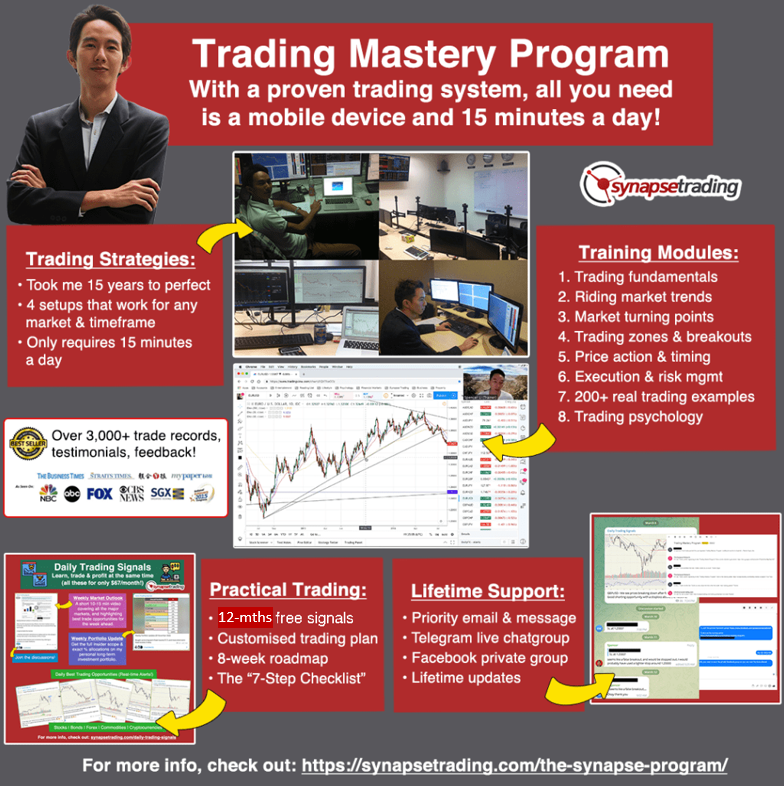 Our flagship mentoring program is suitable for both beginners and advanced traders, covering the 4 strategies which I used over the past 15 years to build up my 7-figure personal trading portfolio.
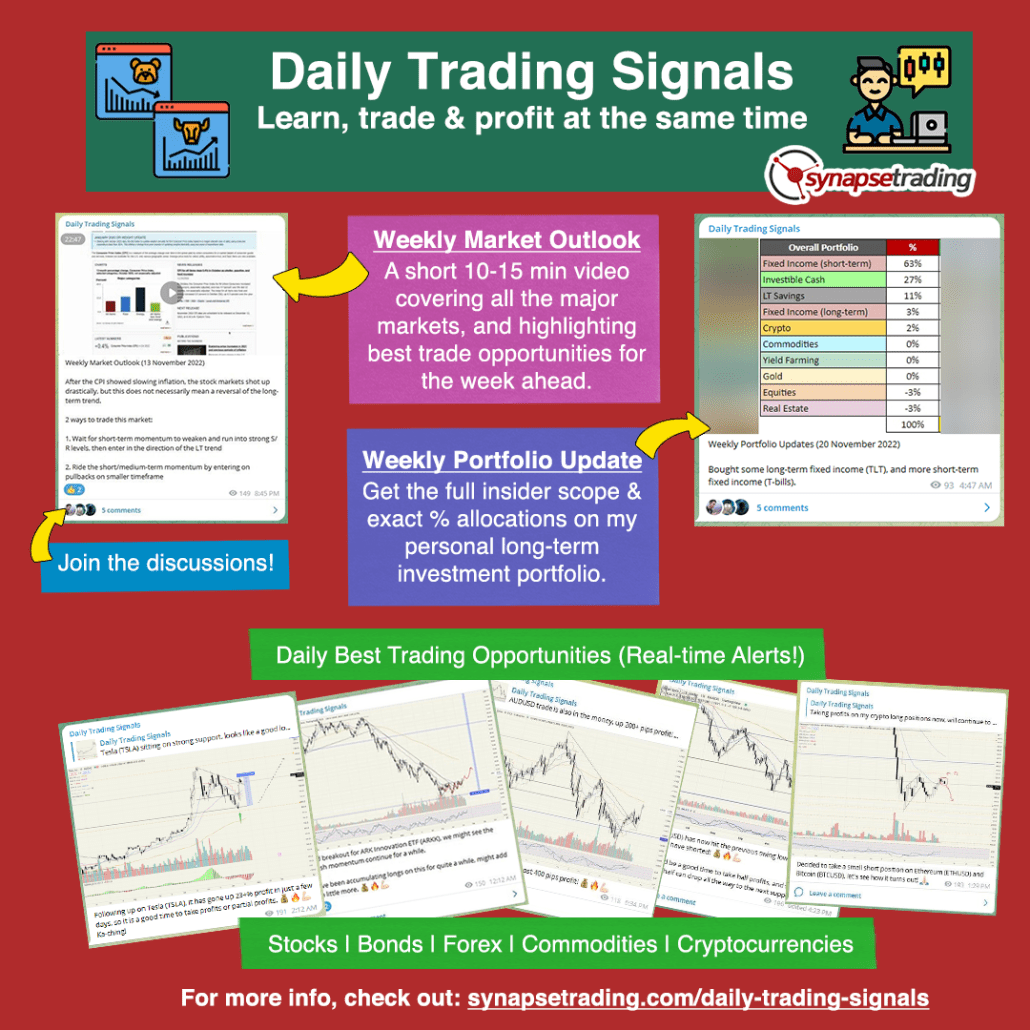 If you're looking for the best trading opportunities every day across various markets, and don't want to spend hours doing the research yourself, check out our private Telegram channel!


Trackbacks & Pingbacks
[…] arrive become detrimentally overconfident in their own market savvy. That is the on-ramp to overconfidence bias, where you trade bigger and more often because you believe in an edge that the actual numbers do […]
Leave a Reply
Want to join the discussion?Feel free to contribute!