
Last updated: 17 October 2026 · By Spencer Li, CFTe
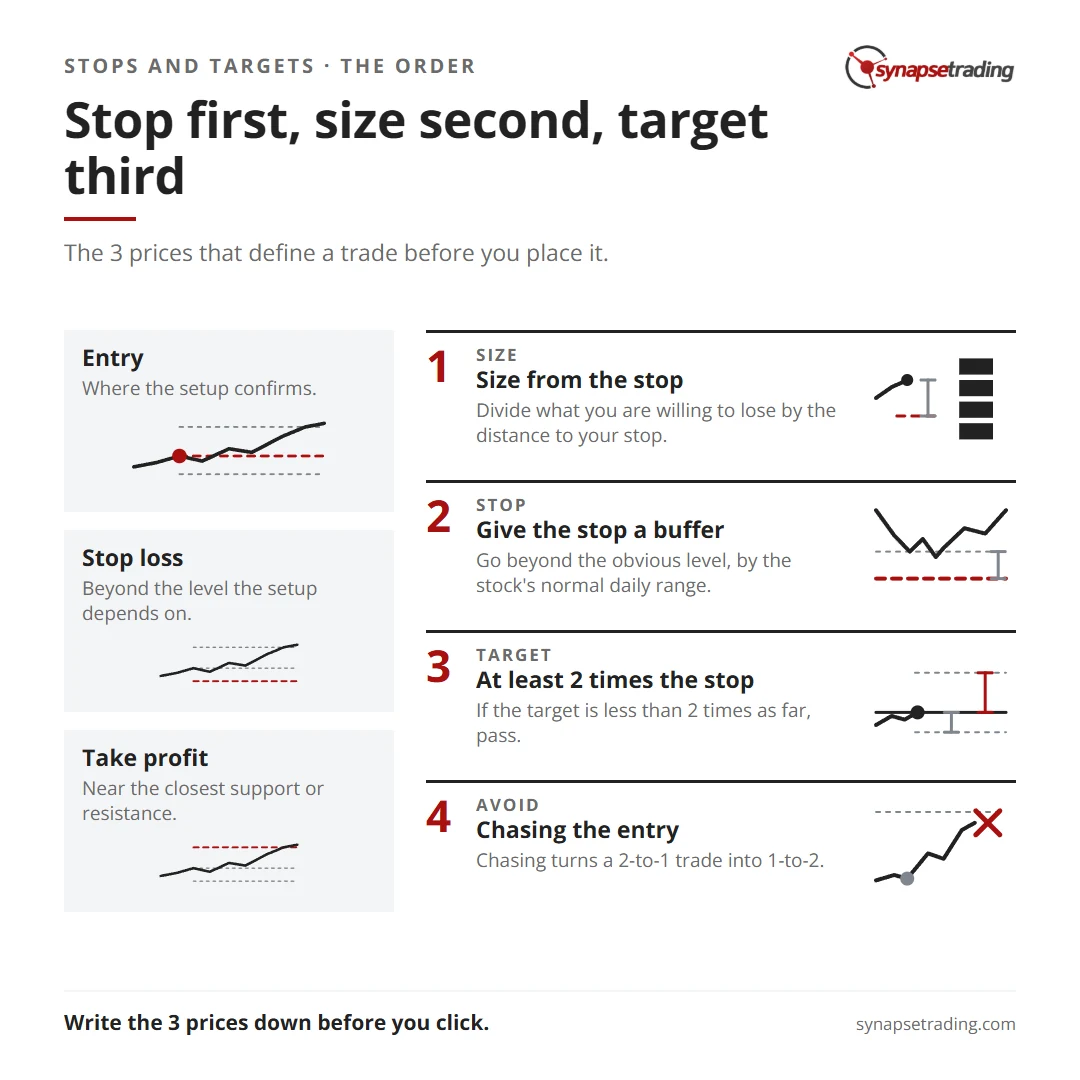
Put your stop loss at the price where your trade idea is proven wrong, with a little room beyond it for normal noise. Put your take profit at the nearest price level where the move is likely to stall. And set them in a particular order: stop first, size second, target third.
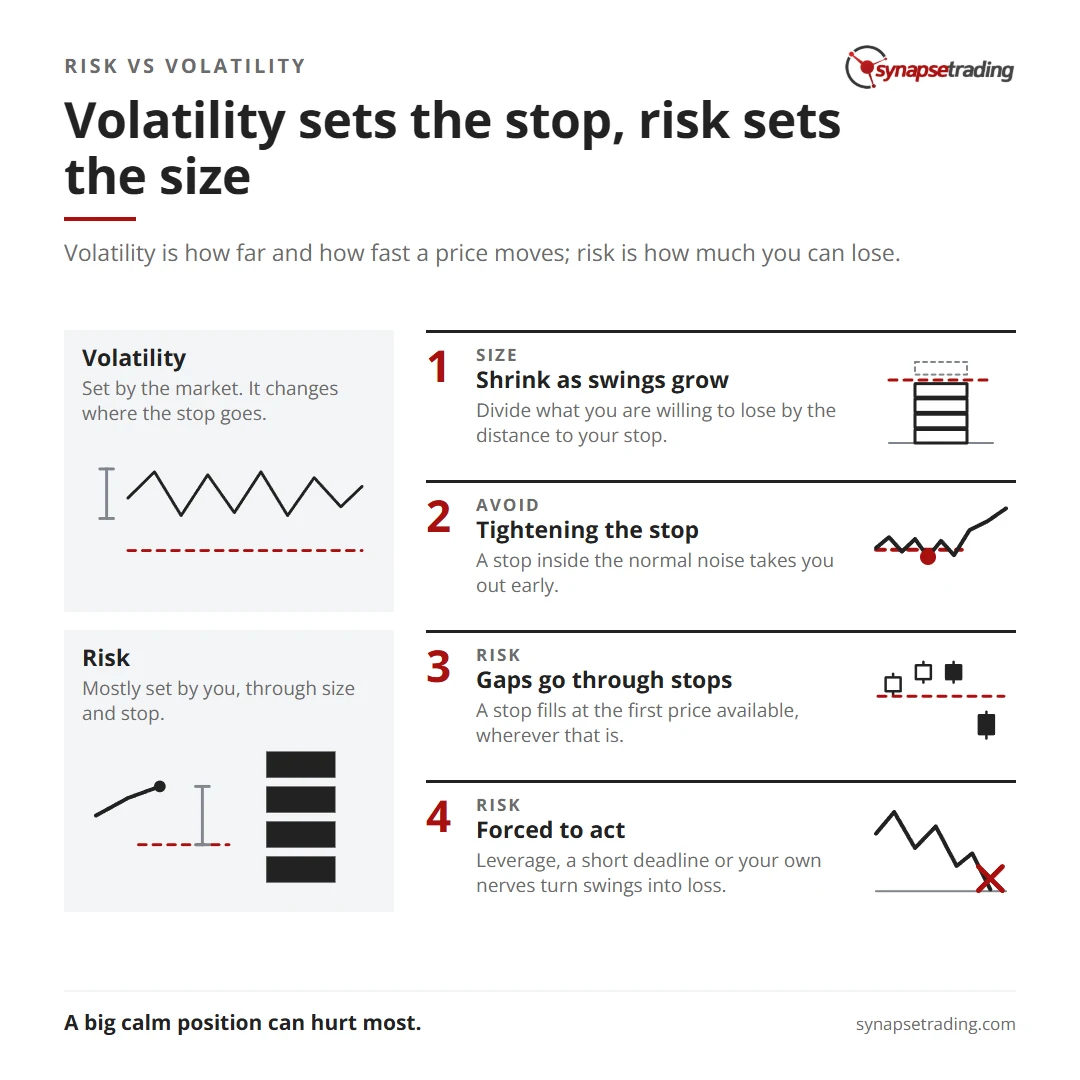
The stop comes first because it decides how big the position can be. Divide what you are willing to lose by the distance from your entry to your stop, and that is your position size. Only then look at the target, and take the trade only if the target sits far enough away to pay for the risk, at least 2 times the distance to the stop as a working minimum.
The entry is simply the price where your setup triggers. If price has already run most of the way to the target by the time you notice, the maths no longer works, and the right entry is often no entry at all.
What are entry, stop loss and take profit?
They are the 3 prices that define a trade before you place it. Traders often shorten them to EP, SL and TP.
| Price | What it answers | Where it usually goes |
| Entry (EP) | when is the idea triggered? | where the setup confirms, such as a break of a level |
| Stop loss (SL) | when is the idea wrong? | beyond the level the setup depends on |
| Take profit (TP) | where is the move likely to stall? | near the closest support or resistance |
Each one answers a different question, which is why each needs its own reason. A stop placed “5% below, because that feels about right” has no reason behind it, and the market has no way of knowing it is there.
Why does the stop come first?
Because it decides the size, and the size decides the damage. Let me use one hypothetical example with round numbers.
A stock trades at 50 and your setup triggers there. The level your idea depends on sits just above 47, so the stop goes at 47, which is 6% below the entry. You risk 1% of your account on every trade. So the position is 1% divided by 6%, about 16.7% of the account. If the stop is hit, you lose 1%, exactly as planned.
Now look at the target. The closest level where sellers showed up before is around 56, which is 6 points above the entry, twice the 3-point distance to the stop. That makes it a 2R trade, where R is the amount you risked. Worth taking.
Do it in the other order and the plan starts to slip. Pick the position size first, by feel, and then the stop ends up wherever keeps the loss “comfortable”, which is usually too tight, inside the stock’s normal wiggle. The 2% money management rule for position sizing walks through the sizing step by step.
Where should the stop go?
Beyond the level that your trade depends on. If you buy because price bounced off support, the idea is wrong once price breaks back through that support, so the stop sits just below it. Placing it at a round percentage, or at an amount of money you would like to lose, ignores the chart completely.
A trader on r/technicalanalysis asked about the most common complaint in September 2026: “Stopped out at the exact high/low repeatedly.” He wanted to know if it was a known effect. It is a familiar pattern. One common explanation is that many traders put their stops at the same obvious spot, just past the last swing high or low, and a quick move into that cluster triggers them all before price turns.
So give the stop a buffer beyond the obvious level, sized to the stock’s normal daily range. A wider stop then means a smaller position, so the risk stays the same. The exact buffer and stop rules we use are part of what we teach in the course. The principle is the part that matters here: the stop marks where you are wrong, plus enough room that ordinary noise cannot reach it.
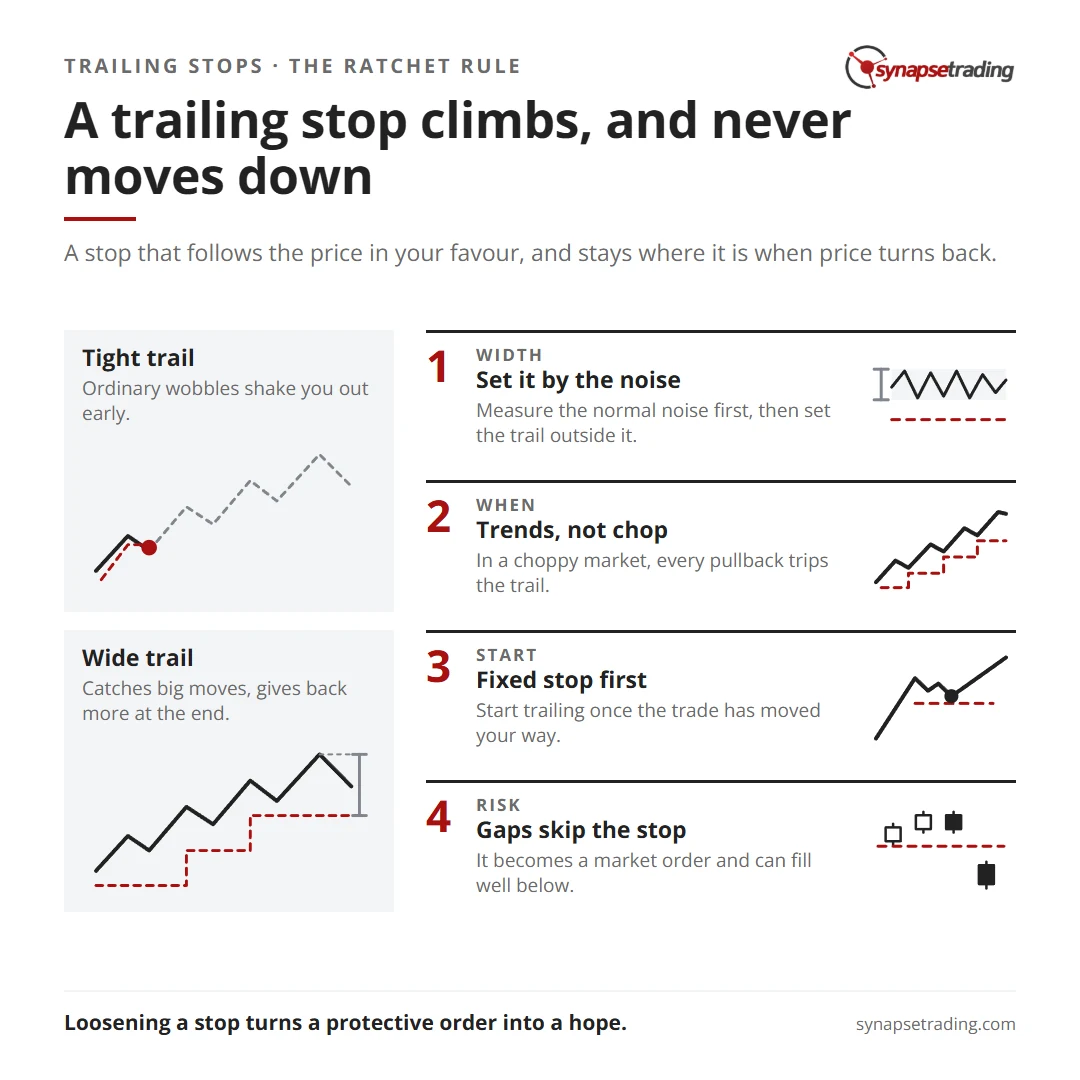
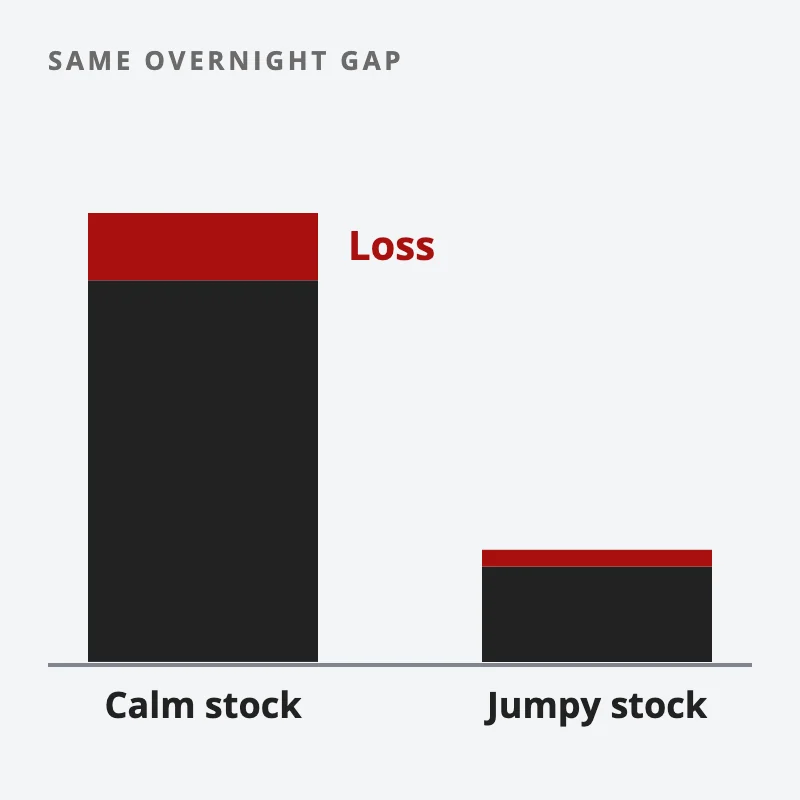
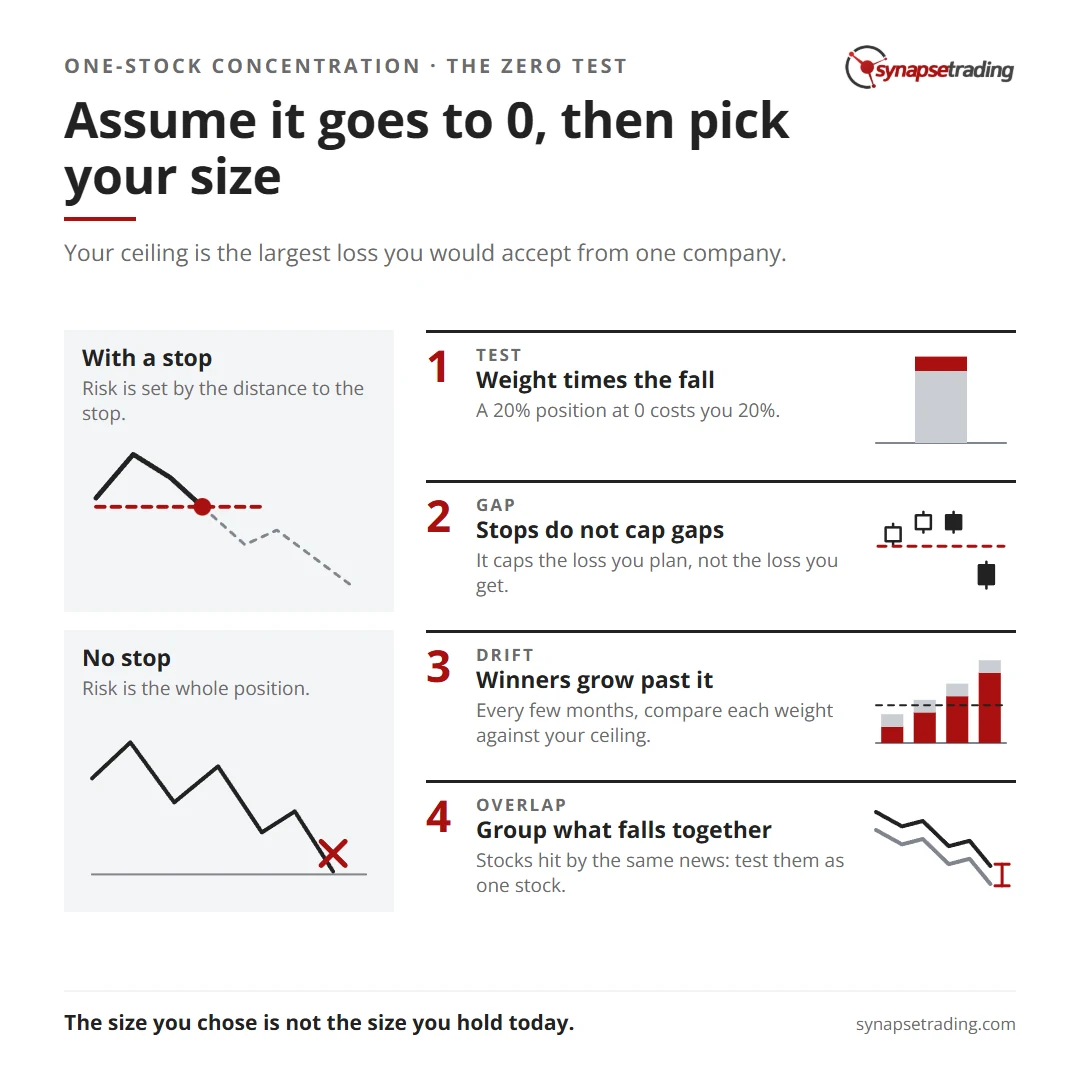
Do note one limit. A stop is an instruction to sell at the next available price. If the stock gaps through your stop overnight, the fill can be well below it, and the loss larger than planned.
If you want a daily routine for setting all 3 before you trade, the free 15-Minute Swing Trader’s Checklist is at the end of this post.
Where should the take profit go?
Near the closest level where the move is likely to pause: the last swing high for a long trade, or a resistance zone price has struggled with before. Put it slightly in front of that level, since the crowd tends to sell into it.
Then check the ratio. If the target is less than about 2 times as far away as the stop, many swing traders simply pass, because a strategy that wins half the time or less needs winners bigger than losers to come out ahead. How win rate and payoff trade off against each other is the whole subject of win rate versus reward-to-risk ratio.
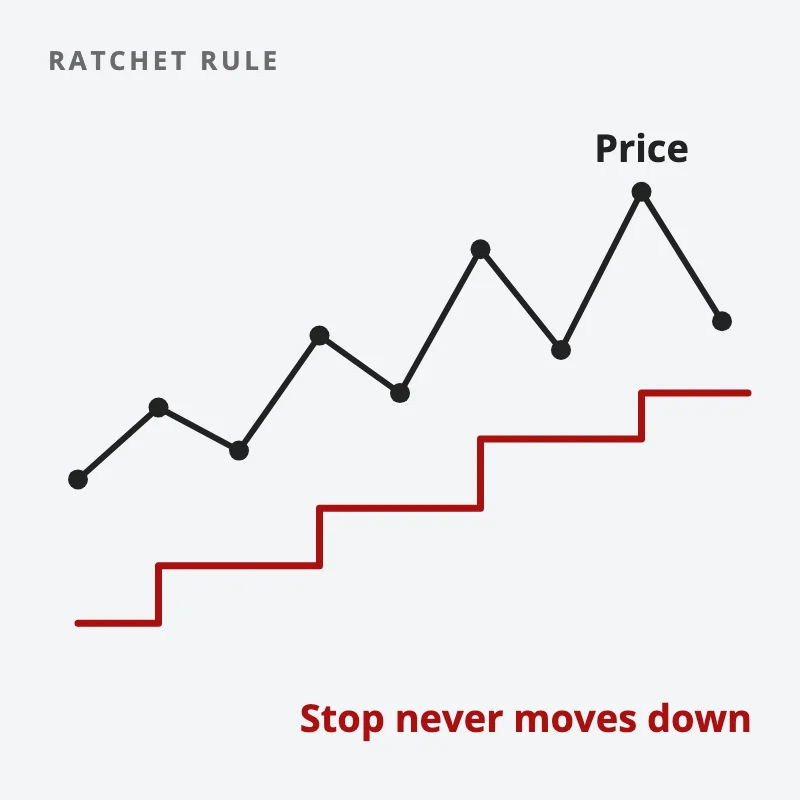
A fixed target is only one way to exit. Some traders take part of the position off at the target and let the rest run behind a moving stop, and some exit when an indicator turns, which is the idea in using trading indicators to exit trades.
Where should the entry go, and is it ever too late?
The entry goes where the setup confirms, and not before. One of our students asked a question I hear in some form every week: “in your opinion is it too late already to enter with that set-up?”
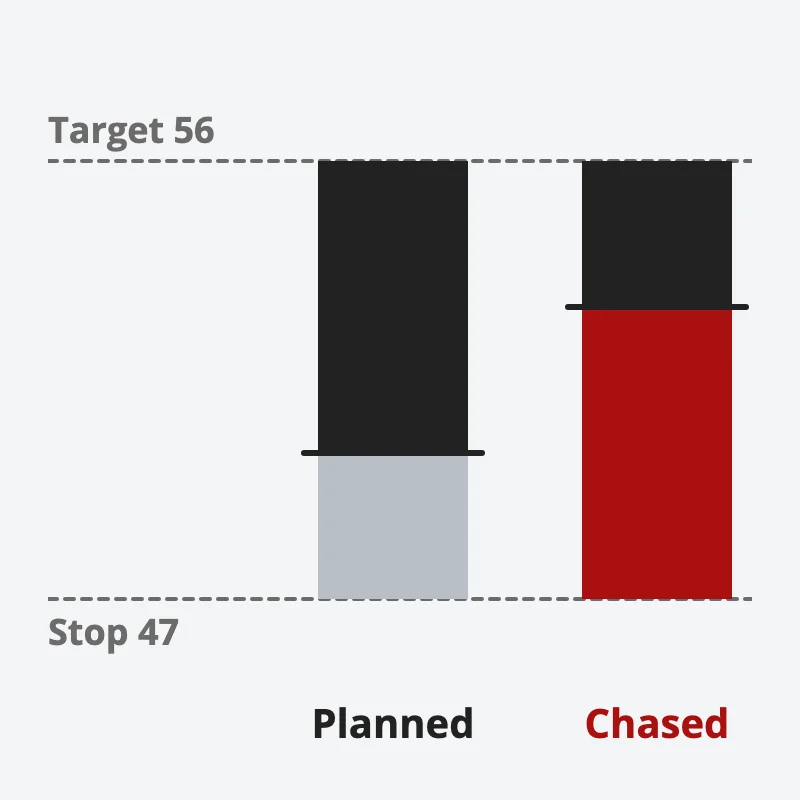
The 3 prices answer it for you. Take the same hypothetical stock. Say you only notice it once it has already reached 53. The stop still belongs at 47, because that is still where the idea is wrong, and the target is still around 56.
| Planned entry | Chased entry | |
| Entry | 50 | 53 |
| Stop | 47 | 47 |
| Target | 56 | 56 |
| Risk (points) | 3 | 6 |
| Reward (points) | 6 | 3 |
| Reward-to-risk | 2R | 0.5R |
Same stock, same chart, same idea. Chasing it turned a 2-to-1 trade into a 1-to-2 trade. So yes, it can be too late, and the ratio is how you tell. If the reward left on the table is smaller than the risk, the trade has already happened without you.
Personally, I think writing the 3 prices down before you click is the single most useful habit in trading. It moves every decision to the moment you are calm, which matters because cutting a loss in real time is hard for everyone, as the psychology of the stoploss explains. For the bigger picture, read why risk management is important in trading and the practical guide to money and risk management.
FAQ
Where should I put my stop loss?
Just beyond the level your trade idea depends on, plus a buffer for normal noise. For a long trade off support, that means a little below the support level.
How far should a stop loss be from the entry?
As far as the chart needs, and no closer. Then shrink the position so that hitting the stop still costs only your fixed risk per trade.
Where should I put my take profit?
Slightly in front of the closest level where price is likely to stall, such as a previous swing high for a long trade.
What is a good reward-to-risk ratio?
Many swing traders look for at least 2 to 1. The right minimum depends on your win rate, since a lower win rate needs bigger winners.
Why does my stop loss keep getting hit before price reverses?
Usually because it sits at the obvious level, where many other stops cluster. A buffer beyond that level, with a smaller position to keep the risk the same, is the common fix.
Go deeper
The free 15-Minute Swing Trader’s Checklist has the daily routine, the questions to ask before every trade, and the five rules that keep you in the game.
About the author. Spencer Li is The 15-Minute Trader and the founder of Synapse Trading. He is a Certified Financial Technician (CFTe) with 15+ years of trading, run from 70+ countries. He holds a B.Acc and B.BM from SMU. Every trade he takes is public, dated, losses left in. He teaches low-risk swing trading in 15 minutes a day, one system for any market.
Educational content only, not personalised financial advice. Trading carries risk, including loss of capital. Past performance is not indicative of future results. Synapse Trading is not licensed or regulated by MAS.