

Rectangle Pattern Trading Strategy: 4 Ways to Trade the Breakout and Avoid the Fakeouts
Want the daily routine? Get the free 15-Minute Swing Trader’s Checklist. Get it free →
By Spencer Li, CFTe · Last updated: 21 September 2026
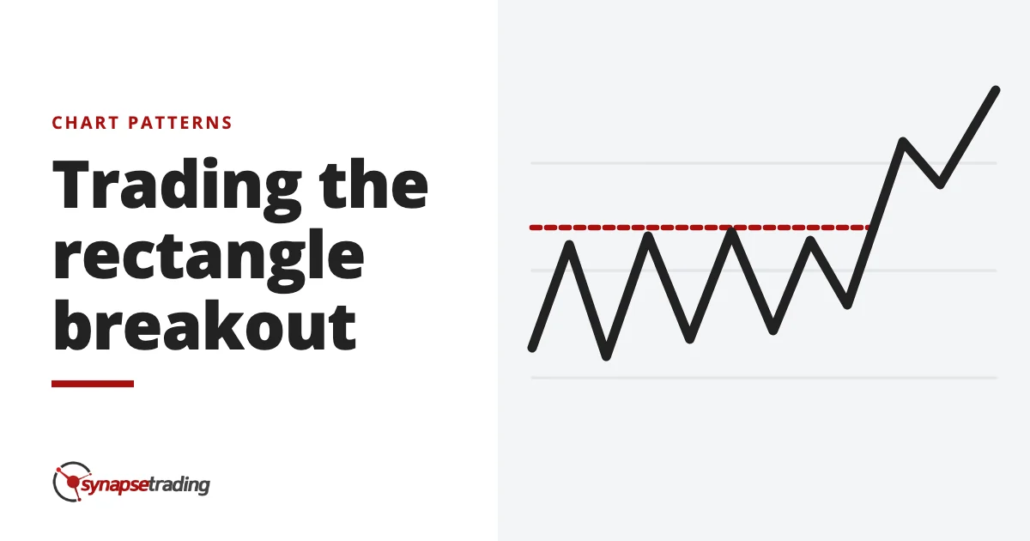
A rectangle pattern is a sideways range where price keeps bouncing between a flat resistance line above and a flat support line below, because buyers and sellers are roughly matched for a while. It is usually a continuation pattern, so the breakout more often goes the same way as the trend before it.
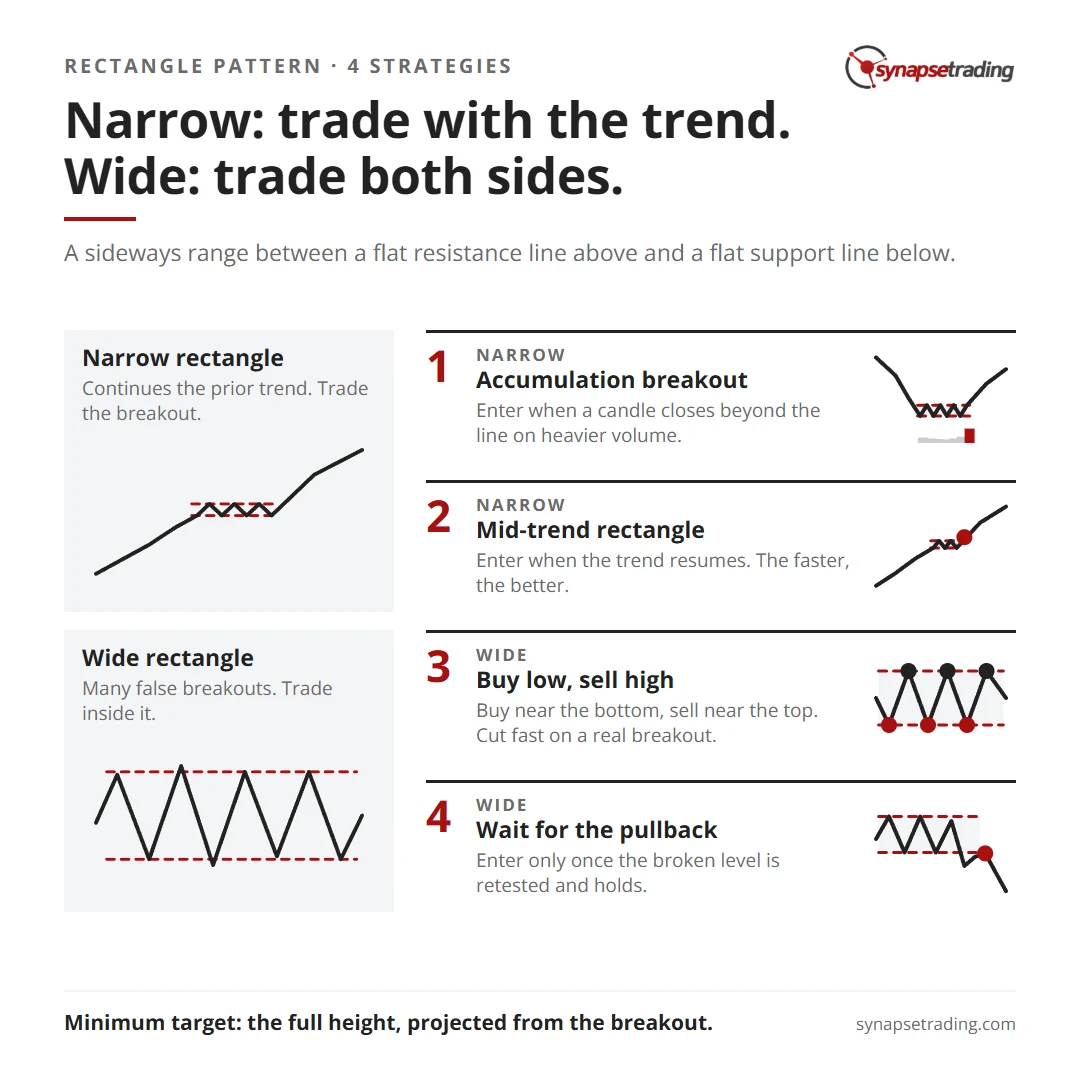
How you trade it depends on its height. A narrow rectangle tends to break out cleanly with the trend, so you trade the breakout. A wide one throws off false breakouts, so you buy near the bottom, sell near the top, and only trade a breakout once it has pulled back.
That gives four strategies, two for each kind. Below are all four, plus the profit target.
What does a rectangle pattern look like on a chart?
In my weekly outlook on 5 March 2026, I drew a red box around the S&P 500. The war headlines that week were loud enough to make anyone nervous, yet the index had spent the whole time moving inside the same tight range, as if nobody had told it.
That box is a rectangle. Draw one horizontal line across the highs and another across the lows, and if price has touched each line at least twice and turned back, you have one. My own breakout rule asks for a level tested two or more times, because one touch could be luck, while two usually means somebody is defending that price.
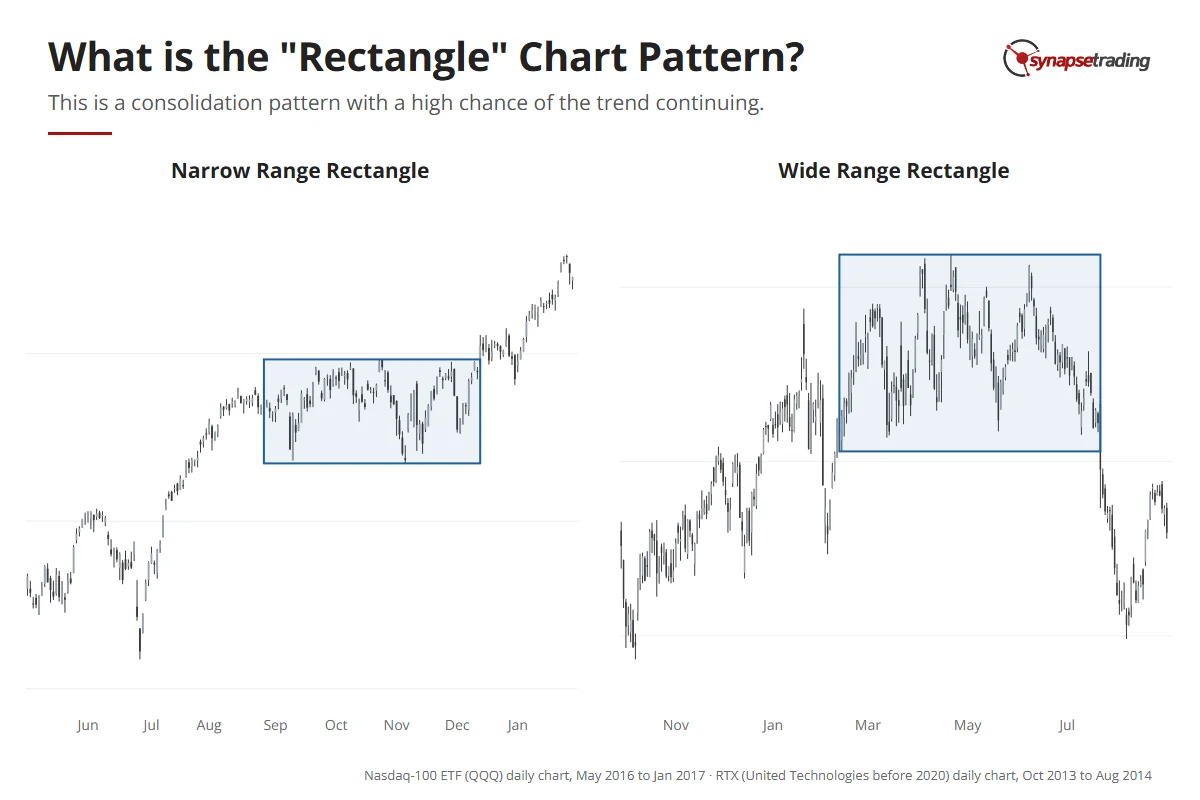
Inside the box, buying and selling are balanced, but the odds lean towards the prior trend.
The day before that outlook, the index broke below the box and then closed back inside it. As I said on the video, “so that means that the breakout failed”. My view was to leave the index alone until it broke out clearly, and the wide range below shows why.
Why does the height of the rectangle matter so much?
Two rectangles can look identical apart from their height, and they behave so differently that I teach them as two separate market types. In my course, a narrow range is a Type 3 market and a wide range is a Type 4.
So why would height change anything? It comes down to who is sitting inside the box.
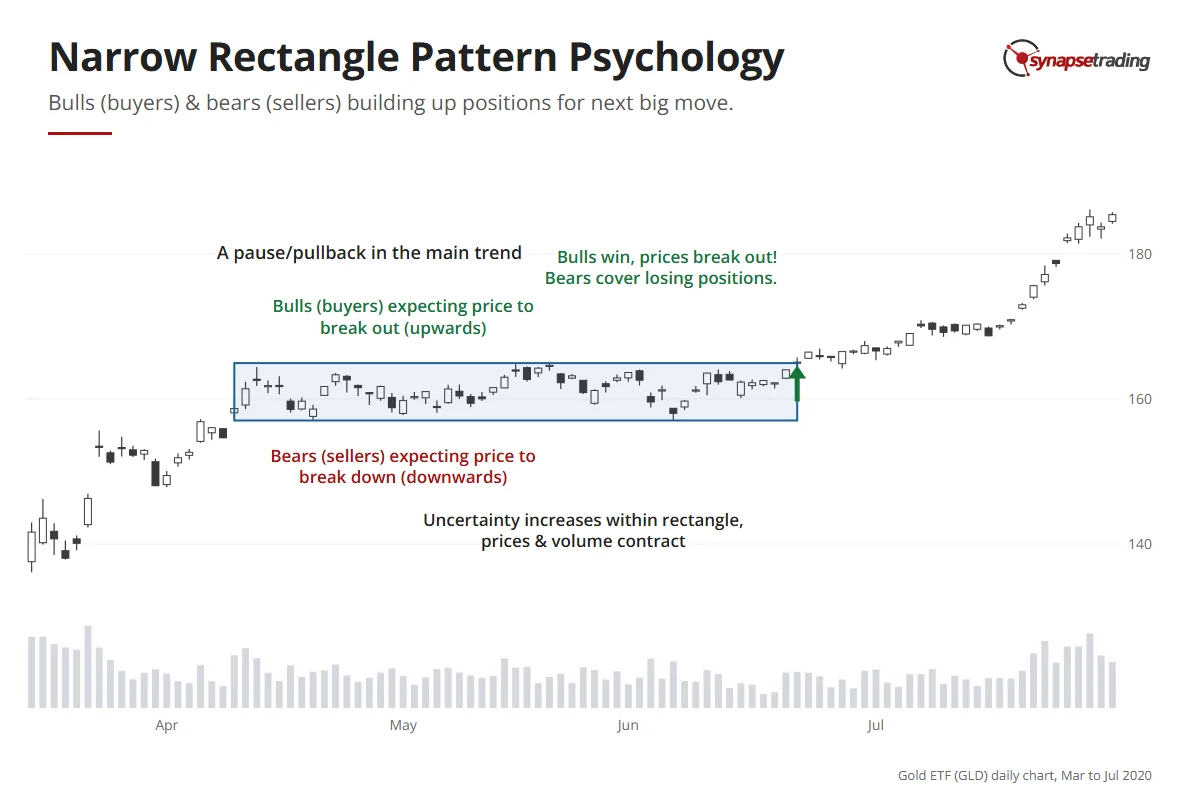
In a narrow rectangle, the trend is taking a breather. Most of the people who rode it are still holding, and only a few are taking profits and waiting to buy back in, so there is very little pressure on anyone to turn the trend around. When the range breaks, it tends to break the same way, with a strong new leg behind it.
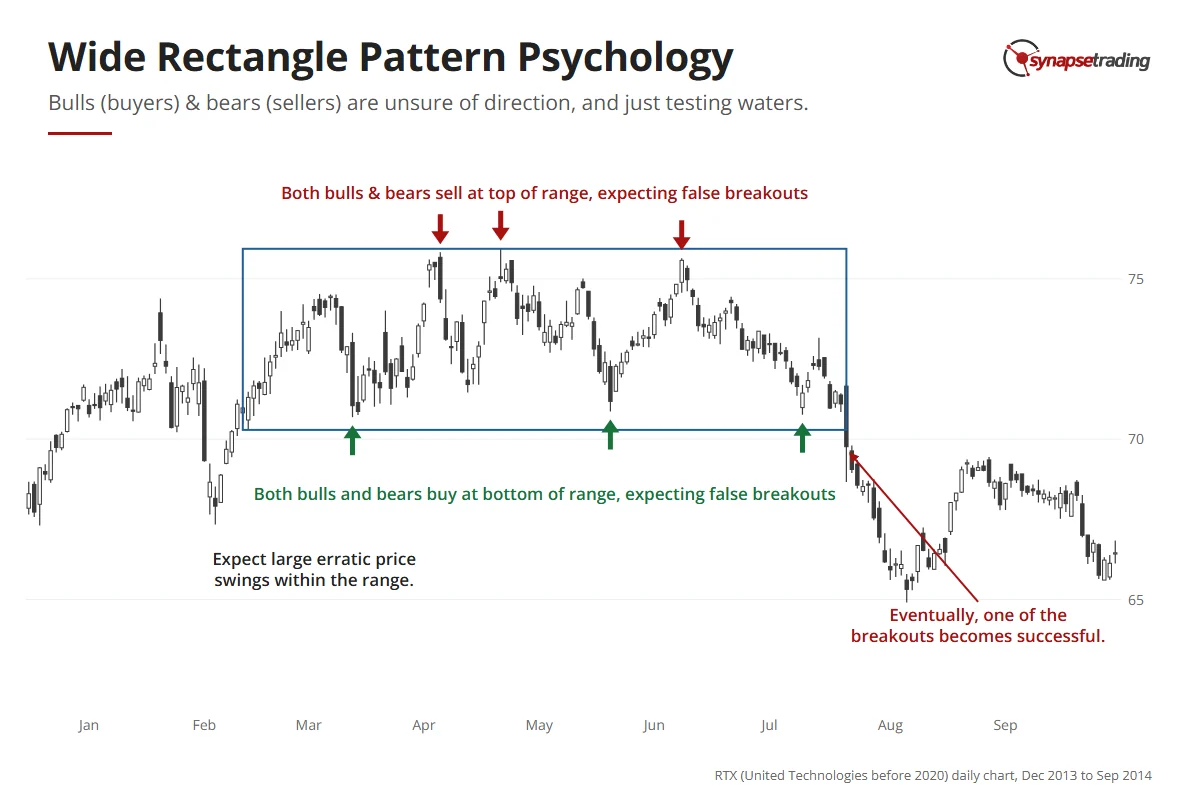
In a wide rectangle, the swings are big enough that traders start trading the range itself, selling near the top and buying near the bottom. That turns it into a far more even tug of war between bulls and bears, with plenty of false breakouts and a much higher chance that the eventual move is a reversal.
Other patterns split the same way, with flags and pennants tending to be narrow and to continue the trend, while the head and shoulders and the double top tend to be wide and reverse it. I cover both families in continuation vs reversal patterns.
| Narrow rectangle, Type 3 | Wide rectangle, Type 4 | |
|---|---|---|
| What it usually does | Continues the prior trend | Reversal becomes more likely |
| Breakouts | More reliable | Many false breakouts |
| How to trade it | Trade the breakout, with the trend | Buy low and sell high inside it |
| Best entry | The breakout close, or the first pullback | Near the edges, or the pullback after a breakout |
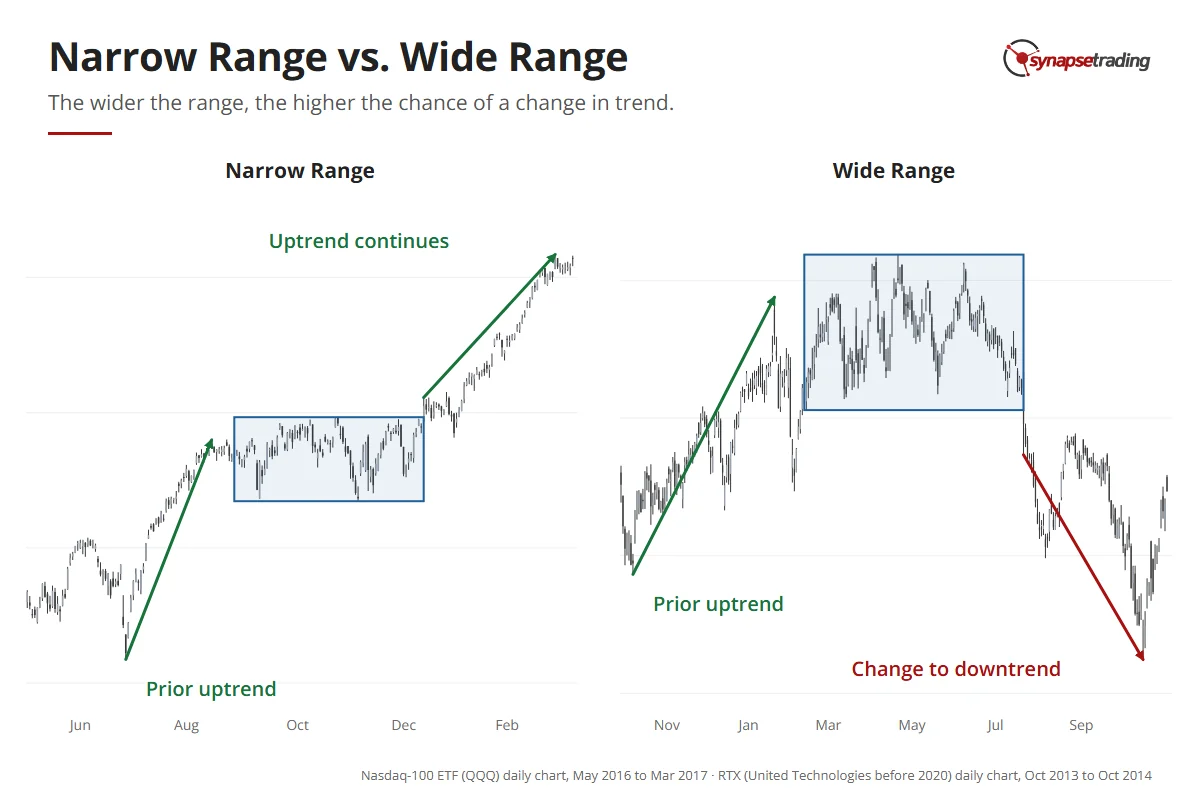
Hence the short version: trade with the trend when the rectangle is narrow, and trade both sides when it is wide.
If you trade around a full-time job, my free 15-minute swing trader checklist is the daily routine I use myself.
Strategy 1: How do you trade an accumulation breakout?
The first narrow-range strategy is to wait for a period of accumulation, then trade the breakout that ends it.
The clue is usually in the volume. As the rectangle forms, volume dries up because nobody is in a hurry, and then it jumps when the breakout fires. What I want to see is a candle that closes beyond the line on clearly heavier volume. A wick that pokes through and closes back inside does not count.
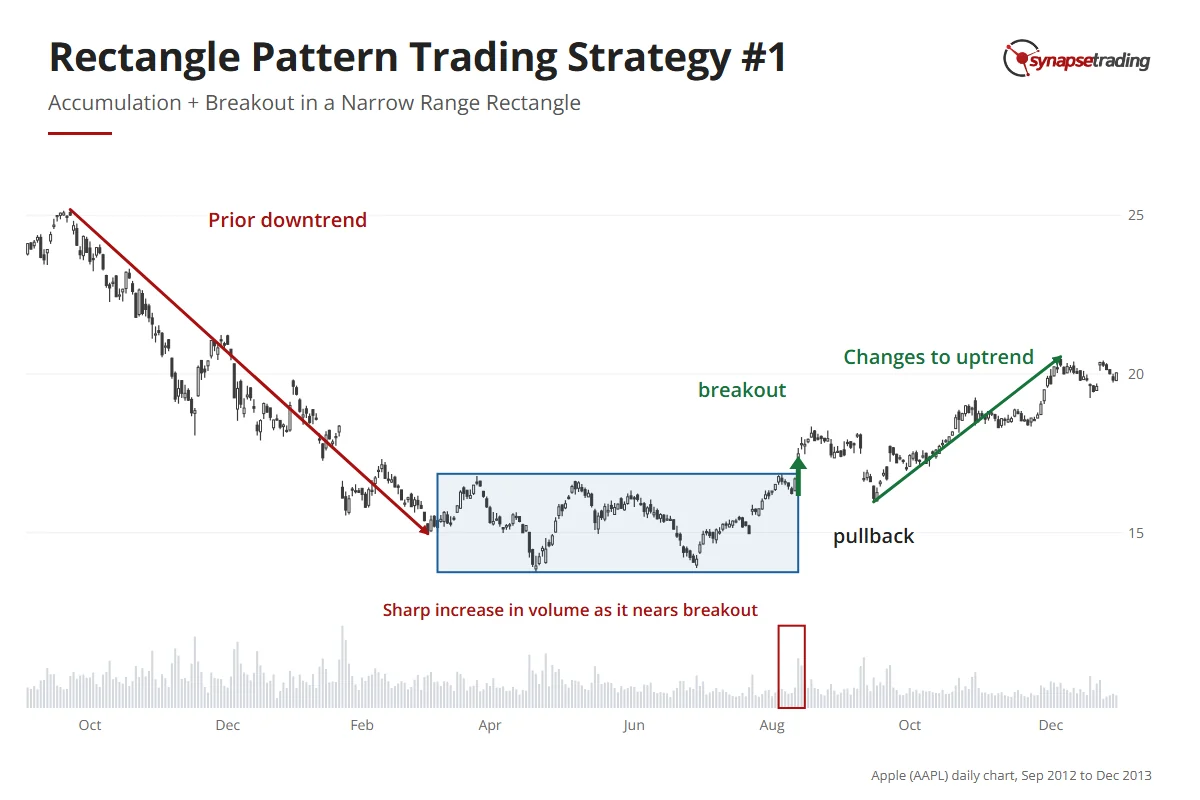
You can enter as the breakout candle closes, or wait for the first pullback. Personally, I take the pullback more often. It still gets me in near the start of the new leg, and the stop sits just below the level that broke, which keeps it tight.
Do note that a narrow range can still end in a reversal if it drags on. The longer a consolidation lasts, the more the people riding the old trend start to doubt it.
Strategy 2: How do you trade a rectangle in the middle of a trend?
The second narrow-range strategy is to find a small rectangle partway through an existing trend, and enter when the trend resumes.
Speed matters here. The longer the pause, the less likely the trend is to continue, so the faster the breakout comes, the better your odds.
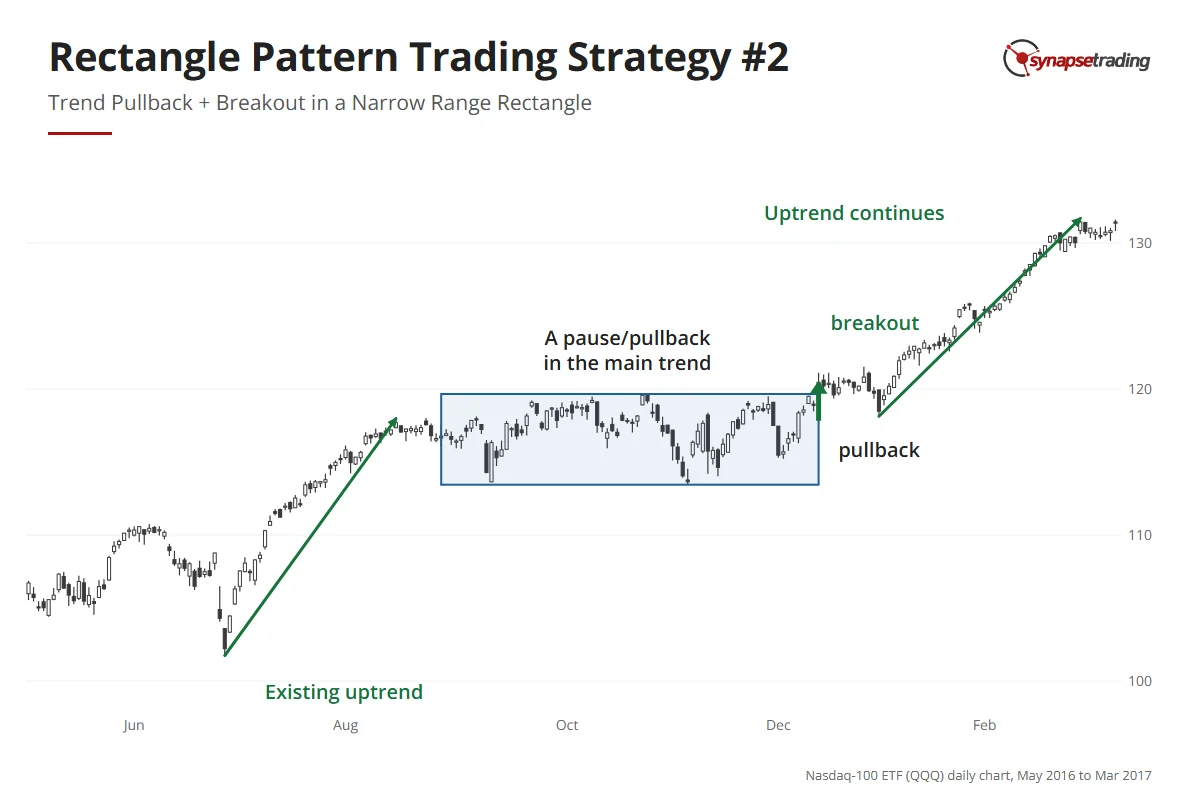
In a clean example, an uptrend pauses inside a small box, then breaks upward and carries on as if it had only stopped for a drink. The entry is the same as before, at the breakout or the first pullback.
Strategy 3: How do you buy low and sell high inside a wide range?
In my outlook on 12 March 2026, QQQ, the fund that tracks the Nasdaq 100, had been moving up and down inside a box. Three times it tried to break out to the downside, and three times it failed and went back up. “There is strong support at the bottom of the box,” I said on the video. There was strong resistance at the top too.
That is a wide range doing what wide ranges do, where false breakouts are more common than real ones, so instead of chasing them you buy near the bottom and sell near the top. Sometimes that means fading a breakout, which is trading against it because you expect it to fail.
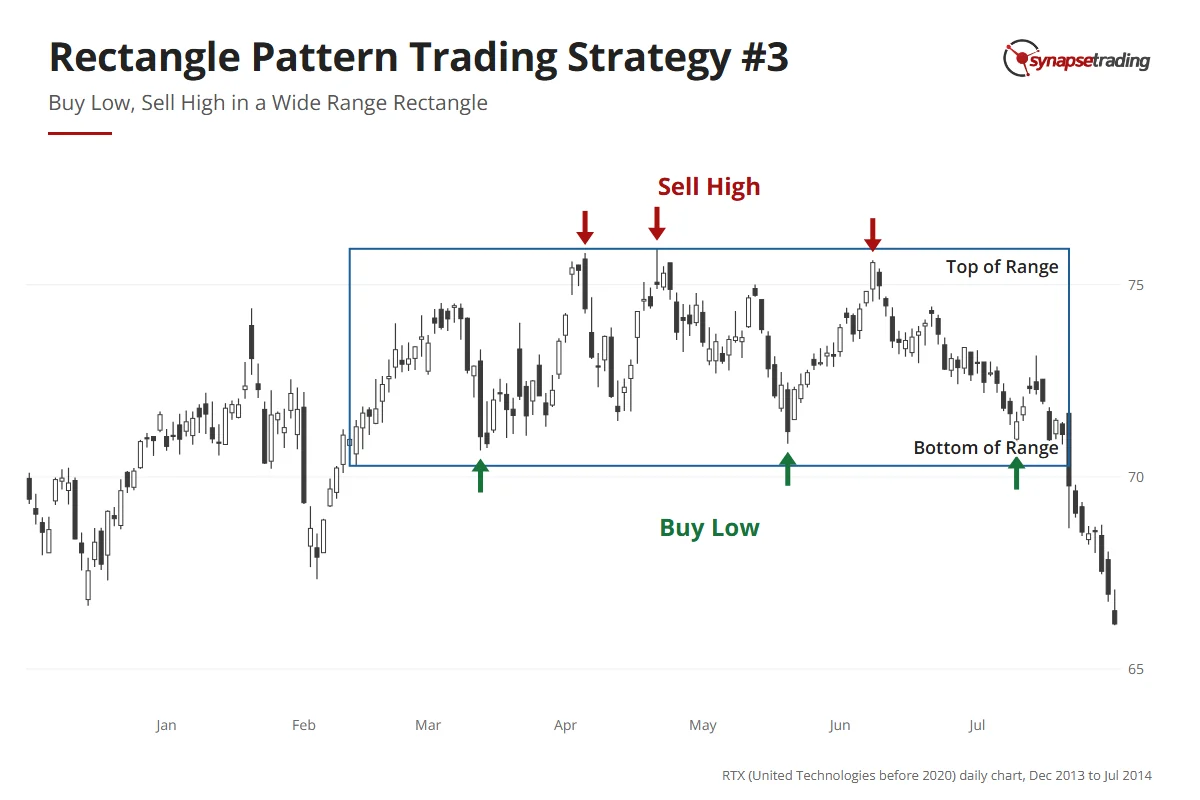
For this to work, the range has to be clearly defined. It also has to be wide enough to leave real “meat” on the trade, meaning room for price to travel from one side to the other after you allow for your stop. You can scale in as well, building buys while price sits in the lower end of the range, then selling those off and building shorts as it reaches the top.
Eventually one of the breakouts will be real. Nobody rings a bell. When that happens, cut the position and get out fast, because fading the edge of a range that has already ended is how a small loss turns into a large one.
Ranges reward patience more than speed, which is the idea behind the free 15-minute swing trader checklist I run each day.
Strategy 4: Why wait for the pullback after a wide-range breakout?
After the sharp drop on 10 October 2025, the S&P 500 settled into a range. Over the next two days it tried to break out on the downside and failed, then tried the upside and failed again, and by my outlook on 23 October it was back in the middle.
Anyone who traded the first move got whipsawed. Anyone who bought early got caught. My conclusion on the video was short: “for this kind of scenario it’s usually better to wait”.
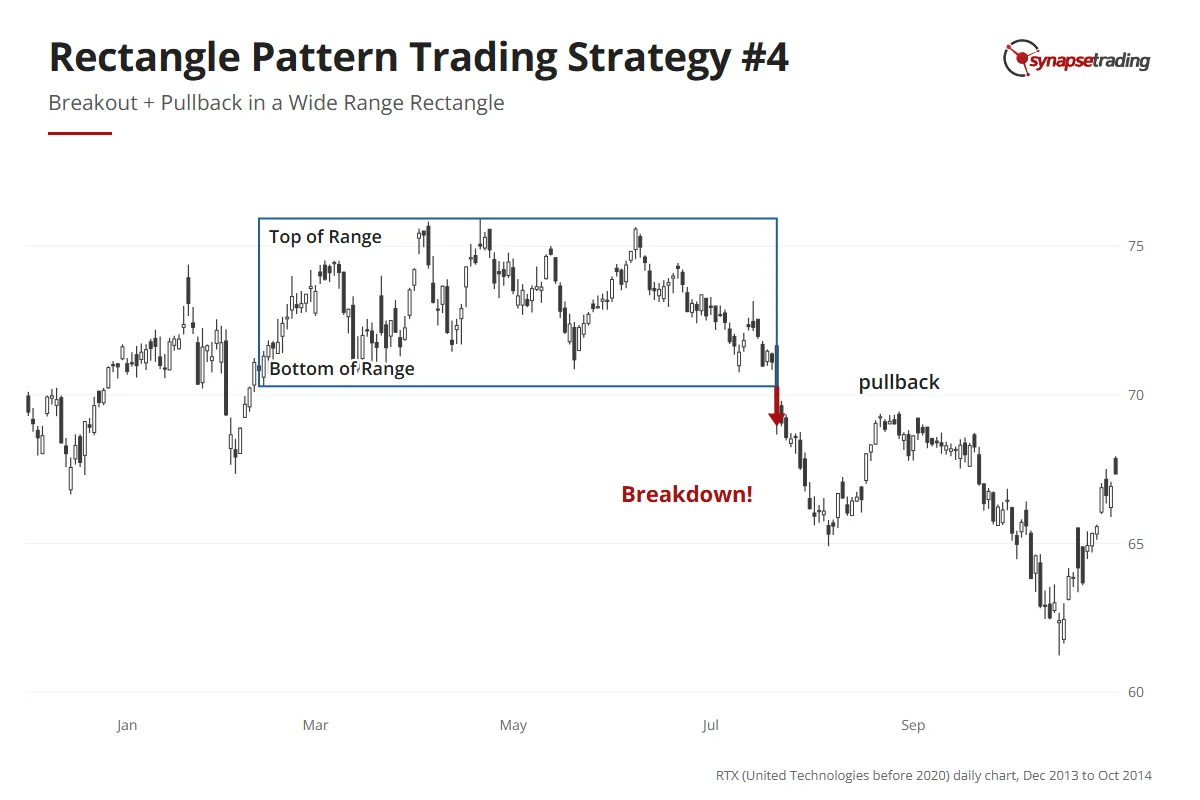
That is the fourth strategy. In a wide range, you only enter a breakout after the pullback, never on the breakout candle itself. Watch how strong the breakout is and how far it runs, then wait for price to come back and retest the broken level, and enter only if that level holds.
On 8 November 2023, a trader on Reddit’s r/Daytrading raised the obvious problem with all this waiting. They wrote that “the market does not give much time in practice to act”. By the time a breakout looks convincing, the stop is far away and the target is close.
It is a fair complaint. Part of it is simply true. Some strong breakouts never come back for a retest, and if you only take the pullback, you will watch a few leave without you. I accept that, because in a wide range the failed breakouts outnumber the clean ones, and the retest is what tells them apart while the stop is still close.
My own records keep me modest about this. The trades I tagged as breakouts, rectangles included, have not won much more often than the rest of my book. The pattern does not win by itself, which is why the entry and the stop do so much of the work.
How do you set a profit target on a rectangle pattern?
A finished rectangle tells you roughly how far the move might go. Take its full height and project that distance from the breakout point, and that level is your minimum target.
Here is a made-up example. Say an index has been stuck between 4,900 and 5,000 points.
The rectangle is 100 points tall, so a breakout above 5,000 has a minimum target of 5,100.
Now add the stop. Suppose you enter on the retest at 5,010, with the stop at 4,970, just below the old resistance. You are risking 40 points to make 90, a reward of 2.25 times the risk.
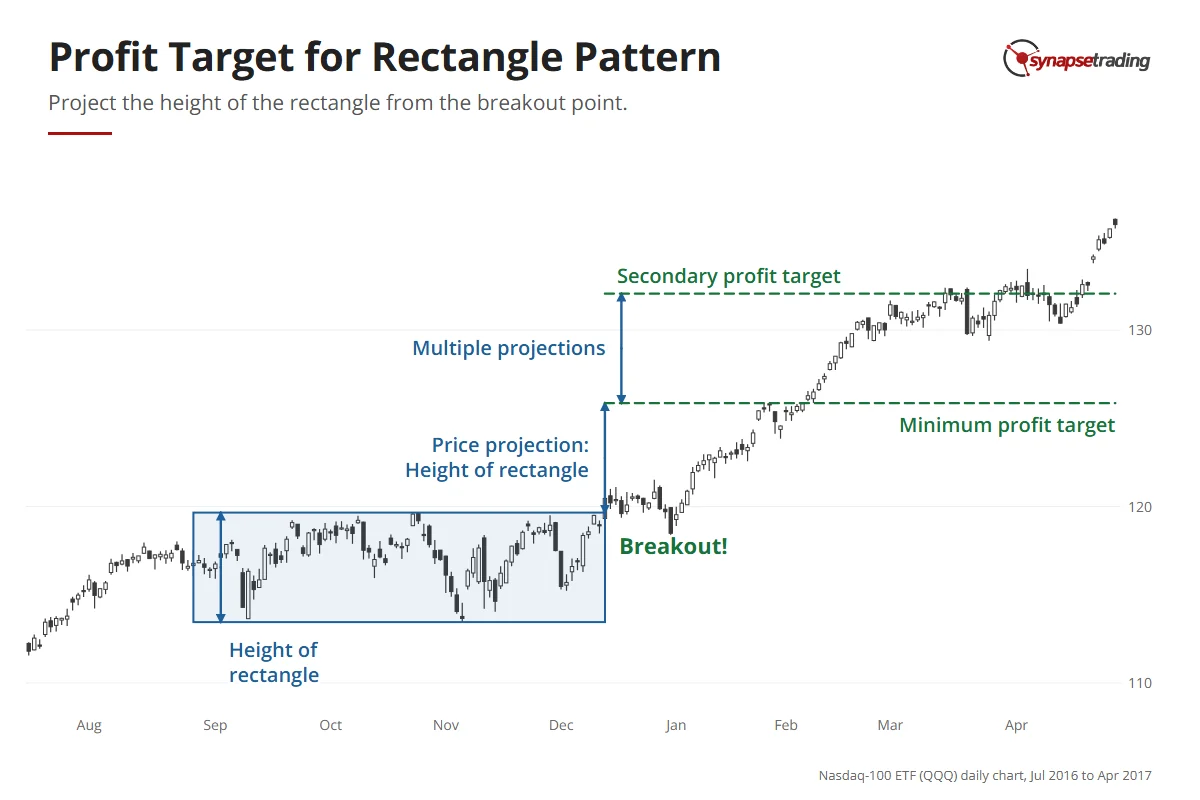
On a small rectangle, you can stack several projections for several targets. And a projection that lines up with an old support or resistance level is worth more than either one alone.
If you want a routine that keeps this to a few minutes after work, grab the free 15-minute swing trader checklist.
Which rectangles should you leave alone?
What is the right number of trades in a messy, sideways market? Quite often it is zero. A line I keep repeating to students is “trade smaller and trade less when the market is harder to trade”, and the rectangle is where it earns its keep.
- Trade with the larger trend. The breakout that goes with the bigger trend has the odds behind it.
- Size down when the range is wide. The wider the range, the bigger the risk, and the higher the chance the trend changes.
- Wait for the pullback when in doubt. It costs a little on the entry and saves you most of the fakeouts.
FAQ
Is a rectangle pattern bullish or bearish?
It follows the trend before it. A rectangle in an uptrend leans bullish and one in a downtrend leans bearish, though wide rectangles are more likely to reverse.
What is the difference between a narrow and a wide rectangle?
Height. A narrow rectangle usually continues the trend, so you trade the breakout. A wide one throws off many false breakouts, so you trade inside it and only take a breakout after the pullback.
How do you avoid false breakouts on a rectangle?
Wait for a candle to close beyond the line on strong volume, and treat a wick through it as noise. In a wide range, enter only on the pullback.
How do you set a profit target on a rectangle pattern?
Project the full height of the rectangle from the breakout point, and treat that level as a minimum target.
Where do you put the stop-loss on a rectangle breakout?
Just beyond the level that broke. If price falls back inside the box, the breakout has failed.
Now that you have all four strategies, which one suits the way you trade, and has a range ever whipsawed you before it finally broke? Let me know in the comments.
To see the rectangle next to every other chart pattern, read the Guide to Trading Price Chart Patterns. Its close cousins are ascending and descending triangles and the expanding triangle, and the rest of the basics are in my free trading guides.

If you would like to learn all the different price chart patterns, also check out: “The Definitive Guide to Trading Price Chart Patterns”
And if you want a routine that does not need you watching every candle, grab the free 15-minute swing trader checklist.
About the author. Spencer Li is The 15-Minute Trader and the founder of Synapse Trading. He is a Certified Financial Technician (CFTe) with 15+ years of trading, run from 70+ countries. He holds a B.Acc and B.BM from SMU. Every trade he takes is public, dated, losses left in. He teaches rules-based swing trading in 15 minutes a day, one system for any market.
Education, not financial advice. Synapse Trading is not licensed by MAS to advise on investment products. Trading carries risk of loss, and past performance is not indicative of future results.
Want the daily routine? Enter your email for the free 15-Minute Swing Trader's Checklist.
Free 5-page PDF, then occasional trading emails. Education only, not financial advice. Unsubscribe anytime. Kit stores your email in the US: see our privacy policy.
Want to learn the full method? The Trading Mastery Program teaches the 4 strategies I have traded since 2011. It suits beginners and experienced traders.
Rather follow the trades as they happen? Daily Trading Signals is our Telegram channel: my trade ideas with entry, stop and exit, and every trade is public.
Questions about this post? Ask in the free Telegram channel →
Educational content only, not personalised financial advice. Trading carries risk, including loss of capital. Past performance is not indicative of future results. Synapse Trading is not licensed or regulated by MAS.

