• Link to Facebook
  • Link to X
  • Link to Instagram
  • Link to Youtube
  • Link to LinkedIn
  • Link to Mail
Synapse Trading
  • Home
  • About
    • My Background
    • My Trading Journey
    • My Travel Log
    • Media & Interviews
  • Mentoring
    • Trading Mastery Program
    • Results & Testimonials
  • Signals
    • Telegram (Free to join!)
    • Daily Trading Signals
    • Daily Trading Signals (Results)
  • Resources
    • Free Trading Guides
    • Tools & Resources
    • Blog & Infographics
  • Contact
    • Contact Us
    • Partnership Opportunities
  • Click to open the search input field Click to open the search input field Search
  • Menu Menu

Learn more about trading strategies, products, analysis, tools to help you supercharge your trading results!

Spencer Li

Understanding Contracts for Difference (CFDs)

Trading Tips
thumbnail CFDs with title

What Are CFDs (Contracts for Difference) and How Do They Work?

Last updated: 3 July 2026 · By Spencer Li, CFTe


A CFD (Contract for Difference) is an agreement between you and a broker to exchange the difference in an asset’s price from when you open the trade to when you close it, without ever owning the asset itself. If the price moves your way, the broker pays you the difference; if it moves against you, you pay the broker. You can go long (buy, betting the price rises) or short (sell, betting it falls), and because CFDs are traded on margin (you put up a small fraction of the position’s value), a small amount of capital controls a large position. That leverage cuts both ways: it magnifies your gains and your losses in equal measure. CFDs let you trade stocks, indices, forex, commodities, and crypto from one account, which is the real draw. The catch is that the same leverage that makes them attractive is what blows up most beginners. So they suit experienced traders who already have risk management down, not someone learning on a live account.

Here is how they actually work, the markets you can trade, the trade-offs, and two worked examples.

What is a CFD, in plain terms?

A CFD is a financial derivative (a contract whose value is derived from something else) that lets you speculate on an asset’s price without buying the asset. You never hold the shares, the gold, or the coins. You hold a contract that tracks the price.

Think of it like betting on the outcome of a football match without buying the team. You agree with the bookmaker (the broker) on a price now. When the match ends (you close the trade), whoever was right collects the difference. That is the whole idea.

Four things happen in every CFD trade:

  • Opening a position. If you think the price will rise, you open a long (buy) position. If you think it will fall, you open a short (sell) position. The ability to short easily is a big part of why traders like CFDs.
  • Leverage. CFDs trade on margin, so a small deposit controls a much larger position. This amplifies profits, and it amplifies losses by exactly the same factor. Do note that this is the part that hurts people.
  • Spread and costs. Your cost includes the spread (the gap between the buy price and the sell price) plus any holding cost charged for keeping a position open overnight.
  • Closing a position. To bank the profit or loss, you do the opposite of what you did to open: you sell if you bought, and you buy if you sold. The difference between your open and your close is your result.

Where did CFDs come from?

CFDs were created in the early 1990s in London, developed by two investment bankers at UBS Warburg, Brian Keelan and Jon Wood. They were not built for retail traders at all. They started as an equity swap that institutions used to hedge positions on the London Stock Exchange cheaply, mostly to sidestep the UK stamp duty tax on buying physical shares.

Three things made them useful from the start:

  • Tax efficiency. They let big institutional players avoid stamp duty on large share purchases.
  • Leverage. They let traders control large positions with a small amount of capital (amplifying profit and loss alike).
  • Flexibility. They made it easy to go both long and short, in any market condition.

Through the late 1990s and early 2000s, online brokerages and trading platforms put CFDs in front of retail traders for the first time. The product spread out of the UK into Europe and Australia, with each region adapting it to its own rules.

That popularity brought scrutiny. Regulators like the Financial Conduct Authority (FCA) in the UK and the Australian Securities and Investments Commission (ASIC) stepped in to protect retail investors. They imposed leverage limits to cap the risk, and they required brokers to give clear risk warnings so clients understand what they are getting into. That regulatory tightening is also why CFDs are restricted or banned outright in some countries.

What can you trade with CFDs?

This is the genuine appeal. One CFD account gives you access to a wide range of markets:

  • Stocks. Shares of companies like Apple, Google, and Tesla.
  • Indices. The S&P 500, FTSE 100, Nikkei 225, and other market indices.
  • Forex. Currency pairs like EUR/USD and GBP/JPY.
  • Commodities. Precious metals like gold and silver, and energy like oil and natural gas.
  • Cryptocurrencies. Bitcoin, Ethereum, and others.
  • ETFs. Exchange-traded funds, for exposure to whole sectors or asset classes at once.

Pros and cons of trading CFDs

CFDs come with real advantages and real risks, and you need both halves of the picture before you decide whether they fit you.

CFDs
LeveragePro: higher potential returns from a smaller deposit. Con: the same leverage can produce losses that exceed your initial outlay.
Market accessPro: stocks, forex, commodities, indices, and crypto from one platform.
DirectionPro: profit from falling markets (short) as easily as rising ones (long).
OwnershipPro: no need to custody or handle the underlying asset. Con: you own nothing, so no dividends-in-kind, no voting, no shares to hold long term.
Entry costPro: lower capital required than buying the asset outright.
Trading costsCon: spread, overnight holding costs, and sometimes commission.
RegulationCon: not available in some countries; restricted in others.
ComplexityCon: managing leveraged positions takes real understanding of markets and risk.
Counterparty riskCon: if the broker defaults, your positions are exposed.

Personally, the line I would underline is counterparty risk and leverage. A CFD is a contract with your broker, not a share you hold in your own name, so the broker’s health matters. And leverage is the single feature that turns a manageable mistake into an account-ending one. Respect it, or it will teach you the hard way.

CFD vs owning the shares: what is the difference?

A common question is how a CFD differs from just buying the stock. The core difference: with a CFD you own a contract that tracks the price, not the asset.

CFDOwning the shares
What you holdA contract with the brokerThe actual asset in your name
Capital requiredA margin deposit (a fraction of position size)The full value of the position
Short sellingEasy, built inHard or restricted for retail
LeverageYes, magnifies gains and lossesUsually no
Overnight costHolding cost charged dailyNone
Time horizon it suitsShort-term speculationLong-term investing
Counterparty riskYes, exposed to the brokerNo

The short version: CFDs are a tool for short-term, leveraged speculation. If your goal is to buy and hold for years, owning the asset is usually the cleaner choice.

Two worked examples

Numbers make this concrete. Here is one long trade and one short trade, costs excluded for clarity.

Long example (stocks). You think Apple will rise. You buy 100 CFD shares of Apple (AAPL) at $150. The price rises to $160, and you close.

  • Opening position: 100 shares x $150 = $15,000
  • Closing position: 100 shares x $160 = $16,000
  • Profit: $16,000 minus $15,000 = $1,000 (excluding costs)

Short example (commodities). You think gold will fall. You sell 10 CFDs of gold at $1,800 per ounce. The price drops to $1,750, and you close.

  • Opening position: 10 ounces x $1,800 = $18,000
  • Closing position: 10 ounces x $1,750 = $17,500
  • Profit: $18,000 minus $17,500 = $500 (excluding costs)

Side by side, so the long-vs-short mechanics are clear:

Long (Apple)Short (Gold)
Your viewPrice will risePrice will fall
Action to openBuy at $150Sell at $1,800
Action to closeSell at $160Buy at $1,750
Result+$1,000+$500

Notice the short trade: you sold first and bought back lower, and you still made money. That is the part new traders find counterintuitive, and it is exactly what CFDs make easy.

Where the human edge comes in

Leverage and one-click access to every market are now free. Any broker hands them to you on signup. What no platform hands you is the discipline to size a leveraged position so a single bad trade cannot end your account, or the judgment to skip a market you do not actually understand. The leverage is the easy part. Knowing how much of it to use, and when to use none at all, is the part worth learning. That is discipline and sizing, the second of the Five Edges no broker can supply for you.

FAQ

What is a CFD in simple terms?
A CFD (Contract for Difference) is an agreement with a broker to exchange the difference in an asset’s price between when you open and close the trade, without owning the asset. If the price moves your way you profit; if it moves against you, you lose.

Are CFDs good for beginners?
Generally no. CFDs use leverage, which magnifies losses as much as gains, so they are best suited to experienced traders who already have risk management in place. A beginner is better off learning position sizing and a tested system first.

Can you lose more than you invest with CFDs?
Yes. Because CFDs are leveraged, losses can exceed your initial deposit. This is why regulators impose leverage limits and require risk warnings, and why sizing matters more than the entry.

What is the difference between a CFD and buying the stock?
With a CFD you hold a contract that tracks the price, not the share itself. CFDs require less capital, allow easy shorting, and use leverage, but carry overnight costs and broker counterparty risk. Owning the stock suits long-term investing; CFDs suit short-term speculation.

What can you trade as CFDs?
Stocks, indices (like the S&P 500 and FTSE 100), forex pairs, commodities (gold, silver, oil), cryptocurrencies, and ETFs, all from a single account.


Now that you know how CFDs work, the question is not really “what is a CFD,” it is “how do I keep leverage from blowing me up.” That answer is the same in every market: a tested system and disciplined sizing. Which leads naturally to the next thing to learn.

If you want the full foundation, start with the pillar: The Beginner’s Guide to Trading.

Want a system that controls the risk for you? Grab the free 15-Minute Swing Trading Starter Kit. It’s the exact routine I use to scan once a day and trade any market in 15 minutes, with sizing baked in so leverage works for you, not against you.


About the author. Spencer Li is the founder of Synapse Trading and a Certified Financial Technician (CFTe) with 15 years of trading across stocks, forex, crypto, commodities, and bonds. His trade log is public, 404 trades, losses left in. He teaches low-risk swing trading in 15 minutes a day, one system for any market.

Education, not financial advice. Synapse Trading is not licensed by MAS to advise on investment products. Trading carries risk of loss, including the risk of losing more than your initial deposit with leveraged products; past performance is not indicative of future results.


Related

The Beginner’s Guide to Trading (pillar) · Leverage and margin explained · Long vs short selling · Forex trading basics
0 Comments/by Spencer Li
https://synapsetrading.com/wp-content/uploads/2024/06/thumbnail-CFDs-with-title.png 1024 1792 Spencer Li https://synapsetrading.com/wp-content/uploads/2019/10/logo.jpg Spencer Li2024-06-20 04:57:192026-07-06 01:03:16Understanding Contracts for Difference (CFDs)
Spencer Li

A Day in the Life of a Trader

Promotions, Trading Tips
Thumbnail A day in the life of a trader

Are you curious about what it’s like to be a trader? I know I was when I first started out. The fast-paced, ever-changing markets were daunting, but also incredibly exciting. 

As a trader, I rely on a wide range of tools and technologies to stay informed and make informed trading decisions. From trading platforms to charting software and high-speed data feeds, each tool plays a critical role in helping me navigate the markets.

And when it comes to strategies and techniques, there are so many different approaches to choose from. Whether it’s technical analysis, fundamental analysis, or news trading, every trader has their own style and preference. It’s all about finding what works for you and sticking to it.

In this video collaboration with XM Global brokerage, I’ll take you through a day in the life of a trader, from pre-market preparation to end-of-day analysis, and share some useful tools to help in your trading journey.


What is the day-to-day schedule of a trader like?

The day-to-day schedule of a trader can vary depending on the type of trading they do and the market they specialize in. 

However, some general activities that traders typically engage in include:

  • Pre-market preparation: Traders usually start their day by reviewing news and market data that may impact their trades. They also analyze their trading strategies and review their portfolio positions.
  • Market open: The first few hours after the market opens are typically the busiest for traders. They execute trades based on their analysis and strategy.
  • Monitoring: Throughout the day, traders monitor the markets and track the progress of their trades. They may adjust their positions or exit trades as needed.
  • Research: Traders spend time researching and analyzing market trends and news, as well as studying the performance of different companies and sectors.
  • Networking: Traders often build relationships with other traders and brokers to gain insights and market information that can help inform their trades.
  • End of day analysis: At the end of the day, traders review their performance and analyze their trades to identify areas for improvement.

Overall, the schedule of a trader is fast-paced and can be demanding, requiring a high level of focus, discipline, and adaptability.

What tools and technologies do traders use?

Traders use a wide range of tools and technologies to help them analyze markets, identify trends, and execute trades. 

Some of the most common tools and technologies used by traders include:

  • Trading platforms: These are software applications that allow traders to access financial markets, view real-time prices and charts, and place trades.
  • Charting software: Traders use charting software to create visual representations of price movements and identify patterns in the market.
  • News feeds: Traders rely on news feeds to stay up-to-date with the latest developments in the markets, including economic data releases, corporate announcements, and geopolitical events.
  • Algorithmic trading systems: These are computer programs that execute trades automatically based on pre-set rules and parameters.
  • Risk management software: Traders use risk management software to monitor and control their exposure to market risks, including volatility, liquidity, and counterparty risk.
  • Electronic trading networks: These are online platforms that connect traders with each other and with liquidity providers, allowing them to trade directly with one another without the need for a broker.
  • Mobile trading apps: Traders use mobile trading apps to access the markets and manage their trades from their mobile devices.
  • High-speed data feeds: Traders require real-time market data to make informed trading decisions. High-speed data feeds provide up-to-the-millisecond pricing information that traders use to execute trades.

What are some strategies and techniques used by traders?

There are various strategies and techniques used by traders, and different traders may prefer different methods depending on their personal preferences and risk tolerance. 

Here are some common strategies and techniques:

  • Technical analysis: This involves studying price charts and using technical indicators to identify trends, patterns, and potential trading opportunities.
  • Fundamental analysis: This involves analyzing economic and financial data, such as company earnings reports, economic indicators, and news events, to make trading decisions.
  • Trend following: This involves identifying the direction of a trend and entering trades in the same direction, hoping to ride the trend for profit.
  • Scalping: This involves making numerous trades over a short time frame to take advantage of small price movements.
  • Swing trading: This involves holding positions for a few days or weeks, aiming to capture price movements within a longer-term trend.
  • Position trading: This involves holding positions for several months to a year or more, taking a long-term view on the markets.
  • News trading: This involves taking advantage of market volatility caused by news events, such as interest rate changes, economic data releases, and geopolitical events.
  • Arbitrage: This involves taking advantage of price differences between different markets or assets to make a profit.

Traders may also use various risk management techniques, such as setting stop-loss orders to limit losses, using leverage to amplify gains, and diversifying their portfolio to reduce risk.

My trading journey and challenges

My trading journey has been a rollercoaster ride, filled with ups and downs. When I first started trading, I was filled with excitement and optimism. I was eager to learn and I spent countless hours reading books, attending seminars, and watching educational videos. However, as I started trading with real money, I quickly realized that things were not as easy as they seemed.

One of the biggest challenges I faced was my emotions. I found it difficult to stay disciplined and stick to my trading plan. I would often get too caught up in the moment and make impulsive decisions, which led to losses. It took a lot of self-reflection and practice to develop the mental fortitude required to be a successful trader.

Another challenge I faced was finding a reliable trading strategy that worked for me. I tried out several different approaches, from day trading to swing trading, but I struggled to find a consistent method that produced the results I was looking for. It wasn’t until I discovered price action trading that I finally found a strategy that resonated with me.

Despite the challenges, I persisted in my trading journey, and over time I learned to manage my emotions and stick to my trading plan. I also became more confident in my trading abilities as I saw my profits grow. Looking back on my journey, I am proud of the progress I have made and the lessons I have learned. Trading is not easy, but with the right mindset and approach, it is possible to succeed.

Looking for a professional trading platform to give you an edge? 

XM Global is a leading brokerage company that is dedicated to providing traders with a seamless and efficient trading experience, providing access to more than 50 currency pairs. As a trusted platform for many traders, XM is committed to helping traders improve their skills and succeed in the trading world.

To further assist traders in their trading journey, XM provides ongoing EN Live Education sessions with experts and global instructors around the world. They have 2 rooms, one for beginners and one for advanced traders, and both rooms are live everyday from 3PM – 12 AM SGT to cover a wide variety of topics to help traders improve their trading. These live education sessions are also a great opportunity for traders to learn valuable insights and strategies that can help them achieve their trading goals.

For traders looking for a reliable and trusted trading platform, XM is the ideal choice. Sign up now using the link below to join their EN Live Education and learn from some of the well-known experts in the industry.

Schedule: Monday – Friday (3PM – 12AM SGT)

Refer here for more information: https://www.xm.com/english-education-schedule 

Concluding Thoughts

In summary, trading is not without its challenges. It can be difficult to stay disciplined and stick to your trading plan when the markets are constantly in flux. And finding a reliable trading strategy that works for you is easier said than done.

But despite the challenges, being a trader is incredibly rewarding. I’ve learned so much over the years and have seen my profits grow as I become more confident in my trading abilities. 

Now that I have shared all about the daily life of a  trader, is this something that you would consider doing full time?

Also, for those who are actively trading, what are some challenges you face in your trading?

Let me know in the comments below.

If you are keen on any partnerships or sponsored content, check out:
🤝 https://synapsetrading.com/?p=28772

0 Comments/by Spencer Li
https://synapsetrading.com/wp-content/uploads/2023/04/Thumbnail-A-day-in-the-life-of-a-trader.png 720 1280 Spencer Li https://synapsetrading.com/wp-content/uploads/2019/10/logo.jpg Spencer Li2023-04-05 03:36:592024-08-03 19:55:26A Day in the Life of a Trader
Spencer Li

Does an Inverted Yield Curve Lead to Recession, and How to Invest in Such a Market?

Trading Tips
Thumbnail Does an Inverted Yield Curve Lead to Recession

Thumbnail Does an Inverted Yield Curve Lead to Recession

Looking to better understand the economy and financial markets?

The yield curve is a must-know!

This powerful tool shows the relationship between bond interest rates and payback times, giving us valuable insights into what people expect for economic growth and inflation.

But that’s not all – the yield curve can also impact financial institutions and even signal potential recessions.

In this blog post, I’m going to talk about what the yield curve is, why an inverted yield curve can lead to recession, and how to invest in such an environment.


What is the Yield Curve?

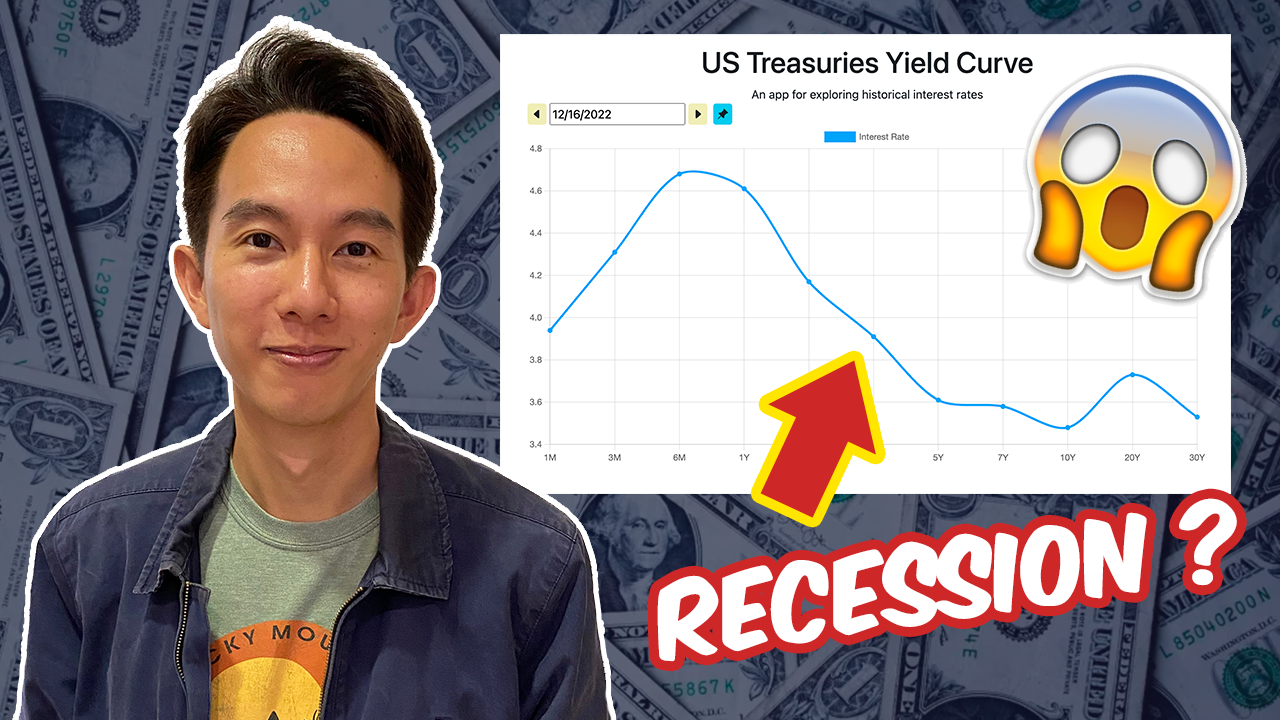
The yield curve is a chart that shows the relationship between the interest rate earned by investors on a bond and how long it will take for the bond to be repaid.

It’s usually plotted on a graph with the interest rate on the vertical axis and the time it takes to repay the bond on the horizontal axis.


normal yield curve

When the curve is going up, it means that bonds with longer payback times have higher interest rates than bonds with shorter payback times.

This is called a normal yield curve.


Yield Curve

When the curve is going down, it means that bonds with shorter payback times have higher interest rates than bonds with longer payback times.

This is called an inverted yield curve.

What Can the Yield Curve Tell Us?

The yield curve is a really important indicator of what’s going on in the economy because it gives us an idea of what people expect to happen with economic growth and inflation in the future.

A normal yield curve usually means that the economy is doing well and that people expect economic growth and inflation to pick up in the future, which is why they’re willing to accept lower interest rates on long-term bonds.

An inverted yield curve, on the other hand, often means that the economy isn’t doing so hot and that people expect economic growth and inflation to slow down in the future, so they want higher interest rates on long-term bonds.

What Affects the Shape of the Yield Curve?

There are a few things that can affect the shape of the yield curve.

One of the biggest factors is the level of short-term interest rates set by the central bank.

When the central bank raises short-term interest rates, it can lead to an upward sloping yield curve because investors want higher interest rates on long-term bonds to make up for the increase in short-term rates.

When the central bank lowers short-term interest rates, it can lead to a downward sloping yield curve because investors are willing to accept lower interest rates on long-term bonds due to the lower short-term rates.

The supply and demand for bonds can also affect the yield curve.

If there’s a lot of bonds available in the market, it can push down bond interest rates and lead to a downward sloping yield curve.

If there’s not a lot of bonds available, it can lead to higher bond interest rates and an upward sloping yield curve.

The expectations of market participants about future economic conditions can also influence the yield curve.

If people expect economic growth and inflation to pick up in the future, they might be willing to accept lower interest rates on long-term bonds in the hopes of getting higher returns later on.

This can lead to an upward sloping yield curve. If people expect economic growth and inflation to slow down, they might want higher interest rates on long-term bonds to make up for the lower expected returns.

This can lead to a downward sloping yield curve.

How Does an Inverted Yield Curve Lead to Recession?

Okay, so why does an inverted yield curve lead to a recession?

It’s all about how it can affect the behavior of businesses and consumers.

When the yield curve is inverted, with short-term rates higher than long-term rates, it can signal that investors are more worried about the short-term economic outlook.

This can make businesses less likely to borrow money for long-term projects, like building new factories or expanding operations.

And it can also make consumers less likely to take out long-term loans, like mortgages, to buy homes or cars.

When businesses and consumers are less likely to borrow and spend money, it can lead to a slowdown in economic activity, which can potentially turn into a recession.

An inverted yield curve can also affect the way banks and other financial institutions make lending decisions, which can further impact economic activity.

It’s important to note that the yield curve is just one indicator and no single indicator can predict the future with 100% accuracy.

But it can give us an idea of what people are expecting to happen with economic growth and inflation in the future, which can be helpful in understanding the potential risks and opportunities in the financial markets.

How to Invest in an Inverted Yield Curve Environment

So, you’re wondering how to invest during an inverted yield curve environment?

This can be tricky because an inverted yield curve is often seen as a sign of an impending recession, which is generally not good news for the economy.

However, there are a few strategies you can consider.

One option is to focus on defensive investments that tend to do well when times are tough.

These might include stocks in utilities, consumer staples, and healthcare companies, as well as bonds with shorter payback times.

Another strategy is to diversify your portfolio to include a mix of different types of assets.

This could mean stocks, bonds, real estate, and other alternative investments.

Diversification can help to spread out your risk and increase your chances of making some money over the long haul.

It’s also important to think about your investment time frame and risk tolerance.

If you have a longer time horizon and are comfortable with taking on some risk, you might be able to ride out market ups and downs and potentially benefit from a rebound.

But if you have a shorter time frame or are more risk-averse, it might be smart to be more cautious and reduce your exposure to risky assets.

Just keep in mind that investing during an inverted yield curve environment can be complicated and carries its own risks.

Concluding Thoughts

In conclusion, the yield curve is a really useful tool for understanding what people expect to happen with the economy and the potential risks and opportunities in the financial markets.

It’s important for investors, policymakers, and market participants to pay attention to the shape of the yield curve to get a sense of where the economy might be headed and what the potential implications might be.

Now that I have shared all about the inverted yield curve, what do you think are some of the best investment opportunities and strategies to use when the yield curve is inverted?

Let me know in the comments below.

0 Comments/by Spencer Li
https://synapsetrading.com/wp-content/uploads/2022/12/Thumbnail-Does-an-Inverted-Yield-Curve-Lead-to-Recession.png 720 1280 Spencer Li https://synapsetrading.com/wp-content/uploads/2019/10/logo.jpg Spencer Li2022-12-19 12:58:272023-01-10 01:50:52Does an Inverted Yield Curve Lead to Recession, and How to Invest in Such a Market?
Spencer Li

Best Online Trading Tips & Quotes from the Internet

Trading Tips
Best Trading Tips Quotes from the Internet

Online Trading Tips: 30 Rules That Actually Move the Needle

Last updated: 3 July 2026 · By Spencer Li, CFTe


The best online trading tip, stripped of the noise, is this: protect your capital first and let your edge play out, because trading success is mostly defense, not offense. Almost every durable rule comes back to four things, risk management, position sizing, patience, and emotional control. Not predictions, not the perfect indicator, not a secret strategy. If you only remember one sentence, remember that the number one goal of a trader is not to make money, it is to trade well. Trade well and the money follows. Chase money directly and performance anxiety cripples you.

Below are the tips I have collected over many years from books, traders I respect, and my own trading, grouped so you can actually use them instead of scrolling past them. My advice has not changed: bookmark this page, read a couple of tips a day, and try putting them into practice. You will be pleasantly surprised at the compounding results.

What is the single most important trading rule?

Play great defense, not offense. The most important rule of trading is to manage risk, not to swing for big gains. Manage your risk well and the wins come in. If you manage your risk, your profits take care of themselves. If you don’t, your parents will take care of you.

Here is why this comes first. Everything in trading gets destroyed a hundred times faster than it is built. One wrong, oversized trade can wipe out profits that took years to compound. A small loss is part and parcel of trading. A large unplanned loss is what empties your account. So the elements of good trading are, in order: cut losses, cut losses, and cut losses. Follow those three and you have a chance.

Risk (the uncertain possibility of loss) is the one input you can fix in advance. You cannot control the market. You can only control yourself, your size, and your exit. So quantify the risk on every trade before you take it, manage it, and make sure you know what you are doing. Risk comes from not knowing what you are doing.

The tips that matter most, grouped

ThemeThe rule in one lineWhy it works
Risk managementNever lose more than ~2% of capital on one tradeEliminates the big loss (#5 of 5 outcomes), which is the only outcome that ruins you
Position sizingRisk small, let the edge play out, then addHigh risk for high returns is a myth; you compound by staying alive
Cut lossesCut losses fast, never average down a loserA small quick loss is the cheapest loss there is
Ride winnersLet winners run; taking small profits is the surest road to lossA few large wins pay for many small losses
PatienceWhen there is no good trade, stay out and waitMost errors come from a compulsion to “do something”
TrendIn a bull market, be long; follow the line of least resistanceThe trend is your friend until it bends
PsychologyTrade what you SEE, not what you THINKThe market does not know or care what you think
Process over outcomeGoal is to trade well, not to be rightOutcome of any single trade is close to random
DisciplineTrust your rules over your feelingsFeelings change; rules are fixed, and that gives you consistency
IndependenceThe crowd is usually wrong at extremesIndependent thinking and action is what makes great traders

Now the detail behind each cluster.

How do I manage risk and size positions?

This is the engine room. Profitable trading is mostly math: risk and reward ratios, position sizing, drawdowns, win rate, losing-streak probabilities, risk of ruin, stop losses, and profit targets. It is all math.

A few rules I live by here:

  • Always set the stop before you enter, not after. Decide where the idea is wrong before you have money on the line, while you are still objective. I set protective stops the moment I enter, then trail them to lock in profit as the trend continues.
  • Never risk more than ~2% of capital on a single trade. Losses are roughly twice as expensive to make up, so keeping each one small is what keeps you in the game.
  • Risk small, then add to what is working. Many traders believe high risk is the price of high returns. Wrong. You risk small, let the edge play out, add capital to winners, and compound over time. That is how it gets big.
  • Decrease size when trading poorly, increase when trading well. Good risk managers do this and grow steadily. Gamblers do the opposite, going bigger to “win it back,” and they blow up.
  • If a trade makes you nervous, you are too big. If you enter and immediately drop to lower timeframes, pray to get to breakeven, or feel sick, reduce the percentage of equity risked, chill, and let the setup unfold.

There are only five outcomes for any trade: breakeven, small win, small loss, big win, big loss. Eliminate the big loss and you have taken the single biggest step toward being profitable for years.

How do I handle losses without blowing up?

Accept them before they happen. Before you take any trade, accept in your heart that there will be losses, so that when the time comes you can cut them without drama. Watching your stop get hit and then seeing price rally hurts. Not having a stop and watching price keep falling hurts far more. A wise trader always has stops in place.

The hard rule: never, ever, under any condition, add to a losing trade or average into a position. If you are buying, each new entry should be higher than the last. If selling, lower. Average losses and one bad trade becomes the mother of all losses. If you cannot take a small loss, sooner or later you take the catastrophic one.

When you take sharp losses, step away. Close trades and stop for several days. After a quick, painful loss the mind plays games, and the urge to “get the money back” is dangerous. It is not the money lost that matters most, it is the mental capital burned sitting in a losing position. Losing a position is aggravating; losing your nerve is devastating.

How do I think about trends and entries?

Follow the line of least resistance, and do not swim against the current. The first and most important rule is simple: in bull markets, be long. It sounds obvious, yet almost every trader has sold the first rally saying the market moved too far, too fast.

A few entry principles:

  • Wait for the market to confirm your opinion. Do not act until price itself confirms the idea. Being a little late is the insurance premium that proves your opinion was right. Don’t be an impatient trader.
  • You do not need insider information or a special edge to ride a trend. When a trend begins, it tends to continue. You just need to find a low-risk entry, hop on, and manage expectations.
  • Buy strength, sell weakness. The survival rule is not “buy low, sell high,” it is “buy higher and sell higher.” The public buys because prices fell; the professional buys because prices rallied.
  • Match your tactic to the market type. Follow strength in a trend (buy uptrends, short downtrends). In a trading range, do the opposite (buy weakness, sell strength). Most traders forget a market can be trending on one timeframe and ranging on another at the same time, so when a trend is unclear, step up one timeframe for a clearer picture.

There are seven legitimate ways to exit a trade, and knowing them beats hoping: trailing stops, support and resistance, Fibonacci extensions, swing high or low, the setup being invalidated, the previous candle’s high or low, and, the one nobody wants, a margin call.

How important is psychology and discipline in trading?

More important than the strategy. Perhaps the biggest mistake I made early was believing trading was all about finding the right strategy. In reality, trading is mostly about becoming the right person.

The recurring theme across every great trader is the same short list: risk management, position sizing, and mental capital. Lose the ego and make money. The market does not know or care what you think, and no matter how smart you think you are, the market is always smarter. Your ego can cost you a lot of money.

Some discipline rules worth taping to your screen:

  • When rules and feelings conflict, go with the rules. Feelings are always changing; rules are fixed and concrete, and that is what gives you consistency.
  • Discipline is a way of life, not a trading mode. If you are not disciplined in your life, you will not magically become disciplined in trading. It is the habit of doing what is necessary over what is easy.
  • Trade what you SEE, not what you THINK. The biggest problem in charting is wishful thinking, convincing yourself a pattern is bullish or bearish based on whether you want to buy or sell. A good chartist stays mentally neutral.
  • Process over outcome. Do not attach too much importance to any single trade. Regularly review your last 20, 50, or 100 trades instead. Good trading is not about being right, it is about trading right.

One reality that never fails: when a trader is really right, the position is always too small, and when really wrong, it is always too large. That asymmetry is psychology, not math, which is why the inner work pays.

How do I avoid overtrading?

Wait like a cheetah. The fastest animal on the plains will still hide in the bush for days and attack only when the odds are overwhelming. Trade like that. Most trading errors come from impatience and the compulsion to do something when nothing is needed.

A simple cheat sheet I use to avoid overtrading:

  1. If you could only take 10 trades this year, would this be one of them?
  2. If you took this exact setup 100 times, are you confident you would make money overall?

Not having a position is also a position. There is no prize for trading every level on the chart. Pick the spots where you earn big when right and lose small when wrong. The result is less trading, fewer commissions, fewer mistakes, and a fatter bottom line. And if you miss one, so be it. There will always be more opportunities. Missing a trade you didn’t want to compromise on is not “missing,” it is sticking to the plan.

The human edge that a scanner cannot copy

A scanner, or an AI, will flag a clean setup for you in a second, and that part is now basically free. What it will not do is tell you to stay out of the middle of a messy market, size down when a pattern is volatile, or sit on your hands through three fake breakouts waiting for the real one. The list above is the easy part to read and the hard part to live. Knowing which trade the moment actually offers, and skipping the rest, is judgment. That is the first of the Five Edges an algorithm cannot trade for you, and it is the part worth a lifetime of practice.

So pick one tip. Start by following one trader, reading one blog post, looking at one chart, cutting one loss, letting one winner run. Start today, repeat tomorrow.

FAQ

What is the best trading tip for beginners?
Risk small and protect your capital before anything else. Never lose more than about 2% of your account on a single trade, always set a stop before you enter, and never average down a loser. Beginners blow up not from bad picks but from oversized positions and losses they refuse to cut.

What is the most important rule in trading?
Manage risk, which means playing defense over offense. The trader’s number one goal is to trade well, not to make money. Trade well, with controlled risk and consistent rules, and the profits follow.

How do I stop overtrading?
Wait for high-quality setups and treat doing nothing as a valid position. Before each trade, ask: if I could only take 10 trades this year, would this be one of them? That single question filters out most of the impulsive trades that erode an account.

Should I add to a losing trade to lower my average?
No. Never average down a loser. Each new buy should be at a higher price than the last, each new short at a lower price. Averaging losses is the fastest way to turn a small, manageable loss into an account-ending one.

Does psychology really matter more than strategy?
For most traders, yes. Consistently profitable traders are not better at predicting price; they deal with uncertainty in a methodical, repeatable way. Trading is mostly about becoming the right person, which is why discipline and emotional control outrank any single indicator.


Now that you have the tips grouped by what they are actually for, which one is your favourite? Let me know in the comments.

And if you want the full system these tips plug into, read the pillar: The Trading Rules Every Professional Trader Lives By. For more wisdom from the names behind these quotes, see Best Trading Tips and Quotes from Legendary Top Traders.

Want the system behind the tips? Grab the free 15-Minute Swing Trading Starter Kit. It is the exact routine I use to scan once a day and trade any market in 15 minutes.


About the author. Spencer Li is the founder of Synapse Trading and a Certified Financial Technician (CFTe) with 15 years of trading across stocks, forex, crypto, commodities, and bonds. His trade log is public, 404 trades, losses left in. He teaches low-risk swing trading in 15 minutes a day, one system for any market.

Education, not financial advice. Synapse Trading is not licensed by MAS to advise on investment products. Trading carries risk of loss; past performance is not indicative of future results.


Related

The Trading Rules Every Professional Trader Lives By (pillar) · Best Trading Tips and Quotes from Legendary Top Traders · Patience and discipline in trading · Trade like a casino, not a gambler · The cheetah and the trader

0 Comments/by Spencer Li
https://synapsetrading.com/wp-content/uploads/2022/07/Best-Trading-Tips-Quotes-from-the-Internet.png 720 1280 Spencer Li https://synapsetrading.com/wp-content/uploads/2019/10/logo.jpg Spencer Li2022-07-24 04:52:272026-07-06 02:43:34Best Online Trading Tips & Quotes from the Internet
Spencer Li

Best Investing Tips & Quotes from Warren Buffett

Trading Tips
Best Trading Tips Quotes from Warren Buffett

Warren Buffett’s Best Investing Tips (and the Quotes Behind Them)

Last updated: 3 July 2026 · By Spencer Li, CFTe


Warren Buffett’s investing tips come down to a handful of repeated ideas: never lose money, buy wonderful companies at fair prices, stay inside your circle of competence, be greedy when others are fearful, hold for the long term, and let temperament (not IQ) do the heavy lifting. Buffett, the chairman and CEO of Berkshire Hathaway and widely regarded as one of the most successful investors alive, has spent decades repeating the same plain rules in dozens of ways. Most of his “tips” are really one tip said many times: price is what you pay, value is what you get, so do the work to know the difference and then sit still.

Below I have pulled together the best of his advice in his own words, then grouped the quotes into the principles they actually teach. Read it once for the lines, then read it again for the patterns. There are fewer ideas here than it looks, which is the point.

The principles at a glance

PrincipleBuffett in one lineWhat it means for you
Protect capital“Rule No. 1 is never lose money.”Survival first. A 50% loss needs a 100% gain to recover.
Price vs value“Price is what you pay. Value is what you get.”Pay less than a thing is worth; the gap is your safety.
Circle of competence“Never invest in a business you cannot understand.”Stay where you can actually judge the odds. Skip the rest.
Be contrarian“Be fearful when others are greedy and greedy when others are fearful.”Fear is the discount window. Use it.
Long horizon“Our favorite holding period is forever.”Buy businesses, not tickers. Let compounding work.
Temperament“The most important quality for an investor is temperament, not intellect.”Discipline beats brains. Control the urge to act.
Margin of safetyCross the bridge rated for 15,000 pounds with a 9,800-pound truck.Leave room to be wrong.
Concentration“Diversification is a protection against ignorance.”If you know what you own, you do not need 50 of them.

Now the detail, in his words.

Rule No. 1: never lose money

Everything else is downstream of this one.

  • “Rule No. 1 is never lose money. Rule No. 2 is never forget Rule No. 1.”
  • “The most important thing to do if you find yourself in a hole is to stop digging.”
  • “Should you find yourself in a chronically leaking boat, energy devoted to changing vessels is likely to be more productive than energy devoted to patching leaks.”
  • “Risk comes from not knowing what you’re doing.”

Note the framing. Buffett does not talk about how to win big. He talks about how not to lose, and then lets the winning take care of itself. That is the same instinct behind low-risk trading: protect the downside, and the upside follows.

Price versus value

This is the heart of value investing, the discipline Buffett is most known for.

  • “Price is what you pay. Value is what you get.”
  • “It’s far better to buy a wonderful company at a fair price than a fair company at a wonderful price.”
  • “What is smart at one price is stupid at another.”
  • “When stock can be bought below a business’s value it is probably the best use of cash.”
  • “For the investor, a too-high purchase price for the stock of an excellent company can undo the effects of a subsequent decade of favorable business developments.”
  • “It’s better to have a partial interest in the Hope diamond than to own all of a rhinestone.”

The shift across his career is worth seeing. Early Buffett hunted cheap junk (fair companies at wonderful prices). Later Buffett, under Charlie Munger’s influence, paid up for quality (wonderful companies at fair prices). The second framing is the one he kept.

Be greedy when others are fearful

Buffett’s most famous one-liner, and he has said it many ways.

  • “We simply attempt to be fearful when others are greedy and to be greedy only when others are fearful.”
  • “Widespread fear is your friend as an investor because it serves up bargain purchases.”
  • “The best chance to deploy capital is when things are going down.”
  • “Most people get interested in stocks when everyone else is. The time to get interested is when no one else is.”
  • “Only when the tide goes out do you discover who’s been swimming naked.”
  • “The best thing that happens to us is when a great company gets into temporary trouble. We want to buy them when they’re on the operating table.”

Do note that this is harder than it reads. Being greedy in a panic feels insane in the moment. That is exactly why it pays.

Stay inside your circle of competence

You do not have to understand everything. You have to know where your understanding stops.

  • “Never invest in a business you cannot understand.”
  • “You only have to be able to evaluate companies within your circle of competence. The size of that circle is not very important; knowing its boundaries, however, is vital.”
  • “There is nothing wrong with a ‘know nothing’ investor who realizes it. The problem is when you are a ‘know nothing’ investor but you think you know something.”
  • “If you don’t feel comfortable making a rough estimate of the asset’s future earnings, just forget it and move on.”
  • “The key to investing is determining the competitive advantage of any given company and, above all, the durability of that advantage.”

The boundary is the asset, not the size. A small circle you actually know beats a large one you only think you know.

Hold for the long term

Buffett buys businesses, not tickers, and his patience is structural, not a mood.

  • “If you aren’t willing to own a stock for ten years, don’t even think about owning it for ten minutes.”
  • “When we own portions of outstanding businesses with outstanding managements, our favorite holding period is forever.”
  • “I buy on the assumption that they could close the market the next day and not reopen it for five years.”
  • “Buy a stock the way you would buy a house. Understand and like it such that you’d be content to own it in the absence of any market.”
  • “Buy into a company because you want to own it, not because you want the stock to go up.”
  • “Someone’s sitting in the shade today because someone planted a tree a long time ago.”

Be patient, and be selective

Buffett treats action as scarce. The fewer swings, the better.

  • “The stock market is a no-called-strike game. You don’t have to swing at everything. You can wait for your pitch.”
  • “An investor should act as though he had a lifetime decision card with just twenty punches on it.”
  • “The difference between successful people and really successful people is that really successful people say no to almost everything.”
  • “Keep things simple and don’t swing for the fences. When promised quick profits, respond with a quick ‘no.'”
  • “It is not necessary to do extraordinary things to get extraordinary results.”

The twenty-punch card is the one I would tape to a fridge. If every trade cost you a permanent punch, how many would you still take?

Temperament over IQ

Buffett’s most counterintuitive claim: the smart part is not the hard part.

  • “The most important quality for an investor is temperament, not intellect.”
  • “Success in investing doesn’t correlate with IQ. What you need is the temperament to control the urges that get other people into trouble.”
  • “Investing is not a game where the guy with the 160 IQ beats the guy with 130 IQ.”
  • “You are neither right nor wrong because the crowd disagrees with you. You are right because your data and reasoning are right.”
  • “Don’t get caught up with what other people are doing. You need to detach yourself emotionally.”

This is the part that maps directly onto trading psychology. The market does not pay you for being clever. It pays you for being steady when everyone else is not.

Margin of safety

Leave yourself room to be wrong, because you will be.

  • “Don’t try and drive a 9,800-pound truck over a bridge that says capacity 10,000 pounds. Go down the road a little bit and find one that says capacity 15,000 pounds.”
  • “We never want to count on the kindness of strangers in order to meet tomorrow’s obligations. I will not trade even a night’s sleep for the chance of extra profits.”
  • “Too-big-to-fail is not a fallback position at Berkshire. We will always arrange our affairs so that any requirements for cash we may conceivably have will be dwarfed by our own liquidity.”

A 10,000-pound bridge and a 10,000-pound truck is not a plan. It is a coin flip with your capital.

Concentration, not diversification

This is where Buffett breaks from the textbook, and he means it.

  • “Diversification is a protection against ignorance. It makes very little sense for those who know what they’re doing.”
  • “We believe that a policy of portfolio concentration may well decrease risk if it raises both the intensity with which an investor thinks about a business and the comfort-level he must feel before buying into it.”

A fair tension to flag. Concentration cuts both ways. Buffett can concentrate because he does institutional-grade due diligence on every holding. For most people, the honest read of that first quote is the opposite of “go all-in”: if you are not doing the work, diversification IS your protection, exactly as he says. Know which camp you are in before you copy the portfolio, not the principle.

Ignore forecasts and noise

Buffett spends almost no energy on prediction.

  • “We’ve long felt that the only value of stock forecasters is to make fortune tellers look good.”
  • “Short-term market forecasts are poison and should be kept locked up in a safe place, away from children.”
  • “In the 54 years Charlie and I have worked together, we have never forgone an attractive purchase because of the macro or political environment. These subjects never come up when we make decisions.”
  • “In the 20th century, the United States endured two world wars, the Depression, a dozen recessions and financial panics, oil shocks, a flu epidemic, and the resignation of a disgraced president. Yet the Dow rose from 66 to 11,497.”
  • “Predicting rain doesn’t count. Building the ark does.”

On fees, cash, and the small stuff that compounds

The quiet drags that eat returns over decades.

  • “If returns are going to be 7 or 8 percent and you’re paying 1 percent for fees, that makes an enormous difference in how much money you’re going to have in retirement.”
  • “Wall Street is the only place that people ride to in a Rolls Royce to get advice from those who take the subway.”
  • “Investors should remember that excitement and expenses are their enemies.”
  • “If you buy things you do not need, soon you will have to sell things you need.”

Invest in yourself first

The highest-return asset Buffett names is not a stock.

  • “The most important investment you can make is in yourself.”
  • “Read 500 pages like this every day. That’s how knowledge works. It builds up, like compound interest. All of you can do it, but I guarantee not many of you will do it.”
  • “I insist on a lot of time being spent, almost every day, to just sit and think. That is very uncommon in American business.”
  • “It’s better to hang out with people better than you. Pick out associates whose behavior is better than yours and you’ll drift in that direction.”

Where the human edge comes in

A screener can hand you a list of cheap, profitable companies in seconds. That part is now free. What it will not do is tell you to sit on your hands through a market that is “obviously” going lower, size a concentrated bet you can actually sleep through, or write down “I am buying this because” and hold yourself to it later. Buffett’s whole edge is temperament and judgment under pressure, which is the one thing the tools cannot supply. The data is the easy part. Knowing your circle, waiting for your pitch, and not flinching is the judgment, and it is the first of the Five Edges no machine can trade for you.

One practical habit of his, worth stealing today: “Write down the reason you are buying a stock before your purchase. Force yourself to write this down. It clarifies your mind and discipline.” That is a trading journal in one sentence.

FAQ

What is Warren Buffett’s number one investing rule?
“Rule No. 1 is never lose money. Rule No. 2 is never forget Rule No. 1.” Buffett’s first principle is capital protection, because a large loss needs an even larger gain just to break even.

What does “be fearful when others are greedy” mean?
It means buy when markets are panicking and prices are cheap, and be cautious when everyone is euphoric and prices are stretched. Buffett calls widespread fear “your friend as an investor because it serves up bargain purchases.”

Does Buffett recommend index funds for ordinary investors?
Yes. For people who do not want to study individual businesses, Buffett recommends dollar-cost averaging into a low-cost broad index fund like the S&P 500: “If you don’t feel like spending six to eight hours per week working on investments, then dollar-cost average into index funds.”

What is the “circle of competence”?
It is the set of businesses you genuinely understand well enough to value. Buffett says the size of the circle does not matter, but knowing its boundaries is vital. Invest inside it; skip everything outside it.

Is Buffett’s advice about value investing relevant to traders?
Partly. The mechanics differ (Buffett holds for years, swing traders for days or weeks), but the foundations overlap: protect capital first, wait for your pitch, control your temperament, and leave a margin of safety. Those are mindset rules, not asset-class rules.


So which of these lands hardest for you? For me it is the twenty-punch card. Treat each decision as if you only had twenty in a lifetime, and most of the bad trades disappear on their own. Let me know your favourite in the comments.

If you want more of this from across the greats, read the companion roundup: Best Trading Tips and Quotes from Legendary Top Traders.

Want a system that uses these principles? Grab the free 15-Minute Swing Trading Starter Kit. It is the exact routine I use to protect capital, wait for the setup, and trade any market in 15 minutes a day.


About the author. Spencer Li is the founder of Synapse Trading and a Certified Financial Technician (CFTe) with 15 years of trading across stocks, forex, crypto, commodities, and bonds. His trade log is public, 404 trades, losses left in. He teaches low-risk swing trading in 15 minutes a day, one system for any market.

Education, not financial advice. Synapse Trading is not licensed by MAS to advise on investment products. Trading carries risk of loss; past performance is not indicative of future results.


Related

The Complete Guide to Trading and Investing (pillar) · Best Trading Tips and Quotes from Legendary Top Traders · Value investing for beginners · Trading psychology and temperament

0 Comments/by Spencer Li
https://synapsetrading.com/wp-content/uploads/2022/07/Best-Trading-Tips-Quotes-from-Warren-Buffett.png 720 1280 Spencer Li https://synapsetrading.com/wp-content/uploads/2019/10/logo.jpg Spencer Li2022-07-24 04:40:342026-07-06 01:59:37Best Investing Tips & Quotes from Warren Buffett
Page 1 of 12123›»

Free Trading Guides

Free Trading Guides

Blog Categories

  • Beginner's Guide
  • Blockchain & Crypto
  • Book Summaries
  • Candlestick Patterns
  • Economics & News Trading
  • Investing & Portfolio Management
  • Living Your Best Life
  • Market Analysis
  • News & Events
  • Price Chart Patterns
  • Promotions
  • Risk & Money Management
  • Stock Trading
  • Testimonials
  • Tools & Resources
  • Trading Psychology
  • Trading Strategies
  • Trading Tips
  • Travel & Lifestyle

Free Trading Guides

Free Trading Guides

Contact Us

Synapse Trading Pte Ltd
Registration No. 201316168H

Whatsapp: +65-8897-1204
Telegram: @iamrecneps
Email: info@synapsetrading.com

Links

Disclaimer
Privacy policy
Terms & Conditions
Contact us
Partnerships

© 2012-2024 Synapse Trading | All rights reserved | - powered by Enfold WordPress Theme
  • Link to Facebook
  • Link to X
  • Link to Instagram
  • Link to Youtube
  • Link to LinkedIn
  • Link to Mail
Scroll to top Scroll to top Scroll to top