

Best Investing Tips & Quotes from Warren Buffett

Join our Telegram channel for more market analysis & trading tips: t.me/synapsetrading
Warren Buffett’s Best Investing Tips (and the Quotes Behind Them)
Last updated: 3 July 2026 · By Spencer Li, CFTe
Warren Buffett’s investing tips come down to a handful of repeated ideas: never lose money, buy wonderful companies at fair prices, stay inside your circle of competence, be greedy when others are fearful, hold for the long term, and let temperament (not IQ) do the heavy lifting. Buffett, the chairman and CEO of Berkshire Hathaway and widely regarded as one of the most successful investors alive, has spent decades repeating the same plain rules in dozens of ways. Most of his “tips” are really one tip said many times: price is what you pay, value is what you get, so do the work to know the difference and then sit still.
Below I have pulled together the best of his advice in his own words, then grouped the quotes into the principles they actually teach. Read it once for the lines, then read it again for the patterns. There are fewer ideas here than it looks, which is the point.
The principles at a glance
| Principle | Buffett in one line | What it means for you |
|---|---|---|
| Protect capital | “Rule No. 1 is never lose money.” | Survival first. A 50% loss needs a 100% gain to recover. |
| Price vs value | “Price is what you pay. Value is what you get.” | Pay less than a thing is worth; the gap is your safety. |
| Circle of competence | “Never invest in a business you cannot understand.” | Stay where you can actually judge the odds. Skip the rest. |
| Be contrarian | “Be fearful when others are greedy and greedy when others are fearful.” | Fear is the discount window. Use it. |
| Long horizon | “Our favorite holding period is forever.” | Buy businesses, not tickers. Let compounding work. |
| Temperament | “The most important quality for an investor is temperament, not intellect.” | Discipline beats brains. Control the urge to act. |
| Margin of safety | Cross the bridge rated for 15,000 pounds with a 9,800-pound truck. | Leave room to be wrong. |
| Concentration | “Diversification is a protection against ignorance.” | If you know what you own, you do not need 50 of them. |
Now the detail, in his words.
Rule No. 1: never lose money
Everything else is downstream of this one.
- “Rule No. 1 is never lose money. Rule No. 2 is never forget Rule No. 1.”
- “The most important thing to do if you find yourself in a hole is to stop digging.”
- “Should you find yourself in a chronically leaking boat, energy devoted to changing vessels is likely to be more productive than energy devoted to patching leaks.”
- “Risk comes from not knowing what you’re doing.”
Note the framing. Buffett does not talk about how to win big. He talks about how not to lose, and then lets the winning take care of itself. That is the same instinct behind low-risk trading: protect the downside, and the upside follows.
Price versus value
This is the heart of value investing, the discipline Buffett is most known for.
- “Price is what you pay. Value is what you get.”
- “It’s far better to buy a wonderful company at a fair price than a fair company at a wonderful price.”
- “What is smart at one price is stupid at another.”
- “When stock can be bought below a business’s value it is probably the best use of cash.”
- “For the investor, a too-high purchase price for the stock of an excellent company can undo the effects of a subsequent decade of favorable business developments.”
- “It’s better to have a partial interest in the Hope diamond than to own all of a rhinestone.”
The shift across his career is worth seeing. Early Buffett hunted cheap junk (fair companies at wonderful prices). Later Buffett, under Charlie Munger’s influence, paid up for quality (wonderful companies at fair prices). The second framing is the one he kept.
Be greedy when others are fearful
Buffett’s most famous one-liner, and he has said it many ways.
- “We simply attempt to be fearful when others are greedy and to be greedy only when others are fearful.”
- “Widespread fear is your friend as an investor because it serves up bargain purchases.”
- “The best chance to deploy capital is when things are going down.”
- “Most people get interested in stocks when everyone else is. The time to get interested is when no one else is.”
- “Only when the tide goes out do you discover who’s been swimming naked.”
- “The best thing that happens to us is when a great company gets into temporary trouble. We want to buy them when they’re on the operating table.”
Do note that this is harder than it reads. Being greedy in a panic feels insane in the moment. That is exactly why it pays.
Stay inside your circle of competence
You do not have to understand everything. You have to know where your understanding stops.
- “Never invest in a business you cannot understand.”
- “You only have to be able to evaluate companies within your circle of competence. The size of that circle is not very important; knowing its boundaries, however, is vital.”
- “There is nothing wrong with a ‘know nothing’ investor who realizes it. The problem is when you are a ‘know nothing’ investor but you think you know something.”
- “If you don’t feel comfortable making a rough estimate of the asset’s future earnings, just forget it and move on.”
- “The key to investing is determining the competitive advantage of any given company and, above all, the durability of that advantage.”
The boundary is the asset, not the size. A small circle you actually know beats a large one you only think you know.
Hold for the long term
Buffett buys businesses, not tickers, and his patience is structural, not a mood.
- “If you aren’t willing to own a stock for ten years, don’t even think about owning it for ten minutes.”
- “When we own portions of outstanding businesses with outstanding managements, our favorite holding period is forever.”
- “I buy on the assumption that they could close the market the next day and not reopen it for five years.”
- “Buy a stock the way you would buy a house. Understand and like it such that you’d be content to own it in the absence of any market.”
- “Buy into a company because you want to own it, not because you want the stock to go up.”
- “Someone’s sitting in the shade today because someone planted a tree a long time ago.”
Be patient, and be selective
Buffett treats action as scarce. The fewer swings, the better.
- “The stock market is a no-called-strike game. You don’t have to swing at everything. You can wait for your pitch.”
- “An investor should act as though he had a lifetime decision card with just twenty punches on it.”
- “The difference between successful people and really successful people is that really successful people say no to almost everything.”
- “Keep things simple and don’t swing for the fences. When promised quick profits, respond with a quick ‘no.'”
- “It is not necessary to do extraordinary things to get extraordinary results.”
The twenty-punch card is the one I would tape to a fridge. If every trade cost you a permanent punch, how many would you still take?
Temperament over IQ
Buffett’s most counterintuitive claim: the smart part is not the hard part.
- “The most important quality for an investor is temperament, not intellect.”
- “Success in investing doesn’t correlate with IQ. What you need is the temperament to control the urges that get other people into trouble.”
- “Investing is not a game where the guy with the 160 IQ beats the guy with 130 IQ.”
- “You are neither right nor wrong because the crowd disagrees with you. You are right because your data and reasoning are right.”
- “Don’t get caught up with what other people are doing. You need to detach yourself emotionally.”
This is the part that maps directly onto trading psychology. The market does not pay you for being clever. It pays you for being steady when everyone else is not.
Margin of safety
Leave yourself room to be wrong, because you will be.
- “Don’t try and drive a 9,800-pound truck over a bridge that says capacity 10,000 pounds. Go down the road a little bit and find one that says capacity 15,000 pounds.”
- “We never want to count on the kindness of strangers in order to meet tomorrow’s obligations. I will not trade even a night’s sleep for the chance of extra profits.”
- “Too-big-to-fail is not a fallback position at Berkshire. We will always arrange our affairs so that any requirements for cash we may conceivably have will be dwarfed by our own liquidity.”
A 10,000-pound bridge and a 10,000-pound truck is not a plan. It is a coin flip with your capital.
Concentration, not diversification
This is where Buffett breaks from the textbook, and he means it.
- “Diversification is a protection against ignorance. It makes very little sense for those who know what they’re doing.”
- “We believe that a policy of portfolio concentration may well decrease risk if it raises both the intensity with which an investor thinks about a business and the comfort-level he must feel before buying into it.”
A fair tension to flag. Concentration cuts both ways. Buffett can concentrate because he does institutional-grade due diligence on every holding. For most people, the honest read of that first quote is the opposite of “go all-in”: if you are not doing the work, diversification IS your protection, exactly as he says. Know which camp you are in before you copy the portfolio, not the principle.
Ignore forecasts and noise
Buffett spends almost no energy on prediction.
- “We’ve long felt that the only value of stock forecasters is to make fortune tellers look good.”
- “Short-term market forecasts are poison and should be kept locked up in a safe place, away from children.”
- “In the 54 years Charlie and I have worked together, we have never forgone an attractive purchase because of the macro or political environment. These subjects never come up when we make decisions.”
- “In the 20th century, the United States endured two world wars, the Depression, a dozen recessions and financial panics, oil shocks, a flu epidemic, and the resignation of a disgraced president. Yet the Dow rose from 66 to 11,497.”
- “Predicting rain doesn’t count. Building the ark does.”
On fees, cash, and the small stuff that compounds
The quiet drags that eat returns over decades.
- “If returns are going to be 7 or 8 percent and you’re paying 1 percent for fees, that makes an enormous difference in how much money you’re going to have in retirement.”
- “Wall Street is the only place that people ride to in a Rolls Royce to get advice from those who take the subway.”
- “Investors should remember that excitement and expenses are their enemies.”
- “If you buy things you do not need, soon you will have to sell things you need.”
Invest in yourself first
The highest-return asset Buffett names is not a stock.
- “The most important investment you can make is in yourself.”
- “Read 500 pages like this every day. That’s how knowledge works. It builds up, like compound interest. All of you can do it, but I guarantee not many of you will do it.”
- “I insist on a lot of time being spent, almost every day, to just sit and think. That is very uncommon in American business.”
- “It’s better to hang out with people better than you. Pick out associates whose behavior is better than yours and you’ll drift in that direction.”
Where the human edge comes in
A screener can hand you a list of cheap, profitable companies in seconds. That part is now free. What it will not do is tell you to sit on your hands through a market that is “obviously” going lower, size a concentrated bet you can actually sleep through, or write down “I am buying this because” and hold yourself to it later. Buffett’s whole edge is temperament and judgment under pressure, which is the one thing the tools cannot supply. The data is the easy part. Knowing your circle, waiting for your pitch, and not flinching is the judgment, and it is the first of the Five Edges no machine can trade for you.
One practical habit of his, worth stealing today: “Write down the reason you are buying a stock before your purchase. Force yourself to write this down. It clarifies your mind and discipline.” That is a trading journal in one sentence.
FAQ
What is Warren Buffett’s number one investing rule?
“Rule No. 1 is never lose money. Rule No. 2 is never forget Rule No. 1.” Buffett’s first principle is capital protection, because a large loss needs an even larger gain just to break even.
What does “be fearful when others are greedy” mean?
It means buy when markets are panicking and prices are cheap, and be cautious when everyone is euphoric and prices are stretched. Buffett calls widespread fear “your friend as an investor because it serves up bargain purchases.”
Does Buffett recommend index funds for ordinary investors?
Yes. For people who do not want to study individual businesses, Buffett recommends dollar-cost averaging into a low-cost broad index fund like the S&P 500: “If you don’t feel like spending six to eight hours per week working on investments, then dollar-cost average into index funds.”
What is the “circle of competence”?
It is the set of businesses you genuinely understand well enough to value. Buffett says the size of the circle does not matter, but knowing its boundaries is vital. Invest inside it; skip everything outside it.
Is Buffett’s advice about value investing relevant to traders?
Partly. The mechanics differ (Buffett holds for years, swing traders for days or weeks), but the foundations overlap: protect capital first, wait for your pitch, control your temperament, and leave a margin of safety. Those are mindset rules, not asset-class rules.
So which of these lands hardest for you? For me it is the twenty-punch card. Treat each decision as if you only had twenty in a lifetime, and most of the bad trades disappear on their own. Let me know your favourite in the comments.
If you want more of this from across the greats, read the companion roundup: Best Trading Tips and Quotes from Legendary Top Traders.
Want a system that uses these principles? Grab the free 15-Minute Swing Trading Starter Kit. It is the exact routine I use to protect capital, wait for the setup, and trade any market in 15 minutes a day.
About the author. Spencer Li is the founder of Synapse Trading and a Certified Financial Technician (CFTe) with 15+ years of trading across stocks, forex, crypto, commodities, and bonds. His trade log is public: every trade since April 2024, dated, losses left in. He has taught a 15-minute daily trading routine since 2014, one system for any market.
Education, not financial advice. Synapse Trading is not licensed by MAS to advise on investment products. Trading carries risk of loss; past performance is not indicative of future results.
Related
The Complete Guide to Trading and Investing (pillar) · Best Trading Tips and Quotes from Legendary Top Traders · Value investing for beginners · Trading psychology and temperament
Want our free trading resources by email? Leave your address below.
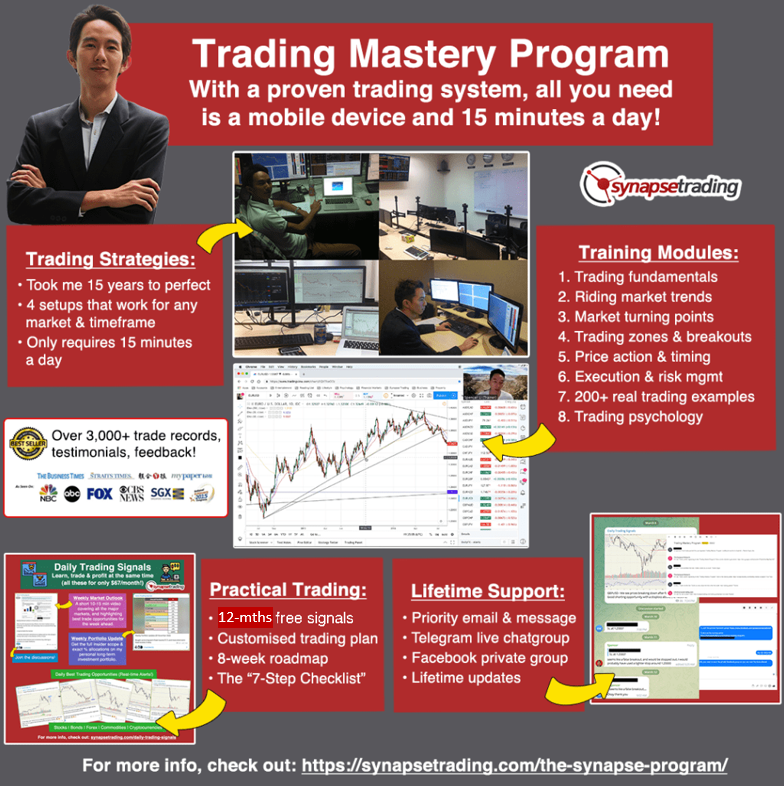 Our flagship mentoring program is suitable for both beginners and advanced traders, covering the 4 strategies which I used over the past 15 years to build up my 7-figure personal trading portfolio.
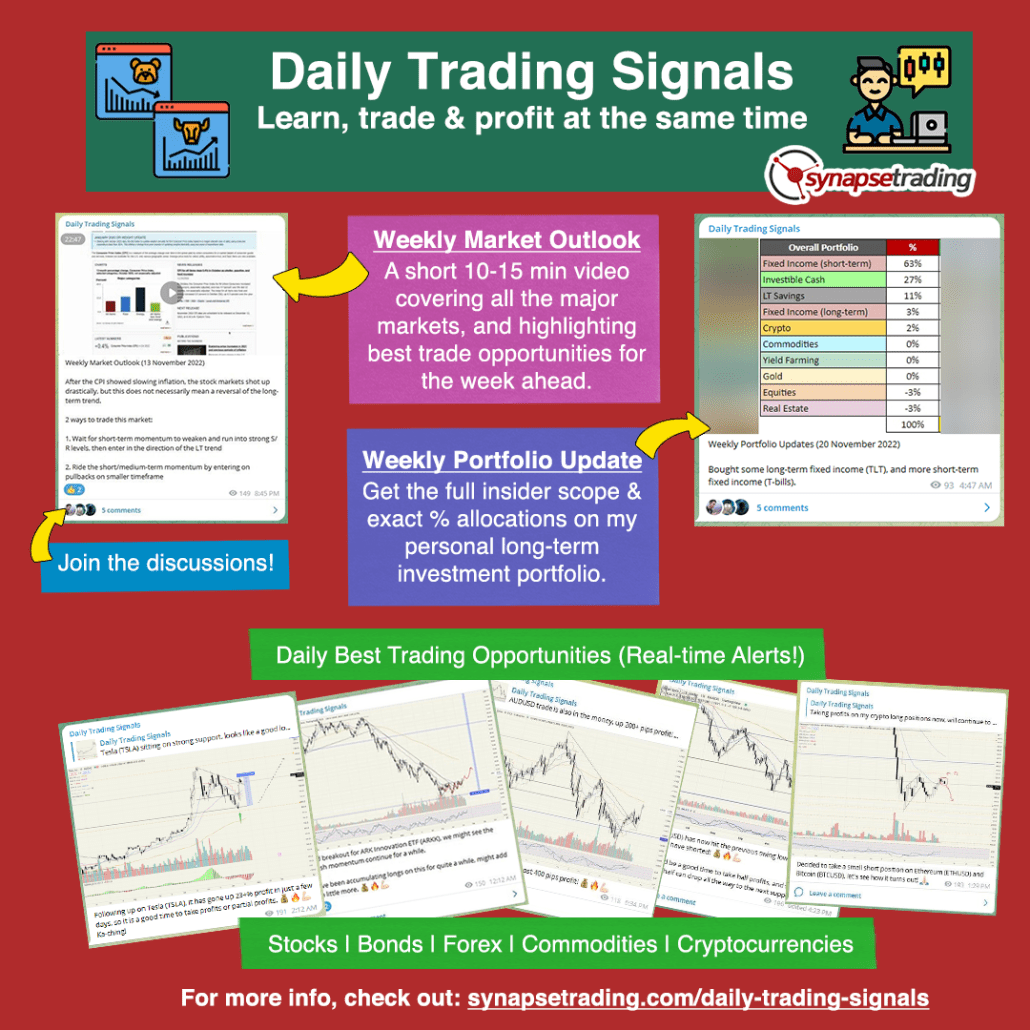 If you're looking for the best trading opportunities every day across various markets, and don't want to spend hours doing the research yourself, check out our private Telegram channel!






Leave a Reply
Want to join the discussion?Feel free to contribute!