

Best Trading Tips & Quotes from George Soros
Join our Telegram channel for more market analysis & trading tips: t.me/synapsetrading
George Soros Trading Tips: 7 Lessons From His Best Quotes
Last updated: 3 July 2026 · By Spencer Li, CFTe
George Soros’s most important trading lesson is that survival beats being right: you make money not by predicting the market correctly but by recognising when you are wrong and correcting it fast. Across his quotes, the same themes repeat. Good investing should feel boring, not exciting. Markets are always biased, never perfectly priced, so the edge is in spotting the gap between perception and reality (his theory of “reflexivity,” the idea that what people believe about a market changes the market itself). Position size and risk control matter more than your hit rate, because how much you make when right and lose when wrong is what compounds. And the danger is never the market; it is your own ego telling you that you cannot be wrong.
Soros is the Hungarian-American investor known as “The Man Who Broke the Bank of England,” after his 1992 short of the British pound made his fund a reported $1 billion in a single bet. His Quantum Fund started with $12 million and grew to roughly $25 billion. So when he talks about how he actually made that money, it is worth slowing down to read.
Here are the seven lessons I pull out of his best quotes.
What is George Soros best known for as a trader?
Soros is best known for two things: the 1992 Black Wednesday trade, and the investing philosophy he calls reflexivity.
On Black Wednesday, his fund short-sold a reported US$10 billion of pounds sterling, betting the UK could not hold its currency peg. It could not. The pound was forced out of the European exchange-rate mechanism, and the trade reportedly netted around $1 billion. That is the headline.
The more useful thing, for a normal trader, is the thinking behind it. Soros does not believe markets price the future correctly. He believes they are always biased, and that the bias itself feeds back into reality. Spot the misconception, size the bet, and wait for reality to catch up. That is the whole game in one line.
The 7 lessons, at a glance
I have grouped his quotes into seven themes. Here they are side by side, with the lesson and the trading takeaway for each.
| # | Lesson | What Soros is really saying | Trading takeaway |
|---|---|---|---|
| 1 | Good investing is boring | If it is fun, you are probably gambling | Build a dull, repeatable process |
| 2 | Survival beats being right | He survives by recognising mistakes fast | Cut losers early, protect the account |
| 3 | Size matters more than accuracy | The money is in how much you make right vs lose wrong | Win big when right, lose small when wrong |
| 4 | Markets are always biased | Prices reflect a distorted view, never the truth | Trade the gap between perception and reality |
| 5 | Don’t predict, prepare scenarios | He corrects false views, he does not forecast | Have a plan for each scenario, not one bet |
| 6 | Bubbles have a real seed | A real trend plus a misconception | Find the trend, then find the flaw in the story |
| 7 | Ego is the real risk | The only thing that can hurt him is feeling omnipotent | Stay humble, the market keeps you honest |
Now the detail, in his own words.
Lesson 1: good investing is boring
“If investing is entertaining, if you’re having fun, you’re probably not making any money. Good investing is boring.”
This is the one I would tattoo on a beginner’s screen. The feeling of action, the dopamine of a fast trade, is almost always a sign you are gambling, not investing. The money is made in the dull, repeated execution of a process you have tested. If your trading is exciting, that is usually a warning, not a reward.
Personally, this is why I teach a system that takes about 15 minutes a day. Boring is the point.
Lesson 2: survival beats being right
“I’m only rich because I know when I’m wrong. I basically have survived by recognising my mistakes.”
“My approach works not by making valid predictions but by allowing me to correct false ones.”
“Once we realise that imperfect understanding is the human condition there is no shame in being wrong, only in failing to correct our mistakes.”
“If I had to sum up my practical skills, I would use one word: survival.”
This is the heart of Soros. He does not win by being right more often. He wins by getting out of wrong trades quickly and cheaply. He even described a physical version of it: a backache that flared up when a position was wrong, and faded the moment he made the decision to act on it.
Do note that, “correct your mistakes fast” is not a soft idea. It is a hard rule with a number attached to it, your stop loss. The trader who cannot admit a loss is the one who blows up.
Lesson 3: size matters more than accuracy
“It’s not whether you’re right or wrong that’s important, but how much money you make when you’re right and how much you lose when you’re wrong.”
This single quote dismantles the obsession most new traders have with win rate. You can be right 40% of the time and still make money, if your winners are large and your losers are small. You can be right 70% of the time and still lose, if one bad trade wipes out ten good ones.
The skill is in position sizing and in letting winners run while cutting losers short. Hence, I spend far more time teaching risk control than entry signals. The entry is the easy part.
Lesson 4: markets are always biased
“I believe the market prices are always wrong in the sense that they present a biased view of the future.”
“Markets are constantly in a state of uncertainty and flux, and money is made by discounting the obvious and betting on the unexpected.”
“Money values do not simply mirror the state of affairs in the real world; valuation is a positive act that makes an impact on the course of events.”
This is reflexivity, Soros’s signature idea. Prices do not passively reflect reality. They shape it. When enough people believe a stock will rise, they buy, and that buying can actually change the company’s fortunes, which then justifies the higher price, for a while. Perception and reality feed on each other.
For a trader, the takeaway is simpler than the theory. Do not assume the price is “correct.” Look for the gap between what the crowd believes and what is actually true. That gap is the trade.
Lesson 5: don’t predict, prepare scenarios
“The financial markets generally are unpredictable. So that one has to have different scenarios. The idea that you can actually predict what’s going to happen contradicts my way of looking at the market.”
“Making an investment decision is like formulating a scientific hypothesis and submitting it to a practical test.”
Notice that the man famous for one of the boldest bets in history does not claim to predict the future. He treats each trade as a hypothesis, then lets the market test it. If the test fails, he is out. If it works, he presses.
This is the opposite of the guru who promises to tell you where the market is going. Soros plans for several outcomes and reacts to the one that shows up.
Lesson 6: bubbles have a real seed
“Stock market bubbles don’t grow out of thin air. They have a solid basis in reality, but reality as distorted by a misconception.”
“Every bubble consists of a trend that can be observed in the real world and a misconception relating to that trend.”
“The worse a situation becomes, the less it takes to turn it around, and the bigger the upside.”
Soros’s bubble model has two parts: a genuine trend, plus a false belief layered on top of it. The dot-com boom had a real trend (the internet did change everything) wrapped in a misconception (that profits did not matter). Spotting both halves is how he timed his entries and his exits.
The flip side is the bottom. When a situation is at its worst, it takes very little good news to turn it, and the upside is largest precisely when the fear is loudest.
Lesson 7: ego is the real risk
“The only thing that could hurt me is if my success encouraged me to return to my childhood fantasies of omnipotence, but that is not likely to happen as long as I remain engaged in the financial markets, because they constantly remind me of my limitations.”
“The hardest thing to judge is what level of risk is safe.”
“Unfortunately, the more complex the system, the greater the room for error.”
For all the talk of strategy, Soros names his own ego as the only thing that could really sink him. The market, he says, keeps him humble by constantly reminding him of his limits. The trader who thinks he has it figured out is the one in danger.
This is also why he keeps it simple. He notes that the more complex the system, the more room for error. Complexity is not sophistication. It is more surface area for mistakes.
Where the human edge comes in
You can feed every one of these quotes to an AI and it will summarise them in a second. What it cannot do is sit with you at the moment a losing trade is staring back, and make you act on Lesson 2 instead of hoping. The quotes are free. The discipline to follow them when real money is on the line is the part no tool supplies for you. That discipline, sizing and the will to cut a loser, is one of the Five Edges that stays human.
FAQ
What is George Soros’s most famous trade?
The 1992 Black Wednesday trade, when his fund short-sold a reported US$10 billion of British pounds, betting the UK could not hold its currency peg. It could not, and the trade reportedly made around $1 billion, earning him the nickname “The Man Who Broke the Bank of England.”
What is George Soros’s investing philosophy?
It centres on “reflexivity,” the idea that market prices do not just reflect reality but actively shape it, so prices are always biased rather than correct. He looks for the gap between the crowd’s distorted view and reality, then sizes a bet on it.
What is the most important George Soros trading lesson?
Survival over accuracy. Soros says he is rich not because he predicts well but because he recognises his mistakes quickly and corrects them, cutting losing trades before they grow large.
Does George Soros believe in predicting the market?
No. He states plainly that markets are unpredictable and that the idea of forecasting outcomes contradicts how he trades. He prepares for multiple scenarios and treats each trade as a hypothesis to be tested.
What did George Soros say about win rate?
He said it is not whether you are right or wrong that matters, but how much you make when right and how much you lose when wrong. In other words, position sizing and risk control matter more than your hit rate.
Which of these seven lessons hits home for you? Let me know in the comments.
And if you want the same treatment for the other greats, read the pillar roundup: Best Trading Tips and Quotes from Legendary Top Traders.
Want a process you can actually follow? Grab the free 15-Minute Swing Trading Starter Kit. It is the exact routine I use to scan once a day and trade any market in 15 minutes, the boring, repeatable kind of investing Soros is talking about.
About the author. Spencer Li is the founder of Synapse Trading and a Certified Financial Technician (CFTe) with 15+ years of trading across stocks, forex, crypto, commodities, and bonds. His trade log is public: every trade since April 2024, dated, losses left in. He has taught a 15-minute daily trading routine since 2014, one system for any market.
Education, not financial advice. Synapse Trading is not licensed by MAS to advise on investment products. Trading carries risk of loss; past performance is not indicative of future results.
Related
Best Trading Tips and Quotes from Legendary Top Traders (pillar) · Trading tips from Warren Buffett · Trading tips from Jesse Livermore · Risk management for swing traders · Trading psychology guide
Want the daily routine? Enter your email for the free 15-Minute Swing Trader's Checklist.
Free, 5 pages, PDF. You get the checklist, then my occasional trading emails. Education only, not financial advice. Unsubscribe anytime.
Where your details go: Kit, our email provider, stores your email address in the United States. Our contract with Kit lets it use your address only to send our emails, and requires Kit to keep it secure. The United States has no national privacy law like Singapore's, so that contract is the main protection. More in our privacy policy.
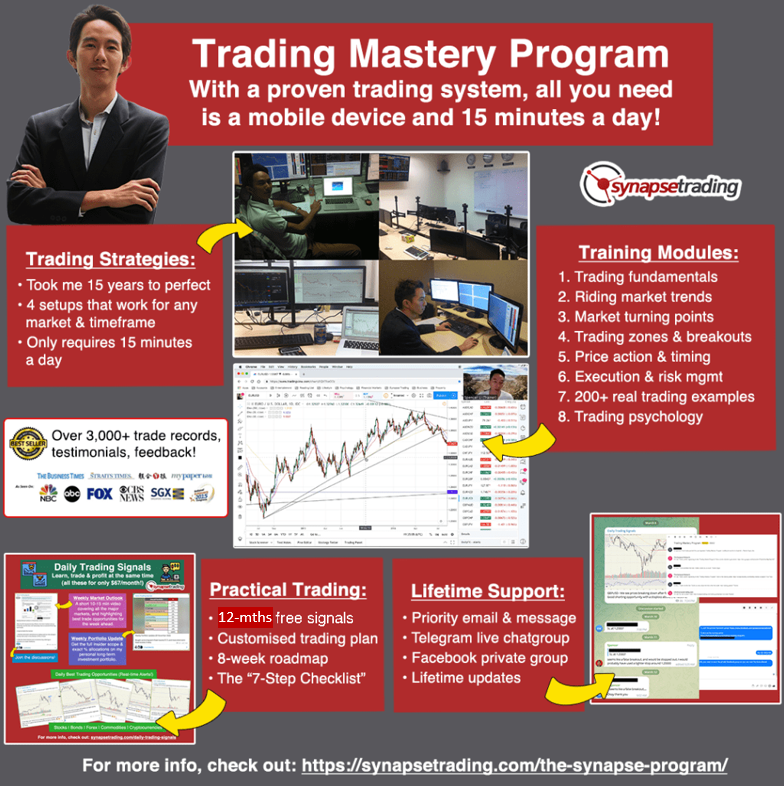 Our flagship mentoring program is suitable for both beginners and advanced traders, covering the 4 strategies which I used over the past 15 years to build up my 7-figure personal trading portfolio.
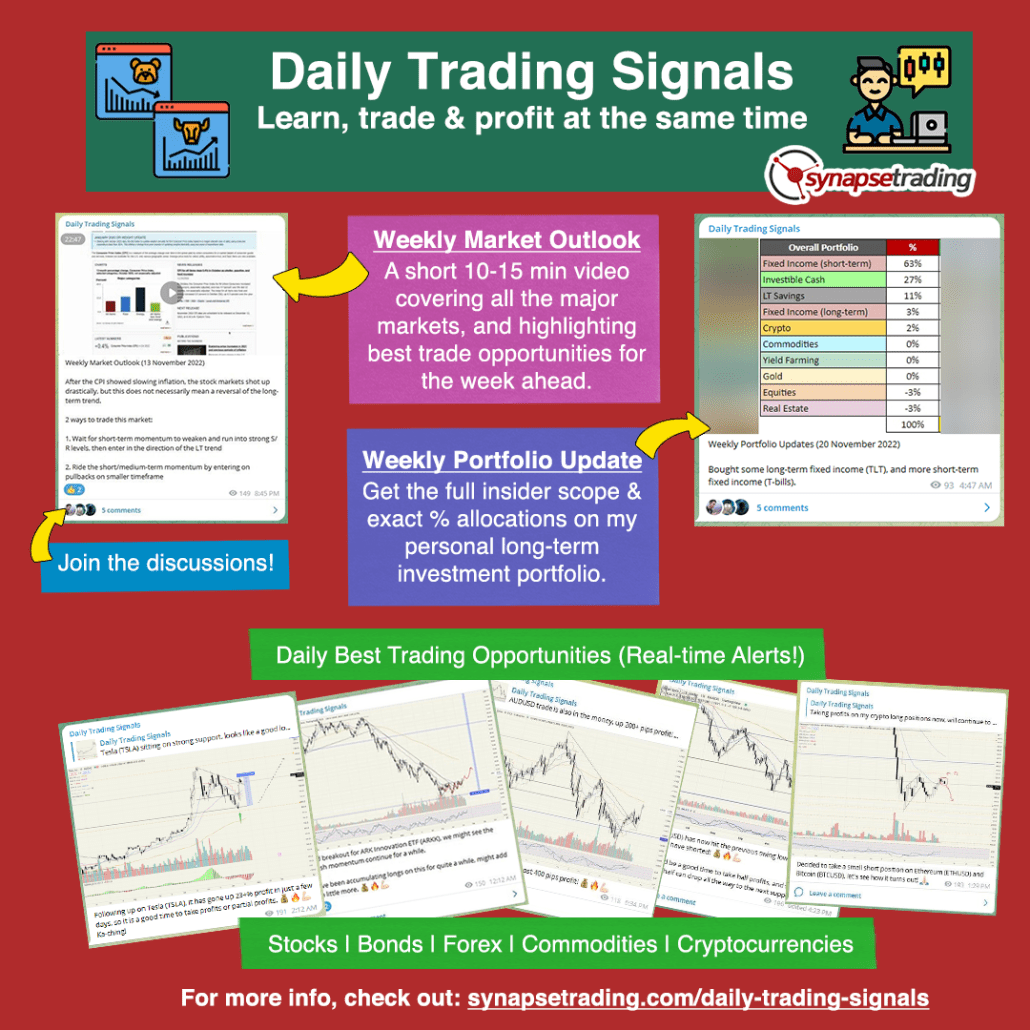 If you're looking for the best trading opportunities every day across various markets, and don't want to spend hours doing the research yourself, check out our private Telegram channel!








Leave a Reply
Want to join the discussion?Feel free to contribute!