

Best Trading Tips & Quotes from William O’Neil

Join our Telegram channel for more market analysis & trading tips: t.me/synapsetrading
William O’Neil’s Best Trading Tips and Quotes (CAN SLIM Rules Explained)
Last updated: 3 July 2026 · By Spencer Li, CFTe
William O’Neil’s core trading lesson is this: cut your losses fast, let your winners run, and follow the market’s facts instead of your own opinions. O’Neil, the founder of Investor’s Business Daily and the creator of the CAN SLIM stock-picking method, summed it up in one line: “The whole secret to winning big in the stock market is not to be right all the time, but to lose the least amount possible when you’re wrong.” He treated his winners as flowers and his losers as weeds, and he pulled the weeds without hesitation. He also believed at least half the game is the general market direction, not the individual stock. The rest of his rules, gathered below, all serve those two ideas: stay objective, and protect your downside.
Here are his best tips and quotes, grouped by the lesson each one teaches.
Who was William O’Neil?
William J. O’Neil was an American entrepreneur, stockbroker, and writer. He founded the brokerage firm William O’Neil & Co. Inc in 1963 and the business newspaper Investor’s Business Daily in 1983. He wrote How to Make Money in Stocks, 24 Essential Lessons for Investment Success, and The Successful Investor, and he created the CAN SLIM investment strategy (a seven-part checklist for finding leading growth stocks).
His style was growth-focused and trend-following: buy strong companies showing strong price action, and cut anything that does not work. The quotes below are his own words. I have kept them intact and added the context for why each one still matters.
Cut your losses, run your winners
This is the heart of O’Neil’s method, and the reason most traders fail without it.
“The stocks that go up the most from where you bought them are your flowers; those that are down from where you bought them are your weeds. If weeds appear, don’t hesitate to reach for the trowel.”
“The whole secret to winning big in the stock market is not to be right all the time, but to lose the least amount possible when you’re wrong.”
“Learn to always sell stocks quickly when you have a small loss rather than waiting and hoping they’ll come back.”
“Investors cash in small, easy-to-take profits and hold their losers. This tactic is exactly the opposite of correct investment procedure. Investors will sell a stock with profit before they will sell one with a loss.”
“Buying a stock without knowing when or why you should sell it is like buying a car with no brakes, or being in a boat with no life preservers, or taking flying lessons that teach you how to take off but not how to land.”
Personally, this is the one cluster I would tattoo on the wall. The instinct to take a quick profit and sit on a loser is human and it is backwards. You end up with a basket of weeds and no flowers. O’Neil’s fix is mechanical: decide your sell rule before you buy, and act on it without negotiating with yourself.
Trust facts over feelings
O’Neil had no patience for opinions, including his own.
“Personal opinions, feelings, hopes, and beliefs about the stock market are usually wrong and often dangerous. Facts and markets, on the other hand, are seldom wrong.”
“A great trader once noted there are only two emotions in the market: hope and fear. ‘The only problem,’ he added, ‘is we hope when we should fear, and we fear when we should hope.’ This is just as true in 2009 as it was in 1909.”
“The moral of the story is: never argue with the market. Your health and peace of mind are always more important than any stock.”
“The market has a simple way of whittling all excessive pride and overblown egos down to size. After all, the whole idea is to be completely objective and recognize what the marketplace is telling you, rather than try to prove that the thing you said or did yesterday or six weeks ago was right. The fastest way to take a bath in the stock market or go broke is to try to prove that you are right and the market is wrong.”
Hence the recurring theme: the market is not there to confirm your ego. The moment a trade becomes about being right rather than being profitable, you have already lost the plot. This is psychology, not analysis, and it is where most edges are actually won or lost.
Watch the crowd, fade the obvious
“When everybody is running around saying how great a stock is, everybody who can buy probably already has, and the only direction for the stock to go at that point is down. When it’s obvious and exciting to everyone, it’s too late!”
“It is one of the great paradoxes of the stock market that what seems too high usually goes higher and what seems too low usually goes lower.”
These two sit in tension on purpose. Fade the euphoria when a name is on every front page, but do not assume “too high” means “short it.” Strength tends to persist. O’Neil bought high and sold higher, which feels wrong until you accept that the crowd’s comfort and the stock’s future return point in opposite directions.
Do the homework, keep it simple
“90% of the people in the stock market, professionals and amateurs alike, simply haven’t done enough homework.”
“Over-diversification is a hedge for ignorance.”
“Remember, keep it simple. Investing is hard enough. Stick to the basic rules of CAN SLIM and don’t complicate it by getting super-tricky.”
“Plot out your mistakes on charts, study them, and write some additional rules in order to correct your mistakes and the actions that cost you money.”
“When you appear to be right always follow up.”
Do note that “simple” is not the same as “easy.” O’Neil wanted a tight set of rules followed consistently, plus a feedback loop where you mark up your own mistakes on the chart and turn each one into a new rule. That loop is the whole job. It is also the part nobody enjoys, which is why most people skip it.
Pick real leaders, not familiar names
“The number one market leader is not the largest company or the one with the most recognized brand name; it’s the one with the best quarterly and annual earnings growth, return on equity, profit margins, sales growth, and price action.”
“Over time, you’ll learn that only one or two out of every 10 stocks you buy will be truly outstanding and capable of doubling or tripling or more in value.”
“There is no reason any investor should ever in any bull market buy or sit with a poor-performing stock with a Relative Strength Rating of 10, 20, 30, 40, or 50. The market is bluntly telling you that that investment is a relatively poor or mediocre choice.”
This is the engine of CAN SLIM. Leadership is measured by earnings and price action, not brand recognition. And because only one or two names in ten do the heavy lifting, you cannot afford to anchor on the laggards. If a stock’s relative strength is in the bottom half, the market is telling you something. Listen.
The general market is half the game
“At least 50% of the whole game is the general market.”
This is the quote I would not let a beginner forget. You can pick a beautiful stock and still lose if you buy it into a falling market. Direction first, then selection.
What CAN SLIM stands for
O’Neil’s method is a checklist, and the quotes above are the philosophy underneath it. Here is the framework in one place.
| Letter | Stands for | What it means in plain terms |
|---|---|---|
| C | Current quarterly earnings | Strong, accelerating recent earnings per share |
| A | Annual earnings growth | A track record of growth over several years |
| N | New product, service, or high | A new catalyst, or a stock breaking to new highs |
| S | Supply and demand | Smaller share float plus rising volume on up-moves |
| L | Leader or laggard | Buy the leaders (high relative strength), skip the laggards |
| I | Institutional sponsorship | Quality funds accumulating the stock |
| M | Market direction | At least half the game; trade with the general trend |
The “M” is the same point O’Neil made in his quote: at least 50% of the whole game is the general market. The checklist finds the stock; the market decides whether it is even worth looking.
Purpose and the long game
Two of O’Neil’s tips are not about charts at all.
“Purpose is a more powerful motivator than money. When you are not paid as much as you would like, your purpose will provide you a reason to continue producing excellence in your work. When you have more money than you ever thought possible, your purpose will provide you with a reason to continue producing excellence in your work.”
“Success in a free country is simple. Get a job, get an education, and learn to save and invest wisely. Anyone can do it. You can do it.”
I include these because trading is a long game, and the people who last are usually playing for a reason bigger than the next quick win. That is not a soft point. Purpose is what keeps you executing the boring rules on the days the market is busy whittling your ego down to size.
Where the human edge comes in
A screener can hand you a CAN SLIM watchlist in a second. It will rank earnings growth, flag the new highs, and sort by relative strength faster than O’Neil’s team ever could by hand. What it will not do is pull the weed when your favorite name turns into a loser, or keep you out of a perfect stock in a falling market, or stop you from arguing with the tape to prove you were right last week. The selection is becoming free. The discipline to cut, to wait, and to stay objective is not. That is the first of the Five Edges, and it is the one O’Neil spent his whole career teaching.
FAQ
What is William O’Neil’s most important trading rule?
Cut your losses quickly and let your winners run. In his words, the secret is “not to be right all the time, but to lose the least amount possible when you’re wrong.” He called winners flowers and losers weeds, and he pulled the weeds early.
What does CAN SLIM stand for?
CAN SLIM is O’Neil’s seven-part checklist for growth stocks: Current quarterly earnings, Annual earnings growth, New catalyst or new high, Supply and demand, Leader or laggard, Institutional sponsorship, and Market direction.
Did William O’Neil say the general market matters more than the stock?
He said “at least 50% of the whole game is the general market.” You can pick a strong stock and still lose if the broad market is falling, so he checked market direction first.
What is a Relative Strength Rating in O’Neil’s method?
It ranks a stock’s price performance against all others, from 1 to 99. O’Neil avoided any stock rated 50 or below, reading a low rating as the market bluntly telling you the stock is a mediocre choice.
Which O’Neil books should I read first?
Start with How to Make Money in Stocks, which lays out CAN SLIM in full. 24 Essential Lessons for Investment Success is a shorter companion, and The Successful Investor covers his market-direction rules.
Now that you have O’Neil’s best tips in one place, which one fits how you trade? Mine is the flowers-and-weeds rule. Let me know yours in the comments.
And if you want the wisdom of every legendary trader gathered the same way, read the roundup: Best Trading Tips and Quotes from Legendary Top Traders.
Want a simple system to put these rules into practice? Grab the free 15-Minute Swing Trading Starter Kit. It’s the exact routine I use to scan once a day and trade any market in 15 minutes.
About the author. Spencer Li is the founder of Synapse Trading and a Certified Financial Technician (CFTe) with 15+ years of trading across stocks, forex, crypto, commodities, and bonds. His trade log is public: every trade since April 2024, dated, losses left in. He has taught a 15-minute daily trading routine since 2014, one system for any market.
Education, not financial advice. Synapse Trading is not licensed by MAS to advise on investment products. Trading carries risk of loss; past performance is not indicative of future results.
Related
Best Trading Tips and Quotes from Legendary Top Traders (pillar) · CAN SLIM strategy explained · How to cut losses and let winners run · Relative strength investing
Want the daily routine? Enter your email for the free 15-Minute Swing Trader's Checklist.
Free, 5 pages, PDF. You get the checklist, then my occasional trading emails. Education only, not financial advice. Unsubscribe anytime.
Where your details go: Kit, our email provider, stores your email address in the United States. Our contract with Kit lets it use your address only to send our emails, and requires Kit to keep it secure. The United States has no national privacy law like Singapore's, so that contract is the main protection. More in our privacy policy.
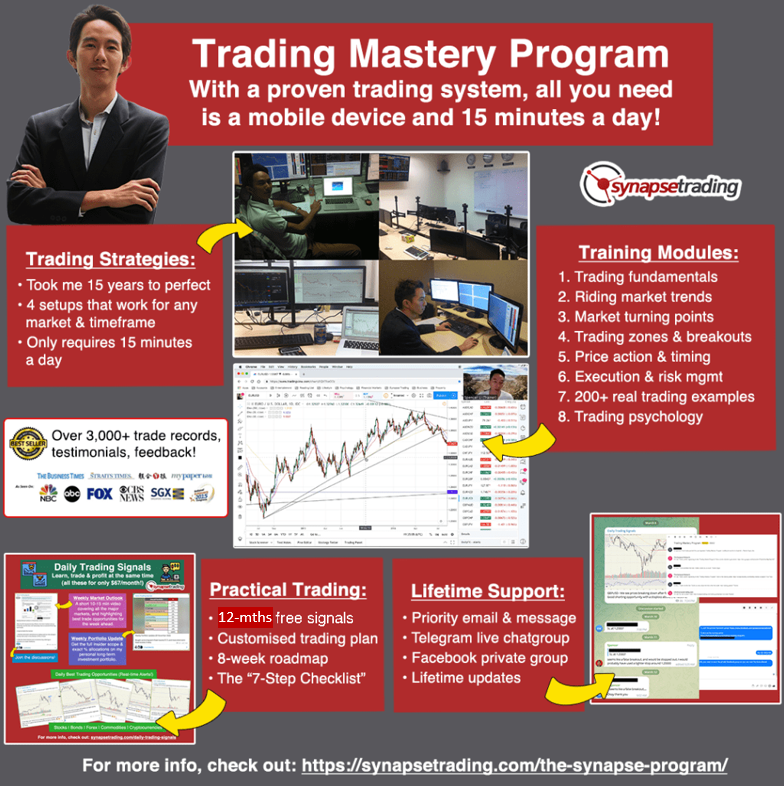 Our flagship mentoring program is suitable for both beginners and advanced traders, covering the 4 strategies which I used over the past 15 years to build up my 7-figure personal trading portfolio.
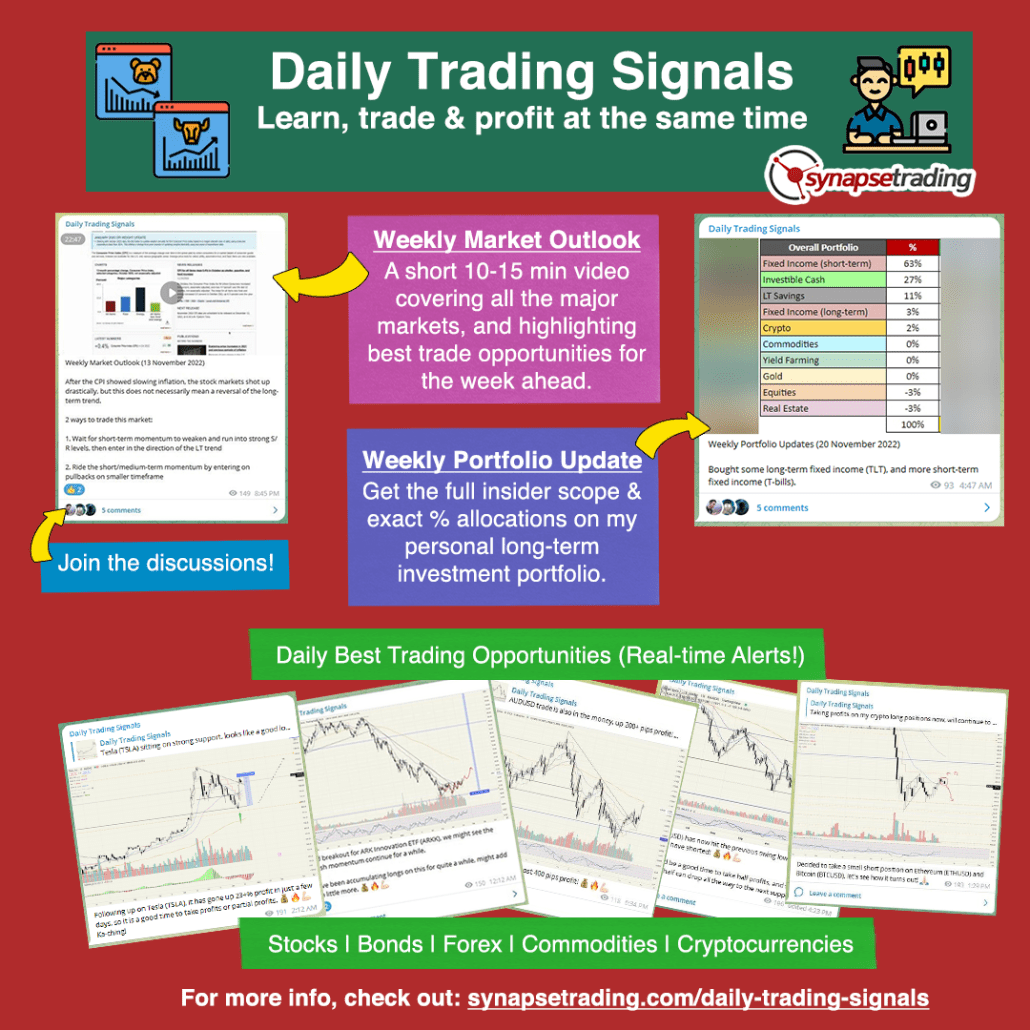 If you're looking for the best trading opportunities every day across various markets, and don't want to spend hours doing the research yourself, check out our private Telegram channel!






Leave a Reply
Want to join the discussion?Feel free to contribute!