

Best Trading Tips & Quotes from Paul Tudor Jones

Join our Telegram channel for more market analysis & trading tips: t.me/synapsetrading
Paul Tudor Jones Trading Tips: 9 Rules from the Macro Legend (With Quotes)
Last updated: 14 June 2026 · By Spencer Li, CFTe
Paul Tudor Jones is the macro trader behind Tudor Investment Corporation, and his most repeated trading tip is simple: play defense before offense. He says he spends his day thinking about losing money, not making it, and he assumes every position he holds is wrong until price proves otherwise. His other signature lessons are to buy the market turns instead of fighting for “the meat in the middle,” to never average down on a loser, to cut losing positions fast because you can always get back in, and to stay humble because the moment you think you know something is the moment you get hurt. The thread running through all of it is risk control. In his own words, “ninety-percent of any great trader is going to be the risk control.”
Below are nine of his rules, each paired with his actual quote and how I apply it in my own swing trading. The quotes are his; the application notes are mine.
Who is Paul Tudor Jones?
Paul Tudor Jones II (born 28 September 1954) is an American hedge fund manager, conservationist and philanthropist. In 1980 he founded Tudor Investment Corporation, an asset management firm. He is best known among traders for calling the 1987 crash and for a macro style built almost entirely around risk control and price action rather than fundamentals.
I am not sharing these because he is famous. I am sharing them because the same handful of ideas show up again and again in his interviews, and they happen to be the ideas that actually keep a trader alive. Here is what he keeps coming back to.
The 9 rules, side by side
| # | Rule | His quote | How I apply it |
|---|---|---|---|
| 1 | Defense first | “Play great defense, not great offense.” | I size and set my stop before I think about the target. |
| 2 | Think about losing, not making | “Don’t focus on making money, focus on protecting what you have.” | I plan the exit before the entry, every trade. |
| 3 | Assume you are wrong | “Everyday I assume every position I have is wrong.” | I know my stop point on every open position. |
| 4 | Trade the turns | “The very best money is made at the market turns.” | I take low-risk reversal entries, not mid-trend chases. |
| 5 | Cut losers fast | “If you have a losing position that is making you uncomfortable, the solution is very simple: Get out.” | If it hits my stop, I am out. I can always re-enter. |
| 6 | Never average a loser | “Don’t ever average losers.” | I add to winners, never to losers. |
| 7 | Stay humble | “The second you think you are very good, you are dead.” | After a great run I cut size, not raise it. |
| 8 | Price leads, fundamentals follow | “Prices move first and fundamentals come second.” | I act on the chart and let the story catch up. |
| 9 | Stay out of no-edge bets | “I don’t risk significant amounts of money in front of key reports.” | I flatten or size down into binary events. |
The rest of the post unpacks the ones worth dwelling on.
What is Paul Tudor Jones’ number one trading rule?
Risk control, above everything else. He is blunt about it: “Ninety-percent of any great trader is going to be the risk control.” And: “Risk control is the most important thing in trading.”
Notice what that does to your day. Most people spend their energy on the fun part, the pie-in-the-sky idea of how much they are going to make. Jones flips it. “That’s why most people lose money as individual investors or traders because they’re not focusing on losing money. They need to focus on the money that they have at risk.” His claim is that if you spent 90 percent of your time on capital at risk instead of on profit fantasies, you would be incredibly successful.
Personally, this is the one I would tattoo on a beginner. The market does not pay you for good ideas. It pays you for surviving the bad ones long enough for the good ones to work.
Defense over offense: protect what you have
This is the heart of his whole approach. “The most important rule is to play great defense, not great offense.” He describes his actual routine like this: “Everyday I assume every position I have is wrong. I know where my stop risk points are going to be. I do that so I can define my maximum drawdown.”
That last phrase is the key one. Maximum drawdown (the worst peak-to-trough loss you will accept) is something you decide on before the trade, not something the market decides for you. Once his stops are set, his job for the rest of the day is calm: enjoy the positions going his way, and have a game plan for the ones going against him.
He frames the cut decision in the plainest possible terms: “If you have a losing position that is making you uncomfortable, the solution is very simple: Get out, because you can always get back in.” Do note that, the “you can always get back in” half is the part beginners forget. Cutting a loser is not closing a door. It is stepping back so you can re-enter when the setup is actually there.
Trade the turns, not the middle
Here is the quote that gets misread the most: “I believe the very best money is made at the market turns. Everyone says you get killed trying to pick tops and bottoms and you make all your money by playing the trend in the middle. Well for twelve years I have been missing the meat in the middle but I have made a lot of money at tops and bottoms.”
This is not a licence to blindly short every rally and buy every dip. It is a statement about where the low-risk entries live. Near a turn, your stop is close (just past the extreme) and your potential move is large (a whole new trend). That is a good reward-to-risk shape. He pairs this with a clear tell for when a move is starting: “When you get a range expansion, the market is sending you a very loud, clear signal that the market is getting ready to move in the direction of that expansion.”
I trade the same way. I would rather take a tight-stop entry at a structural turn than chase a trend that is already two-thirds done. If you want the mechanics of trading these turns, that is exactly what my price-action setups guide covers.
Never average down, and only add to winners
“Don’t ever average losers. Decrease your trading volume when you are trading poorly; increase your volume when you are trading well.”
Averaging down (buying more of a position as it falls, to lower your average price) feels smart and is usually a trap. It turns a small, controlled loss into a large, uncontrolled one, and it is the single most common way retail accounts blow up. Jones does the opposite: he presses size when he is in form and pulls size when he is not. Your account balance is feedback. Listen to it.
Stay humble: the second you feel good, you are in danger
The psychology quotes are the ones that age the best. “Don’t be a hero. Don’t have an ego. Always question yourself and your ability. Don’t ever feel that you are very good. The second you do, you are dead.”
And the one I find genuinely useful: “My biggest hits have always come after I have had a great period and I started to think that I knew something.” This matches what I see in my own trading and in my students. The dangerous moment is not the losing streak. It is right after the winning streak, when confidence quietly turns into oversizing. Hence, the discipline is counterintuitive: cut your size after you win, not after you lose.
Price leads, fundamentals follow
“I always believe that prices move first and fundamentals come second.” For a swing trader this is freeing. You do not need to out-research the analysts. You need to read what price is already telling you. He pushes it further on valuation: “your job is to buy what goes up and to sell what goes down so really who gives a damn about PE’s?” He also warns that the final third of a great move is a blow-off, a parabolic mania that no classroom prepares you for. Respect it, do not try to fade it early.
The mindset beneath the rules
A few of his lines are less tactics and more the operating system underneath them:
- “You learn more from your losses, than from your gains.”
- “Sometimes failure is merely chasing you off the wrong road and onto the right one.”
- “Intellectual capital will always trump financial capital.”
- “The secret to being successful is to have an undying and unquenchable thirst for information and knowledge.”
You can have every rule above written on your wall and still lose if you cannot stay humble and keep learning. The rules are the easy part. Living them, trade after trade, is the hard part.
Where the human edge comes in
You could feed all nine of these rules to an AI and it could recite them back to you flawlessly. What it cannot do is feel the pull to average down a loser, recognise that pull as the danger signal it is, and override it. It cannot notice that you have started to feel good and quietly cut your size before the overconfidence costs you. Jones’ rules are simple to state and brutally hard to follow, and the gap between the two is psychology. That gap is the first of the Five Edges no algorithm can trade for you. A bot can hold the rule. Only you can hold the line when it is uncomfortable.
FAQ
What is Paul Tudor Jones’ most famous trading rule?
Play defense before offense. He says he spends his day thinking about losing money rather than making it, and that “ninety-percent of any great trader is going to be the risk control.”
Does Paul Tudor Jones trade trends or reversals?
He is best known for trading market turns. In his words, he made his money “at tops and bottoms” while deliberately “missing the meat in the middle,” because the turns offer tight stops and large potential moves.
Why does Paul Tudor Jones say never to average down?
Because adding to a losing position turns a small, controlled loss into a large, uncontrolled one. His rule is the reverse: increase size when you are trading well, decrease it when you are trading poorly.
What did Paul Tudor Jones mean by “the second you think you are good, you are dead”?
That overconfidence is the trader’s biggest risk. His own worst losses came right after winning streaks, when he started believing he knew something. The fix is to cut size after a good run, not raise it.
Is “prices move first, fundamentals come second” useful for retail traders?
Yes. It means you can act on what price is already doing instead of trying to out-research institutions on the news. The chart leads; the story catches up later.
So which of these nine rules fits how you trade? Mine is the first one, defense before offense, because it makes every other rule possible. Let me know yours in the comments.
And if you want trading tips from more of the greats mapped to the same risk-first lens, read the roundup: Best Trading Tips and Quotes from Legendary Top Traders.
Want the system behind the rules? Grab the free 15-Minute Swing Trading Starter Kit. It’s the exact routine I use to scan once a day and trade any market in 15 minutes, with the risk controls built in.
About the author. Spencer Li is the founder of Synapse Trading and a Certified Financial Technician (CFTe) with 15+ years of trading across stocks, forex, crypto, commodities, and bonds. His trade log is public: every trade since April 2024, dated, losses left in. He has taught a 15-minute daily trading routine since 2014, one system for any market.
Education, not financial advice. Synapse Trading is not licensed by MAS to advise on investment products. Trading carries risk of loss; past performance is not indicative of future results.
Related
Best Trading Tips and Quotes from Legendary Top Traders (pillar) · Definitive Guide to Trading Price Chart Patterns · Trading psychology guide · How to set a stop loss
Want the daily routine? Enter your email for the free 15-Minute Swing Trader's Checklist.
Free, 5 pages, PDF. You get the checklist, then my occasional trading emails. Education only, not financial advice. Unsubscribe anytime.
Where your details go: Kit, our email provider, stores your email address in the United States. Our contract with Kit lets it use your address only to send our emails, and requires Kit to keep it secure. The United States has no national privacy law like Singapore's, so that contract is the main protection. More in our privacy policy.
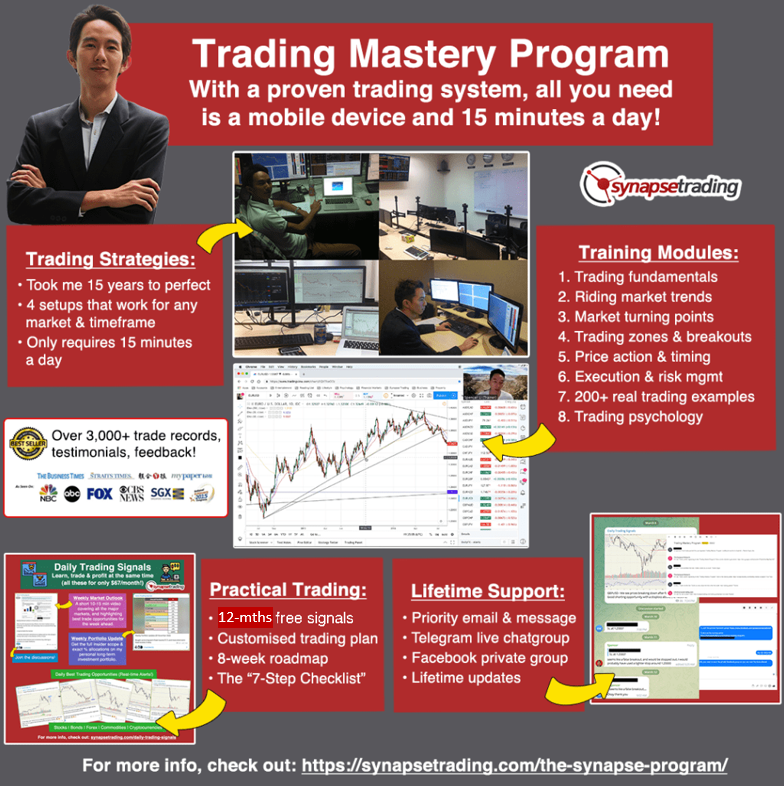 Our flagship mentoring program is suitable for both beginners and advanced traders, covering the 4 strategies which I used over the past 15 years to build up my 7-figure personal trading portfolio.
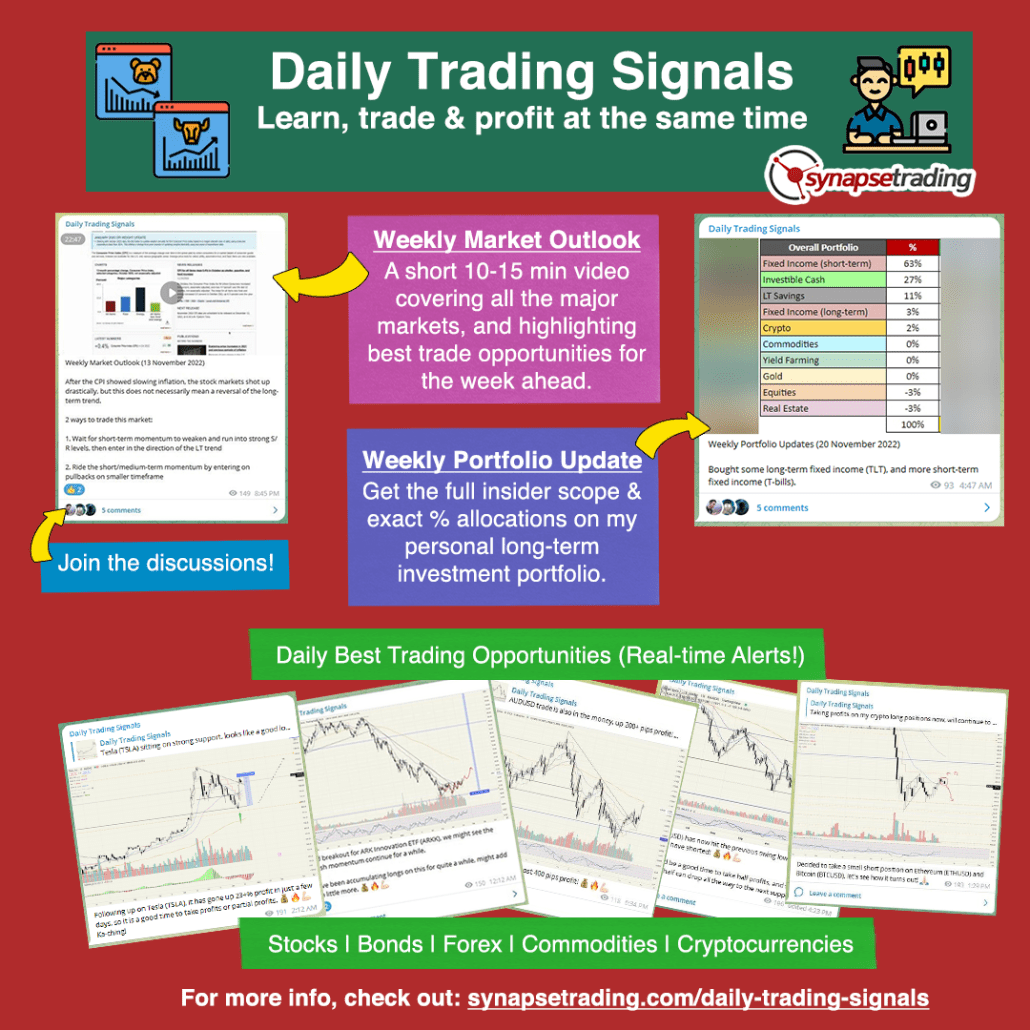 If you're looking for the best trading opportunities every day across various markets, and don't want to spend hours doing the research yourself, check out our private Telegram channel!









Leave a Reply
Want to join the discussion?Feel free to contribute!