

Best Trading Tips & Quotes from Jesse Livermore

Join our Telegram channel for more market analysis & trading tips: t.me/synapsetrading
Jesse Livermore’s Trading Rules: His Best Tips and Quotes, Explained
Last updated: 3 July 2026 · By Spencer Li, CFTe
Jesse Livermore’s trading rules come down to five ideas: trade the main trend not the daily noise, wait for confirmation before you act, cut losses fast and never average down, sit tight once you are right, and control your emotions above everything. Livermore (1877 to 1940) was the trader behind Reminiscences of a Stock Operator, famous for shorting the 1907 panic and the 1929 crash. He made and lost millions several times over, which is exactly why his rules are worth reading: they are written by someone who learned them the expensive way. His single most quoted line says it best: “It never was my thinking that made the big money for me. It always was my sitting.” The lesson is that finding a good trade is the easy part. Holding it, and surviving the bad ones, is where the money is actually made or lost.
Below are his best tips and quotes, grouped into the lessons they teach, with what each one means in practice.
What are Jesse Livermore’s most important trading rules?
If you only take five things from Livermore, take these. The quotes below are his own words; the “what it means” column is the practical translation.
| Rule | Livermore’s words | What it means in practice |
|---|---|---|
| Trade the trend, not the ticks | “The big money was not in the individual fluctuations but in the main movements.” | Stop scalping the noise. Position for the larger move and let it run. |
| Wait for confirmation | “Don’t take action with a trade until the market itself confirms your opinion. Being a little late is insurance that your opinion is correct.” | Let the market prove you right before you commit. Late and correct beats early and wrong. |
| Cut losses, never average down | “Always sell what shows you a loss and keep what shows you a profit.” | Take the small loss immediately. Adding to a loser is the fastest way to a big one. |
| Sit tight when you are right | “Men who can both be right and sit tight are uncommon.” | The hard part is not the entry. It is doing nothing while a winner works. |
| Control your emotions | “Emotional control is the most essential factor in playing the market.” | Greed, fear, and boredom lose more money than bad analysis ever does. |
Everything else he wrote is a variation on one of these five. Here they are in full.
Trade the trend, not the daily noise
Livermore’s core insight is that the real money is in the main movement, not the wiggles.
“The big money was not in the individual fluctuations but in the main movements, that is, not in reading the tape but in sizing up the entire market and its trend.”
This is the famous “Mr. Partridge” lesson from Reminiscences. An old trader kept telling everyone “this is a bull market,” and what he meant was: stop fussing over every up-tick, you are in a bull market, so be long and stay long.
“Nobody can catch all the fluctuations. In a bull market your game is to buy and hold until you believe that the bull market is near its end.”
He also told traders to stop chasing perfection at the edges:
“One of the most helpful things that anybody can learn is to give up trying to catch the last eighth, or the first. These two are the most expensive eighths in the world.”
An eighth was the old fractional price tick (stocks used to trade in eighths of a dollar). His point: trying to nail the exact top and exact bottom costs more than it ever earns. Get the middle of the move and you have done your job.
Personally, this is the Livermore lesson I lean on most. A lot of new traders confuse activity with progress. The chart moves, so they feel they should be doing something. Livermore’s answer is that the chart moving is not a reason to trade. The trend changing is.
Wait for the market to confirm you
Livermore drew a hard line between guessing and waiting.
“To anticipate the market is to gamble. To be patient and react only when the market gives the signal is to speculate.”
“Don’t take action with a trade until the market itself confirms your opinion. Being a little late in a trade is insurance that your opinion is correct. In other words, don’t be an impatient trader.”
He had a name for the spot where he would finally act: the Pivotal Point (his term for a key price level where the trend’s direction gets confirmed, the same idea we now call support, resistance, or a breakout level).
“Whenever I have had the patience to wait for the market to arrive at what I call a Pivotal Point before I started to trade, I have always made money in my operations.”
And in a sideways market, his rule was simply to wait for the range to break:
“In a narrow market, when prices move within a narrow range, there is no sense in trying to anticipate what the next big movement is going to be. The thing to do is to watch the market, determine the limits of the get-nowhere prices, and make up your mind that you will not take an interest until the price breaks through the limit in either direction.”
Do note that “being a little late” is not the same as being slow or lazy. He is saying: give up the first sliver of the move in exchange for proof the move is real. That trade is worth making every time.
Cut losses fast, and never average down
If there is one rule Livermore repeats more than any other, it is this one.
“It is foolhardy to make a second trade if your first trade shows you a loss. Never average losses. Let this thought be written indelibly upon your mind.”
“Of all the speculative blunders there are few greater than trying to average a losing game. Always sell what shows you a loss and keep what shows you a profit.”
He even confessed his own version of the mistake, the one almost every trader makes:
“I did precisely the wrong thing. The cotton showed me a loss and I kept it. The wheat showed me a profit and I sold it out.”
That is loss aversion in one sentence: we hold our losers hoping they come back, and we sell our winners to lock in a small gain. Livermore is telling you to do the exact opposite. And the loss itself is not the problem:
“A loss never bothers me after I take it. I forget it overnight. But being wrong, not taking the loss, that is what does the damage to the pocketbook and to the soul.”
The mechanism he points to is the stop-loss:
“The lucky trader is one who minimizes mistakes and, if they do make a mistake, acts to minimize the damage by exiting from the situation quickly. In practice this means having a written plan for each trade you enter, the most important element of which is the stop-loss.”
Hence the order of operations he is really teaching: decide where you are wrong before you enter, write it down, and obey it without arguing. The stop is not a guess about the future. It is the line where your idea is disproven.
Sit tight when you are right
Cutting losses is half the job. The other half is the opposite skill, and Livermore thought it was rarer.
“It never was my thinking that made the big money for me. It always was my sitting. Got that? My sitting tight!”
“Men who can both be right and sit tight are uncommon. I found it one of the hardest things to learn. But it is only after a stock operator has firmly grasped this that he can make big money.”
“The market does not beat them. They beat themselves, because though they have brains they cannot sit tight.”
This is the part most people skip when they quote Livermore. Everyone loves “cut your losses.” Far fewer can run a winner without flinching out at the first pullback. He is explicit that the second skill is harder, and that it is where the big money actually lives.
“Experience has proved to me that real money made in speculating has been in commitments showing a profit right from the start.”
In other words: a good entry tends to work quickly. If a trade is dragging from the open, that is information, not an invitation to wait and hope.
Control your emotions, and know when to do nothing
Livermore was blunt that the market is mostly a psychology test.
“Emotional control is the most essential factor in playing the market. Never lose control of your emotions when the market moves against you. Don’t get too confident over your wins or too despondent over your losses.”
“Instead of hoping he must fear, and instead of fearing he must hope. He must fear that his loss may develop into a much bigger loss, and hope that his profit may become a big profit.”
That line is worth re-reading. Most traders feel hope on their losers (it will come back) and fear on their winners (I had better take this before it vanishes). Livermore says flip both.
He was equally clear that not trading is a position.
“There is a time to go long. There is a time to go short. There is a time to go fishing.”
“Remember this: when you are doing nothing, those speculators who feel they must trade day in and day out are laying the foundation for your next venture. You will reap benefits from their mistakes.”
“Play the market only when all factors are in your favour. No person can play the market all the time and win.”
The enemy he names is the urge to act for the sake of acting:
“The desire for constant action irrespective of underlying conditions is responsible for many losses on Wall Street, even among the professionals, who feel that they must take home some money every day, as though they were working for regular wages.”
This is the single most useful idea for a part-time trader. You do not get paid for screen time. Sitting on your hands through a market with no edge is not laziness. It is the discipline that funds the trades that do have an edge.
Think for yourself, and don’t believe in tips
Livermore had no patience for traders who outsource their decisions.
“A man must believe in himself and his judgement if he expects to make a living at this game. That is why I don’t believe in tips.”
“If I buy stocks on Smith’s tip I must sell those same stocks on Smith’s tip. I am depending on him. Suppose Smith is away on a holiday when the selling time comes around?”
That second quote is the whole problem with tips in one image. A tip gives you an entry and nothing else. No exit, no plan, no way to manage the trade when it moves. He was just as hard on people who read about trading and confused it with doing it:
“The semi-sucker had read books about trading, usually written by yet higher grade suckers, but he did not realise that reading books was not the same as trading experience.”
Yes, that includes posts like this one. Reading Livermore is not trading Livermore. The quotes are a map. You still have to walk the ground.
Where the human edge comes in
A scanner will find Livermore’s Pivotal Point for you in a second. An algorithm can flag the breakout, draw the trend, and even size the position. What no tool will do for you is sit tight through a winner you are itching to close, take the small loss without arguing with the screen, or go fishing in a market that offers you nothing. Every rule Livermore wrote is about behaviour. The price action is just where the behaviour shows up. The pattern is the easy part. The discipline to follow your own plan when fear and hope are both pulling at you is the judgment, and it is the first of the Five Edges no machine can trade for you. Livermore figured that out a century ago, with a pencil and a ticker tape.
FAQ
What is Jesse Livermore’s most famous trading quote?
“It never was my thinking that made the big money for me. It always was my sitting.” It captures his core lesson: holding a good position is harder, and more profitable, than finding one.
What were Jesse Livermore’s main trading rules?
Trade the main trend rather than daily noise, wait for the market to confirm your opinion before acting, cut losses quickly and never average down, sit tight while a winner runs, and keep tight emotional control. He also refused to trade on tips, insisting traders rely on their own judgement.
What did Livermore mean by a “Pivotal Point”?
A Pivotal Point was Livermore’s term for a key price level where the trend’s direction is confirmed. He would wait for price to reach that level before entering, which maps onto what modern traders call support, resistance, and breakout levels.
Did Jesse Livermore really say “sell down to the sleeping point”?
The line comes from a story he tells of a trader who could not sleep because of an oversized cotton position. The advice was to “sell down to the sleeping point.” The lesson: if a position is too big to let you rest, it is too big, so cut it until you can.
Are Livermore’s rules still relevant today?
Yes, because they are about human behaviour, not a specific era’s technology. As he put it, “There is nothing new on Wall Street. What has happened in the past will happen again, because human nature does not change.” Greed, fear, and impatience still move markets the same way.
Now that you have his rules in one place, which one is hardest for you to follow? For me it is sitting tight on a winner. Let me know in the comments.
If you want to see how these timeless ideas turn into a repeatable modern method, start with the pillar: The Definitive Guide to Trading Psychology and Discipline.
Want the system behind the discipline? Grab the free 15-Minute Swing Trading Starter Kit. It’s the exact routine I use to scan once a day and trade any market in 15 minutes, stop-loss written before I enter, just like Livermore taught.
About the author. Spencer Li is the founder of Synapse Trading and a Certified Financial Technician (CFTe) with 15+ years of trading across stocks, forex, crypto, commodities, and bonds. His trade log is public: every trade since April 2024, dated, losses left in. He has taught a 15-minute daily trading routine since 2014, one system for any market.
Education, not financial advice. Synapse Trading is not licensed by MAS to advise on investment products. Trading carries risk of loss; past performance is not indicative of future results.
Related
Definitive Guide to Trading Psychology and Discipline (pillar) · Best Trading Tips and Quotes from Legendary Top Traders · How to Cut Losses and Let Winners Run · Reminiscences of a Stock Operator: Book Summary
Want our free trading resources by email? Leave your address below.
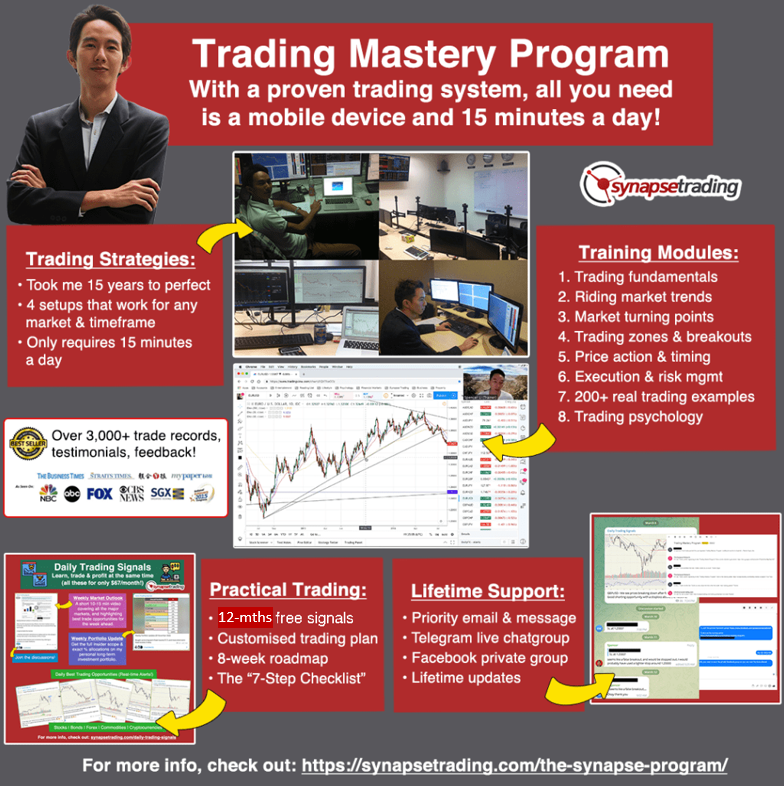 Our flagship mentoring program is suitable for both beginners and advanced traders, covering the 4 strategies which I used over the past 15 years to build up my 7-figure personal trading portfolio.
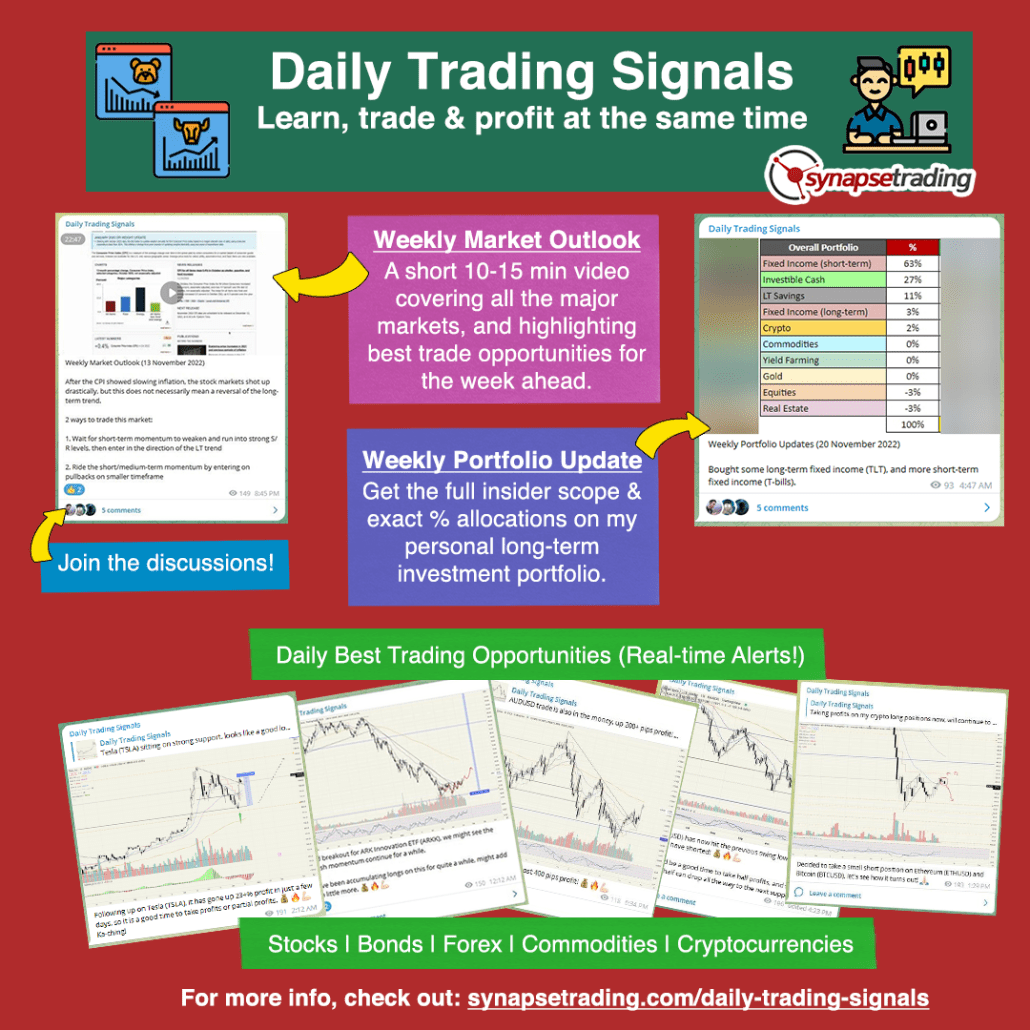 If you're looking for the best trading opportunities every day across various markets, and don't want to spend hours doing the research yourself, check out our private Telegram channel!









Leave a Reply
Want to join the discussion?Feel free to contribute!