

Best Trading Tips & Quotes from Alexander Elder

Join our Telegram channel for more market analysis & trading tips: t.me/synapsetrading
Alexander Elder’s Best Trading Tips: The 3 Ms and the Rules from “Trading for a Living”
Last updated: 3 July 2026 · By Spencer Li, CFTe
Alexander Elder’s best-known trading principle is the “3 Ms”: Mind, Method, and Money. Get all three right and you trade like a professional; ignore any one and you blow up. Mind is your psychology, both your own emotions and the mass psychology of the crowd. Method is your system for picking trades and your firm rules for when to buy and sell. Money is how you guard your capital so a losing streak cannot end your career. Elder, a psychiatrist turned trader and the author of the 1993 classic Trading for a Living, built his whole framework on one uncomfortable idea: the market is a minus-sum game, and most traders lose because of their own emotions, not because the analysis is too hard. His core rules are simple to state and hard to live: trade well, not often; cut losses without fuss; keep a trading diary; and never risk more than a planned “businessman’s risk” on any single trade.
Below are his sharpest tips, grouped by the 3 Ms, with the original quotes kept intact.
Who is Alexander Elder?
Alexander Elder, M.D., was born in Leningrad and grew up in Estonia, where he entered medical school at the age of 16. At 23, while working as a ship’s doctor, he jumped a Soviet ship in Africa and received political asylum in the US, where he worked as a psychiatrist. That background gave him a rare lens on the psychology of trading.
He is the author of Trading for a Living, considered a modern classic among traders. First published in 1993, the book has been translated into more than a dozen languages and is still used to teach traders around the world.
Personally, this is the book I point most beginners to first, because it fixes the thing that actually breaks accounts (the mind) rather than chasing the thing beginners think breaks accounts (the entry signal).
What are the 3 Ms in trading?
The 3 Ms are Elder’s three pillars of successful trading: Mind, Method, and Money. In his words: “Successful trading depends on the 3Ms: Mind, Method and Money. Beginners focus on analysis, but professionals operate in a three dimensional space. They are aware of trading psychology, their own feelings and the mass psychology of the markets.”
He also frames them as the three legs of a stool: “Every winner needs to master three essential components of trading: a sound individual psychology, a logical trading system and good money management. These essentials are like three legs of a stool. Remove one and the stool will fall, together with the person who sits on it.”
Here is how the three break down.
| Pillar | What it covers | Elder’s core rule |
|---|---|---|
| Mind (psychology) | Your own emotions plus the mass psychology of the crowd | “If you let the market make you feel high or low, you will lose money.” |
| Method (system) | How you choose trades and your firm rules for entry and exit | “It pays to write down your plan. You need to know exactly under what conditions you will enter and exit a trade.” |
| Money (risk) | How you protect your trading capital | “Watch your capital as carefully as a professional scuba diver watches his air supply.” |
Beginners obsess over Method, the entry signal. Elder’s point is that the other two legs are where careers are actually won or lost.
Mind: the psychology tips
Elder was a psychiatrist, so this is the leg he hammers hardest. The market does not punish bad analysis nearly as often as it punishes bad emotion.
- “The markets are unforgiving, and emotional trading always results in losses.”
- “Many traders ride an emotional roller coaster and miss the essential element of winning: the management of their emotions.”
- “If you let the market make you feel high or low, you will lose money.”
- “When a beginner wins he feels brilliant and invincible, then he takes wild risk and loses everything.”
- “The mental baggage from childhood can prevent you from succeeding in the markets. You have to identify your weaknesses and work to change. Keep a trading diary. Write down your reasons for entering and exiting every trade. Look for repetitive patterns of success and failure.”
Do note that the trading diary is the most actionable item on this whole list. It is the one tool that turns “I keep losing” into a specific, fixable pattern you can see on paper.
He is also blunt about gurus: “The public wants gurus, and new gurus will come. As an intelligent trader, you must realize that in the long run, no guru is going to make you rich. You have to work on that yourself.” I run a trading school, and I will say the same thing. A teacher can shorten your learning curve. Nobody can trade the account for you.
Method: the system tips
A system is necessary, but Elder is clear that a system alone is not enough. You still have to drive it.
- “There are good trading systems out there, but they have to be monitored and adjusted using individual judgment. You have to stay on the ball. You cannot abdicate responsibility for your success to a mechanical system.”
- “It is hard enough to know what the market is going to do; if you don’t know what you are going to do, the game is lost.”
- “Remember, your goal is to trade well, not to trade often.”
- “An astute trader aims to enter the market during quiet times and take profits during wild times.”
- “It is essential to wait for trades with a good risk / reward ratio. Patience is a virtue for a trader.”
- “Do not make decisions on the spur of the moment, when you are vulnerable to being sucked into the crowd. Plans are created by reasoning individuals. Impulsive trades are made by sweaty group members.”
That last line is my favourite in the whole collection. “Reasoning individuals” versus “sweaty group members” is the entire difference between a plan written the night before and a trade clicked in the heat of the open.
Money: the risk-management tips
This is the leg that keeps you in the game long enough for the other two to pay off.
- “To help ensure success, practice defensive money management. A good trader watches his capital as carefully as a professional scuba diver watches his air supply.”
- “The answer is to draw a line between a businessman’s risk and a loss. As traders, we always take businessman’s risks, but we may never take a loss greater than this predetermined risk.”
- “A loser’s true problem is not account size but overtrading and sloppy money management. He takes risks that are too big for his account size, however small or big. No matter how good his system may be, a streak of bad trades is sure to put him out of business.”
- “When the market deviates from your analysis, you have to cut losses without fuss or emotions.”
- “Use limit orders almost exclusively, except when placing stops. Be careful what tools you spend money on: there are no magic solutions. Success cannot be bought, only earned.”
A “businessman’s risk” (the small, pre-planned amount you accept on a trade as a normal cost of doing business) is the key idea here. You decide that number before you enter. Anything bigger than it is no longer a risk you chose. It is a loss that chose you.
Hence, Elder’s advice for a losing streak is the opposite of what most traders do: “Most private traders on a losing streak keep trying to trade their way out of a hole. The sensible thing to do would be to reduce your trading size and then stop and review your system.”
Why most traders lose, in Elder’s words
Elder does not soften this. He argues the market is structurally built to take money from the majority.
- “Markets need a fresh supply of losers just as builders of the ancient pyramids needed a fresh supply of slaves. Losers bring money into the markets.”
- “Why do most traders lose and wash out of the markets? Emotional and mindless trading are big reasons, but there is another. Markets are actually set up so that most traders must lose money. The trading industry slowly kills traders with commissions and slippage.”
- “Being simply better than average is not good enough. You have to be head and shoulders above the crowd to win a minus-sum game.”
That phrase, “minus-sum game,” is the one to remember. After costs, the average trader does not break even. The average trader loses slowly. To win you cannot be average; you have to be clearly better than the crowd you are trading against.
Where the human edge comes in
A mechanical system, or an AI, can now generate signals all day. That part is close to free. What it will not do is sit on its hands during a losing streak. How far to cut your size, the way Elder tells you to? No AI you can buy in Singapore is allowed to tell you that, and the ones that try were not built for you. It will not feel the emotional pull at the open and override it for you. It will not write your trading diary or read it back honestly. Elder said it forty years ago: a system “has to be monitored and adjusted using individual judgment.” The signal is the cheap part. Judgment, discipline, and the management of your own psychology are the part worth learning, and they are the edges no model trades for you.
FAQ
What are the 3 Ms of trading by Alexander Elder?
The 3 Ms are Mind, Method, and Money. Mind is trading psychology (your emotions and the crowd’s), Method is your system and your firm entry and exit rules, and Money is how you manage and protect your trading capital. Elder calls them the three legs of a stool: remove one and you fall.
What is Alexander Elder’s most famous book?
Trading for a Living, first published in 1993. It is considered a modern classic among traders and has been translated into more than a dozen languages.
What is a “businessman’s risk” in trading?
It is Elder’s term for the small, pre-planned amount you accept losing on a trade as a normal cost of doing business. The rule is that you may take a businessman’s risk, but you must never take a loss greater than that predetermined amount.
Why does Elder say most traders lose?
Two reasons. First, emotional and mindless trading. Second, structure: he argues markets are a minus-sum game where costs like commissions and slippage slowly drain the average trader, so being merely “better than average” is not enough to win.
What is the single most actionable Elder tip for a beginner?
Keep a trading diary. Write down your reasons for entering and exiting every trade, then look for repeating patterns of success and failure. It turns vague frustration into a specific, fixable problem.
Now that you have Elder’s rules grouped by the 3 Ms, which tip hits hardest for how you trade right now? Let me know in the comments.
And if you want more wisdom from the legends, read the companion roundup: Best Trading Tips and Quotes from Legendary Top Traders.
Want the system behind the discipline? Grab the free 15-Minute Swing Trading Starter Kit. It’s the exact routine I use to scan once a day and trade any market in 15 minutes, with the risk rules built in.
About the author. Spencer Li is the founder of Synapse Trading and a Certified Financial Technician (CFTe) with 15+ years of trading across stocks, forex, crypto, commodities, and bonds. His trade log is public: every trade since April 2024, dated, losses left in. He has taught a 15-minute daily trading routine since 2014, one system for any market.
Education, not financial advice. Synapse Trading is not licensed by MAS to advise on investment products. Trading carries risk of loss; past performance is not indicative of future results.
Related
The Trader’s Mindset: Mastering Trading Psychology (pillar) · Best Trading Tips and Quotes from Legendary Top Traders · Risk Management and Position Sizing · How to Keep a Trading Journal
Want the daily routine? Enter your email for the free 15-Minute Swing Trader's Checklist.
Free, 5 pages, PDF. You get the checklist, then my occasional trading emails. Education only, not financial advice. Unsubscribe anytime.
Where your details go: Kit, our email provider, stores your email address in the United States. Our contract with Kit lets it use your address only to send our emails, and requires Kit to keep it secure. The United States has no national privacy law like Singapore's, so that contract is the main protection. More in our privacy policy.
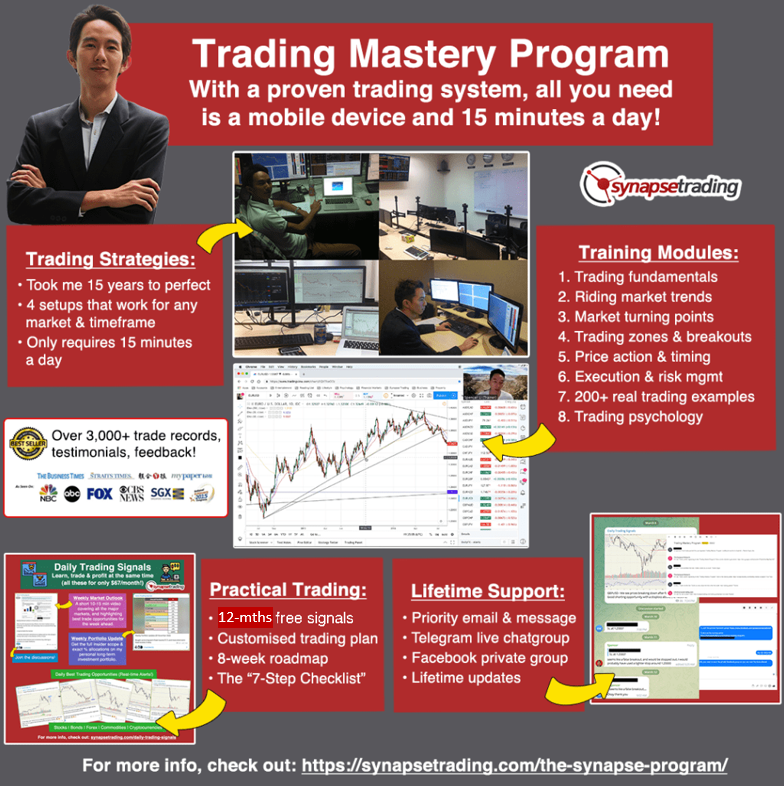 Our flagship mentoring program is suitable for both beginners and advanced traders, covering the 4 strategies which I used over the past 15 years to build up my 7-figure personal trading portfolio.
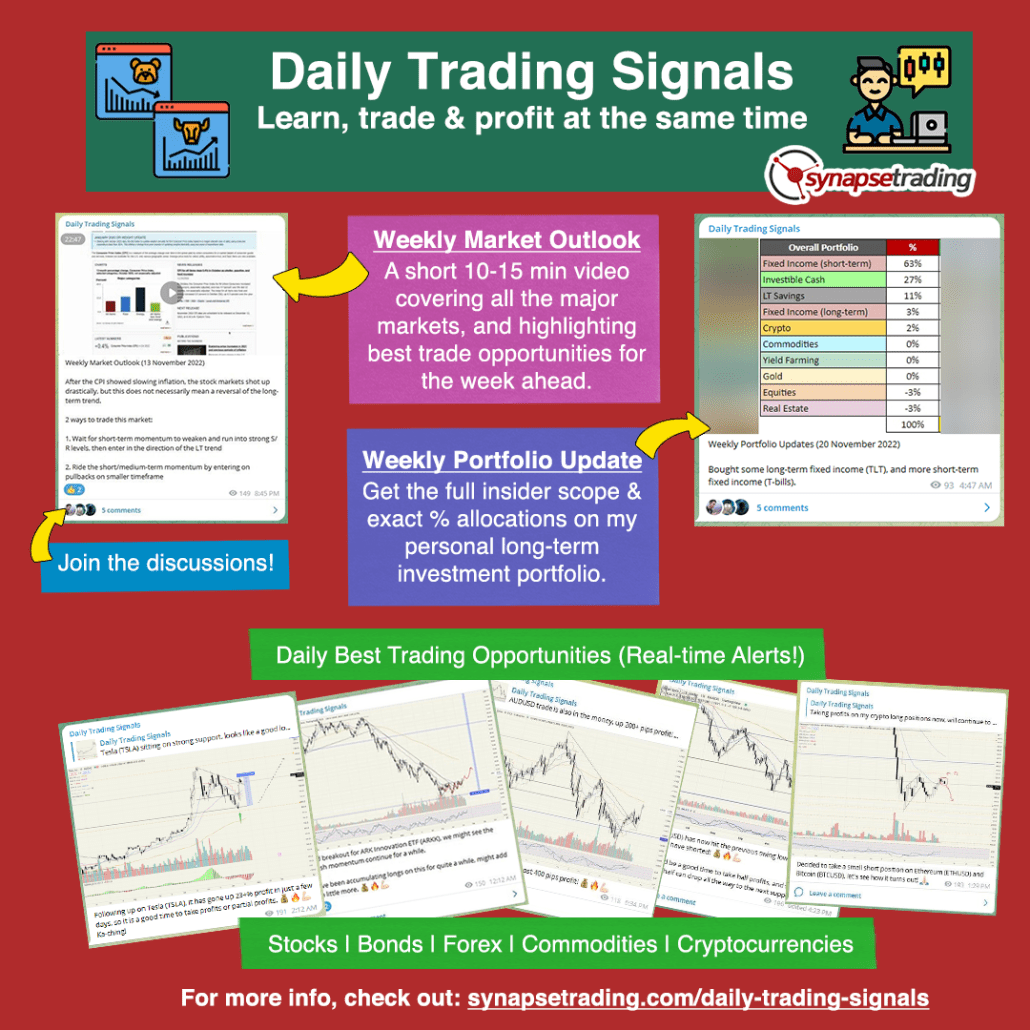 If you're looking for the best trading opportunities every day across various markets, and don't want to spend hours doing the research yourself, check out our private Telegram channel!








Leave a Reply
Want to join the discussion?Feel free to contribute!