

Best Online Trading Tips & Quotes from the Internet

Join our Telegram channel for more market analysis & trading tips: t.me/synapsetrading
Online Trading Tips: 30 Rules That Actually Move the Needle
Last updated: 3 July 2026 · By Spencer Li, CFTe
The best online trading tip, stripped of the noise, is this: protect your capital first and let your edge play out, because trading success is mostly defense, not offense. Almost every durable rule comes back to four things, risk management, position sizing, patience, and emotional control. Not predictions, not the perfect indicator, not a secret strategy. If you only remember one sentence, remember that the number one goal of a trader is not to make money, it is to trade well. Trade well and the money follows. Chase money directly and performance anxiety cripples you.
Below are the tips I have collected over many years from books, traders I respect, and my own trading, grouped so you can actually use them instead of scrolling past them. My advice has not changed: bookmark this page, read a couple of tips a day, and try putting them into practice. You will be pleasantly surprised at the compounding results.
What is the single most important trading rule?
Play great defense, not offense. The most important rule of trading is to manage risk, not to swing for big gains. Manage your risk well and the wins come in. If you manage your risk, your profits take care of themselves. If you don’t, your parents will take care of you.
Here is why this comes first. Everything in trading gets destroyed a hundred times faster than it is built. One wrong, oversized trade can wipe out profits that took years to compound. A small loss is part and parcel of trading. A large unplanned loss is what empties your account. So the elements of good trading are, in order: cut losses, cut losses, and cut losses. Follow those three and you have a chance.
Risk (the uncertain possibility of loss) is the one input you can fix in advance. You cannot control the market. You can only control yourself, your size, and your exit. So quantify the risk on every trade before you take it, manage it, and make sure you know what you are doing. Risk comes from not knowing what you are doing.
The tips that matter most, grouped
| Theme | The rule in one line | Why it works |
|---|---|---|
| Risk management | Never lose more than ~2% of capital on one trade | Eliminates the big loss (#5 of 5 outcomes), which is the only outcome that ruins you |
| Position sizing | Risk small, let the edge play out, then add | High risk for high returns is a myth; you compound by staying alive |
| Cut losses | Cut losses fast, never average down a loser | A small quick loss is the cheapest loss there is |
| Ride winners | Let winners run; taking small profits is the surest road to loss | A few large wins pay for many small losses |
| Patience | When there is no good trade, stay out and wait | Most errors come from a compulsion to “do something” |
| Trend | In a bull market, be long; follow the line of least resistance | The trend is your friend until it bends |
| Psychology | Trade what you SEE, not what you THINK | The market does not know or care what you think |
| Process over outcome | Goal is to trade well, not to be right | Outcome of any single trade is close to random |
| Discipline | Trust your rules over your feelings | Feelings change; rules are fixed, and that gives you consistency |
| Independence | The crowd is usually wrong at extremes | Independent thinking and action is what makes great traders |
Now the detail behind each cluster.
How do I manage risk and size positions?
This is the engine room. Profitable trading is mostly math: risk and reward ratios, position sizing, drawdowns, win rate, losing-streak probabilities, risk of ruin, stop losses, and profit targets. It is all math.
A few rules I live by here:
- Always set the stop before you enter, not after. Decide where the idea is wrong before you have money on the line, while you are still objective. I set protective stops the moment I enter, then trail them to lock in profit as the trend continues.
- Never risk more than ~2% of capital on a single trade. Losses are roughly twice as expensive to make up, so keeping each one small is what keeps you in the game.
- Risk small, then add to what is working. Many traders believe high risk is the price of high returns. Wrong. You risk small, let the edge play out, add capital to winners, and compound over time. That is how it gets big.
- Decrease size when trading poorly, increase when trading well. Good risk managers do this and grow steadily. Gamblers do the opposite, going bigger to “win it back,” and they blow up.
- If a trade makes you nervous, you are too big. If you enter and immediately drop to lower timeframes, pray to get to breakeven, or feel sick, reduce the percentage of equity risked, chill, and let the setup unfold.
There are only five outcomes for any trade: breakeven, small win, small loss, big win, big loss. Eliminate the big loss and you have taken the single biggest step toward being profitable for years.
How do I handle losses without blowing up?
Accept them before they happen. Before you take any trade, accept in your heart that there will be losses, so that when the time comes you can cut them without drama. Watching your stop get hit and then seeing price rally hurts. Not having a stop and watching price keep falling hurts far more. A wise trader always has stops in place.
The hard rule: never, ever, under any condition, add to a losing trade or average into a position. If you are buying, each new entry should be higher than the last. If selling, lower. Average losses and one bad trade becomes the mother of all losses. If you cannot take a small loss, sooner or later you take the catastrophic one.
When you take sharp losses, step away. Close trades and stop for several days. After a quick, painful loss the mind plays games, and the urge to “get the money back” is dangerous. It is not the money lost that matters most, it is the mental capital burned sitting in a losing position. Losing a position is aggravating; losing your nerve is devastating.
How do I think about trends and entries?
Follow the line of least resistance, and do not swim against the current. The first and most important rule is simple: in bull markets, be long. It sounds obvious, yet almost every trader has sold the first rally saying the market moved too far, too fast.
A few entry principles:
- Wait for the market to confirm your opinion. Do not act until price itself confirms the idea. Being a little late is the insurance premium that proves your opinion was right. Don’t be an impatient trader.
- You do not need insider information or a special edge to ride a trend. When a trend begins, it tends to continue. You just need to find a low-risk entry, hop on, and manage expectations.
- Buy strength, sell weakness. The survival rule is not “buy low, sell high,” it is “buy higher and sell higher.” The public buys because prices fell; the professional buys because prices rallied.
- Match your tactic to the market type. Follow strength in a trend (buy uptrends, short downtrends). In a trading range, do the opposite (buy weakness, sell strength). Most traders forget a market can be trending on one timeframe and ranging on another at the same time, so when a trend is unclear, step up one timeframe for a clearer picture.
There are seven legitimate ways to exit a trade, and knowing them beats hoping: trailing stops, support and resistance, Fibonacci extensions, swing high or low, the setup being invalidated, the previous candle’s high or low, and, the one nobody wants, a margin call.
How important is psychology and discipline in trading?
More important than the strategy. Perhaps the biggest mistake I made early was believing trading was all about finding the right strategy. In reality, trading is mostly about becoming the right person.
The recurring theme across every great trader is the same short list: risk management, position sizing, and mental capital. Lose the ego and make money. The market does not know or care what you think, and no matter how smart you think you are, the market is always smarter. Your ego can cost you a lot of money.
Some discipline rules worth taping to your screen:
- When rules and feelings conflict, go with the rules. Feelings are always changing; rules are fixed and concrete, and that is what gives you consistency.
- Discipline is a way of life, not a trading mode. If you are not disciplined in your life, you will not magically become disciplined in trading. It is the habit of doing what is necessary over what is easy.
- Trade what you SEE, not what you THINK. The biggest problem in charting is wishful thinking, convincing yourself a pattern is bullish or bearish based on whether you want to buy or sell. A good chartist stays mentally neutral.
- Process over outcome. Do not attach too much importance to any single trade. Regularly review your last 20, 50, or 100 trades instead. Good trading is not about being right, it is about trading right.
One reality that never fails: when a trader is really right, the position is always too small, and when really wrong, it is always too large. That asymmetry is psychology, not math, which is why the inner work pays.
How do I avoid overtrading?
Wait like a cheetah. The fastest animal on the plains will still hide in the bush for days and attack only when the odds are overwhelming. Trade like that. Most trading errors come from impatience and the compulsion to do something when nothing is needed.
A simple cheat sheet I use to avoid overtrading:
- If you could only take 10 trades this year, would this be one of them?
- If you took this exact setup 100 times, are you confident you would make money overall?
Not having a position is also a position. There is no prize for trading every level on the chart. Pick the spots where you earn big when right and lose small when wrong. The result is less trading, fewer commissions, fewer mistakes, and a fatter bottom line. And if you miss one, so be it. There will always be more opportunities. Missing a trade you didn’t want to compromise on is not “missing,” it is sticking to the plan.
The human edge that a scanner cannot copy
A scanner, or an AI, will flag a clean setup for you in a second, and that part is now basically free. What it will not do is tell you to stay out of the middle of a messy market, or sit on your hands through three fake breakouts waiting for the real one. How far to size down when a pattern is volatile? No AI you can buy in Singapore is allowed to tell you that, and the ones that try were not built for you. The list above is the easy part to read and the hard part to live. Knowing which trade the moment actually offers, and skipping the rest, is judgment. That is the first of the Five Edges an algorithm cannot trade for you, and it is the part worth a lifetime of practice.
So pick one tip. Start by following one trader, reading one blog post, looking at one chart, cutting one loss, letting one winner run. Start today, repeat tomorrow.
FAQ
What is the best trading tip for beginners?
Risk small and protect your capital before anything else. Never lose more than about 2% of your account on a single trade, always set a stop before you enter, and never average down a loser. Beginners blow up not from bad picks but from oversized positions and losses they refuse to cut.
What is the most important rule in trading?
Manage risk, which means playing defense over offense. The trader’s number one goal is to trade well, not to make money. Trade well, with controlled risk and consistent rules, and the profits follow.
How do I stop overtrading?
Wait for high-quality setups and treat doing nothing as a valid position. Before each trade, ask: if I could only take 10 trades this year, would this be one of them? That single question filters out most of the impulsive trades that erode an account.
Should I add to a losing trade to lower my average?
No. Never average down a loser. Each new buy should be at a higher price than the last, each new short at a lower price. Averaging losses is the fastest way to turn a small, manageable loss into an account-ending one.
Does psychology really matter more than strategy?
For most traders, yes. Consistently profitable traders are not better at predicting price; they deal with uncertainty in a methodical, repeatable way. Trading is mostly about becoming the right person, which is why discipline and emotional control outrank any single indicator.
Now that you have the tips grouped by what they are actually for, which one is your favourite? Let me know in the comments.
And if you want the full system these tips plug into, read the pillar: The Trading Rules Every Professional Trader Lives By. For more wisdom from the names behind these quotes, see Best Trading Tips and Quotes from Legendary Top Traders.
Want the system behind the tips? Grab the free 15-Minute Swing Trading Starter Kit. It is the exact routine I use to scan once a day and trade any market in 15 minutes.
About the author. Spencer Li is the founder of Synapse Trading and a Certified Financial Technician (CFTe) with 15+ years of trading across stocks, forex, crypto, commodities, and bonds. His trade log is public: every trade since April 2024, dated, losses left in. He has taught a 15-minute daily trading routine since 2014, one system for any market.
Education, not financial advice. Synapse Trading is not licensed by MAS to advise on investment products. Trading carries risk of loss; past performance is not indicative of future results.
Related
The Trading Rules Every Professional Trader Lives By (pillar) · Best Trading Tips and Quotes from Legendary Top Traders · Patience and discipline in trading · Trade like a casino, not a gambler · The cheetah and the trader
Want the daily routine? Enter your email for the free 15-Minute Swing Trader's Checklist.
Free, 5 pages, PDF. You get the checklist, then my occasional trading emails. Education only, not financial advice. Unsubscribe anytime.
Where your details go: Kit, our email provider, stores your email address in the United States. Our contract with Kit lets it use your address only to send our emails, and requires Kit to keep it secure. The United States has no national privacy law like Singapore's, so that contract is the main protection. More in our privacy policy.
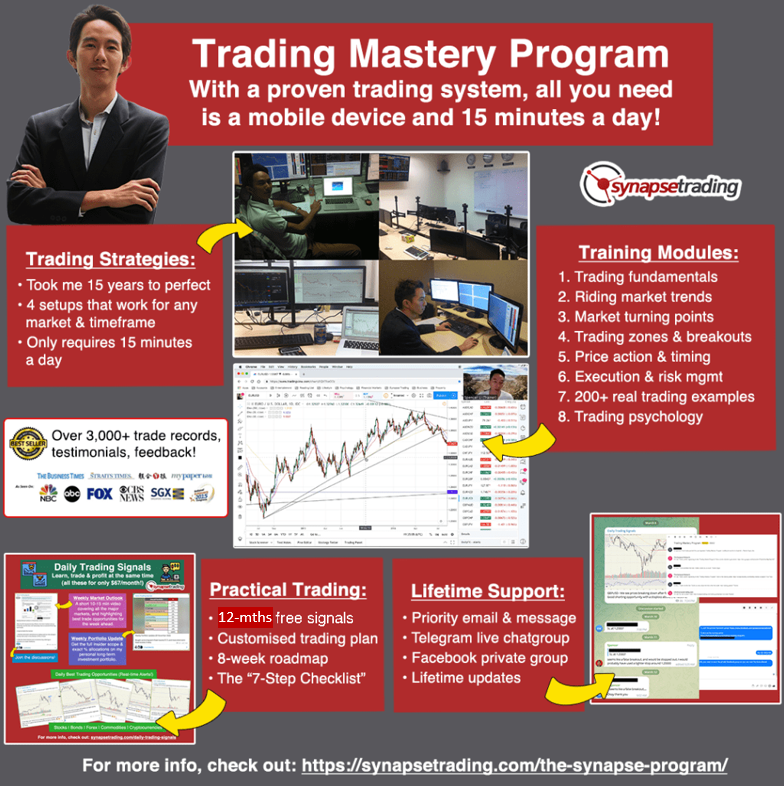 Our flagship mentoring program is suitable for both beginners and advanced traders, covering the 4 strategies which I used over the past 15 years to build up my 7-figure personal trading portfolio.
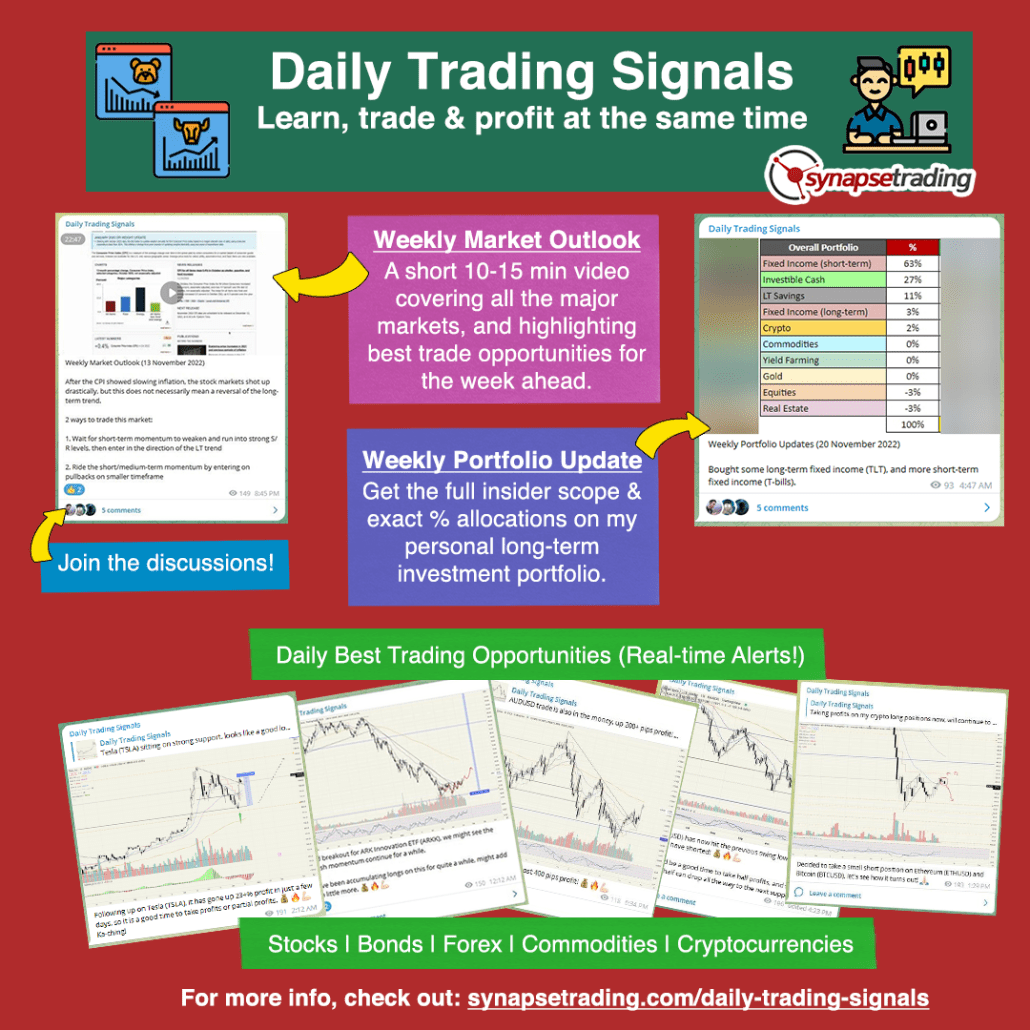 If you're looking for the best trading opportunities every day across various markets, and don't want to spend hours doing the research yourself, check out our private Telegram channel!








Leave a Reply
Want to join the discussion?Feel free to contribute!