• Link to Facebook
  • Link to X
  • Link to Instagram
  • Link to Youtube
  • Link to LinkedIn
  • Link to Mail
Synapse Trading
  • Home
  • About
    • My Background
    • My Trading Journey
    • My Travel Log
    • Media & Interviews
  • Mentoring
    • Trading Mastery Program
    • Results & Testimonials
  • Signals
    • Telegram (Free to join!)
    • Daily Trading Signals
    • Daily Trading Signals (Results)
  • Resources
    • Free Trading Guides
    • Tools & Resources
    • Blog & Infographics
  • Contact
    • Contact Us
    • Partnership Opportunities
  • Click to open the search input field Click to open the search input field Search
  • Menu Menu

What is life like after financial freedom? How can one live a fulfilling life?

Spencer Li

Personal Review of 2023 & Plans for 2024

Living Your Best Life

sri lanka worlds end

As the sun sets on 2023, I find myself at a poignant crossroads, nearing midlife, where the urge for drastic changes gives way to a deeper appreciation for the gifts I already possess.

In the words of Socrates, “The secret of change is to focus all of your energy not on fighting the old, but on building the new.”

This year has been a testament to that philosophy – a journey of intentional living and mindful growth.

Celebrating Health and New Goals

This year, my most significant triumph was in the realm of health. I achieved a long-awaited goal of increasing my weight (muscle mass) from 59kg to 65kg.

This milestone wasn’t just about numbers; it was a commitment to myself, upheld by visiting the gym thrice a week for six months and consuming 3000-4000 calories daily.

As Marcus Aurelius once said, “The impediment to action advances action. What stands in the way becomes the way.”

My journey in 2023 was a physical embodiment of this wisdom.

For 2024, my plan is to maintain this weight and pivot my focus towards enhancing flexibility, mobility, and core strength.

Physical health is not a destination but a continuous journey, and I am excited to explore the realms of tennis, Calisthenics, and perhaps even martial arts.

Expanding Horizons and Nourishing the Soul

This year, I ventured into Parkour, Pilates, and Yoga, each teaching me the art of balance, strength, and inner peace.

In 2024, I aspire to delve deeper into culinary arts, marrying the joy of cooking with the essence of eating healthily.

Meditation, currently a 10-15 minute daily practice, has become a cornerstone of my tranquility. Next year, I hope to attend a meditation retreat, deepening this practice and enhancing my spiritual wellbeing.

Cultivating Relationships and Personal Growth

In 2023, I focused on nurturing relationships – spending precious moments with friends and family, and strengthening bonds with my partner.

I read extensively on topics like gratitude, care, and relationship dynamics, constantly learning to be a better companion.

On the self-development front, over 50 hours were dedicated to studying MBTI (cognitive stacks) and Enneagram, which is useful for understanding cognitive processing, communication, and core motivations and fears which drive behaviors.

I plan to spend 2024 deep-diving more into psychology, philosophy, sociology and if time permits, topics like art, history, politics, etc. This better helps me understand myself and the people around me.

Financial Stability and Community Growth

With my finances securely on autopilot, and with more than enough resources to live the rest of my life, 2023 was less about financial growth and more about managing my portfolio for consistent returns.

My goal was not to spend a crazy amount of time trading or tracking the markets, instead it was to generate 5-10% returns a month consistently with minimal time and effort by using proven setups and systems (15 minutes a day).

This stability allowed me to focus on “Synapse Trading”, supporting my growing community through the “Trading Mastery Program” and the “Daily Trading Signals”.

In 2024, I aim to continue delivering value and guiding others in the upcoming crypto bull market, to help everyone in my community attain financial freedom as soon as possible.

Wanderlust and the Joy of Travel

Travel remains an unquenchable passion, and a big part of my life. My dream is to eventually visit every country in the world (the safe ones), and I am only half way there having visited 70+ countries.

In the coming year, I plan to spend two months exploring new destinations and revisiting cherished ones, embracing the beauty and diversity of our world.

Personal Musings for 2024

  1. How can we continue to grow and evolve while remaining grounded in gratitude for our current blessings?
  2. In what ways can the pursuit of physical health and mindfulness positively impact our relationships and personal development?
  3. How can we balance the pursuit of personal goals with the commitment to uplift and support our community?

As I look forward to 2024, I am reminded of a quote by Henry David Thoreau, “Go confidently in the direction of your dreams. Live the life you have imagined.”

With a heart full of gratitude, I step into the new year with a commitment to live intentionally, love deeply, and explore uncharted territories of self-growth and community contribution.

And as I embrace the new year, I carry with me the lessons of the past and the hope for a future filled with purpose, connection, and joy.

Let’s make 2024 a year of meaningful pursuits and heartfelt connections!


thumbnail an unofficial guide to living our best life beyond financial freedom

If you are excited to get more life hacks, also check out: “Beyond Financial Freedom: An Unofficial Guide to Living Your Best Life”

0 Comments/by Spencer Li
https://synapsetrading.com/wp-content/uploads/2019/10/logo.jpg 0 0 Spencer Li https://synapsetrading.com/wp-content/uploads/2019/10/logo.jpg Spencer Li2023-12-31 14:43:312023-12-31 15:11:11Personal Review of 2023 & Plans for 2024
Spencer Li

Birthday Reflections Upon Turning 37

Living Your Best Life
2023 07 10 18 47 51 1

As I greet another year of life, I find it fitting to reserve this day for introspection, gratitude, and projection. This ritual of quiet contemplation serves not just as a moment of pause, but also as an opportunity for recalibration.

In no particular order, here are my areas of focus for the coming years, each one a beacon to guide my journey:

The idea of embracing new experiences, like an artist exploring different mediums, resonates deeply with me. Whether it’s mastering the culinary artistry of cooking, learning a new sport like surfing, losing myself in the rhythm of Salsa (hopefully some day), discovering the nuanced layers of fine wine, or dabbling in traditional and contemporary art forms, these pursuits represent the unquenchable thirst for knowledge that I hold dear.

The desire to nurture my relationships, to tend to the garden of friendship, has never been stronger. In the years to come, I intend to invest not just my time, but my attention, care, and love, into these vital connections. The richness of human connection is not in the number of friends and family we have but in the depth and authenticity of the bonds we cultivate.

In the realm of romantic relationships, I stand at the precipice of hope and commitment. I am learning, growing, and striving to be a better partner every day. It’s a journey of understanding, patience, and unending love that is as much about self-discovery as it is about discovering another soul. In the coming years, I aspire not just to find that extraordinary love but to build and nurture it with all the care and tenderness it deserves.

My journey towards personal growth includes a commitment to understanding the intricacies of the human mind. Diving into realms of psychology, philosophy, and cognitive mental models promises to unlock doors to self-awareness, thereby empowering me to navigate life’s maze with more wisdom and compassion.

A commitment to health, both physical and mental, remains a cornerstone of my life’s priorities. Regular exercise, mindful eating, and mental wellness practices are not mere activities, but a pact with myself to cherish and respect the gift of life.

My aspiration to traverse the globe remains unwavering, with the ambitious goal of experiencing 100 countries before I turn 40. Each journey represents a unique opportunity to broaden my horizons, to learn, to grow, and to create memories that will last a lifetime.

As I progress on this journey, I aim to espouse the principles of minimalism further. It is not about denying oneself but about channeling one’s focus, attention, and resources to what truly matters, to what brings joy, peace, and fulfillment.

Mindfulness, empathy, gratitude, and self-esteem are the pillars of my quest for personal growth. My ambition is to evolve continually, to be better at showing love, extending kindness, and celebrating the abundance of life.

My passion for enlightening and inspiring others through my writing, through sharing my thoughts, experiences, and learnings, is a flame that burns brighter each day. In the upcoming years, I plan to enrich my blog and various channels with more diverse and meaningful content.

Lastly, I will continue to seek avenues that allow me to make a positive impact in others’ lives. Whether through my career, volunteer work, or in the simple, everyday acts of kindness, I want my existence to resonate with purpose.

As I conclude this reflection, I extend my deepest gratitude to all those who have stood by me, supported me, and contributed to making my 37th birthday unforgettable. I look forward to the upcoming years with eagerness and optimism, ready to embrace all that life has in store.


View this post on Instagram


A post shared by Spencer Li (@iamrecneps)


thumbnail an unofficial guide to living our best life beyond financial freedom

If you are excited to get more life hacks, also check out: “Beyond Financial Freedom: An Unofficial Guide to Living Your Best Life”

0 Comments/by Spencer Li
https://synapsetrading.com/wp-content/uploads/2023/07/2023-07-10-18.47.51-1-scaled.jpg 1920 2560 Spencer Li https://synapsetrading.com/wp-content/uploads/2019/10/logo.jpg Spencer Li2023-07-15 23:42:592023-07-15 23:46:14Birthday Reflections Upon Turning 37
Spencer Li

What is Epicureanism? (11 Practical Ways to Apply it in Your Life!)

Living Your Best Life
Thumbnail What is Epicureanism

What Is Epicureanism, and How Do You Apply It in Daily Life?

Last updated: 3 July 2026 · By Spencer Li, CFTe


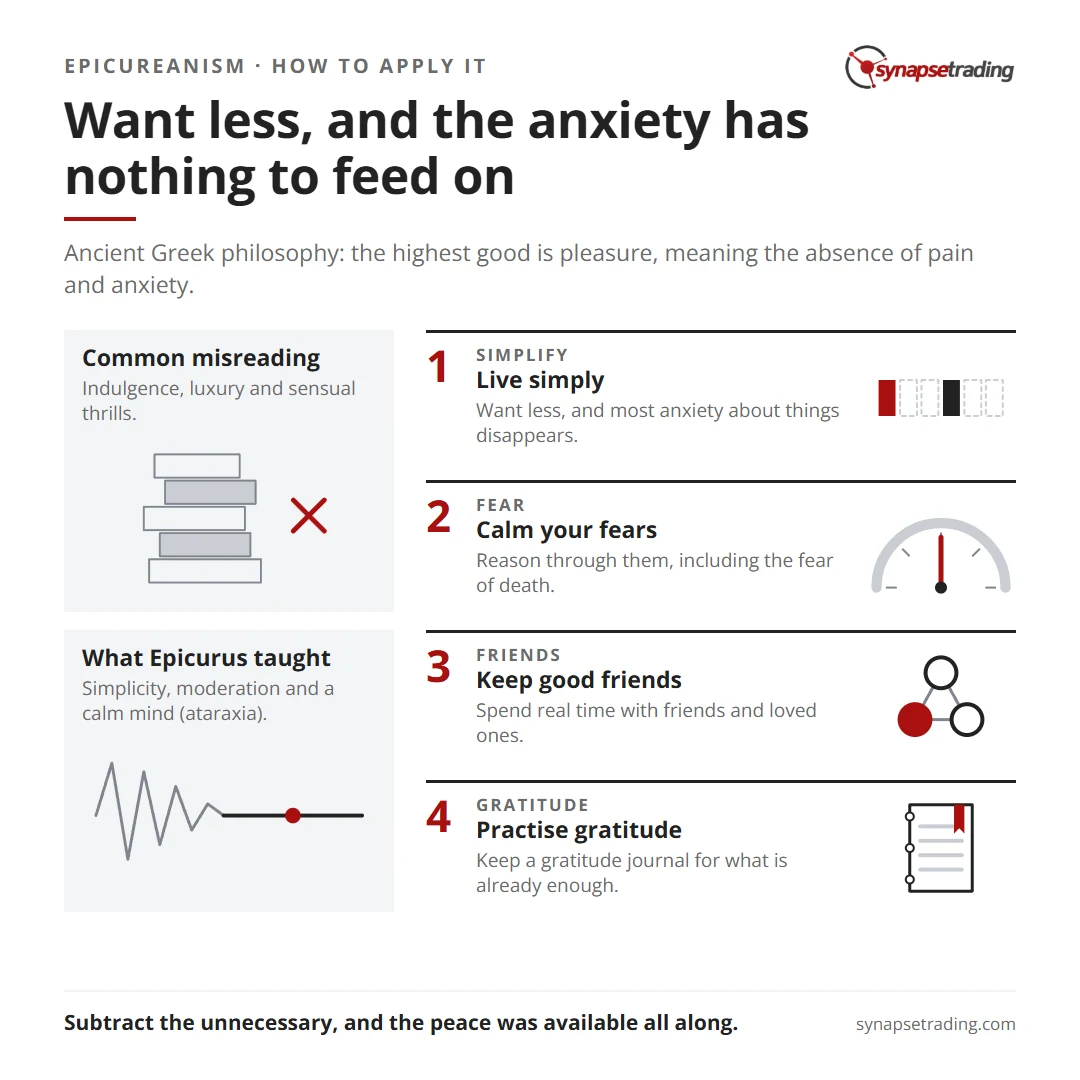
Epicureanism is an ancient Greek philosophy, founded by Epicurus in the 4th century BCE, that treats pleasure as the highest good but defines pleasure as the absence of pain and anxiety, not the chase for luxury. The goal is a calm, stable contentment the Greeks called ataraxia (a state of inner peace and freedom from disturbance). You reach it not by acquiring more, but by wanting less: living simply, keeping good friends close, calming your fears (especially the fear of death), and being grateful for what is already enough. To apply it day to day, you trim unnecessary desires, invest in friendship, take care of body and mind, and practise being content in the present. It is, in short, the opposite of the modern “more is better” treadmill.

So no, Epicureanism is not about indulgence, even though the word “epicure” now means a lover of fine food. Epicurus himself lived on bread, water, and the occasional pot of cheese. Let me explain what he actually taught, and how you can use it.
What is Epicureanism?

Epicureanism is the philosophy that the point of life is to pursue pleasure and avoid pain, but with a careful definition of what pleasure means. For Epicurus, the highest pleasure is not a thrill or a feast. It is ataraxia: a steady, untroubled peace of mind.

The path to it has a few clear pillars:

  • Live simply. Want less, and most of your anxiety about getting and keeping things disappears.
  • Calm your fears. Especially the big two, the fear of the gods and the fear of death, which Epicurus argued are both unfounded.
  • Keep good friends. Epicurus rated friendship above almost everything else for a happy life.
  • Use reason. Understand how the world actually works, and irrational dread loses its grip.

Personally, I find the core move underrated. Epicurus did not say “get more so you feel less anxious.” He said “want less, and the anxiety has nothing to feed on.” That is a different operating system from the one most of us run.

Where did Epicureanism come from?

Epicureanism was founded by Epicurus, born on the island of Samos and later settled in Athens, where he set up a school in a garden on the edge of the city. The school took its nickname from the place: “The Garden.”

He built on two earlier ideas. From Democritus he took atomism, the view that everything is made of tiny, indestructible particles (atoms) moving through empty space, and that natural events can be explained by those atoms rather than by the whims of gods. From the Cyrenaics he took the idea that pleasure is the goal of life, then corrected it: true pleasure, he argued, is found in inner peace, not in sensual indulgence.

The Garden was unusual for its time. It welcomed women and even enslaved people as students, which was rare. Epicurean communities, also called Gardens, spread across the Greek and Roman world, and the philosophy stayed influential well into the Roman period.

What does Epicureanism actually teach? (the common misreadings)

The biggest trap with Epicureanism is the modern word “epicurean,” which suggests a person devoted to luxury and rich food. That is almost the reverse of what Epicurus meant. Here is the gap between the popular version and the original, side by side.

Common misreadingWhat Epicurus actually taught
Chase as much pleasure as possibleChase the absence of pain and anxiety (ataraxia); a calm mind beats an excited one
Indulgence and luxurySimplicity and moderation; bread and water, friends, a quiet life
Pleasure means sensual thrillsThe highest pleasure is mental tranquillity, not bodily excitement
Fear death and the afterlifeDeath is nothing to us; while we exist it is not here, and when it comes we do not
More possessions equal more happinessMost desires are unnecessary; contentment comes from wanting less
Friends are optionalFriendship is one of the surest sources of a happy life

Do note that, this is why classifying Epicurus as a hedonist is misleading. He was a hedonist only in the technical sense that pleasure is the goal. In practice, his prescription looks closer to a minimalist monk than a party host.

What are the benefits of Epicureanism?

Adopting Epicurean principles tends to deliver a handful of practical benefits:

  • A simpler, calmer life. Cutting back on excess removes a large source of stress and craving.
  • Inner peace (ataraxia). Wisdom and self-control, applied steadily, produce a stable contentment that does not depend on the next acquisition.
  • Stronger relationships. Treating friendship as essential, not optional, builds a support network that carries you through hard times.
  • Less fear. Reasoning through your fears, including the fear of death, removes a lot of background dread.
  • Clearer thinking. Reason and logic, applied to your own life, replace superstition and panic with understanding.
  • A more ethical life. Living virtuously, with kindness and fairness, is treated not as a chore but as part of the good life.

How do you apply Epicureanism in daily life?

You apply Epicureanism by deliberately wanting less, investing in people, calming your fears, and practising contentment in the present. Here are the practical moves, drawn straight from the philosophy.

Live simply and moderately. Avoid excess. Focus on the essentials. A simple daily habit: set aside a few minutes for reflection, and practise gratitude for what you already have.

Invest in friendship and community. Spend real time with friends and loved ones. Build a supportive circle around you, whether through a club, a shared interest, or community work.

Practise self-control and wisdom. Use a daily practice, meditation or quiet study, to strengthen self-control and keep learning about the world and yourself.

Mind your thoughts and emotions. Journaling and mindfulness help you notice negative thought patterns and replace them with steadier ones.

Live virtuously. Kindness and fairness are part of the package. Small, repeated acts (helping someone, volunteering, watching how your actions land on others) compound.

Cultivate gratitude. Keep a gratitude journal, thank the people who matter, and take time to appreciate the everyday and the natural world.

Protect body and mind. Exercise, eat well, sleep enough, and seek help when you are struggling. Epicurus put avoidance of pain at the centre, and your health is the foundation of that.

Find balance. Pursue pleasures, but do not become a slave to any one of them. Set limits, and keep variety in your life.

Be content with what you have. Set realistic expectations, and notice what actually brings you contentment rather than what you are told should.

Live in the present. Stop replaying the past and pre-living the future. Focus on the task in front of you and the moment you are in.

Aim at ataraxia. The thread through all of the above is inner peace. Understand your place in the world, control your desires, and the calm follows.

Hence, the practical heart of Epicureanism is not a single dramatic change. It is a steady trimming of what you crave, paired with a steady investment in what reliably makes life good.

Who are famous examples of Epicureans?

Several historical figures lived by, or were shaped by, Epicurean ideas. Do note that, some applied the principles loosely rather than strictly, filtered through their own time and beliefs.

  • Lucretius: Roman poet and philosopher, and the great popularizer of Epicureanism in Rome. His poem De Rerum Natura (On the Nature of Things) lays out the whole system. He urged people to focus on the present and to stop fearing death, which he saw as a natural part of the cycle of life.
  • Horace: Roman poet and a contemporary of Lucretius, who wrote often about Epicurean themes. His refrain was to live simply, avoid excess, focus on the essentials, and be content with what you have.
  • Epictetus: A Greek Stoic philosopher who began life enslaved. Primarily a Stoic, he shared the Epicurean stress on controlling your desires and accepting what you cannot change, and on building inner strength rather than chasing possessions.
  • Seneca: Roman philosopher, statesman, and playwright. Also primarily a Stoic, he drew on Epicurus too, quoting him approvingly on living virtuously, simply, and free from fear.

Concluding thoughts

Epicureanism offers a different answer to the question of how to live well. Instead of chasing fleeting pleasures and possessions, it asks you to focus on the essentials, live simply, keep good friends, calm your fears, and find contentment in the present.

I think its central insight holds up remarkably well after two thousand years. We spend a lot of energy trying to add things to our lives to feel at peace. Epicurus quietly suggests the opposite: subtract the unnecessary, and the peace was available all along.

Now that you have the gist of what Epicureanism is and how to apply it, do you think it is a philosophy you would want to adopt? And if you already live by some of it, what other practical ways have you put it to work? Let me know in the comments.

FAQ

Is Epicureanism about indulgence and luxury?
No. The modern word “epicure” suggests a lover of luxury, but Epicurus taught simplicity and moderation. He defined pleasure as the absence of pain and anxiety (ataraxia), and lived on bread, water, and the company of friends.

What is ataraxia?
Ataraxia is the Epicurean goal: a state of inner peace and freedom from disturbance. You reach it through wisdom, self-control, simple living, and by calming your fears rather than feeding your desires.

Is Epicureanism the same as Stoicism?
No, but they overlap. Both prize self-control, reason, and freedom from fear. Stoicism centres on virtue and accepting what you cannot change; Epicureanism centres on pleasure (defined as tranquillity) and on simplicity and friendship.

What did Epicurus say about death?
Epicurus argued that death is “nothing to us”: while we are alive, death is not present, and once death comes, we no longer exist to experience it. The point was to remove the fear of death as a source of anxiety.

How do I start applying Epicureanism today?
Start small. Trim one or two unnecessary wants, invest real time in a friendship, take care of your sleep and health, and spend a few minutes each day on gratitude and reflection. The philosophy is built from steady habits, not grand gestures.


If you enjoy this kind of life philosophy, you may also like my longer piece, Beyond Financial Freedom: An Unofficial Guide to Living Your Best Life.


About the author. Spencer Li is the founder of Synapse Trading and a Certified Financial Technician (CFTe) with 15 years of trading across stocks, forex, crypto, commodities, and bonds. He writes on markets, psychology, and the occasional question of how to live well. His trade log is public, 404 trades, losses left in. He teaches low-risk swing trading in 15 minutes a day, one system for any market.

Reflective essay, not financial or psychological advice.


Related

Beyond Financial Freedom: An Unofficial Guide to Living Your Best Life · Stoicism for traders and everyday life · How to find meaning and live your best life

0 Comments/by Spencer Li
https://synapsetrading.com/wp-content/uploads/2023/01/Thumbnail-What-is-Epicureanism.png 720 1280 Spencer Li https://synapsetrading.com/wp-content/uploads/2019/10/logo.jpg Spencer Li2023-01-17 08:22:482026-07-06 01:52:10What is Epicureanism? (11 Practical Ways to Apply it in Your Life!)
Spencer Li

What is Existentialism? (12 Practical Ways to Apply it in Your Life!)

Living Your Best Life
Thumbnail What is Existentialism

Existentialism in Everyday Life: What It Is and How to Apply It

Last updated: 3 July 2026 · By Spencer Li, CFTe


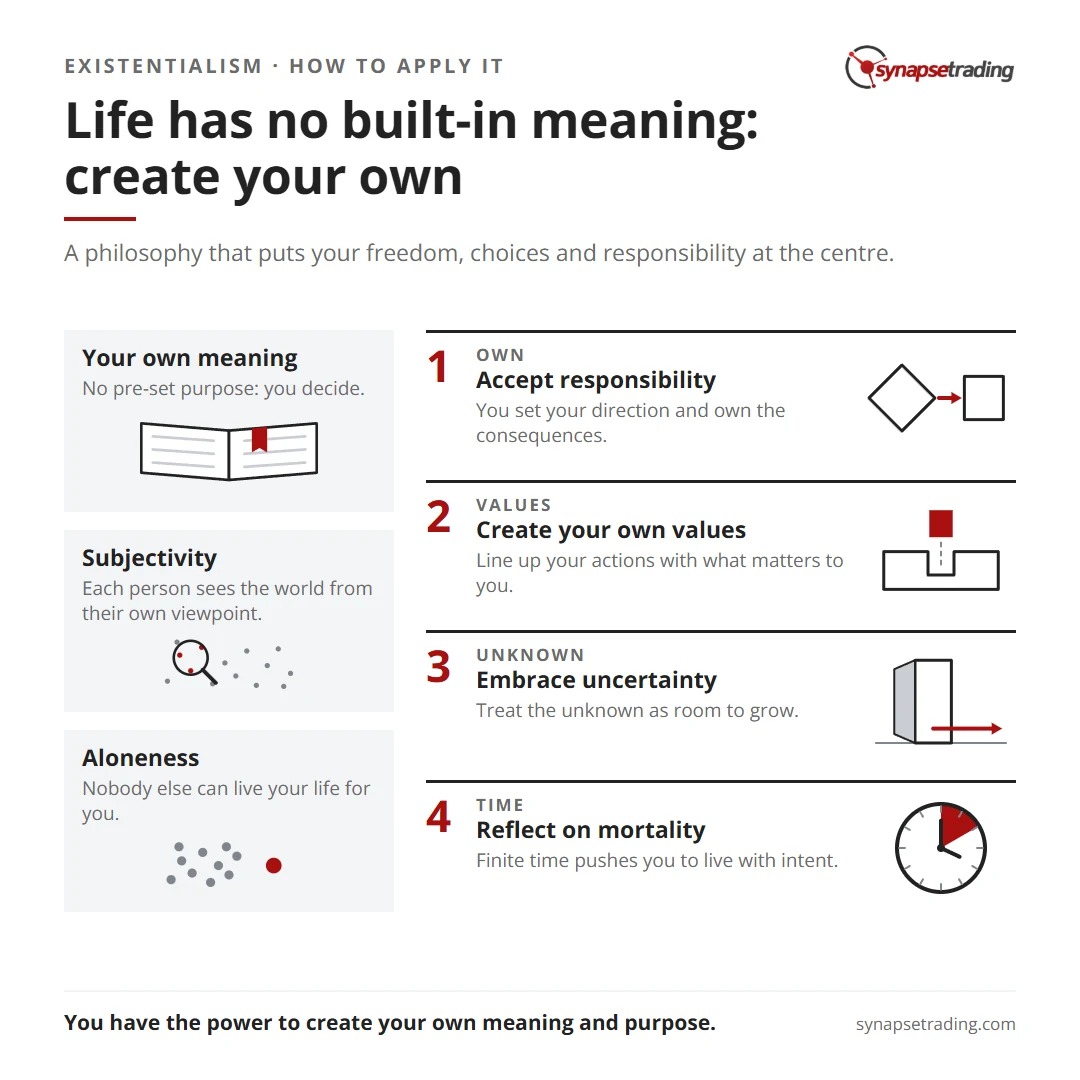
Existentialism is the idea that life has no built-in meaning, so each person is free, and responsible, to create their own. There is no purpose handed down by a higher power or a fixed external order. That sounds bleak at first. In practice it is the opposite. If nobody assigns your meaning, then nobody can take it from you either. You apply existentialism by accepting that your choices are yours, living by values you actually picked rather than inherited, getting comfortable with uncertainty, and using the fact that your time is finite as a reason to live deliberately now. The payoff is a real sense of ownership over your own life, more honest self-reflection, and the freedom to be authentic instead of performing a script someone else wrote.

Here is where it comes from, what it actually claims, and the concrete ways you can put it to work.

What is existentialism?

Existentialism is a philosophical movement that emerged in the late 19th and early 20th centuries. It puts the individual at the centre: your freedom, your choices, and your responsibility for the meaning you make.

A few core claims sit underneath it.

First, you are responsible for your own meaning. There is no pre-set purpose waiting to be discovered, so you cannot outsource the question to tradition, religion, or other people. You decide, and you live with the consequences.

Second, your experience is your own (subjectivity, the idea that each person sees the world from a viewpoint nobody else fully shares). There is no single objective truth you can stand on. There is only the world as you actually meet it.

Third, there is a built-in aloneness to being human. Nobody else can live your life or face your death for you. That isolation can feel like anxiety and alienation. It can also be a quiet kind of freedom, because if you are truly the author here, you get to write the thing.

Where did existentialism come from?

Existentialism grew out of a fast-changing world. The industrial revolution and the rise of science and technology left a lot of people feeling disconnected from the old sources of meaning, and this philosophy was one way of making sense of that.

The Danish philosopher Søren Kierkegaard is often called the “father of existentialism”. He wrote about the individual’s subjective experience and the weight of personal choice, and he kept faith and a personal relationship with God at the centre of it.

The German philosopher Friedrich Nietzsche rejected inherited morality and religion and put the emphasis on the individual’s will. His ideas laid the groundwork for much of what followed.

The movement was popularised in the mid-20th century by Jean-Paul Sartre, Martin Heidegger, and others. Sartre focused on freedom and personal responsibility for one’s own existence. Heidegger focused on the question of being, the idea that you have to understand your own existence before you can understand the world around you. The psychoanalytic work of Sigmund Freud and Carl Jung on the human psyche also fed into it.

The reach went well past philosophy. Existentialism shaped literature, theatre, film, and art, and it is still influential today.

What are the benefits of existentialism?

Personally, I think the appeal is that it hands the steering wheel back to you. The main benefits:

  • It empowers the individual. Once you accept that you are the one making meaning, you stop waiting for permission and start acting with a real sense of agency.
  • It encourages self-reflection. Questioning your own existence is uncomfortable, but it leads to a deeper read on who you actually are and where you fit.
  • It promotes authenticity. The goal is to live by your own lights rather than chasing external validation or conforming to a default. That is where genuine fulfilment tends to come from.
  • It is honest about how hard life is. There is no tidy, objective answer to the question of existence, and existentialism does not pretend otherwise. It lets you hold the complexity instead of papering over it.
  • It rewards individuality and creativity. If you are building your own meaning, you are free to express yourself in ways that are genuinely yours.

Do note that it has its critics. The same philosophy can be read as bleak or pessimistic, and it can lean so far into the individual that it underweights the social, economic, and political forces that shape people’s lives. Worth holding both.

How do you apply existentialism in your life?

Here is the practical part. These are not steps to complete in order, they are habits to combine in whatever way fits you.

  • Accept responsibility for your choices. You set the direction of your life, and you own the consequences. That is sobering and freeing at the same time.
  • Embrace freedom and choice. You have the power to shape your own path. You are not locked into societal expectations or some predetermined track.
  • Recognise the inherent meaninglessness of life. This sounds harsh, but it is liberating. If there is no pre-defined purpose to find, you can stop hunting for it and start building your own.
  • Create your own values. Reflect on what actually matters to you, then work to line your actions up with it, instead of running on values you never chose.
  • Embrace uncertainty. Get comfortable with ambiguity. Treat the unknown as room to grow rather than something to flee.
  • Practise mindfulness. Being present with your own thoughts, feelings, and actions helps you connect with your real self and live more deliberately.
  • Develop authenticity. Be true to your own values. Stop living by what other people expect of you.
  • Cultivate self-awareness. Notice your thoughts and feelings, and ask what is really driving your actions, so your choices line up with who you are.
  • Seek out new experiences. Growth tends to live just outside the comfort zone. Try new things, new hobbies, new places.
  • Find your own purpose. This is rarely a single lightning bolt. It is usually a slow process of testing different activities, values, and goals until something fits.
  • Practise self-acceptance. Accept yourself as you are rather than contorting to fit someone else’s mould. It also makes you more accepting of other people.
  • Reflect on your own mortality. Your time is finite and it will end. Sitting with that, rather than dodging it, is what sharpens the present moment and pushes you to live with intent.

Famous examples of existentialist thinkers

Existentialism runs through the work of a lot of well-known figures. Here is a quick map of who shaped it and the line each is remembered for.

ThinkerKnown forA line they are remembered by
Jean-Paul Sartre (French philosopher)Radical freedom and personal responsibility; you must create your own meaning“Man is condemned to be free.”
Friedrich Nietzsche (German philosopher)Critique of inherited morality; the individual transcending it“Become who you are.”
Albert Camus (French writer and philosopher)The meaninglessness of life and the rebellion of living freely anyway“The only way to deal with an unfree world is to become so absolutely free that your very existence is an act of rebellion.”
Martin Heidegger (German philosopher)The question of being; living authentically and true to yourself“Being-in-the-world is a more primordial state than either the ‘I’ or the ‘world’ considered separately.”
Simone de Beauvoir (French philosopher and feminist)Individual freedom and challenging the roles society assigns“One is not born, but rather becomes, a woman.”

Do note that none of these figures were existentialists and nothing else. Their thinking ranged wider than this one movement, and their ideas get read and applied differently depending on who is doing the reading.

Concluding thoughts

Existentialism asks you to take responsibility for your own life and your own choices, instead of leaning on inherited morality or religion to decide for you. It pushes self-reflection, it rewards authenticity, and it says you have to understand your own existence before the rest of the world makes sense.

It is a demanding philosophy. For anyone willing to sit with it, though, the return is a real sense of empowerment, honest self-reflection, and the freedom to live as yourself.

The next time you feel lost or uncertain, remember the core of it: you have the power to create your own meaning and purpose.

So, now that you have what existentialism is and the concrete ways to apply it, is this a life philosophy you would actually adopt? And for those already living it, what other ways have you put existentialism to work? Let me know in the comments.

If you enjoyed this, you might also like Beyond Financial Freedom: An Unofficial Guide to Living Your Best Life.

FAQ

What is existentialism in simple terms?
Existentialism is the view that life has no built-in meaning, so each person is free, and responsible, to create their own meaning and live by values they actually chose.

Who is the father of existentialism?
The Danish philosopher Søren Kierkegaard is usually called the father of existentialism. He wrote about subjective experience, personal choice, and the individual’s relationship with God.

What is the main idea of existentialism?
That existence comes before any assigned purpose. You are not handed a meaning by a higher power or a fixed order, so you have to take responsibility for creating it yourself.

Is existentialism pessimistic?
It can read that way, since it accepts that life is hard and has no objective answer. But many people find it empowering, because it puts authorship of your own life back in your hands.

How can I apply existentialism in daily life?
Own your choices, choose your own values, get comfortable with uncertainty, stay present through mindfulness, seek out new experiences, and use the fact that your time is finite as a reason to live deliberately.


About the author. Spencer Li is the founder of Synapse Trading and a Certified Financial Technician (CFTe) with 15 years of trading across stocks, forex, crypto, commodities, and bonds. His trade log is public, 404 trades, losses left in. He teaches low-risk swing trading in 15 minutes a day, one system for any market, and writes on the wider question of how to live a deliberate, examined life.

This is a personal reflection, not financial advice. Synapse Trading is not licensed by MAS to advise on investment products. Trading carries risk of loss; past performance is not indicative of future results.


Related

Beyond Financial Freedom: An Unofficial Guide to Living Your Best Life · How to find your purpose · Stoicism for modern life

0 Comments/by Spencer Li
https://synapsetrading.com/wp-content/uploads/2023/01/Thumbnail-What-is-Existentialism.png 720 1280 Spencer Li https://synapsetrading.com/wp-content/uploads/2019/10/logo.jpg Spencer Li2023-01-13 20:32:182026-07-06 01:56:34What is Existentialism? (12 Practical Ways to Apply it in Your Life!)
Spencer Li

What is Stoicism? (13 Practical Ways to Apply it in Your Life!)

Living Your Best Life
Thumbnail What is Stoicism

Thumbnail What is Stoicism

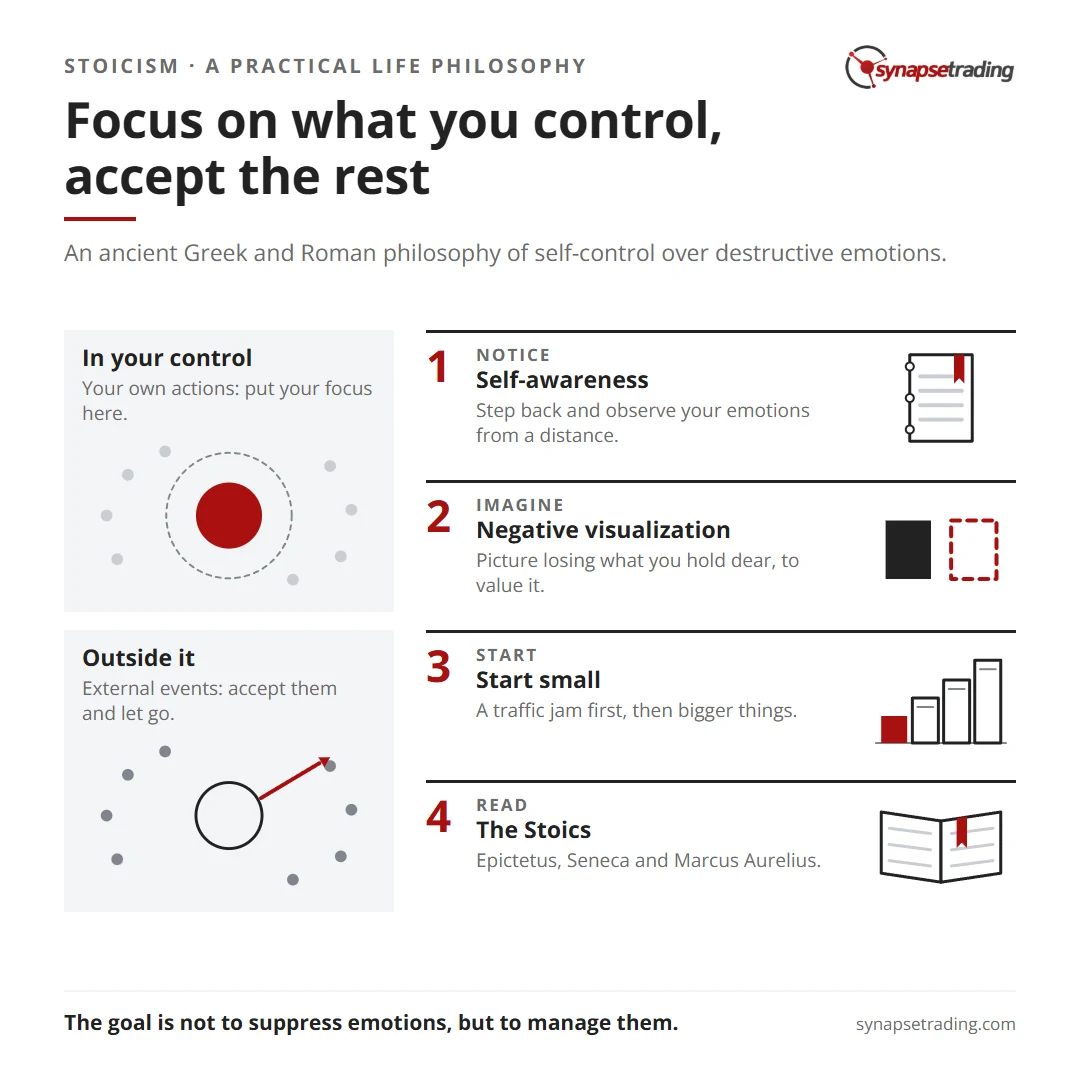
Stoicism is a philosophy that originated in ancient Greece and Rome that emphasizes the development of self-control and fortitude as a means of overcoming destructive emotions.

It teaches that by accepting the present moment as it is, we can achieve peace of mind and inner harmony.

Through the practice of Stoicism, you can learn to live a more virtuous and fulfilling life, and gain valuable insights on how to handle stress and adversity.

In this blog post, I will explore the origins and benefits of this life philosophy, and practical ways you can apply it in your life.


What is Stoicism?

Stoicism is a philosophy that originated in ancient Greece and was later developed by the Romans.

It is a philosophy of personal ethics that emphasizes the development of self-control and fortitude as a means of overcoming destructive emotions.

It teaches that by accepting the present moment as it is, we can achieve peace of mind and inner harmony.

The Stoics believed that by understanding the nature of the universe, and our place in it, we could live a virtuous life in accordance with reason and nature.

This approach advocates the development of self-control and resilience against destructive emotions, like anger, fear, or resentment.

The ultimate goal is to achieve a state of ataraxia (inner peace) and apatheia (emotionlessness) where the individual is not controlled by the emotions and is able to act rationally and ethically.

Origins of Stoicism

The origins of Stoicism can be traced back to ancient Greece, specifically to the city of Athens, where the philosopher Zeno of Citium founded the Stoic school of philosophy in the early 3rd century BCE.

Zeno was a student of the Cynic philosopher Crates of Thebes, but he rejected the Cynics’ way of life and instead focused on developing a rational system of ethics.

The Stoic philosophy was then developed by other philosophers such as Epictetus, Seneca, and Marcus Aurelius.

These philosophers are considered the three most prominent Stoics, and their texts, particularly the Enchiridion of Epictetus and the Meditations of Marcus Aurelius, continue to be read and studied today.

Stoicism was popular among the educated elite of ancient Rome and it has had a significant influence on Western thought, it was a philosophy that was primarily concerned with personal ethics and self-improvement, it was a way of life and a way to find peace and wisdom within oneself and the world.

Stoicism was taught in famous places like the Stoa Poikile or painted porch in Athens, the Stoic school was one of the most influential and prominent schools of philosophy in ancient Greece and Rome.

Benefits of Stoicism

Stoicism can offer many benefits for those who choose to adopt its principles and practices.

Some of these benefits include:

  • Inner peace and contentment: By accepting the present moment and focusing on what is within our control, we can avoid becoming consumed by negative emotions such as anger, fear, or resentment. This can lead to a sense of inner peace and contentment.
  • Improved ability to handle stress and adversity: Stoicism teaches us to maintain a clear and rational mindset in difficult situations, which can help us to better handle stress and adversity.
  • Self-control and resilience: Stoicism emphasizes the importance of self-control and resilience, helping us to develop the ability to maintain our composure and make rational decisions, even in difficult or challenging situations.
  • Virtue development: Stoicism emphasizes the development of virtues such as wisdom, integrity, courage and self-control which can improve one’s character and make them a better person.
  • Rational perspective: It encourages rational thinking, rather than emotional reactions, and to see things in a more objective perspective.
  • Improves decision making: By focusing on what is within our control, and letting go of what is not, we can make more effective and well-informed decisions.
  • Self-awareness and self-improvement: Through the practice of stoicism, we can become more aware of our thoughts, emotions, and actions, which can help us to identify areas for self-improvement.
  • Acceptance: Stoicism encourages acceptance of the present moment, and teaches that by accepting what we cannot change, we can let go of negative emotions, and find a sense of peace.

In general, Stoicism can lead to a more balanced, virtuous and rational way of life, which can have a positive impact on one’s personal and professional life.

How to Apply Stoicism in Your Life

To apply Stoicism in your life, you can try the following practical tips and examples:

  1. Self-awareness: Start by becoming more aware of your thoughts and emotions. Try to identify when you are getting caught up in negative emotions and try to step back and observe them from a distance. This will help you to understand your own thought patterns, which can aid in self-improvement.
  2. Acceptance: Practice acceptance by focusing on what is within your control and letting go of things you cannot control. This will help to reduce feelings of frustration and powerlessness, and improve your ability to cope with difficult situations.
  3. Mindfulness: Practice mindfulness, meditation and journaling to help with self-awareness and to practice acceptance. This can also improve emotional regulation, cognitive flexibility and self-awareness,
  4. Practice gratitude: Try to focus on what you have rather than what you don’t have, and practice gratitude for the positive things in your life.
  5. Separate what you can change and what you cannot change: Try to separate things you can change and things you cannot change, this will help to reduce feelings of frustration and powerlessness.
  6. Negative visualization: Practice negative visualization, where you imagine losing something you hold dear, so you can appreciate what you have. This will help you to develop a sense of perspective and gratitude.
  7. Cultivate virtues: Cultivate virtues such as integrity, courage, wisdom, and self-control. Incorporating these values into your life can improve your character and lead to a more virtuous and fulfilling life.
  8. Keep a rational perspective: Try to keep a rational perspective in difficult situations. Remember that emotions are temporary and that things will pass. Practice rationality and logical thinking.
  9. Read and study the works of Stoic philosophers: Read and study the works of Stoic philosophers such as Epictetus, Seneca, and Marcus Aurelius. These philosophers offer valuable insights and practical advice on how to apply Stoicism in daily life.
  10. Start small: Try to apply stoic principles in small aspects of your life, such as how to deal with a traffic jam, or an unresponsive coworker, small victories will make it easier to apply it to bigger aspects of your life.
  11. Be mindful of your actions: Be mindful of your actions and the choices you make, always try to act in a virtuous way.
  12. Focus on what is essential: Stoicism teaches to focus on what is essential, prioritize your goals and values, and let go of things that don’t align with them.
  13. Be resilient: Cultivate resilience, practice facing difficult challenges and setbacks with a calm, rational, and detached attitude.

All these tips and examples, if practiced regularly, can help you to integrate Stoicism into your daily life and improve your overall well-being.

Remember that the goal is not to suppress or ignore your emotions, but to develop the ability to manage them in a healthy way.

Keep in mind that it takes time and effort to develop a Stoic mindset, but with patience and dedication, you can learn to live a more fulfilling life in accordance with reason and virtue.

Famous Examples of Stoicism

There have been many famous historical figures who have applied Stoicism in their lives and have shared their practical advice on how to live a virtuous and fulfilling life.

Some of the most notable figures include:

  • Epictetus: A slave turned philosopher who taught that the key to happiness is to focus on our own actions rather than external events. He taught that by understanding the difference between what we can control and what we cannot control, we can reduce feelings of frustration and powerlessness. Epictetus emphasized the importance of self-discipline, and stated that the mind should be trained to remain calm in the face of adversity.
  • Seneca: A Roman philosopher and statesman who wrote extensively on the practical application of Stoicism in daily life. Seneca believed that by understanding the nature of the universe, we can live in accordance with reason and nature, and that we should focus on cultivating virtues such as wisdom, courage, and self-control. He also stressed the importance of self-awareness and self-improvement.
  • Marcus Aurelius: Roman Emperor and Stoic philosopher who wrote in his famous book “Meditations” about how to live a virtuous life in the face of adversity. Marcus Aurelius advocated for the importance of virtue, self-control and rationality. He also emphasized the need to detach oneself from emotions, to focus on what is in one’s control, and to live a life of service to others.

All these figures and many others, offer practical advice on how to apply Stoicism in daily life, their works are still read and studied today, for the valuable insights and wisdom that they provide.

Concluding Thoughts

In conclusion, Stoicism is an ancient philosophy that can offer many benefits for those new to it.

It emphasizes the development of self-control and resilience against destructive emotions, and encourages accepting the present moment and focus on what is in one’s control, leading to inner peace and contentment.

It also offers valuable insights on how to handle stress and adversity, virtues development and rational thinking, making it a valuable tool to improve one’s personal and professional life and find inner peace.

Now that I have shared what stoicism is about, and the practical ways you can apply it in your life, do you think this is a life philosophy which you will want to adopt?

For those already embracing this philosophy, what are some other ways which you have applied stoicism in your life?

Let me know in the comments below.


thumbnail an unofficial guide to living our best life beyond financial freedom

If you are excited to get more life hacks, also check out: “Beyond Financial Freedom: An Unofficial Guide to Living Your Best Life”

0 Comments/by Spencer Li
https://synapsetrading.com/wp-content/uploads/2023/01/Thumbnail-What-is-Stoicism.png 720 1280 Spencer Li https://synapsetrading.com/wp-content/uploads/2019/10/logo.jpg Spencer Li2023-01-11 18:14:302023-02-10 19:58:50What is Stoicism? (13 Practical Ways to Apply it in Your Life!)
Page 1 of 512345

Free Trading Guides

Free Trading Guides

Blog Categories

  • Beginner's Guide
  • Blockchain & Crypto
  • Book Summaries
  • Candlestick Patterns
  • Economics & News Trading
  • Investing & Portfolio Management
  • Living Your Best Life
  • Market Analysis
  • News & Events
  • Price Chart Patterns
  • Promotions
  • Risk & Money Management
  • Stock Trading
  • Testimonials
  • Tools & Resources
  • Trading Psychology
  • Trading Strategies
  • Trading Tips
  • Travel & Lifestyle

Free Trading Guides

Free Trading Guides

Contact Us

Synapse Trading Pte Ltd
Registration No. 201316168H

Whatsapp: +65-8897-1204
Telegram: @iamrecneps
Email: info@synapsetrading.com

Links

Disclaimer
Privacy policy
Terms & Conditions
Contact us
Partnerships

© 2012-2024 Synapse Trading | All rights reserved | - powered by Enfold WordPress Theme
  • Link to Facebook
  • Link to X
  • Link to Instagram
  • Link to Youtube
  • Link to LinkedIn
  • Link to Mail
Scroll to top Scroll to top Scroll to top