• Link to Facebook
  • Link to X
  • Link to Instagram
  • Link to Youtube
  • Link to LinkedIn
  • Link to Mail
Free PDF: The 15-Minute Swing Trader's Checklist, the daily routine of a trader since 2007
Synapse Trading
  • Mentoring
    • Trading Mastery Program
    • All mentoring options
  • Signals
    • Daily trading signals
    • Signals trade log
  • Results
    • Student results and testimonials
    • Public trade log, losses left in
  • Free guides
    • Start here
    • Trading foundations
    • Technical analysis
    • Strategies and systems
    • Risk and money
    • Trading psychology
    • Markets and products
    • Free trading guides
    • Tools and resources
    • Blog
  • About
    • My background
    • My trading journey
    • Media and interviews
    • Travel log
  • Contact
    • Contact me
    • Partnerships
  • Start free
  • Click to open the search input field Click to open the search input field Search
  • Menu Menu

Forex, stocks, crypto, options and commodities – what you trade, as opposed to how.

Spencer Li

Is Insider Buying a Good Sign? What the Research Says, and How to Read a Filing

Markets & Products
Is insider buying bullish? - stocks

Some insider purchases have carried real information. Most insider trades carry none, and the filing tells you which is which

Published: 17 October 2026 · Last updated: 19 October 2026 · By Spencer Li, CFTe


In one well-known study of US company insiders from 1975 to 1996, the shares that insiders bought went on to beat the market by “about 40 basis points per month”, which compounds to roughly 5% a year. The shares they sold did not underperform at all.

So yes, insider buying can be a good sign, but only a certain kind of buying. A director paying cash for shares on the open market is telling you something. A director receiving shares as part of their pay, exercising options, or buying through a plan set up months ago is mostly telling you about their pay package. And even the good kind is a reason to look closer, rather than a reason to buy.

In this post, I’m going to show you where these trades are disclosed in the US and in Singapore, what the research really found, and a simple three-part check: who bought, how they got the shares, and how much.
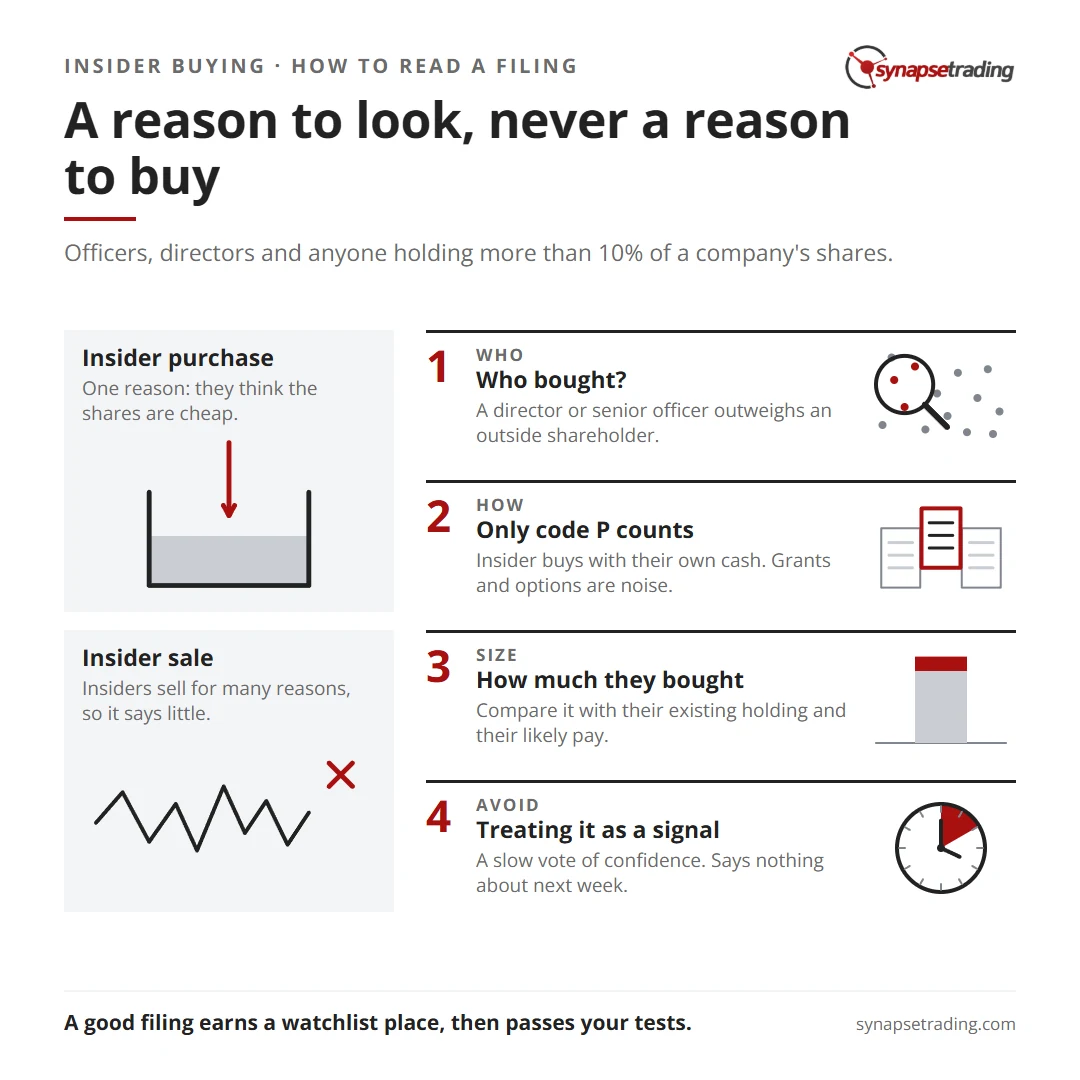
A reason to look, never a reason to buy. Summary card for the post: Is Insider Buying a Good Sign? What the Research Says, and How to Read a Filing.

Where can you see what insiders are buying?

Both the US and Singapore make insiders report their trades within days, and both publish the reports for free.

In the US, the SEC counts officers, directors and anyone holding more than 10% of a company’s shares as insiders. Its investor bulletin is clear on the timing: “Form 4 must be filed within two business days following the transaction date.” The forms sit on the SEC’s EDGAR database, and free sites such as OpenInsider collect them into searchable tables.

In Singapore, the rule sits in the Securities and Futures Act. A director or chief executive must notify the company “within 2 business days” of a change in their interest in its shares. The company then has to announce it to the exchange “as soon as practicable and in any case, no later than the end of the business day following the day on which the corporation received the notice.” So a director’s purchase of an SGX stock usually shows up in the company’s announcements on the SGX website within a few working days. If you are new to the local market, our post on how SGX trading works covers the basics.

Does insider buying really predict stock returns?

On average, in the older data, open-market purchases did. Sales mostly did not.

The study I opened with, by Jeng, Metrick and Zeckhauser, found that “the purchase portfolio earns abnormal returns of about 40 basis points per month”, while “The sale portfolio does not earn abnormal returns.” It also found that only about one-sixth of that extra return arrived in the first five days after the trade. Most of it came later, after the filing was public, which is why ordinary investors care about this at all.

A later study by Cohen, Malloy and Pomorski split insiders into two groups. “Routine” insiders trade in the same month year after year, often for reasons like tax or a bonus date. “Opportunistic” insiders break their own pattern. The opportunistic trades “yields value-weight abnormal returns of 82 basis points per month”, while “the abnormal returns associated with routine traders are essentially zero.”

Here is the arithmetic, so you can see the size of it.

  • 40 basis points a month: 1.004 to the power of 12 is about 1.049, so roughly 5% a year above the benchmark.
  • 82 basis points a month: 1.0082 to the power of 12 is about 1.103, so roughly 10% a year.

Those are attractive numbers, but do note three things first. Both studies use data that is decades old, and research on market anomalies finds that about half of a published return tends to disappear once the paper is out and traders act on it (McLean and Pontiff, 2016). The figures are averages across hundreds of trades, before trading costs. And the effect has been strongest in smaller companies, where one person’s purchase is a bigger share of the company.

If you want a routine for turning a lead like this into a trade you can actually manage, our free 15-Minute Swing Trader’s Checklist walks through the questions to ask first. Get the free checklist →

Why do insider sales say so little?

Because insiders sell for many reasons, and most of them have nothing to do with the company’s prospects.

The SEC’s own bulletin says it plainly: “insiders may sell company securities for any number of reasons, including for liquidity and diversification purposes.” A founder selling to buy a house or pay a tax bill is doing what anyone with most of their money in one stock would do.

A purchase is different. There is really only one reason to take your own cash and put more of it into a company that already pays your salary. You think the shares are cheap.

How do you read an insider filing?

Ask three questions, and together they sort the useful filings from the noise.

Who bought? A director or a senior officer who sees the business every day carries more weight than a large outside shareholder. In the US, a fund that owns more than 10% also files Form 4, and its buying often reflects its own strategy rather than inside knowledge of the business.

How did they get the shares? This is where most of the filings fall away. On a Form 4, each trade carries a one-letter code, and only one of them is an insider choosing to put cash in.

Code or typeWhat it meansWhat it tells you
POpen market or private purchaseThe one that matters: the insider chose to buy with their own money
SOpen market or private saleLittle on its own: insiders sell for many reasons
AGrant or award from the companyNothing: it is part of their pay
MExercise of an optionUsually nothing: it turns pay into shares
FShares withheld to pay tax or the exercise priceNothing: it is paperwork
10b5-1 box tickedThe trade was set up in advance under a trading planLess: the decision was made months earlier

Since April 2023, a US Form 4 also shows a checkbox when the trade was made under a pre-scheduled 10b5-1 plan. Directors and officers usually have to wait at least 90 days after setting up such a plan before it can trade. A ticked box means the decision is old news. In Singapore filings, read the description of the transaction for the same clue: a market purchase is the case you are looking for.
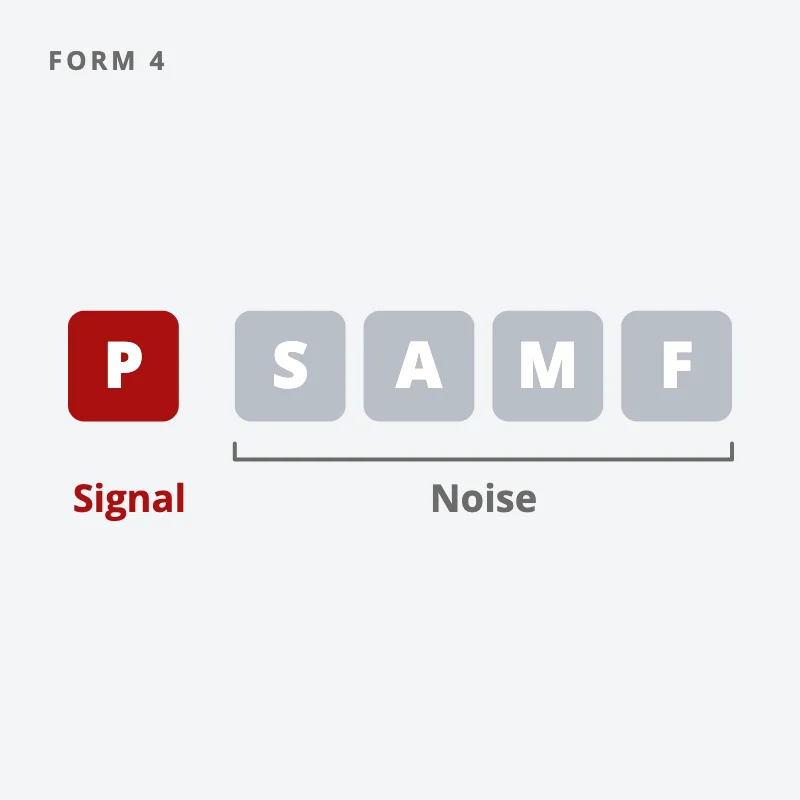
Form 4 trade codes as tiles: P, an open-market purchase with the insider's own cash, stands apart from S, A, M and F, which are noise
Only code P, an insider buying with their own cash, carries real information.

How much did they buy? Compare the size of the purchase with the insider’s existing holding and their likely pay. A chief executive buying a year’s salary worth of shares is a statement. A director adding a token amount after a bad quarter may be a gesture. Several insiders buying in the same few weeks is stronger than one, although one large online test of over 4,000 purchases found that the “several at once” bonus was not reliable on its own.

What are the traps with following insider buying?

The biggest trap is treating a filing as a buy signal with a date on it.

A trader online tested insider purchases as a way to predict the next earnings report, and concluded: “Insider buying was wrong 79% of the time.” It sounds damning. But a reply in the same thread made the better point: “Insider buying is historically a 12–24 month signal, not a next-quarter earnings predictor.” Insiders are only allowed to trade in certain windows, usually just after results, so their purchases reflect what they knew last quarter. Our post on holding stocks through earnings explains why a single report is a coin toss for anyone outside the company.

That test used only 19 names, far too few to settle anything, but it teaches the right lesson. An insider purchase is a slow, patient vote of confidence in the business. It says nothing about next week’s price, and it does not tell you where to get in or where you are wrong.

The other trap is the story. Once you know the chairman bought, every chart looks bullish, which is the narrative fallacy at work.

Should you use insider buying in your own trading?

The safest way to use an insider purchase is as a reason to look, never a reason to buy.

A good filing earns a stock a place on the watchlist. From there, it has to pass the same tests as any other idea: a trend you can see, a clear level to trade from, and a stop that keeps the loss small if the insider turns out to be wrong. Insiders are sometimes wrong, and they can wait years for their view to play out. Our guide on how to find stocks to swing trade shows how that first cut of a watchlist can work.

So, the last time you saw a headline about an insider buying, did you check the code? Was it cash on the open market, or a grant dressed up as news? And was the stock already in a trend you would trade anyway? For more on finding and judging individual shares, see the guide to stocks and CFDs trading.

FAQ

Is insider buying a good sign?

It can be. Open-market purchases by directors and officers beat the market on average in past studies, while sales, grants and option exercises mostly did not. Treat it as a reason to research the stock, rather than a reason to buy it.

Where can I see insider buying for US stocks?

On the SEC’s EDGAR database, where insiders file Form 4 within two business days of a trade. Free sites such as OpenInsider collect these filings into searchable lists.

How do I see director dealings for SGX stocks?

A Singapore-listed company must announce a director’s change in shareholding to the exchange by the end of the business day after it is notified. The announcements appear in the company announcements section of the SGX website.

Is insider selling a bad sign?

Usually not on its own. The SEC notes that insiders sell for many reasons, including liquidity and diversification, and studies found that the stocks insiders sold did not underperform.

Is it legal for insiders to buy their own company’s shares?

Yes, when they trade within the rules and report the trade. Trading on inside information that the public does not have is illegal, which is why insiders usually trade only in open windows after results.

Go deeper

An insider purchase is a lead, and a lead still needs a plan. The free 15-Minute Swing Trader’s Checklist has the daily routine, the questions to ask before every trade, and the five rules that protect your account.


About the author. Spencer Li is The 15-Minute Trader and the founder of Synapse Trading. He is a Certified Financial Technician (CFTe) with 15+ years of trading, run from 70+ countries. He holds a B.Acc and B.BM from SMU. Every trade he takes is public, dated, losses left in. He teaches low-risk swing trading in 15 minutes a day, one system for any market.

Educational content only, not personalised financial advice. Trading carries risk, including loss of capital. Past performance is not indicative of future results. Synapse Trading is not licensed or regulated by MAS.
by Spencer Li
https://synapsetrading.com/wp-content/uploads/2026/10/insider-buying-card.webp 630 1200 Spencer Li https://synapsetrading.com/wp-content/uploads/2026/10/synapse-logo-horizontal-light.png Spencer Li2026-10-12 10:27:352026-10-19 20:37:58Is Insider Buying a Good Sign? What the Research Says, and How to Read a Filing
Spencer Li

What Are 0DTE Options, and Why Do They Behave Like Gambling?

Markets & Products
What are 0DTE options? - options

Same-day options explained: why theta and gamma peak on the last day, and the honest answer to trading them without it turning into a casino.

Last updated: 18 October 2026 · By Spencer Li, CFTe


A 0DTE option is an option with zero days to expiry, which means it expires at the end of the same trading day you trade it. On the S&P 500 index there is now an expiry every trading day, since Cboe added Tuesday and Thursday expiries in 2022, and the same-day contracts have taken over. In July 2026, Cboe reported that 0DTE options made up a record 66.2% of all SPX options volume. An earlier Cboe note, for August 2025, put retail traders at an estimated 53% of that same-day volume.

They behave like gambling for a mechanical reason. With only hours left, there is almost no time value to cushion you. Theta takes whatever remains by the close, and gamma is at its peak, so the option swings from near-worthless to several times its price and back on small moves in the index. The payoff looks like a lottery ticket: usually a small loss, now and then a large win, and very little in between.

Do note that we do not teach options at Synapse Trading, and I do not trade them myself. My own trading is end-of-day swing trading in shares, forex and ETFs. This post sits under our ultimate guide to options trading, and it answers a question I keep seeing, almost word for word: “how do I trade 0DTE options without it turning into gambling?”

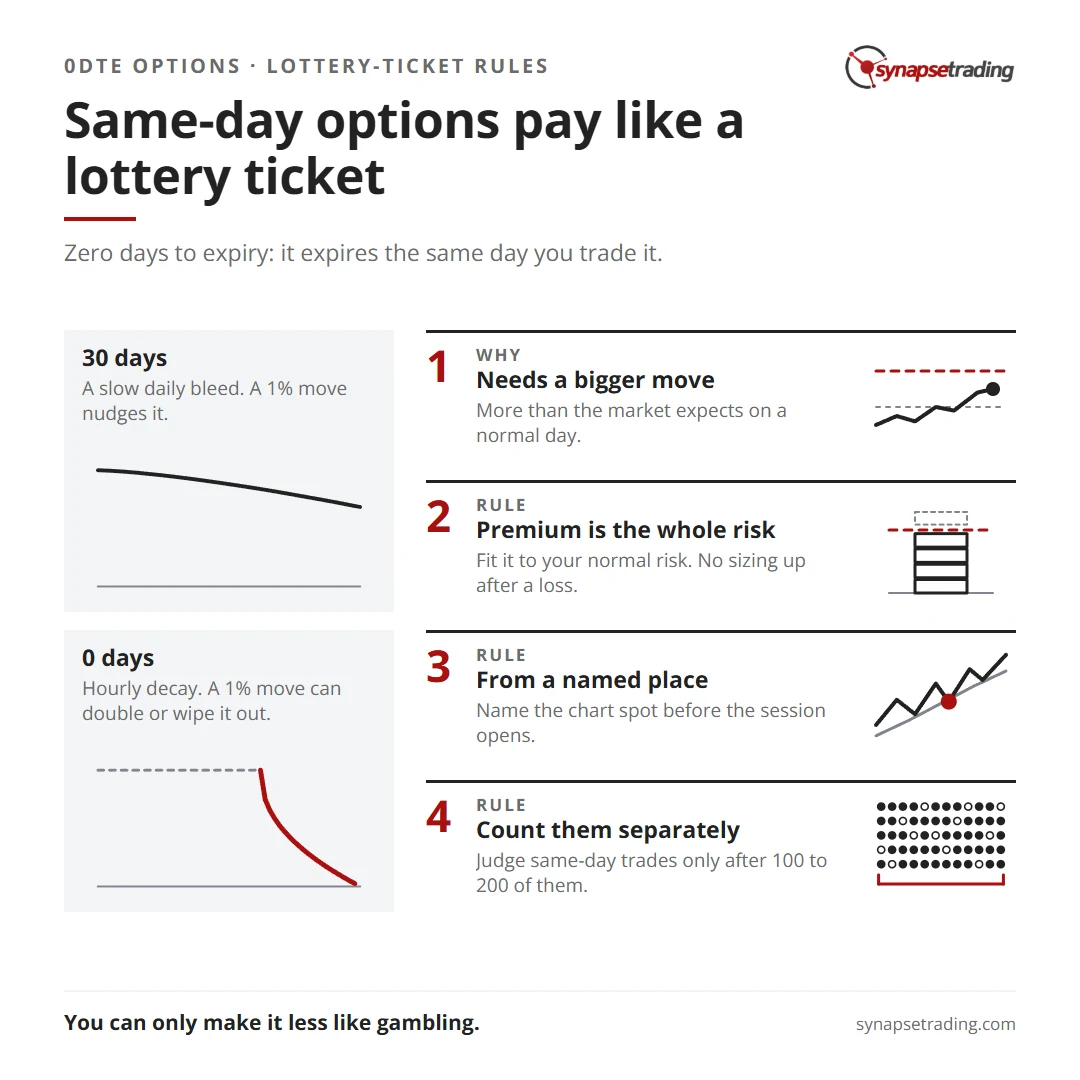
Same-day options pay like a lottery ticket. Summary card for the post: What Are 0DTE Options, and Why Do They Behave Like Gambling?.

What exactly is a 0DTE option?

Any option on its last day is a 0DTE option. A monthly option bought 30 days ago becomes one on expiry morning. What changed in 2022 is that the most traded index options now have an expiry every single day, so a trader can open and close a fresh same-day position each session, all year.

Cboe announced the Tuesday and Thursday SPX expiries in April 2022, saying they would “expand the product suite to provide expirations every trading day of the week.” The volume followed. In September 2026 the same-day contracts set a monthly record of 3.4 million a day on SPX alone, according to Cboe’s own figures.

So why the rush? Part of it is price. A same-day option costs less than a monthly one at the same strike, because there is so little time left to pay for. Part of it is speed. You find out by the close whether you were right, which feels a lot like a game that pays out the same evening. Both of those are the same feature seen from 2 sides, and that feature is the problem.

What happens to theta and gamma on the last day?

Let me show you with a worked example, hypothetical and in round numbers.

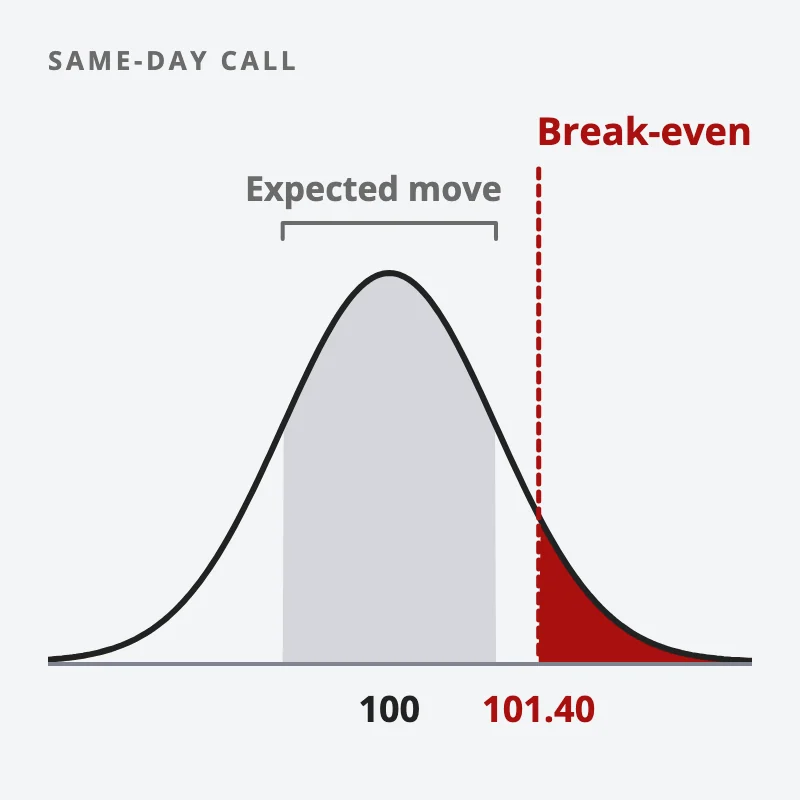
An index trades at 100. A call at the 101 strike, expiring at today’s close, costs 0.40. With the VIX at 16, a rough rule says the market expects about a 1% move in a day, so about 1 point here (the VIX divided by 16 gives the expected daily range in percent).

For this call to break even at the close, the index has to finish above 101.40. That is a 1.4% rise in a few hours, bigger than the move the market expects on a normal day.

A bell curve of where the index may close, centred on 100 with the expected move marked; the break-even of 101.40 sits beyond it, leaving only a thin red tail
This same-day call needs a bigger move than the market expects on a normal day.
  • The index closes at 100.90, up a respectable 0.9%. The call expires worthless. You lose 100% of the premium.
  • The index closes at 102, a strong day. The call is worth 1.00. You make 150% on the premium.
  • The index spikes to 101.50 at lunchtime and fades. For an hour the call was worth more than you paid, and by the close it is worth nothing.

That third line is the one that hurts. Gamma is so large on the last day that the option’s delta can swing from, say, 0.10 to 0.60 and back within a session, so the price lurches with every small move. Theta, meanwhile, is draining the time value hour by hour instead of day by day. You are not just betting on direction. You are betting on direction, size and timing, all inside one afternoon.

The same strike30 days to expiry0 days to expiry
Time value leftPlentyAlmost none
ThetaA slow daily bleedHourly, and all of it by the close
GammaLow, the option changes slowlyAt its peak near the strike
What a 1% move doesNudges the priceCan double it or wipe it out
Room to be early or wrongWeeksHours

Why does that make 0DTE feel like a casino?

I have written before that trading is only gambling if you play like the gambler. The casino wins because it takes many small bets with the odds slightly in its favour, sized so that no single night can ruin it. The gambler loses because he does the opposite: big bets, chosen by feel, raised after a loss.

A same-day option pulls you towards the gambler’s side of the table. The bets are cheap, so it is easy to place a lot of them. Each one resolves fast, so the next one is always tempting. And the payoff is lopsided, so a single big win can paper over a long run of small losses, which is exactly how a slot machine keeps people at the stool.

You might think the fix is to sit on the other side and be the casino, selling the same-day options instead of buying them. It is a tempting idea. But the seller’s version has its own trap: many small wins, then one afternoon that takes back months, because the seller holds the lottery ticket’s tail.

The traders who have been through it say the same thing. One trader on r/options, 2 years into options, split his results by days to expiry in May 2026. His 0DTE trades lost at a 41% win rate while his longer-dated trades made money: “the data says 0DTE was just where my discipline broke.” In his case the leak was size. “i was sizing 0DTE 2-3x what i risked on longer-dated stuff,” he wrote. After cutting it: “the account isn’t bleeding for the first time in months.”

In his case the product was only half the problem. The other half was a size he picked, in his own words, “sizing emotionally because i could exit by close anyway.”

If you would rather start with the part of trading we do teach, the free 15-Minute Swing Trader’s Checklist covers the questions to ask before every trade, whatever you trade.

How do you trade 0DTE options without it turning into gambling?

The honest answer is that you can only make it less like gambling. The product’s shape stays the same whatever plan you bring to it. What a plan changes is whether one bad session can ruin you.

These are what I call the 3 lottery-ticket rules, and they are the rails I would hold anyone to before a single same-day trade.

  1. The premium is the whole risk, and it fits your normal risk per trade. A bought option has no level to stop out at in the time available, so the premium you pay is the loss. If your rule is 1% of the account per trade, then on a SGD 50,000 account the premium is SGD 500 or less. No sizing up after a loss, ever. That is the moment the gambler takes over.
  2. Only from a named place on the chart, decided before the session opens. The bottom of a range, a pullback in a clear trend, a failed breakout. If you cannot name the location before the market opens, there is no trade, only an itch.
  3. Count them separately. Keep your same-day trades in their own column, the way the Reddit trader did, and judge them only after 100 to 200 of them. Fewer than that and you are looking at noise. If the column is losing while everything else is fine, the answer is in the data.

There is a fourth rule for anyone in Singapore, and it is practical rather than mathematical. The US market opens at 9.30 pm or 10.30 pm Singapore time, depending on the season, and closes at 4 am or 5 am. A same-day option expires at that close. If you have a day job, you are either asleep when your trade resolves, or awake at 4 am and paying for it the next day.

So which side of the table are you on when you open the options app late at night? Are you placing the bet the plan allowed, or the one that feels exciting?

FAQ

What does 0DTE mean?
0DTE means zero days to expiry. A 0DTE option expires at the end of the same trading day it is traded, so all of its remaining time value disappears within hours.

Are 0DTE options gambling?
They behave like gambling because the payoff is lopsided: usually a small loss, now and then a large win. Whether your trading is gambling depends on your size and your process, and a same-day option makes both harder to keep under control.

Why do 0DTE options lose value so fast?
Because there is almost no time left for the move to happen. Theta drains what remains of the time value by the close, and gamma is at its peak, so the price swings hard on small moves in the underlying.

Is selling 0DTE options safer than buying them?
Selling wins more often, but each loss can be many times the premium collected. The seller trades frequent small gains for rare large losses, so the risk moves rather than goes away.

Can you trade 0DTE options from Singapore?
Yes, through a broker that offers US-listed options, once it has approved your account for options. The US session runs from 9.30 pm or 10.30 pm to 4 am or 5 am Singapore time, so same-day options expire in the middle of the Singapore night. Our guide to choosing an options broker from Singapore covers the approval and cost checks.

Go deeper

This post covers the product. If you would rather start with what we do teach, the free 15-Minute Swing Trader’s Checklist has the daily routine, the questions to ask before every trade, and the five rules that keep you in the game.


About the author. Spencer Li is The 15-Minute Trader and the founder of Synapse Trading. He is a Certified Financial Technician (CFTe) with 15+ years of trading, run from 70+ countries. He holds a B.Acc and B.BM from SMU. Every trade he takes is public, dated, losses left in. He teaches low-risk swing trading in 15 minutes a day, one system for any market.

Educational content only, not personalised financial advice. Trading carries risk, including loss of capital, and isn’t suitable for everyone. Past performance is not indicative of future results. Synapse Trading is not licensed or regulated by MAS.
by Spencer Li
https://synapsetrading.com/wp-content/uploads/2026/10/what-are-0dte-options-card.webp 630 1200 Spencer Li https://synapsetrading.com/wp-content/uploads/2026/10/synapse-logo-horizontal-light.png Spencer Li2026-10-06 12:31:012026-10-22 12:58:57What Are 0DTE Options, and Why Do They Behave Like Gambling?
Spencer Li

Iron Condor Strategy: How It Works, the Real Odds, and What Goes Wrong

Markets & Products
The iron condor strategy - options

One trade worked through in full, the win rate you actually need, and the 3 ways a quiet trade turns into a big loss

Published: 17 October 2026 · Last updated: 17 October 2026 · By Spencer Li, CFTe


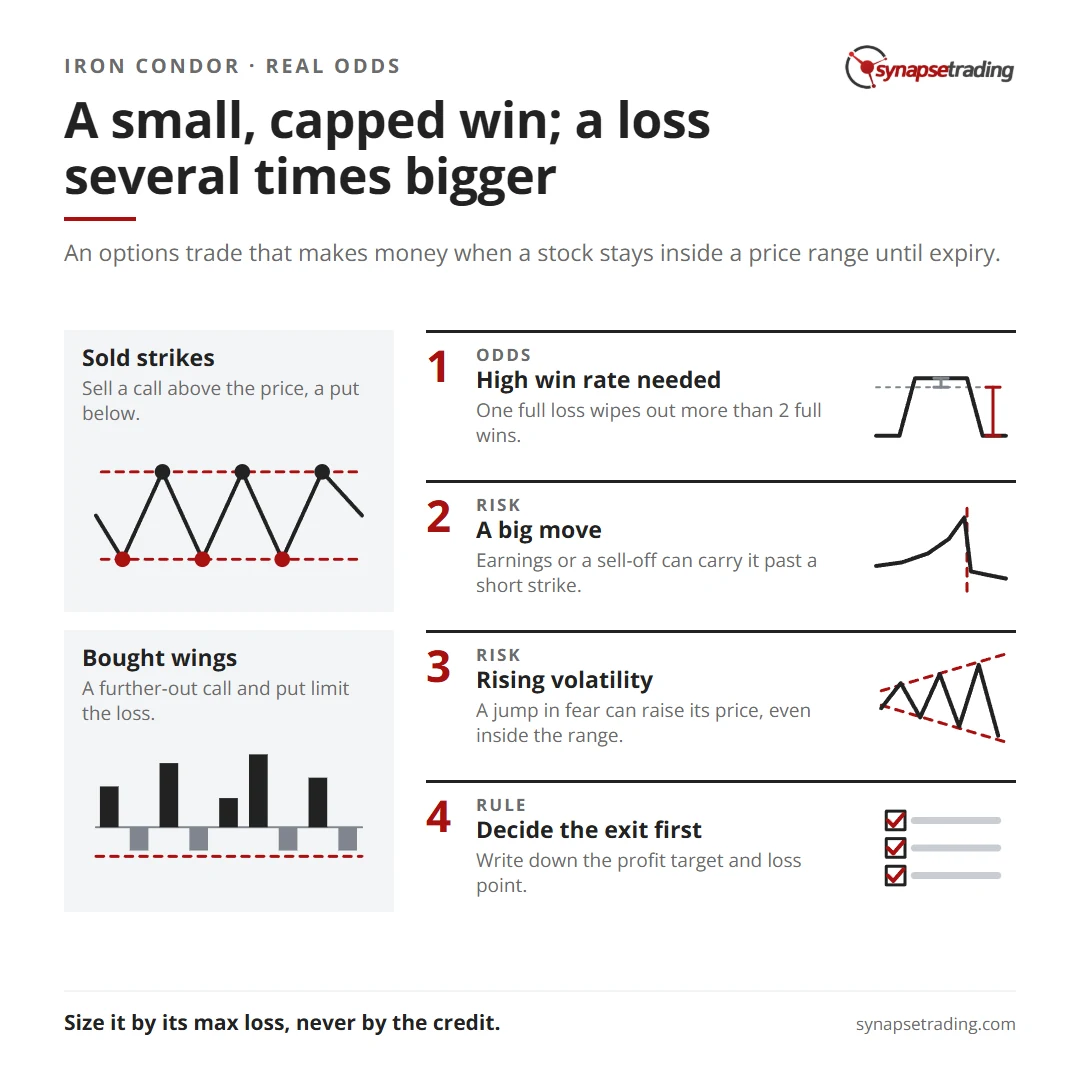
An iron condor is an options trade that makes money when a stock stays inside a price range until expiry. You sell a call above the current price and a put below it, and buy a further-out call and put as protection. You collect a credit up front and keep all of it if the stock finishes between your 2 short strikes.

It is popular for one reason. It wins most of the time, because wide strikes leave the stock plenty of room, and unlike selling options with no protection, the bought options put a hard limit on what you can lose.

The catch is in the arithmetic. The most you can make is small, and the most you can lose is several times bigger. So an iron condor needs a high win rate just to break even, and a few bad weeks can erase months of small gains. Below is one trade worked in full, and a simple 3-part check.

A small, capped win; a loss several times bigger. Summary card for the post: Iron Condor Strategy: How It Works, the Real Odds, and What Goes Wrong.

How does an iron condor work?

An iron condor is 2 credit spreads at once, one on each side of the price. Here is a hypothetical example with round numbers.

A stock trades at USD 100, and you open 4 options that all expire next month:

  1. Sell a 110 call and buy a 115 call. This is the call spread above the price.
  2. Sell a 90 put and buy an 85 put. This is the put spread below the price.
  3. Collect a total credit of USD 1.50 a share, say 0.75 from each side.

Here is what happens at expiry, per share:

Stock price at expiryResult per shareWhat happened
85 or lower-3.50, the max lossThe put spread lost in full
88.500Lower breakeven
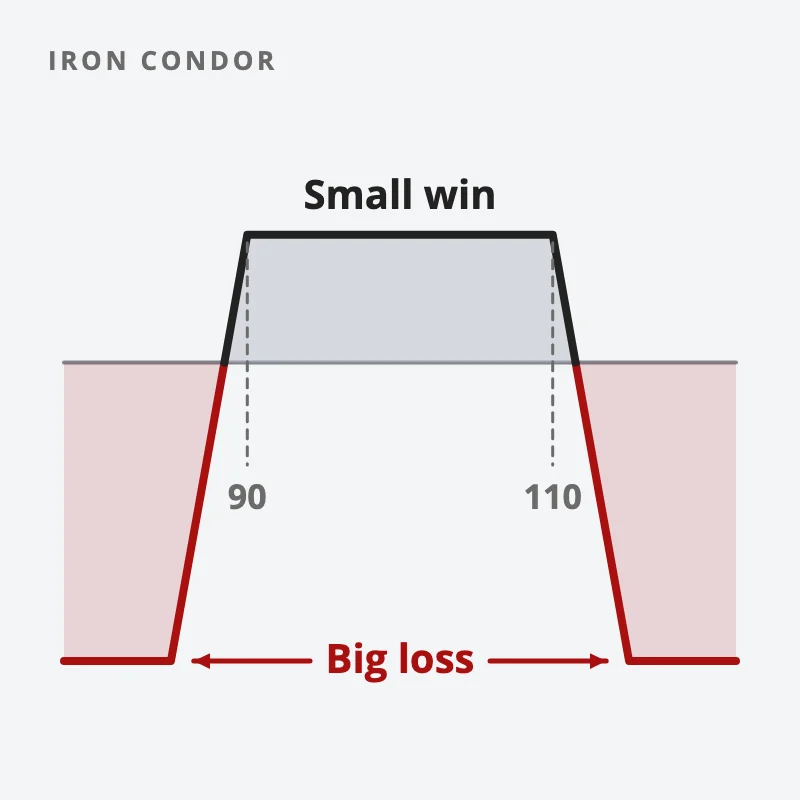
90 to 110+1.50, the max profitEvery option expires worthless
111.500Upper breakeven
115 or higher-3.50, the max lossThe call spread lost in full

The max profit is the credit, 1.50. The max loss is the width of one side, 5, minus the credit, which is 3.50. One contract covers 100 shares, so that is USD 150 at best and USD 350 at worst per condor.

Iron condor payoff at expiry: a wide flat small win between the 90 and 110 strikes, and a much deeper loss on either side
An iron condor’s win is small and capped, while its loss is several times bigger.

Only one side can lose in full, because the stock cannot finish above 115 and below 85 at the same time. Our post on sizing a credit spread by its max loss shows how to turn that 3.50 into a position size.

What is the real success rate of an iron condor?

This is the question people search most, and the honest answer has 2 halves.

The first half is the win rate. Pick strikes far enough away and the stock will finish inside the range most of the time, which is why condor results so often show 70%, 80% or more winners.

The second half is the break-even win rate. In the example, one full loss of 3.50 wipes out more than 2 full wins of 1.50. To break even with full wins and full losses, you need to win 3.50 out of every 5.00 at stake, which is 70% of the time. The wider your strikes, the higher your win rate, but the smaller your credit, and the higher the win rate you need. Both numbers climb together.

So a high win rate on its own says very little. A trader on an options forum who sold very far out-of-the-money spreads did this sum for himself, and concluded: “Seems like a zero sum game or even a negative sum game.”

Robert Carver, who ran money for a systematic hedge fund, gives a plain warning in Systematic Trading. If you make steady profits nearly every day and most trades win, he writes, “there is a good chance you are engaged in negative skew trading. It’s just that you haven’t yet seen any rare large losses.” Our post on selling options for income looks at why that pattern catches so many people.

What makes an iron condor lose money?

Three things, and only the first shows up on the payoff table.

1. A big move. A surprise earnings result, a central bank decision or a market sell-off can carry the stock past one of your short strikes in a day. The protection limits the damage. It is still the full 3.50.

2. Rising volatility. An iron condor is a bet that the stock will move less than the market expects, and in options terms it gains from time passing and loses when expected volatility rises. Our guide to the options Greeks explains theta and vega if those words are new. Even if the stock stays inside your range, a jump in fear can push the condor’s price up, and closing early then costs you.

3. Costs and fills. A condor has 4 legs, so you pay 4 commissions and cross 4 bid-ask spreads to open it, and again to close it early. On a trade where the most you can make is 1.50, every few cents matters.

There is also the fine print around expiry. US-listed stock options can be exercised before expiry, so a short leg deep in the money can be assigned early. And if the stock closes right at one of your short strikes on expiry day, you may not know until the next morning whether you hold the shares. The post on what happens when an option is assigned covers both in detail.

Very short condors that expire the same day have become popular, and they compress all of this into hours. The post on 0DTE options explains how that changes the risk.

If you want the daily routine for the trades we do teach, the free 15-Minute Swing Trader’s Checklist is at the end of this post. Get the free checklist →

How do experienced traders manage iron condors?

Most decide the exit first.

One trader on an options forum wrote in April 2026 that he had spent 12 years fighting the same problem: “one big loser wiping out all the small winners.” Defending and rolling the trade had not fixed it. What finally worked for him was a fixed rule: close the condor at half its max profit, or as soon as one short option moved close to the money. His win rate fell to around 60%, but his results became smoother, because no single loss could grow to the full width.

That is a fair point in favour of the strategy. A condor with a firm exit rule behaves quite differently from one left to run to expiry. It still does not change the shape of the trade. The wins stay small and fixed, and the losses still have to be kept small by you, every time, including on the day the market gaps through your stop.

A 3-part check before any iron condor

Here is a simple check that works for any condor, whatever the market:

  1. The range. Write down both breakevens. Then list every event before expiry that could move the stock past them, such as earnings, a dividend date or a central bank meeting.
  2. The ratio. Divide the max loss by the max profit. Work out the win rate you need to break even, and ask honestly whether your record beats it after costs.
  3. The exit rule. Decide the exit before you enter. Write down the profit target, the loss point, and the number of condors that would lose together if the whole market fell sharply in one day.

Size any trade like this by its max loss, never by the credit. The credit is the number you see, and the max loss is the number that decides whether you are still trading next year.

So, if your last 10 condors all won, how would you know whether you have an edge, or just have not met the bad week yet? And how many of your open trades would lose together if the market gapped 5% overnight? For the full picture of how options fit into a trading plan, see the guide to options trading.

FAQ

What is an iron condor in simple terms?

It is 4 options combined into one trade that profits if a stock stays between 2 prices until expiry. You collect a credit up front, and the 2 bought options limit how much you can lose.

What is the max loss on an iron condor?

It is the width of the wider spread minus the total credit collected. In the example above, that is 5.00 minus 1.50, or 3.50 a share.

What is the difference between an iron condor and an iron butterfly?

An iron butterfly sells both the call and the put at the same strike, usually at the current price. It collects a bigger credit, but the stock has to finish closer to that one price to keep it. An iron condor sells 2 different strikes, so it has a wider profit zone and a smaller credit.

What is the difference between an iron condor and a short strangle?

A short strangle sells the same call and put without buying the protective options. It collects more, but its possible loss on a big move has no fixed limit. The iron condor gives up some credit to limit the loss.

Does Synapse Trading teach iron condors?

No, we do not teach options at the moment. We teach end-of-day swing trading in shares, forex and ETFs, and the risk-per-trade sizing above works the same whichever product you use.

Go deeper

This post covers one corner of options. If you would rather start with what we do teach, the free 15-Minute Swing Trader’s Checklist has the daily routine, the questions to ask before every trade, and the five rules that protect your account.


About the author. Spencer Li is The 15-Minute Trader and the founder of Synapse Trading. He is a Certified Financial Technician (CFTe) with 15+ years of trading, run from 70+ countries. He holds a B.Acc and B.BM from SMU. Every trade he takes is public, dated, losses left in. He teaches low-risk swing trading in 15 minutes a day, one system for any market.

Educational content only, not personalised financial advice. Trading carries risk, including loss of capital. Past performance is not indicative of future results. Synapse Trading is not licensed or regulated by MAS.
by Spencer Li
https://synapsetrading.com/wp-content/uploads/2026/10/iron-condor-strategy-card.webp 630 1200 Spencer Li https://synapsetrading.com/wp-content/uploads/2026/10/synapse-logo-horizontal-light.png Spencer Li2026-09-17 22:31:052026-10-17 21:19:38Iron Condor Strategy: How It Works, the Real Odds, and What Goes Wrong
Spencer Li

How to Choose the Best Options Broker in Singapore: 8 Checks Before You Fund the Account

Markets & Products
Choose an options broker - options

Why options approval and fees feel so hard from Singapore, and the checks that tell you which broker fits you, with no broker named and no referral link.

Last updated: 15 October 2026 · By Spencer Li, CFTe


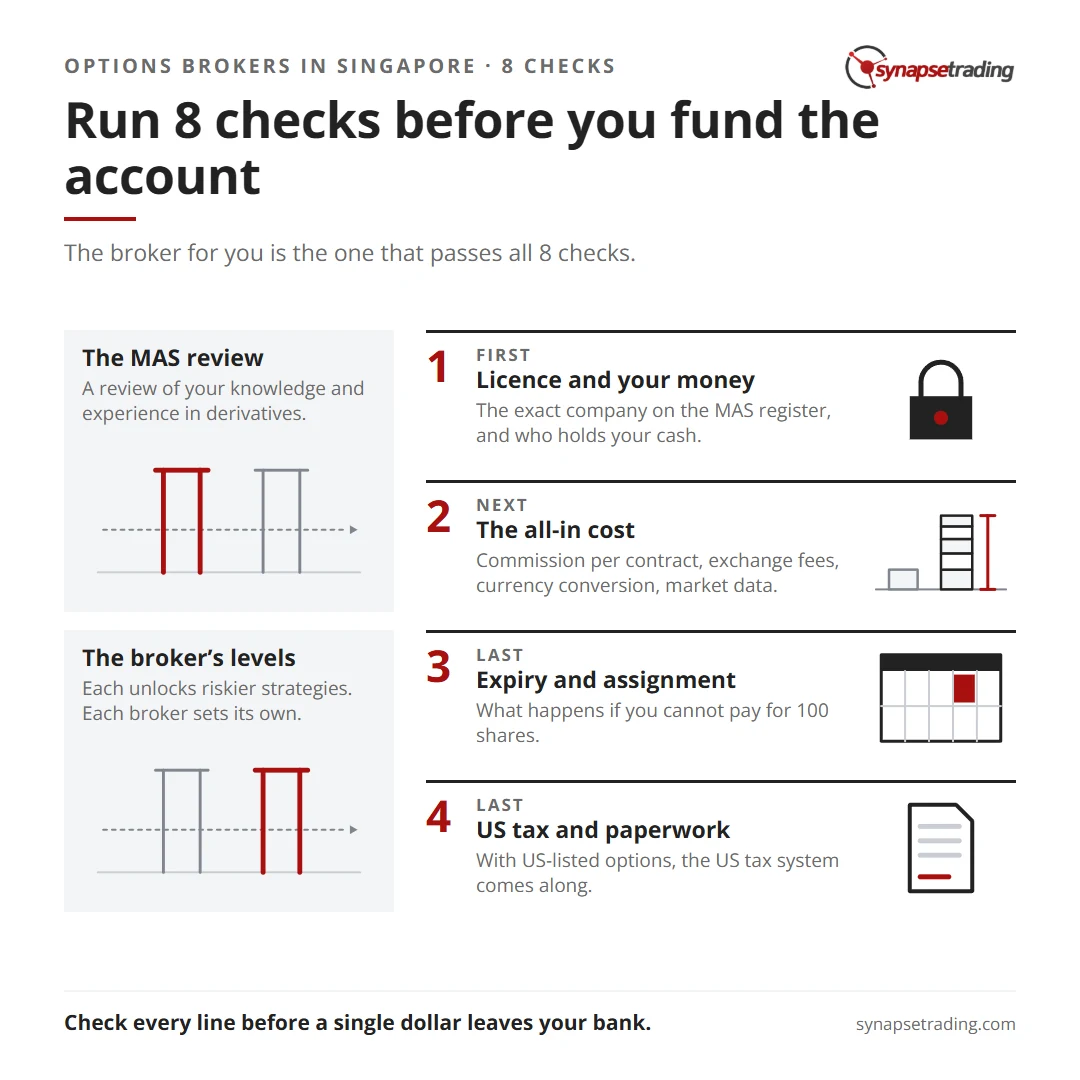
There is no single best options broker in Singapore, and I am not going to name one. The best broker for you is the one that passes 8 checks. It is licensed by MAS, and you know which company holds your money. It offers the markets and the approval level you need, at an all-in cost per contract you can see. It explains expiry and assignment in writing, its platform handles your orders, and you understand the US tax that comes with US-listed options.

Most of the “why is this so hard” comes from one MAS rule. Options are derivatives, and before a broker opens an account for you to trade listed derivatives, MAS requires it to review your “knowledge and experience in derivatives.” Many brokers then add their own approval levels on top. That is why the sign-up feels like an exam.

Do note that we do not teach options at Synapse Trading, and this post names no broker and carries no referral link. It sits under our ultimate guide to options trading, and it answers a question that turns up again and again on Singapore forums: which broker should I use for options, and why are the fees and approvals so hard?

Run 8 checks before you fund the account. Summary card for the post: How to Choose the Best Options Broker in Singapore: 8 Checks Before You Fund the Account.

Why is options approval so hard to get in Singapore?

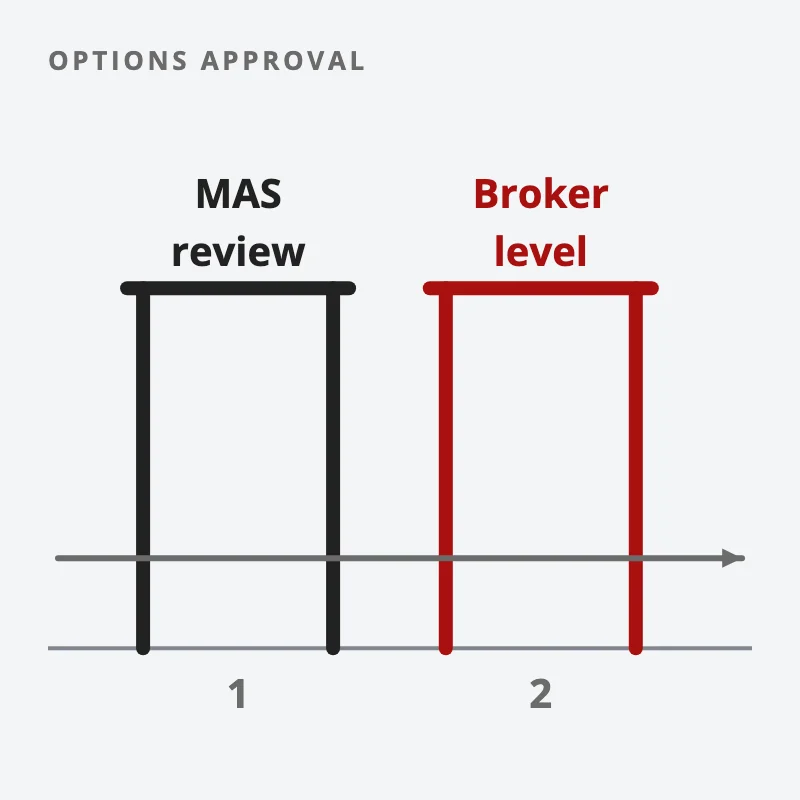
Because there are 2 gates, and most people only expect one.

The first gate is the law. Under MAS Notice SFA 04-N12, any capital markets product outside a short list of simpler ones is a Specified Investment Product. Before a broker opens an account for you to trade a listed one, it must run a Customer Account Review, which the notice defines as “a review of a Customer’s knowledge and experience in derivatives.” Options are derivatives, so expect this review before an options account opens. You pass if you meet any one of these, from Annex 2 of the notice:

  • a diploma or higher in a field such as accountancy, business, economics or finance
  • a professional finance-related qualification
  • at least 6 trades in listed Specified Investment Products in the preceding 3 years
  • at least 3 consecutive years of relevant work experience in the past 10 years

If you meet none of them, MoneySense, the national financial education site, says you can also pass by completing the free SGX Online Education Programme module and its assessment. And if you still do not pass, the door is not shut. The notice says the broker must tell you the outcome in writing, get your written confirmation that you still want to go ahead, and explain the features and risks of derivatives to you. A lot of people take the first “you did not pass” email as a rejection, when it is the start of that process.

A pass does not last forever. Paragraph 16 of the notice stops the broker from letting you trade listed Specified Investment Products more than 3 years after your review, unless you traded them through that account more than once in the past 3 years, or you take a new review. US-listed options also count as overseas-listed products. Paragraphs 29D and 29E say the broker must give you a written risk warning, and get your acknowledgement, before your first such trade.

The second gate is the broker’s own. Many brokers sort options accounts into levels, each one unlocking riskier strategies. Covered calls and bought calls and puts usually sit near the bottom, spreads in the middle, and selling uncovered options at the top. Each broker sets its own rules for who gets which level. So you can clear the MAS review and still find that the strategy you wanted is locked.

A path through two gates: first the MAS review, then the broker's own approval level
Options approval has two gates: the MAS review first, then the broker’s own levels.

The 8 checks, in one table

I call this the fund-it-last checklist, because every line on it can be checked before a single dollar leaves your bank account, and almost none of it is easy to fix afterwards.

#The checkWhat to look forWhere to find it
1Licensed by MASThe exact company you sign with appears on the MAS registerMAS Financial Institutions Directory
2Who holds your moneyThe legal entity on your account agreement, and what protection applies to itThe account agreement and the client money disclosure
3The markets you wantUS-listed stock and ETF options, index options, or options on other exchangesThe broker’s product list
4Your approval levelWhich strategies each level allows, and how to move upThe options application and its FAQ
5The all-in costCommission per contract, exchange fees, currency conversion, market dataThe full fee schedule, not the headline page
6Expiry and assignmentWhat happens to an in-the-money option at expiry, and if you cannot pay for 100 sharesThe options terms and the margin policy
7The platformAn options chain with the Greeks, open interest and multi-leg ordersA demo or paper account
8Tax and paperworkThe US tax form, and what happens to dividends and estatesThe broker’s tax pages, then the IRS pages linked below

How do I check that a broker is licensed and my money is protected?

Start with the register. MAS keeps a public Financial Institutions Directory. Search for the exact company name on your account agreement, and check that it holds a capital markets services licence. Then search the MAS Investor Alert List for the same name. The scam checks in our post on how to choose a good forex broker apply here too.

The second half is where people get caught out. A broker group can run several companies in several countries, and the one holding your account decides which rules protect you. Singapore’s rules for licensed brokers have a whole part on customers’ money and assets, including how it is held in trust accounts. Ask the broker, in writing, which entity holds your cash and your positions, how the cash is held, and where.

Then there is the US scheme people quote in forums. SIPC protects customers of SIPC-member firms up to USD 500,000, “which includes a $250,000 limit for cash,” whatever country they live in, but only for accounts held at a SIPC member. An account held with a company that is not a SIPC member is outside it, so check which entity holds yours. And SIPC, in its own words, “does not protect against the decline in value of your securities.” Nothing protects you from a bad trade.

Why are options fees so hard to compare?

Because the price is spread across several lines, and most comparison pages only show 1. A share trade usually has one commission. An options trade can carry a commission per contract, a minimum per order, exchange and regulatory fees, and the spread you pay when Singapore dollars become US dollars. Some platforms also charge for live options prices, so the real cost only shows up after you have funded the account.

Here is the arithmetic that trips up small accounts, hypothetical and in round numbers. One contract covers 100 shares. An option quoted at 0.50 costs 50 US dollars before any fee. If the broker charges a per-order minimum, a 1-contract trade can pay several percent of the premium in fees, in and out, before the trade has done anything. A multi-leg order pays it on every leg.

So the useful number is the all-in cost of the trade you will actually place: a 1-contract trade and a 4-leg trade, every line on the fee schedule, plus the currency conversion.

What happens at expiry and assignment?

A bought option that finishes in the money is usually exercised for you at expiry, which means you suddenly own, or owe, 100 shares per contract. If you do not have the cash or the margin for that, the broker may close the position for you, at a price you did not choose. A sold option on a US stock can be assigned early, and a sold call assigned just before an ex-dividend date can leave you owing that dividend.

None of this is hidden, but it sits deep in the options terms. The expiry and assignment section should give 3 answers before you deposit: when exercise happens automatically, what the broker does if you cannot cover the shares, and when it will close positions on its own.

What about US tax and paperwork?

If you trade US-listed options from Singapore, the US tax system comes along.

Expect to be asked for Form W-8BEN, the IRS “Certificate of Foreign Status of Beneficial Owner”. The IRS tells a foreign person to give it to the withholding agent or payer, which for your US shares is usually the broker. On US-source dividends paid to non-residents, the IRS rule is to “withhold at 30% or lesser tax treaty rate.” Singapore does not appear on the IRS list of countries with a US income tax treaty, so the reduced treaty rate is not available to Singapore residents. An option pays no dividend. But an assigned option can leave you holding the shares, and the shares do.

Then there is the one people learn about late. For a non-resident who is not a US citizen, the IRS says the estate must file a US estate tax return “if the fair market value at death of the decedent’s U.S.-situated assets exceeds $60,000,” and those assets include “stock of corporations organized in or under U.S. law.” That threshold is low. This is general information, so check your own position with a tax professional.

Which broker should I use for options from Singapore?

The one that passes all 8 checks for the way you plan to trade, and only you can run that test.

Personally, I think the order matters more than the shortlist. The licence and money checks come first, because they protect you from the broker. The approval level and the cost come next, because they decide whether the strategy works at all. Expiry, the platform and tax come last, because they decide how painful your first mistake will be.

So which of the 8 can you already answer in writing, and which would you have found out the hard way?

If you would rather start with the part of trading we do teach, the free 15-Minute Swing Trader’s Checklist covers the questions to ask before every trade, whatever the market and whatever the broker.

FAQ

Can I trade options in Singapore?
Yes. Singapore residents can trade options through a broker licensed by MAS, once the broker has run the Customer Account Review that MAS requires for listed derivatives and approved your account for options.

What is the Customer Account Review?
The Customer Account Review is a check, required by MAS Notice SFA 04-N12, of your knowledge and experience in derivatives before a broker opens an account for you to trade listed Specified Investment Products. You pass by meeting one criterion, such as a relevant diploma, a finance qualification, 6 trades in the past 3 years, or 3 years of relevant work experience. If you meet none, you can still proceed after the broker explains the risks and you confirm in writing.

Is my money protected if my options broker fails?
It depends on which company holds your account and how it holds your money, so ask the broker in writing. SIPC protection applies only to accounts held at a SIPC-member firm. Nothing protects you from trading losses.

Do I pay US tax on options as a Singapore resident?
You may pay US withholding tax on dividends from US shares, at 30% for Singapore residents, which matters if an option is assigned and you end up holding the shares. US estate tax can also apply to US shares above USD 60,000. Check your own case with a tax professional.

Go deeper

This post covers the broker. If you would rather start with what we do teach, the free 15-Minute Swing Trader’s Checklist has the daily routine, the questions to ask before every trade, and the five rules that keep you in the game.


About the author. Spencer Li is The 15-Minute Trader and the founder of Synapse Trading. He is a Certified Financial Technician (CFTe) with 15+ years of trading, run from 70+ countries. He holds a B.Acc and B.BM from SMU. Every trade he takes is public, dated, losses left in. He teaches low-risk swing trading in 15 minutes a day, one system for any market.

Educational content only, not personalised financial advice. Trading carries risk, including loss of capital, and isn’t suitable for everyone. Past performance is not indicative of future results. Synapse Trading is not licensed or regulated by MAS.
by Spencer Li
https://synapsetrading.com/wp-content/uploads/2026/10/options-broker-singapore-card.webp 630 1200 Spencer Li https://synapsetrading.com/wp-content/uploads/2026/10/synapse-logo-horizontal-light.png Spencer Li2026-09-16 15:32:502026-10-15 08:23:45How to Choose the Best Options Broker in Singapore: 8 Checks Before You Fund the Account
Spencer Li

Can Selling Options Pay a Steady Monthly Income?

Markets & Products
Options income every month? - options

Selling options for income, and what the monthly number leaves out

Last updated: 5 October 2026 · By Spencer Li, CFTe


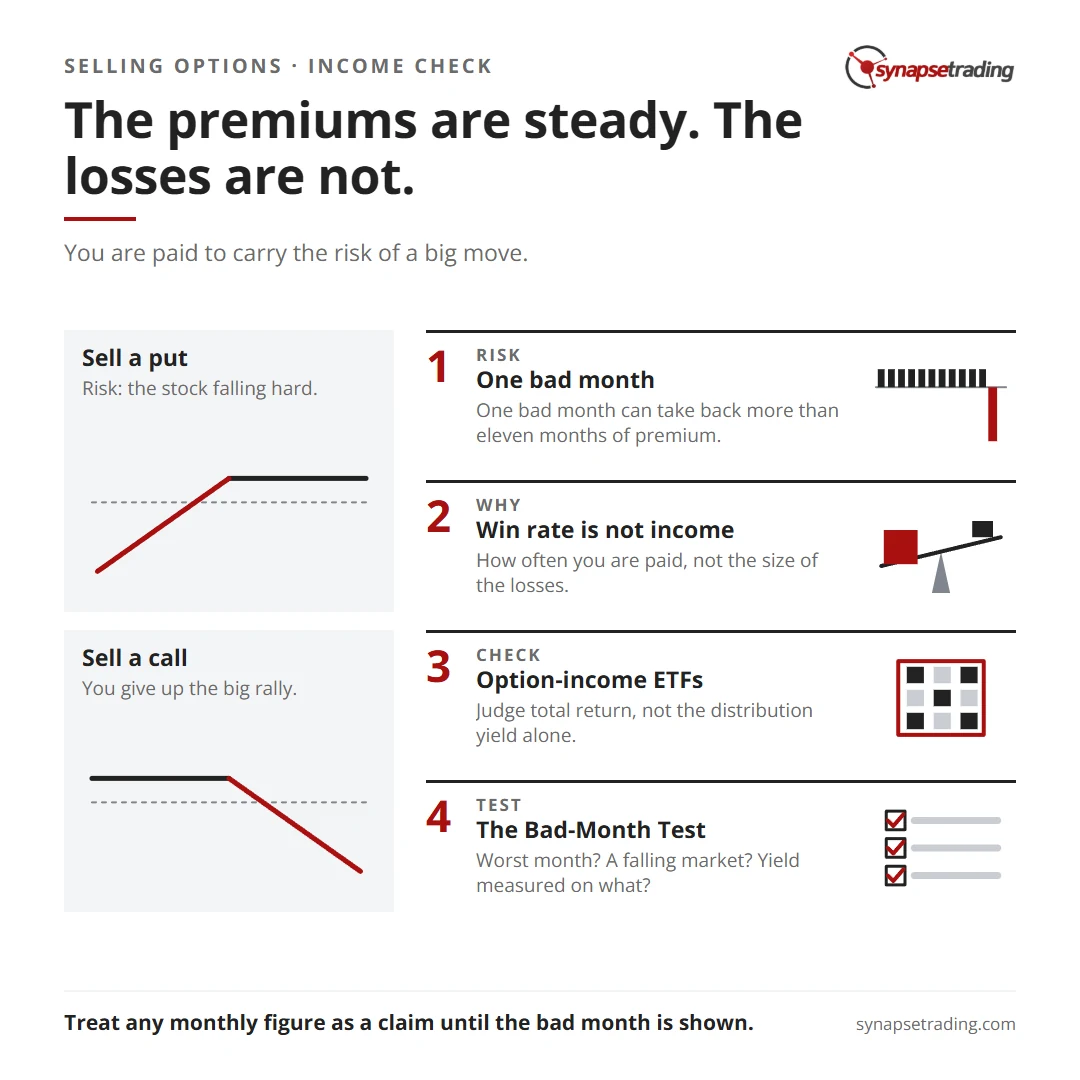
Selling options can collect small premiums month after month while markets are calm. Whether that adds up to a steady monthly income is a different question, and nobody can promise it. The premiums are steady. The losses are not.

When you sell an option, you are paid to carry the risk of a big move. Most months the big move does not come, and you keep the premium. In the month it does, a single loss can take back many months of premium at once. So a monthly figure on its own tells you almost nothing about what selling options for income will actually pay. It only means something with the worst month printed beside it.

That is the whole post in one line, and the rest is the arithmetic, the evidence and a simple check you can run on any income claim. I will call the check the Bad-Month Test.

The premiums are steady. The losses are not. Summary card for the post: Can Selling Options Pay a Steady Monthly Income?.

Where does the premium come from?

Think about the travel insurance you buy before a holiday. You pay a small amount, you almost never claim, and the insurer keeps most of what you paid. That is a good business for the insurer, until the year a volcano closes every airport in the region and the claims arrive all at once.

An option seller is the insurer. The buyer of a put is paying you to carry the risk of the stock falling hard. The buyer of a call is paying you to give up the big rally. Either way, the premium is the price of a risk you agreed to hold, and the market sets that price to cover the bad months on average, over time.

So the premium is real, and it is also a payment for something. That something shows up eventually.

What do small wins and rare losses add up to?

Let’s put numbers on it, with one hypothetical example. The figures are made up to keep the arithmetic easy, and they are not what any strategy pays.

Say you sell a cash-secured put every month on the same stock, about 10% below the current price, and collect 1.5% of the cash you set aside each time. For 11 months the stock stays above the strike and every put expires. In month 12, bad results come out and the stock falls about 32%, to 34 against your strike of 45.

MonthsWhat happensResult on the cash set aside
1 to 11each put expires, premium kept+1.5% a month, +16.5% in total
12assigned at 45, shares worth 34, premium keptabout −22.9%
The year11 good months, 1 bad oneabout −6.4%

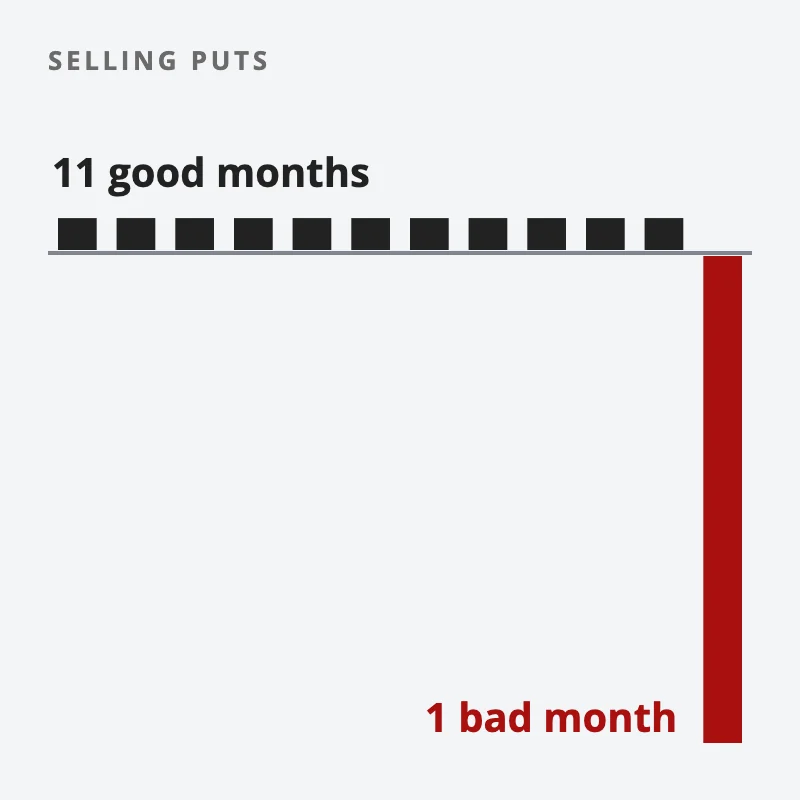
Look at the 2 numbers in collision. Eleven months of income that felt steady, and one month that cost 15 months of premium. The average month in that year was a loss, even though 92% of the months paid.

Eleven small bars for eleven months of premium kept, then one red bar for the bad month, many times longer and pointing down
One bad month can take back more than eleven months of steady premium.

And notice what the monthly statement looked like for 11 straight months. Smooth, green and reassuring. Anyone who stopped counting at month 11 would have called it a steady income. That is the problem with judging this strategy by its good months, because the good months are the ones you see most of.

What do traders who tried it report?

The question comes up constantly. In the r/thetagang forum, which exists for option sellers, one thread asks it directly: “Anyone actually living abroad off CSP/wheel income consistently?” CSP there means cash-secured puts.

The evidence people post is mixed, and most of it is self-reported. A retail backtest on r/options in September 2026 ran 42 option strategies on 3 big US index ETFs from 2020 to 2025, each held for 10 trading days. Bull put spreads, a common income structure, won 70.4% of the time and averaged slightly below zero after costs. Selling cash-secured puts won 74.1% of the time, and its worst single trade lost about 20% of the ETF’s value. Another trader logged 60 index iron condor fills in March 2026 and wrote that his “actual returns were consistently coming in 15-20% below what my model projected”, because the fills on a multi-leg order are worse than the price on the screen.

None of this proves that option selling cannot work. It shows that a high win rate and a positive income are 2 different things, and that the gap between them is made of the rare large loss plus the costs.

If you want the routine for the trades we do teach, the free 15-Minute Swing Trader’s Checklist is at the end of this post.

What about option-income ETFs?

These funds sell options on a basket of shares or an index, and pay out the premiums as regular distributions. Some advertise a distribution yield that looks very generous.

A distribution is not the same as a return, though. The figure that matters is the total return, which is the change in the fund’s price plus everything it paid out. If the price falls while the payouts continue, part of what you received was your own capital coming back to you. Funds like this do report part of a payout as exactly that, a return of capital. One covered-call fund’s own notice for September 2026 estimated all of that month’s payout as return of capital. (Tax on the payouts, for a Singapore investor holding a US-listed fund, is a separate matter that this post does not cover.)

So the fund gets the same check as the strategy: what happened in the bad months, and what was left after them.

How do you check a monthly income claim?

Here is the Bad-Month Test. It is 3 questions, and they work on a YouTube channel, a course page, a fund factsheet or a friend at dinner.

  1. What was the worst month, and the deepest drawdown, printed beside the average? An average with no worst month beside it is half a number.
  2. Does the record run through a falling market? A record built only in rising months has not met its bad month yet.
  3. What is the yield measured on? A yield on the full cash the trade could cost is one thing. A yield on the margin the broker asked for is the same trade with leverage on top, and it fails much faster.

Treat any monthly figure as a claim until the bad month is shown beside it. That says nothing about whether option selling is good or bad as a strategy. It says the income framing hides the very number that decides it.

If you want to see the strategy most often sold as monthly income laid out stage by stage, the wheel strategy and cash-secured puts shows where it breaks. The ultimate guide to options trading has the wider map, and why trading only works if you run it like a casino explains the other half of the insurer’s job, which is never letting one claim sink the company.

So, back to the r/thetagang question, whether anyone lives abroad off this consistently. Maybe. But the reply worth having is the one that comes with the Bad-Month Test answered, and that is the reply to ask for.

FAQ

Can selling options pay a steady monthly income?
It can collect small premiums in most calm months, but the losses arrive rarely and in size, so the total is not steady. Any monthly figure needs the worst month and the drawdown beside it before it means anything.

Is selling options for income safe?
No strategy that carries the downside of a stock is safe. Selling a put or a covered call collects a premium in exchange for holding that downside, and one large fall can cost many months of premium.

Why does selling options have such a high win rate?
Because most options expire without the big move they insure against, so the seller keeps the premium most of the time. The win rate measures how often you are paid, and it says nothing about the size of the losses.

Are option-income ETFs a good source of monthly income?
Judge them on total return, the price change plus the payouts, and not on the distribution yield alone. Part of a payout can be your own capital coming back to you.

How much do you need to sell options for income?
For a cash-secured put, 100 times the strike price for each contract. Using margin instead lowers the cash needed and raises the risk.

Does Synapse Trading teach option selling?
No, we do not teach options at the moment. We teach end-of-day swing trading in shares, forex and ETFs, with the same rule that applies here, which is to judge any method by its losing stretch as well as its average.

Go deeper

The Bad-Month Test is the same habit that keeps a swing trader honest about any system, and the swing-trading side is the part we do teach. The free 15-Minute Swing Trader’s Checklist has the daily routine, the questions to ask before every trade, and the five rules that keep you in the game.


About the author. Spencer Li is The 15-Minute Trader and the founder of Synapse Trading. He is a Certified Financial Technician (CFTe) with 15+ years of trading, run from 70+ countries. He holds a B.Acc and B.BM from SMU. Every trade he takes is public, dated, losses left in. He teaches low-risk swing trading in 15 minutes a day, one system for any market.

Educational content only, not personalised financial advice. Trading carries risk, including loss of capital, and isn’t suitable for everyone. Past performance is not indicative of future results. Synapse Trading is not licensed or regulated by MAS.
by Spencer Li
https://synapsetrading.com/wp-content/uploads/2026/10/selling-options-for-income-card.webp 630 1200 Spencer Li https://synapsetrading.com/wp-content/uploads/2026/10/synapse-logo-horizontal-light.png Spencer Li2026-09-03 13:04:372026-10-05 18:16:10Can Selling Options Pay a Steady Monthly Income?
Page 1 of 14123›»

Free checklist

The 15-Minute Swing Trader’s Checklist

The daily and weekly routine I use to find, manage and review trades in about 15 minutes a day, trading since 2007.

Get the free checklist

Topics

  • Trading foundations
  • Technical analysis
  • Strategies and systems
  • Risk and money
  • Trading psychology
  • Markets and products

Synapse Trading

Swing trading for busy professionals, in 15 minutes a day.

Start free

Learn

  • Start here
  • Free trading guides
  • Blog
  • Tools and resources

Programs

  • Trading Mastery Program
  • Daily trading signals
  • Student results
  • Public trade log

Company

  • About
  • Contact me
  • Partnerships
  • Disclaimer
  • Privacy policy
  • Terms & Conditions

Synapse Trading Pte Ltd
Registration No. 201316168H
WhatsApp +65-8897-1204
info@synapsetrading.com

Contact Us

Synapse Trading Pte Ltd
Registration No. 201316168H

Whatsapp: +65-8897-1204
Telegram: @iamrecneps
Email: info@synapsetrading.com

Links

Disclaimer
Privacy policy
Terms & Conditions
Contact us
Partnerships

© 2012-2026 Synapse Trading | All rights reserved. Educational content only, not personalised financial advice. Trading carries risk, including loss of capital. Past performance is not indicative of future results. Synapse Trading is not licensed or regulated by MAS.
  • Link to Facebook
  • Link to X
  • Link to Instagram
  • Link to Youtube
  • Link to LinkedIn
  • Link to Mail
Scroll to top Scroll to top Scroll to top