

Iron Condor Strategy: How It Works, the Real Odds, and What Goes Wrong
Want the daily routine? Get the free 15-Minute Swing Trader’s Checklist. Get it free →
One trade worked through in full, the win rate you actually need, and the 3 ways a quiet trade turns into a big loss
Published: 17 October 2026 · Last updated: 17 October 2026 · By Spencer Li, CFTe
An iron condor is an options trade that makes money when a stock stays inside a price range until expiry. You sell a call above the current price and a put below it, and buy a further-out call and put as protection. You collect a credit up front and keep all of it if the stock finishes between your 2 short strikes.
It is popular for one reason. It wins most of the time, because wide strikes leave the stock plenty of room, and unlike selling options with no protection, the bought options put a hard limit on what you can lose.
The catch is in the arithmetic. The most you can make is small, and the most you can lose is several times bigger. So an iron condor needs a high win rate just to break even, and a few bad weeks can erase months of small gains. Below is one trade worked in full, and a simple 3-part check.
How does an iron condor work?
An iron condor is 2 credit spreads at once, one on each side of the price. Here is a hypothetical example with round numbers.
A stock trades at USD 100, and you open 4 options that all expire next month:
- Sell a 110 call and buy a 115 call. This is the call spread above the price.
- Sell a 90 put and buy an 85 put. This is the put spread below the price.
- Collect a total credit of USD 1.50 a share, say 0.75 from each side.
Here is what happens at expiry, per share:
| Stock price at expiry | Result per share | What happened |
| 85 or lower | -3.50, the max loss | The put spread lost in full |
| 88.50 | 0 | Lower breakeven |
| 90 to 110 | +1.50, the max profit | Every option expires worthless |
| 111.50 | 0 | Upper breakeven |
| 115 or higher | -3.50, the max loss | The call spread lost in full |
The max profit is the credit, 1.50. The max loss is the width of one side, 5, minus the credit, which is 3.50. One contract covers 100 shares, so that is USD 150 at best and USD 350 at worst per condor.
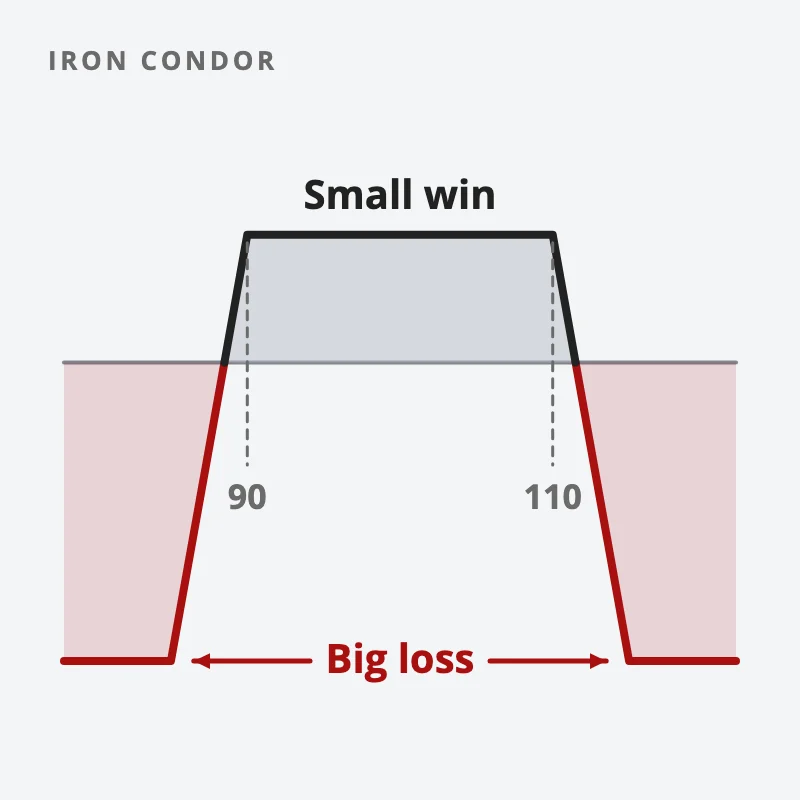
Only one side can lose in full, because the stock cannot finish above 115 and below 85 at the same time. Our post on sizing a credit spread by its max loss shows how to turn that 3.50 into a position size.
What is the real success rate of an iron condor?
This is the question people search most, and the honest answer has 2 halves.
The first half is the win rate. Pick strikes far enough away and the stock will finish inside the range most of the time, which is why condor results so often show 70%, 80% or more winners.
The second half is the break-even win rate. In the example, one full loss of 3.50 wipes out more than 2 full wins of 1.50. To break even with full wins and full losses, you need to win 3.50 out of every 5.00 at stake, which is 70% of the time. The wider your strikes, the higher your win rate, but the smaller your credit, and the higher the win rate you need. Both numbers climb together.
So a high win rate on its own says very little. A trader on an options forum who sold very far out-of-the-money spreads did this sum for himself, and concluded: “Seems like a zero sum game or even a negative sum game.”
Robert Carver, who ran money for a systematic hedge fund, gives a plain warning in Systematic Trading. If you make steady profits nearly every day and most trades win, he writes, “there is a good chance you are engaged in negative skew trading. It’s just that you haven’t yet seen any rare large losses.” Our post on selling options for income looks at why that pattern catches so many people.
What makes an iron condor lose money?
Three things, and only the first shows up on the payoff table.
1. A big move. A surprise earnings result, a central bank decision or a market sell-off can carry the stock past one of your short strikes in a day. The protection limits the damage. It is still the full 3.50.
2. Rising volatility. An iron condor is a bet that the stock will move less than the market expects, and in options terms it gains from time passing and loses when expected volatility rises. Our guide to the options Greeks explains theta and vega if those words are new. Even if the stock stays inside your range, a jump in fear can push the condor’s price up, and closing early then costs you.
3. Costs and fills. A condor has 4 legs, so you pay 4 commissions and cross 4 bid-ask spreads to open it, and again to close it early. On a trade where the most you can make is 1.50, every few cents matters.
There is also the fine print around expiry. US-listed stock options can be exercised before expiry, so a short leg deep in the money can be assigned early. And if the stock closes right at one of your short strikes on expiry day, you may not know until the next morning whether you hold the shares. The post on what happens when an option is assigned covers both in detail.
Very short condors that expire the same day have become popular, and they compress all of this into hours. The post on 0DTE options explains how that changes the risk.
If you want the daily routine for the trades we do teach, the free 15-Minute Swing Trader’s Checklist is at the end of this post. Get the free checklist →
How do experienced traders manage iron condors?
Most decide the exit first.
One trader on an options forum wrote in April 2026 that he had spent 12 years fighting the same problem: “one big loser wiping out all the small winners.” Defending and rolling the trade had not fixed it. What finally worked for him was a fixed rule: close the condor at half its max profit, or as soon as one short option moved close to the money. His win rate fell to around 60%, but his results became smoother, because no single loss could grow to the full width.
That is a fair point in favour of the strategy. A condor with a firm exit rule behaves quite differently from one left to run to expiry. It still does not change the shape of the trade. The wins stay small and fixed, and the losses still have to be kept small by you, every time, including on the day the market gaps through your stop.
A 3-part check before any iron condor
Here is a simple check that works for any condor, whatever the market:
- The range. Write down both breakevens. Then list every event before expiry that could move the stock past them, such as earnings, a dividend date or a central bank meeting.
- The ratio. Divide the max loss by the max profit. Work out the win rate you need to break even, and ask honestly whether your record beats it after costs.
- The exit rule. Decide the exit before you enter. Write down the profit target, the loss point, and the number of condors that would lose together if the whole market fell sharply in one day.
Size any trade like this by its max loss, never by the credit. The credit is the number you see, and the max loss is the number that decides whether you are still trading next year.
So, if your last 10 condors all won, how would you know whether you have an edge, or just have not met the bad week yet? And how many of your open trades would lose together if the market gapped 5% overnight? For the full picture of how options fit into a trading plan, see the guide to options trading.
FAQ
What is an iron condor in simple terms?
It is 4 options combined into one trade that profits if a stock stays between 2 prices until expiry. You collect a credit up front, and the 2 bought options limit how much you can lose.
What is the max loss on an iron condor?
It is the width of the wider spread minus the total credit collected. In the example above, that is 5.00 minus 1.50, or 3.50 a share.
What is the difference between an iron condor and an iron butterfly?
An iron butterfly sells both the call and the put at the same strike, usually at the current price. It collects a bigger credit, but the stock has to finish closer to that one price to keep it. An iron condor sells 2 different strikes, so it has a wider profit zone and a smaller credit.
What is the difference between an iron condor and a short strangle?
A short strangle sells the same call and put without buying the protective options. It collects more, but its possible loss on a big move has no fixed limit. The iron condor gives up some credit to limit the loss.
Does Synapse Trading teach iron condors?
No, we do not teach options at the moment. We teach end-of-day swing trading in shares, forex and ETFs, and the risk-per-trade sizing above works the same whichever product you use.
Go deeper
This post covers one corner of options. If you would rather start with what we do teach, the free 15-Minute Swing Trader’s Checklist has the daily routine, the questions to ask before every trade, and the five rules that protect your account. Enter your email and we’ll send it over:
We use your email address to send you the checklist, then emails about trading and our courses. Unsubscribe in one click, any time. Privacy policy.
About the author. Spencer Li is The 15-Minute Trader and the founder of Synapse Trading. He is a Certified Financial Technician (CFTe) with 15+ years of trading, run from 70+ countries. He holds a B.Acc and B.BM from SMU. Every trade he takes is public, dated, losses left in. He teaches low-risk swing trading in 15 minutes a day, one system for any market.
Educational content only, not personalised financial advice. Trading carries risk, including loss of capital. Past performance is not indicative of future results. Synapse Trading is not licensed or regulated by MAS.
Want the daily routine? Enter your email for the free 15-Minute Swing Trader's Checklist.
Free 5-page PDF, then occasional trading emails. Education only, not financial advice. Unsubscribe anytime. Kit stores your email in the US: see our privacy policy.
Want to learn the full method? The Trading Mastery Program teaches the 4 strategies I have traded since 2011. It suits beginners and experienced traders.
Rather follow the trades as they happen? Daily Trading Signals is our Telegram channel: my trade ideas with entry, stop and exit, and every trade is public.
Questions about this post? Ask in the free Telegram channel →
Educational content only, not personalised financial advice. Trading carries risk, including loss of capital. Past performance is not indicative of future results. Synapse Trading is not licensed or regulated by MAS.

