

How to Craft a Winning Trading Plan (The 7 Key Ingredients)

Join our Telegram channel for more market analysis & trading tips: t.me/synapsetrading
You’ve probably heard that you need a trading plan before you start trading, but how exactly do you go about crafting one?
Now, if you’ve ever tried to start a business, you will know that you need a business plan, which tells you the A to Z of everything you need to do for your business, the step-by-step process you’re going to execute your plan, your strategy, and all that.
So the same thing applies to trading.
You need a trading plan before you start trading.
And today I’m going to share with you the 7 key ingredients that you need to craft a winning trading plan.
Table of Contents
Trading Plan Ingredient #1 Trading Style
The first thing you need to do is to determine what is your preferred trading style.
Now, there are three main types of trading styles: day trading, swing trading, and position trading.
The main determining factor would probably be the amount of time that you can afford to spend on trading.
So if you are doing it as a full-time job, or if you have a lot of time to spend, then you can probably consider trying day trading.
And if you like the fast-paced environment and making quick decisions, then that may be something for you.
On the other hand, if you’re just doing it as a part-time endeavor where you have maybe an hour or 2 a day to spend on trading, then you might consider swing trading instead where you take longer-term positions, more in the medium to long-term position instead of going in and out of the market, such as like in day trading.
Lastly, if you do not have much time at all to spend, then probably the most effective thing for you to do is position trading that you take long-term positions that could last weeks or months.
So this does not require you to spend a lot of time analyzing the charts on a day-to-day basis.
Trading Plan Ingredient #2 Trading Timeframe
Now, the second factor to consider is the timeframe.
Now this corresponds closely to the trading style that you choose.
For example, if you are day trading, most likely you’ll be using an intraday timeframe such as the 5-minute chart or the 15-minute chart, or even the 1-hour chart.
On the other hand, if you are swing trading, most likely you’ll be using a timeframe such as the hourly chart, the 4-hour chart or the daily chart.
And lastly, if you are doing position trading, which is a long-term endeavor, you’ll probably be using the daily chart or the weekly chart, or even the monthly chart.
Trading Plan Ingredient #3 Product Selection
The third major ingredient is the product.
Now, this is the trading product that you are choosing to specialize in.
For example, it could be things like forex, stocks, bonds, commodities, derivatives, cryptocurrencies, options, etc.
There are actually many different products, so you need to find a product that suits your trading style, suits your personality, something that you are going to be familiar with.
Trading Plan Ingredient #4 Risk Management
Now, this is the part that determines how you allocate your resources.
So for example, one thing to note is your starting capital, which is the amount of capital that you are going to start with, because this will determine your trading size and the risk that you’re going to take for each trade.
So for example, a common calculation is to risk 1 to 2% of your capital per trade, depending on how much risk you want to take.
If you are starting with $10,000, then you will probably be risking 2% of $10,000 per trade, which is about $200 a trade.
And the other thing you need to take note off, is the open risk on all your trades.
If you are risking, say 1 or 2% on each trade, you need to ask yourself, what is the maximum risk or maximum drawdown that can happen if all the positions that you have open at one time, all get stopped out simultaneously.
So when that happens, what is the total amount of risk?
And that is known as the open risk.
If you’re risking 1% a trade and you have 5 trades that all go sour at the same time, you lose 5%. So 5% is your open risk.
You want to limit your open risk to less than 5% because you don’t want to lose a large chunk of your capital at the same time.
It’s ideal that you have a limit to the monthly drawdown that you incur, because you don’t want to have a scenario where you lose a large chunk of your capital in one time period, because if you will lose too much capital in one month, then in the next month, you have no more capital to trade.
If you are not doing well this month, it will be ideal to perhaps take a break from trading and you can come back to fight the next month.
Trading Plan Ingredient #5 Type of Analysis
The next major category to look at is the type of analysis that you are going to be using.
Now, there are three main types of analysis: price action, classical charting, and technical indicators.
Now, each of these is a complex topic that I have created other tutorials on.
So the main thing for you is really to decide which one you are going to specialize in.
But most of the time as a trader, it’s important to actually learn and master all the three different techniques because you are going to use them in combination in certain ways.
And that actually leads you to formulate your trading strategies, which is number 6, the type of strategy that you are going to be using.
Trading Plan Ingredient #6 Type of Strategy
Now, personally, I feel that most trading strategies will fall under 4 main categories: breakouts, trend-following, counter-trend and market reversals.
So if you look at your strategy, you want to be able to see which category it falls under so that you can better understand, what are the strengths and weakness of each strategy.
To help you out, I have other tutorials that cover each strategy in greater detail.
So, what are the different strategies that I use?
Breakouts are when price breaks to new highs or new lows.
Trend-following is more like finding an opportunity to ride on a strong trending market.
So usually you look to enter on pullbacks.
Counter-trends are usually opportunities where the market has gone to certain extremes, like too overbought or too oversold. Knowing how to pinpoint and target those counter-trends, is the essence of counter-trend trading.
Lastly, market reversals are like the big kind of reversals or turns in the market.
They do not happen that frequently, but when it does happen, you want to be aware because it leads to a change in the major trend.
Trading Plan Ingredient #7 Trade Execution
The final 7th ingredient is the trade execution.
Now there are three key parameters that you need to determine before you decide to enter a trade.
And that is the trade entry, the stop loss and the target price.
The trade entry is the price at which you are going to enter the trade and that is determined by the strategy and the setup that you are using.
The stop loss is the price that you are going to get out of the trade.
So, a stop loss is there to protect and limit the amount of loss that you are going to incur on the trade.
There are certain types of stop loss, such as the fixed stop loss, the trailing stop loss and all these should be part of your trading plan.
And finally, the last thing is the target price, which is where you are going to take profit on a trade if it does go in your favor.
So you need to have certain preset rules, for example, how are you going to project a target price?
Or how are you going to determine where’s the optimal point to scale down your positions or to get out of the position totally?
Trading Plan Bonus Ingredients
Now that I’ve covered the seven key ingredients to a winning trading plan, there are some other things that you might want to include as well.
For example, evaluation metrics.
How do you going to measure and improve the performance of your trades, as well as trading psychology rules that you can implement to prevent you from making cognitive biases or mistakes in your trading.
So remember that the key purpose of having a solid trading plan is to separate the execution phase from the planning phase.
Ideally, the moment the market opens, you are focused on executing your trading plan and you no longer have to strategize because if you are trying to do both at the same time, it is going to be really difficult to concentrate.
Therefore, that is the idea of a trading plan.
Now that I have shared the key ingredients in my planning plan,
What are some of the things that are missing from your trading plan or things that you think can be improved on?
Do let me know in the comments below.
About the author. Spencer Li is the founder of Synapse Trading and a Certified Financial Technician (CFTe) with 15+ years of trading across stocks, forex, crypto, commodities, and bonds. His trade log is public: every trade since April 2024, dated, losses left in. He has taught a 15-minute daily trading routine since 2014, one system for any market.
Education, not financial advice. Synapse Trading is not licensed by MAS to advise on investment products. Trading carries risk of loss; past performance is not indicative of future results.
Want our free trading resources by email? Leave your address below.
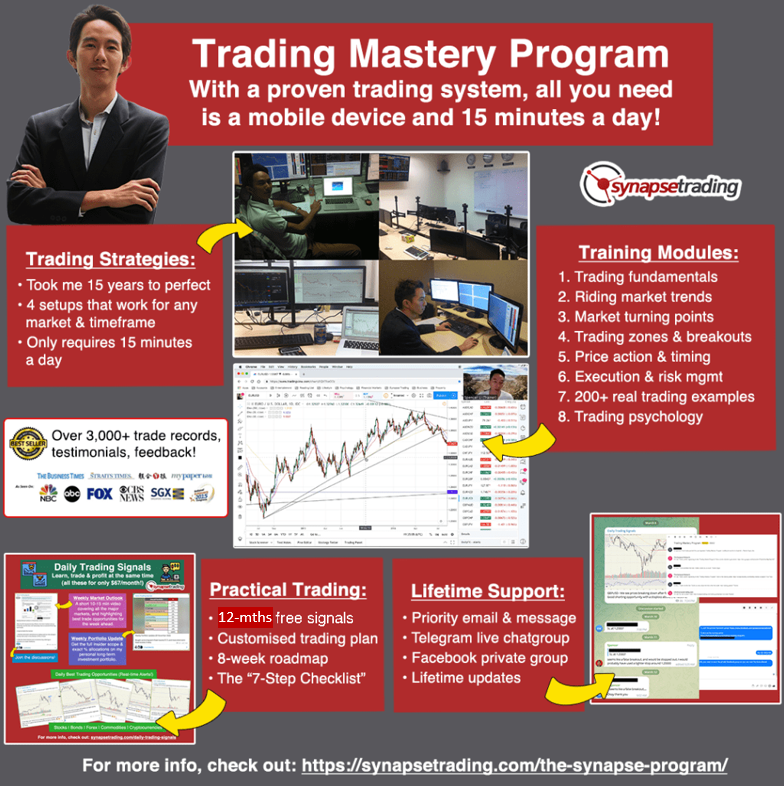 Our flagship mentoring program is suitable for both beginners and advanced traders, covering the 4 strategies which I used over the past 15 years to build up my 7-figure personal trading portfolio.
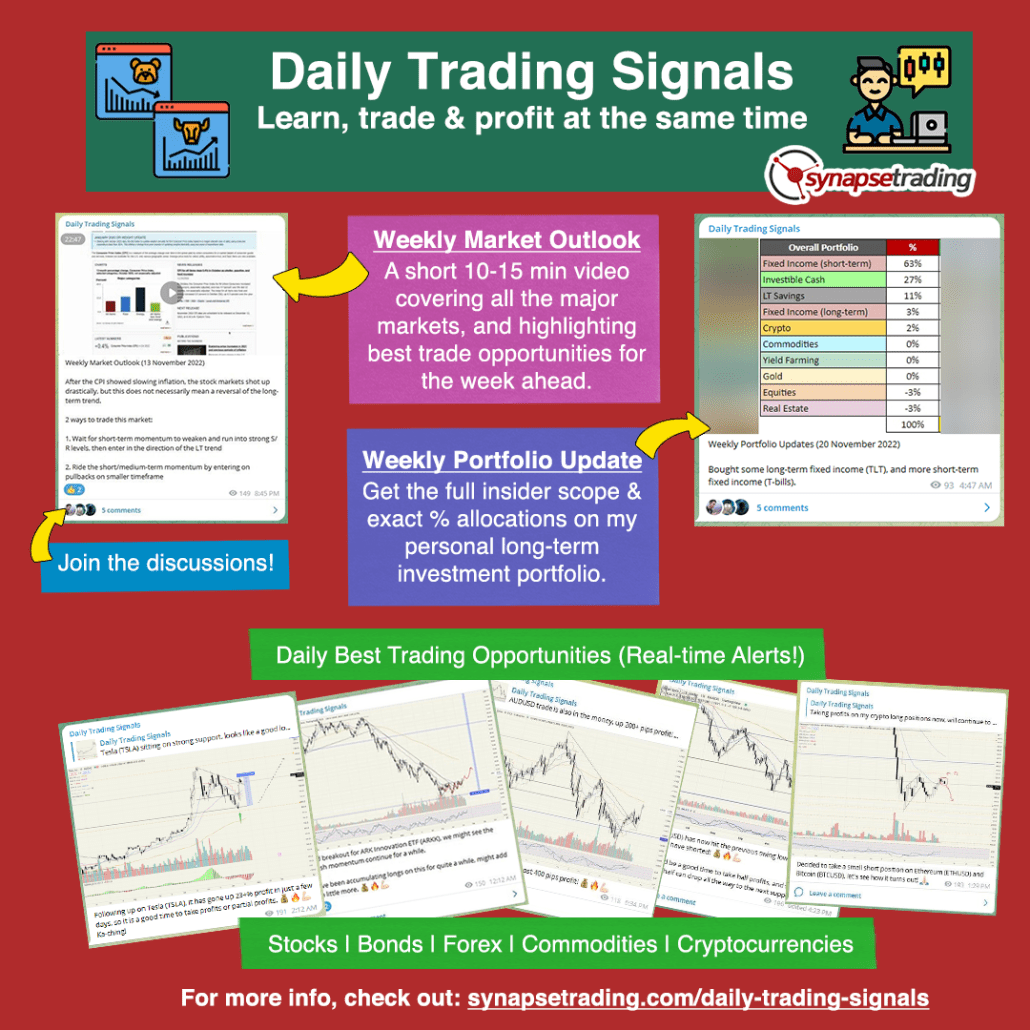 If you're looking for the best trading opportunities every day across various markets, and don't want to spend hours doing the research yourself, check out our private Telegram channel!



Leave a Reply
Want to join the discussion?Feel free to contribute!