
Why Paper Trading is a Waste of Time (And What are Better Alternatives?)
Want the daily routine? Get the free 15-Minute Swing Trader’s Checklist. Get it free →
Paper Trading: Is It Worth It, and What Are the Better Alternatives?
Last updated: 27 September 2026 · By Spencer Li, CFTe
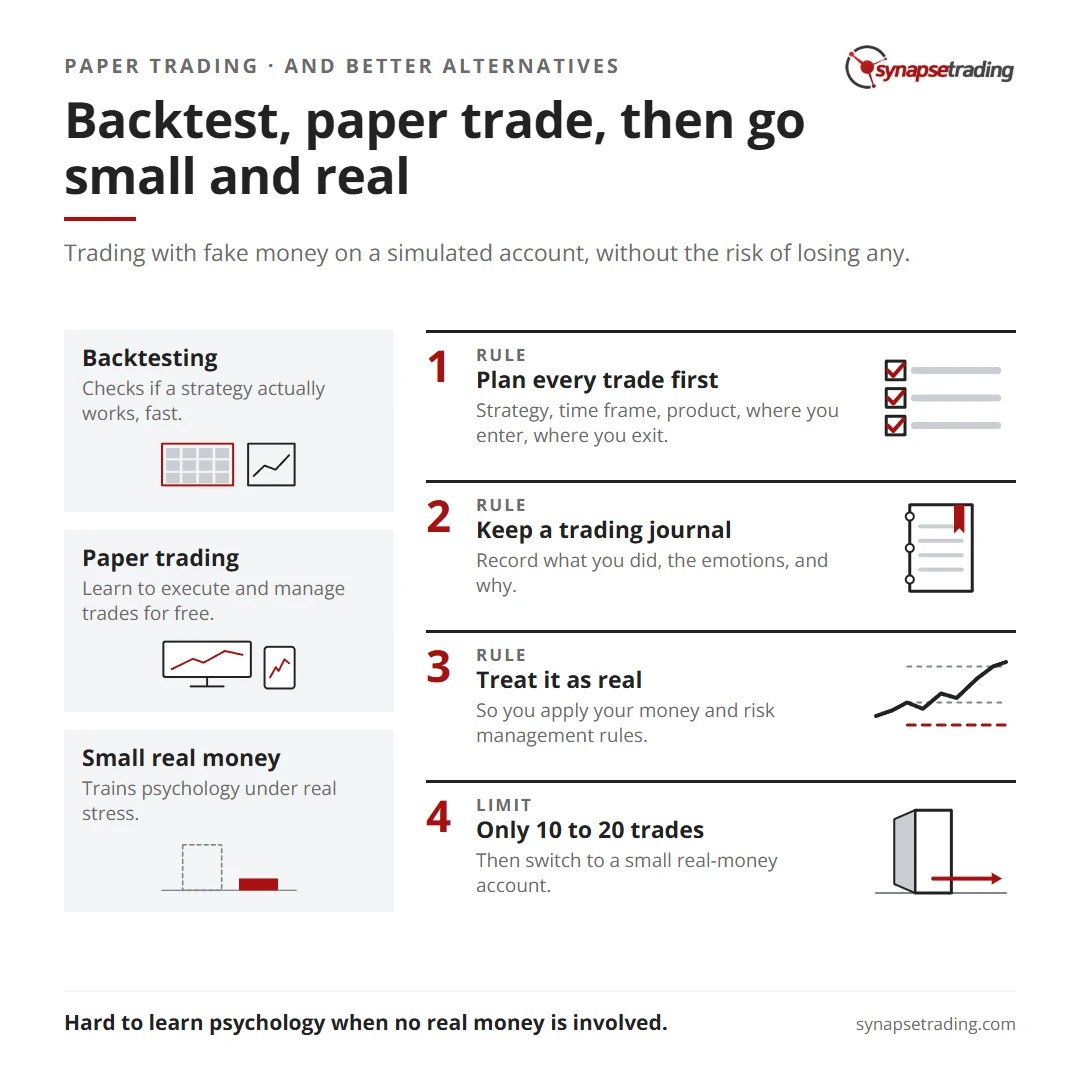
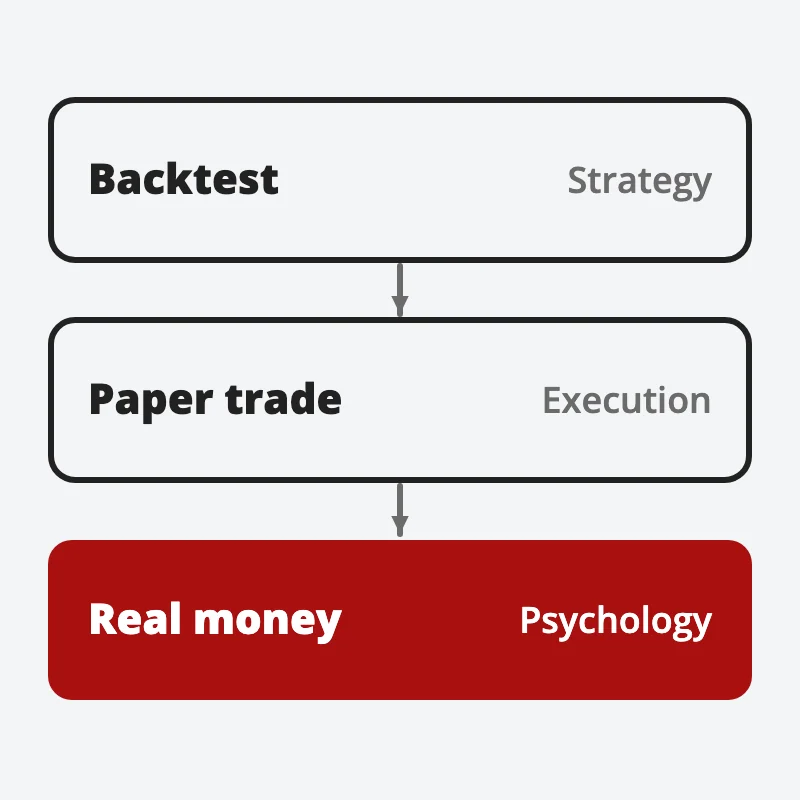
Paper trading (also called demo trading or virtual trading, where you trade with fake money to simulate the experience without real risk) is worth it for your first 10 to 20 trades, and not much beyond that. It is good for one job: learning to execute and manage trades without paying for your beginner mistakes. It is bad at the job most people hope it will do, which is teaching trading psychology, because there is no real money on the line. The two better tools for what people usually want from paper trading are backtesting (to check if a strategy works) and a small real-money account (to train your psychology). The flow I recommend is simple: backtest the strategy, paper trade to learn the process, then switch to a small real-money account as fast as you reasonably can.
Here is what paper trading does well, where it fails, how to do it correctly, and the alternatives that do each job better.
What is paper trading?
Paper trading, demo trading, and virtual trading are the same thing: trading with fake money on a simulated account, so you get the experience of trading without the risk of losing any.
You use a virtual or demo account, place buys and sells, and watch how the trades play out, but no real money ever changes hands. So you cannot lose anything.
The logic for a beginner is sound. Most of your worst mistakes happen at the very start. Paper trading lets you make those mistakes for free. You start with fake capital, focus on honing the mechanics, and scale up to real money as your skill improves.
That works for the first 10 to 20 trades, where you just want to learn how to fire off an order and manage it. After that, paper trading hits its ceiling, for one reason: you cannot learn real trading psychology from it.
Why paper trading cannot teach you trading psychology
Mindset is a major factor in trading success, arguably the deciding one. And mindset only switches on when something is at stake.
Imagine playing poker with fake money. Is it the same experience? Definitely not.
Trading, like poker, tests your ability to make sound decisions under the stress of having money on the line. Take the money away and you take the stress away, and the stress is the whole point. Without skin in the game, the experience is just not the same.
This is not a small caveat. It is the single biggest reason not to overstay in the demo phase.
How to paper trade correctly (the 3 rules most people skip)
Most people paper trade wrongly, and hence it ends up being a waste of time. If you want to get real value out of it, three things matter.
1. Have a trading plan first. Before you place any trade, on a real or demo account, plan it fully: what strategy, what time frame, what product, where you enter, where you exit. If you go into paper trading and just randomly buy and sell, there is no learning at all, because whether you win or lose, you have no idea whether what you did was right or wrong. (More on this in How to Craft a Winning Trading Plan.)
2. Keep a trading journal. Record the whole decision-making process: what you bought and sold, the emotions involved, and why you made each call. That data, from your plan and your journal together, is what lets you improve the strategy before you risk real money. (See How to Create a Trading Journal.)
3. Treat the demo account as if it were real. This is the most important one. It is the closest you can get to simulating real psychology. If you treat fake money like real money, you will actually apply your money-management and risk-management rules, instead of doing reckless things you would never do with your own cash.
Ways to paper trade
There are two easy ways, and you do not need anything fancy.
The manual way is pen and paper, or a spreadsheet. You spot a setup, note “buy X lots at this price,” and as price moves you record your exit and the result. It is slow, but it forces you to write down your thinking.
The software way is a demo account. TradingView and most brokerage platforms give you a virtual account where you can buy and sell the real products on the platform, and every transaction is logged for you to review later. If your demo platform matches the live platform you will eventually trade on, even better.
Paper trading vs backtesting vs a small real-money account
Here is the part the original slug points at: the alternatives. Paper trading is not the only tool, and for two of the three jobs beginners care about, it is not even the best one. This table is the whole post in one view.
| Tool | What it is | Best for | Weakness |
|---|---|---|---|
| Backtesting | Running a strategy against historical data, ideally automated | Checking if a strategy actually works, fast | Past results do not guarantee future ones; no execution practice |
| Paper trading | Trading fake money on a demo account in real time | Learning to execute and manage trades for free; forward-testing | Teaches no real psychology; can hide slippage and commissions; breeds overconfidence |
| Small real-money account | Live trading with a small amount you can afford to lose | Training trading psychology under real stress | Real losses; needs discipline and strict sizing |
The point of the table: if all you want is to know whether a strategy works, backtesting does that far better than paper trading. You can test 10 to 20 strategies by computerizing it, all at once, before you ever place a trade. And if you want to learn psychology, only real money does that. Paper trading sits in the middle, doing one narrow job (process and execution) well.
Pros and cons of paper trading
The pros:
- No risk. You can key in the wrong order or press the wrong button, reset the account, and try again. It is a cost-free way to make beginner mistakes.
- Confidence. As you get familiar with the platform and your execution, you build confidence in your strategy and test whether it holds up. This works best when the demo platform matches your future live platform.
- Forward-testing. Unlike backtesting (which looks at the past), paper trading tests your strategy forward, in live conditions, in real time.
The cons:
- No skin in the game. The big one. Hard to learn psychology when no real money is involved.
- Overconfidence. You can crush it on paper and then fall apart with real money. I saw this constantly when I traded professionally at hedge funds: people who did beautifully on the demo account lost their nerve, or got too cocky, the moment real money was on the line, and blew up.
- Slippage and commissions. Demo accounts often do not reflect real transaction costs accurately. If your strategy trades a lot, those costs add up and your demo results will flatter you.
- Backtesting does the strategy-check job better. If “does my strategy work” is the only question, reach for backtesting, not paper trading.
The part the demo account cannot give you
A backtest will tell you if the edge exists. A demo account will teach your fingers where the buttons are. Neither one will teach you what your stomach does when a real position goes against you and your own money is bleeding in real time. That is psychology, and it is one of the Five Edges no simulator can hand you. It only switches on when the loss is real. Hence, the goal is not to stay in the demo forever, it is to graduate out of it on purpose, as soon as you have the mechanics down.
Summary: the right progression
My advice to new traders is to paper trade for about 10 to 20 trades, then move to a small real-money account. It does not matter how small you start, as long as it is real money, because that is the only way to see what your psychology actually does under stress. From there you scale up slowly as you gain confidence.
The full flow, in order:
- Backtest your strategies. Once you have one that works, you
- Paper trade it to get familiar with the process and execution, and once you are comfortable, you
- Move to real money (start small) to train your trading psychology.
That is the whole progression. Backtest to validate, paper trade to practice, real money to grow up. Skip the middle if you must, but do not skip the last one, and do not live there forever.
So, now that you know the correct way to paper trade and the better alternatives for each job, do you still think paper trading is useful, and have you tried it yourself?
FAQ
Is paper trading worth it?
For your first 10 to 20 trades, yes. It is a cost-free way to learn how to execute and manage trades. Beyond that it has limited value, because it cannot teach you trading psychology when no real money is at stake.
What is the difference between paper trading and backtesting?
Backtesting runs a strategy against historical data to check if it works, and it is faster and more thorough for that. Paper trading tests a strategy forward in live conditions and lets you practice execution, but it does not prove an edge as efficiently as backtesting.
Why does paper trading fail to teach trading psychology?
Because there is no skin in the game. Trading, like poker, tests your decisions under the stress of real money on the line. Remove the money and you remove the stress, which is the very thing you need to learn to handle.
How do I paper trade correctly?
Three rules: plan every trade fully before you take it, keep a trading journal of your decisions and emotions, and treat the demo account exactly as if it were real money so you apply proper risk management.
How long should I paper trade before going live?
About 10 to 20 trades, just long enough to learn the mechanics. Then move to a small real-money account you can afford to lose, because real money is the only way to train your psychology.
Now that you have the progression, where are you in it: backtesting, paper trading, or live? Let me know in the comments.
And if you want the full starting roadmap, read the pillar: The Beginner’s Guide to Trading and Technical Analysis.
Want a system you can actually paper trade and then take live? Grab the free 15-Minute Swing Trading Starter Kit. It is the exact routine I use to scan once a day and trade any market in 15 minutes.
About the author. Spencer Li is The 15-Minute Trader and the founder of Synapse Trading. He is a Certified Financial Technician (CFTe) with 15+ years of trading, run from 70+ countries. He holds a B.Acc and B.BM from SMU. Every trade he takes is public, dated, losses left in. He teaches low-risk swing trading in 15 minutes a day, one system for any market.
Education, not financial advice. Synapse Trading is not licensed by MAS to advise on investment products. Trading carries risk of loss; past performance is not indicative of future results.
Related
Beginner’s Guide to Trading and Technical Analysis (pillar) · How to Craft a Winning Trading Plan · How to Create a Trading Journal · Backtesting a trading strategy
Want the daily routine? Enter your email for the free 15-Minute Swing Trader's Checklist.
Free 5-page PDF, then occasional trading emails. Education only, not financial advice. Unsubscribe anytime. Kit stores your email in the US: see our privacy policy.
Want to learn the full method? The Trading Mastery Program teaches the 4 strategies I have traded since 2011. It suits beginners and experienced traders.
Rather follow the trades as they happen? Daily Trading Signals is our Telegram channel: my trade ideas with entry, stop and exit, and every trade is public.
Questions about this post? Ask in the free Telegram channel →
Educational content only, not personalised financial advice. Trading carries risk, including loss of capital. Past performance is not indicative of future results. Synapse Trading is not licensed or regulated by MAS.

