

The Different Styles of Trading (Holding Period, Timeframe, Products, etc)

Join our Telegram channel for more market analysis & trading tips: t.me/synapsetrading
Table of Contents
The 3 Styles of Trading: Short-Term vs Medium-Term vs Long-Term (and Which Fits You)
Last updated: 3 July 2026 · By Spencer Li, CFTe
There are three main styles of trading, sorted by how long you hold a position: short-term, medium-term, and long-term. Short-term trading (day trading and scalping) means closing positions within the same day or even within seconds, using 5-minute or 15-minute charts, and it suits full-time traders who can watch the screen constantly. Medium-term trading, also called swing trading, holds for days to a few weeks on the 4-hour or daily chart, and it is the best fit for part-time traders with a full-time job. Long-term trading holds for weeks to months on the daily or weekly chart, and it suits people who want to check in only weekly or monthly. Your style decides your holding period, your timeframe, your time commitment, and the products you trade. For most people with a job, medium-term swing trading is the sensible starting point. Short-term trading is the most stressful and the least beginner-friendly, so I do not recommend it to people just starting out.
Here is how each style works, who it suits, and where it goes wrong.
What does “trading style” actually mean?
By style, I mean the way you approach trading. It is not the strategy or the indicator. It is the rhythm you commit to.
That rhythm then locks in four things at once:
- Your holding period (seconds, days, or months)
- Your timeframe (which chart you read)
- Your time commitment (how often you have to look)
- The products you can realistically trade
Get the style wrong for your life, and nothing downstream will work. A person with a 9-to-5 who tries to scalp 5-minute charts will lose to the people doing it full time. Pick the style that fits your schedule first, then build the strategy on top.
The 3 styles, side by side
| Holding period | Main timeframe | How often you check | Best for | Typical products | |
|---|---|---|---|---|---|
| Short-term (day trading, scalping) | Seconds to one day | 5-min, 15-min, or shorter | Constantly, every few minutes | Full-time traders | Forex, futures, larger stock markets |
| Medium-term (swing trading) | Days to a few weeks | 4-hour or daily | Every few hours or once a day | Part-time traders with a job | Forex, CFDs, lower-cost stock markets |
| Long-term (position trading, investing) | Weeks to months | Daily or weekly | Weekly, monthly, even quarterly | People with no time, more capital | Stocks, ETFs, REITs, dividend assets |
The products differ for a reason. Short-term traders need things that are very liquid, have low commissions, and move enough during a single day to be worth trading. Medium-term traders want products built for retail, with transaction costs low enough that holding for days still pays. Long-term traders want assets that appreciate over time and pay you to wait, which is why dividends and REITs show up here and not in scalping.
Is short-term trading right for me?
Short-term trading is mainly for people doing it full time. It includes day trading (closing all positions by the end of the day, so you never hold overnight) and scalping (taking extremely short-term positions that can last seconds).
You will mainly be using 5-minute or 15-minute charts, or even shorter timeframes. That means checking your screen every few minutes, or staring at it constantly.
This can be quite stressful for beginners. Hence, it is strongly not recommended as a starting point. The people on the other side of your trades are often full-timers with faster tools and years of screen time, and you are paying commissions on every fast in-and-out.
Is medium-term (swing) trading right for me?
Medium-term trading is the most ideal for part-time traders, because it does not require much monitoring of the markets. It is also known as swing trading, because it captures the “swings” in the market.
You will mainly be using the 4-hour or daily chart. So you only need to check your charts every few hours, or even once a day. That makes it ideal for people who have a full-time job and do not want to spend all day looking at charts.
Personally, this is the style I teach and trade. The products tend to be the ones better suited to retail traders: forex, CFDs (contracts for difference, where you trade the price move without owning the asset), and stock markets that do not carry too-high transaction costs. You get most of the opportunity without the screen addiction.
Is long-term trading right for me?
Long-term trading is suited for people who do not have any time at all. It includes position traders and investors who take positions that can last weeks or months.
You will mainly be using the daily or weekly chart, so you will probably only be checking your positions weekly, monthly, or even quarterly. This is the most hands-off option.
Do note that, it also requires a lot of patience. And it is not suitable for people with little capital, because your money is going to get locked up for long periods. The products tend to be more asset-based: stocks, ETFs (exchange-traded funds, baskets of assets you buy in one ticker), REITs (real estate investment trusts), and other assets that can appreciate over time and pay dividends.
So which style should you pick?
Start from your calendar, not from your ambition. The honest order for most people:
- Have a full-time job and limited screen time? Medium-term swing trading. This is the default I point beginners to.
- Trading full time and able to watch the market all day? Short-term becomes possible, but go in knowing it is the most stressful and the most competitive.
- Have spare capital, plenty of patience, and almost no time to watch? Long-term position trading lets your money work while you do other things.
There is no “best” style in the abstract. There is only the one that fits your time, your capital, and your temperament. The traders who blow up usually picked a style that fought their own life.
A screener can tell you what a chart is doing on any timeframe. It cannot tell you which timeframe you can actually sustain at 11pm after a full day of work. That choice, matching the style to your real life and then holding the discipline to stay in it, is judgment, and it is the first of the Human Edges no tool trades for you.
FAQ
What are the 3 main styles of trading?
Short-term (day trading and scalping), medium-term (swing trading), and long-term (position trading and investing). They differ by holding period, timeframe, time commitment, and the products traded.
Which trading style is best for beginners with a full-time job?
Medium-term swing trading. It uses the 4-hour or daily chart, so you only need to check your positions every few hours or once a day, which fits around a full-time job.
What is the difference between day trading and swing trading?
Day trading closes all positions within the same day, using very short timeframes like 5-minute or 15-minute charts and constant screen time. Swing trading holds for days to a few weeks on the 4-hour or daily chart, needing only a daily check.
Why is short-term trading not recommended for beginners?
It uses 5-minute or 15-minute charts that demand near-constant attention, which is stressful, and you are competing against full-time traders with faster tools while paying commissions on frequent trades.
What products suit each trading style?
Short-term suits liquid, low-commission, high-movement markets like forex, futures, and large stock markets. Medium-term suits retail-friendly forex, CFDs, and lower-cost stocks. Long-term suits asset-based holdings like stocks, ETFs, REITs, and dividend payers.
Now that you have the three styles side by side, which one actually fits your week? Let me know in the comments.
And if you are still deciding where to start, read the pillar: The Beginner’s Guide to Trading and Technical Analysis.
Want a style that fits a busy schedule? Grab the free 15-Minute Swing Trading Starter Kit. It’s the exact routine I use to scan once a day and trade any market in 15 minutes.
About the author. Spencer Li is the founder of Synapse Trading and a Certified Financial Technician (CFTe) with 15+ years of trading across stocks, forex, crypto, commodities, and bonds. His trade log is public: every trade since April 2024, dated, losses left in. He has taught a 15-minute daily trading routine since 2014, one system for any market.
Education, not financial advice. Synapse Trading is not licensed by MAS to advise on investment products. Trading carries risk of loss; past performance is not indicative of future results.
Related
Beginner’s Guide to Trading and Technical Analysis (pillar) · What is swing trading? · Day trading vs swing trading · How much capital do you need to start trading?
Want our free trading resources by email? Leave your address below.
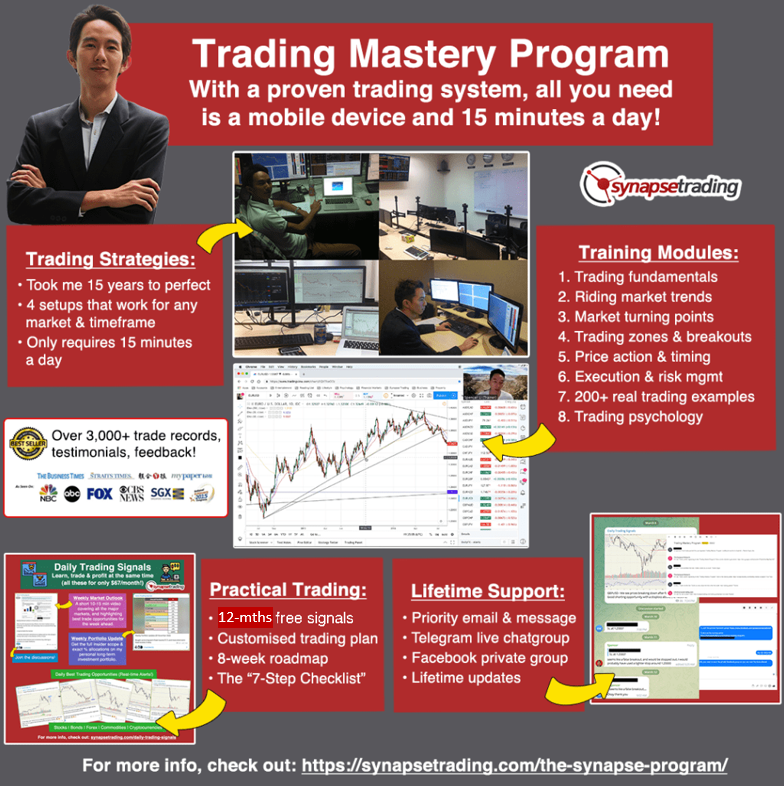 Our flagship mentoring program is suitable for both beginners and advanced traders, covering the 4 strategies which I used over the past 15 years to build up my 7-figure personal trading portfolio.
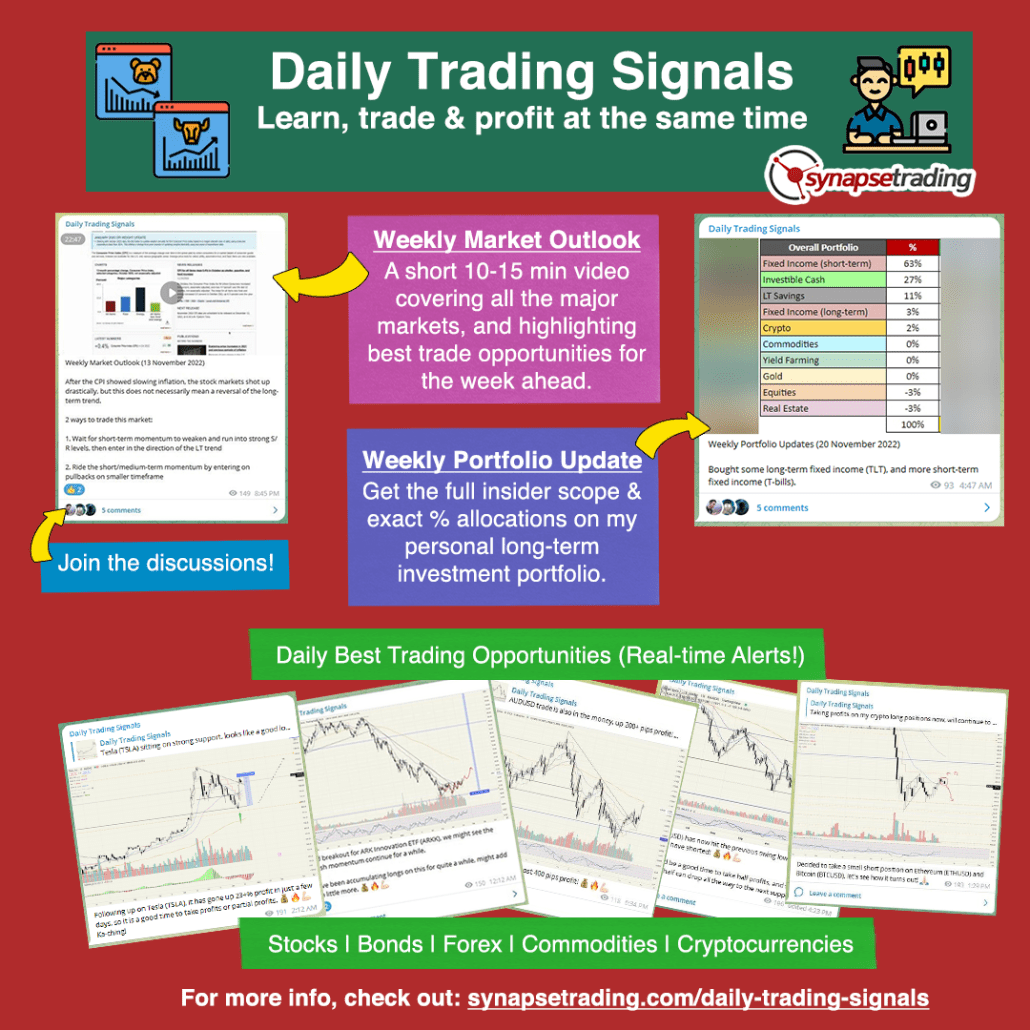 If you're looking for the best trading opportunities every day across various markets, and don't want to spend hours doing the research yourself, check out our private Telegram channel!


Leave a Reply
Want to join the discussion?Feel free to contribute!