

How to Size a Credit Spread Using Its Max Loss
Want the daily routine? Get the free 15-Minute Swing Trader’s Checklist. Get it free →
Why the premium is the wrong number to size by, worked through on one spread
Published: 16 October 2026 · Last updated: 16 October 2026 · By Spencer Li, CFTe
Most people new to credit spreads ask how much one can make. The better question is how many to run, and it is the one a Reddit thread, titled simply “Credit spreads risk”, kept circling.
The short answer is to size a credit spread by its maximum loss, never by the premium it pays or the margin it frees up. On a simple credit spread, the max loss is the gap between the two strikes minus the credit you collected. Decide what slice of your account you are willing to lose on one trade, divide it by the max loss of one spread, and round down. That is your ceiling. Then count every spread on stocks that move together as a single position, because in a sell-off they all lose at the same time.
The rest of this post works that through on one spread, with the arithmetic shown in full.
What is the max loss on a credit spread?
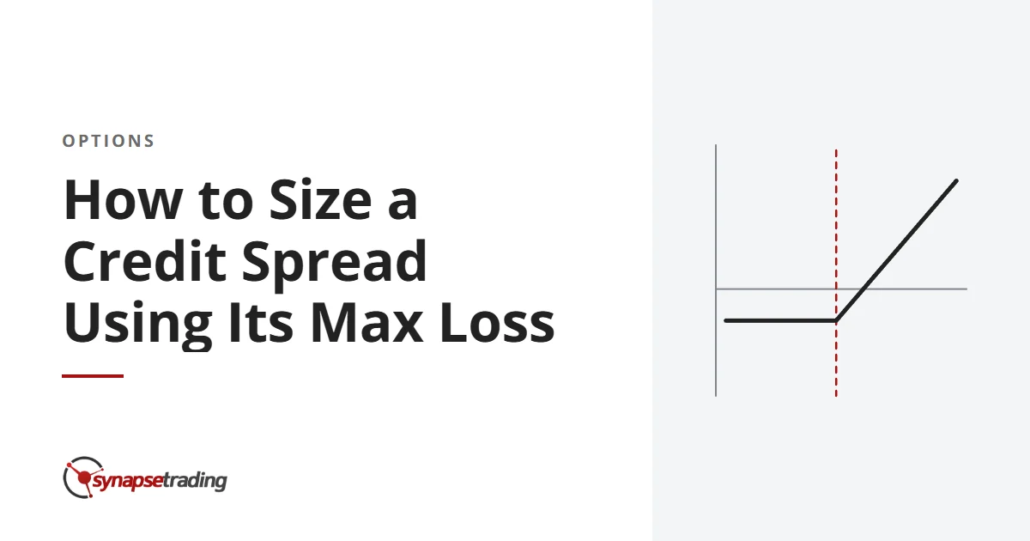
Take a hypothetical spread, with round numbers. A stock trades at USD 100. You sell a put with a strike of 95 and buy a put with a strike of 90, both expiring next month, and collect a net USD 1.00 a share. This is a put credit spread, sometimes called a bull put spread.
The 90 put is your insurance. It sets the floor on how much you can lose, which is what makes this a “defined-risk” trade.
| Stock price at expiry | Result per share | As a multiple of the credit |
| 95 or higher | +1.00, you keep the credit | +1× |
| 94 | 0, your breakeven | 0 |
| 92 | −2.00 | −2× |
| 90 or lower | −4.00, the max loss | −4× |
The max loss is the width, 5, minus the credit, 1. That is 4 a share, against a best case of 1 a share. One contract covers 100 shares, so both numbers scale by 100.
You need four full wins to pay for one full loss.
This is the trade-off the guide to options trading describes as “many small wins, then one loss that erases them”. It is built into the shape of the spread, before a single trade is placed.
Why does sizing by the premium go wrong?
Because the premium is the number you can see, and the loss is the number you have to imagine.
Picture a trader whose account is big enough that one of these spreads can lose 0.8% of it. The credit on one spread feels too small to bother with, so he sells five. Five credits look good on the screen. But five spreads also carry a max loss of 4% of the account, riding on one stock, one week and one direction.
Make it ten, and one bad week takes 8% of the account. A run of three bad weeks in a falling market, and a good year is wiped out in a month.
Traders who have been through this say so in their own words. A trader on r/thetagang, looking back on 2 years of selling options, put this first on his list of mistakes: “OVERSIZING: used way more margin that I should have.” After he cut his margin use, he wrote: “This alone made the most difference.”
There is a quieter cost too. At a 1-to-4 payoff, you need to win more than 4 trades in 5 just to break even, if every loss is a full loss. Real losses are often smaller, because people close early, but real fills are also worse than the screen shows, and over dozens of trades that gap adds up to more than most people expect when they start. One trader on Reddit logged 60 index iron condor fills against the midpoint on his screen in March 2026. His real returns came in “15-20% below what my model projected”, because the fills on a multi-leg order were worse than the midpoint.
So the high win rate is what you pay for with the lopsided payoff. Neither half comes free.
Loss-First Sizing, in four steps
Here is the method, which I call Loss-First Sizing, because the loss is the first number you write down.
- Set the risk budget. Pick the slice of your account you will risk on one trade, as a percentage. In this example it is 1%. Our post on the 2% money management rule explains how to choose that slice.
- Find the max loss of one spread, as a share of the account. Width minus credit, times 100 shares, divided by the account. In the example, 4 a share works out to 0.8% of the account.
- Divide and round down. 1% divided by 0.8% is 1.25, so the answer is 1 spread. If the answer is below 1, the spread is too wide for the account, so you narrow the strikes or skip the trade.
- Group what moves together. Spreads on five chip stocks are one position in a sell-off. They share one risk budget between them.
Run the example through it and the answer is one spread. Just one, against the five that felt worth the effort. That gap, between what feels worth doing and what the account can carry, is where most of the damage comes from.
Before you enter, also write down the point at which you will close the spread if it goes against you. Deciding that in the moment, with the loss growing and the fear rising, is how a planned small loss turns into the max loss.
Sizing is the part of this that carries straight over to what we do teach. Our free 15-Minute Swing Trader’s Checklist has the daily routine and the questions to ask before any trade, position size included. Get the free checklist →
Why is margin the wrong measure of size?
Each broker sets its own margin rule for spreads, so check yours. Whatever it holds, “margin used” can look like a natural measure of size, and it is easy to stop there.
It answers the wrong question. At best, margin tells you what one spread can lose. It says nothing about how many spreads your account can survive losing at the same time, which is the question that decides whether you are still trading next year.
How does this work for an iron condor and other multi-leg trades?
An iron condor is two credit spreads at once, a put spread below the price and a call spread above it. The good news is that, at expiry, the stock cannot finish below the puts and above the calls at the same time. So only one side can take the full loss.
The max loss on an iron condor is the width of the wider side minus the total credit for both sides. Size it with the same four steps, using that number.
Every other multi-leg structure works the same way. Find the worst case at expiry, write it down per contract, and size from there. If you cannot work out the worst case, that is a sign to skip the trade, because you are taking a risk you cannot measure.
What can go wrong that the max loss does not show?
Two things, both from the fine print.
The first is early assignment. US-listed stock options can be exercised on any business day. The Options Industry Council says “All standardized equity options use American-style exercise,” and the clearing house hands out exercise notices at random. If your short leg is deep in the money, you can be assigned before expiry while your insurance leg is still open. On a call spread near an ex-dividend date, the Council warns that “An assigned call writer (covered or not) is obligated to deliver the stock plus the dividend.” The full mechanics are in what happens when an option is assigned.
The second is expiry day itself. If the stock closes between your two strikes, your short leg finishes in the money and is likely to be assigned, while your insurance leg expires worthless. You can wake up holding 100 shares per contract over a weekend. Some brokers close such positions before the bell, so read your broker’s expiry rules. From Singapore, a Friday expiry ends at the New York close, in the early hours of Saturday morning local time, so this happens while you are asleep.
Neither changes the max loss on paper. Both can change what your account looks like on Monday morning.
What is the most you would be comfortable losing on one trade? And how many of your open spreads would lose together if the market fell 5% tomorrow? Those two answers, written down before the next trade, size the spread for you.
FAQ
How do you calculate the max loss on a credit spread?
Take the width between the strikes, subtract the credit you collected, and multiply by 100 for one contract. A 5-point spread sold for 1.00 has a max loss of 4.00 a share, four times the credit.
How many credit spreads should I trade at once?
Trade only as many as fit your risk budget when you size by the max loss, rounded down. Spreads on stocks that tend to move together share a single budget, because they tend to lose together.
Is a credit spread safer than selling a naked put?
A credit spread caps the loss, so the worst case is known before you enter, which a naked put does not offer. The trade-off is that the loss can still be several times the credit, so the sizing matters just as much.
What is the max loss on an iron condor?
It is the width of the wider spread minus the total credit collected on both sides. Only one side can lose in full at expiry, because the stock cannot finish beyond both.
Does Synapse Trading teach credit spreads?
No, we do not teach options at the moment. We teach end-of-day swing trading in shares, forex and ETFs, and the risk-per-trade sizing in this post works the same whichever product you use.
Go deeper
This post covers one corner of options. If you would rather start with what we do teach, the free 15-Minute Swing Trader’s Checklist has the daily routine, the questions to ask before every trade, and the five rules that keep you in the game. Enter your email and we’ll send it over:
We use your email address to send you the checklist, then emails about trading and our courses. Unsubscribe in one click, any time. Privacy policy.
About the author. Spencer Li is the founder of Synapse Trading and a Certified Financial Technician (CFTe) with 15 years of trading across stocks, forex, crypto, commodities, and bonds. His trade log is public: every trade since April 2024, dated, losses left in. He teaches low-risk swing trading in 15 minutes a day, one system for any market.
Educational content only, not personalised financial advice. Trading carries risk, including loss of capital. Past performance is not indicative of future results. Synapse Trading is not licensed or regulated by MAS.
Want the daily routine? Enter your email for the free 15-Minute Swing Trader's Checklist.
Free 5-page PDF, then occasional trading emails. Education only, not financial advice. Unsubscribe anytime. Kit stores your email in the US: see our privacy policy.
Want to learn the full method? The Trading Mastery Program teaches the 4 strategies I have traded since 2011. It suits beginners and experienced traders.
Rather follow the trades as they happen? Daily Trading Signals is our Telegram channel: my trade ideas with entry, stop and exit, and every trade is public.
Educational content only, not personalised financial advice. Trading carries risk, including loss of capital. Past performance is not indicative of future results. Synapse Trading is not licensed or regulated by MAS.


Leave a Reply
Want to join the discussion?Feel free to contribute!