

Loss Aversion Bias – Why a Loss Has Twice the Psychological Impact

Join our Telegram channel for more market analysis & trading tips: t.me/synapsetrading
Table of Contents
Loss Aversion Bias in Trading: Why Losing Hurts Twice as Much (and How to Fix It)
Last updated: 3 July 2026 · By Spencer Li, CFTe
Loss aversion bias is the tendency to feel the pain of a loss about twice as strongly as the pleasure of an equal gain, so we go out of our way to avoid losses rather than to chase profits. It was first described by Daniel Kahneman and Amos Tversky in 1979 as part of prospect theory. For traders, it shows up in two costly habits: holding losers far too long, hoping they come back, and cutting winners far too early, scared the profit will evaporate. Both habits do the same damage. They make your losses big and your wins small, which is the exact opposite of what you need to make money. The fix is not willpower. It is a preset stop-loss, decided before you enter, that takes the decision out of your hands when emotion is loudest.
Here is what loss aversion is, how it sabotages real trades, and the one rule that defuses it.
What is loss aversion bias?
Loss aversion bias is a finding from behavioral finance (the study of how psychology drives money decisions) that says the possibility of a loss is, on average, about twice as powerful a motivator as the possibility of a gain of the same size.
Kahneman and Tversky developed it in 1979 as part of the original prospect theory. The short version: people would rather avoid a loss than capture an equal-sized gain. Losing 100 dollars stings more than winning 100 dollars pleases. So we make lopsided choices to dodge the sting, even when those choices cost us money over time.
That asymmetry is normal. It probably kept our ancestors alive. The problem is that markets punish it.
How loss aversion sabotages your trades
In trading, the bias leaks out in two directions, and both of them hurt.
First, it stops you cutting losers. Loss aversion can keep you holding a losing trade long after the reason for the trade is gone, because closing it means admitting the loss is real. Industry veterans have a name for this: “get-even-itis.” You wait and wait for the trade to climb back to your entry, instead of cutting it and moving on to a better one. It is dangerous because the best response to a loss is to take it quickly and free yourself up. The longer you wait, the bigger the hole.
Second, it makes you cut winners too early. The same fear of loss makes you fixate on protecting a profit the moment one appears. As soon as a trade is green, the loss-averse part of your brain panics that the market will reverse and snatch the gain back, so you grab the small profit and run. The problem is that exiting early to protect a gain caps your upside. You never catch the big moves, the ones that actually pay for all the small losses.
Put the two together and you get the trader’s nightmare: small wins, big losses. That math does not survive contact with a real account.
Loss aversion vs disciplined trading, side by side
| The loss-averse trader | The disciplined trader | |
|---|---|---|
| A trade goes against them | Holds and hopes (“get-even-itis”), waiting for a rebound | Exits at the preset stop, no debate |
| A trade goes in their favour | Grabs the small profit early, scared it reverses | Lets the winner run to a planned target |
| Where the decision is made | In the moment, with emotion running hot | Before entry, when the mind is calm |
| The shape of the results | Big losses, small wins | Small losses, big wins |
| State of mind for the next trade | Tense, anchored to the last position | Neutral, capital freed up, ready |
The left column feels safer in the moment. The right column is what actually compounds.
What is the best solution for loss aversion in trading?
The best solution is a preset stop-loss, the price you decide in advance to exit a losing trade.
If you are disciplined and you set that stop point before you enter, you simply exit when the price is breached. Personally, I think this is the single most underrated tool a new trader has, because of what it removes rather than what it adds. It removes the blind hope of a rebound. There is no “maybe one more day.” The decision was already made when you were calm, not now when you are scared.
It does two more useful things. By squaring off the position, it resets you to a neutral frame of mind for the next trade, instead of staying emotionally hooked to the loser. And it frees up the capital that was trapped in a dead trade, so you can put it into a better one.
Do note that the stop only works if you respect it. A stop-loss you keep moving lower “just this once” is not a stop-loss. It is a wish.
As Ralph Waldo Emerson put it: “Win as though you were used to it, lose as if you enjoyed it for a change.”
Where the human edge comes in
Any platform can place a stop-loss order for you in one click. That part is free. What no tool can do is make you honour it when the trade is 2 percent underwater and every instinct is screaming that it will bounce back. The bias is human, so the discipline has to be human too. A system can hold the line; only you can decide not to override it. That is the second of the Five Edges, discipline and sizing, and it is the one loss aversion attacks hardest.
FAQ
What is loss aversion bias in simple terms?
It is the tendency to feel a loss about twice as strongly as an equal gain, so we work harder to avoid losses than to capture profits. Kahneman and Tversky described it in 1979 as part of prospect theory.
How does loss aversion affect traders?
It makes traders hold losing trades too long, hoping for a rebound (“get-even-itis”), and close winning trades too early to protect the profit. The result is big losses and small wins.
What is “get-even-itis”?
It is an industry nickname for waiting too long for a losing trade to climb back to your entry price, instead of cutting the loss and moving on. It is a direct symptom of loss aversion.
How do I overcome loss aversion in trading?
Set a stop-loss before you enter the trade and exit when it is hit, with no exceptions. Deciding in advance, while you are calm, removes the in-the-moment emotion that drives the bias.
Is loss aversion the same as risk aversion?
No. Risk aversion is a general preference for certainty. Loss aversion is the specific finding that losses hurt roughly twice as much as equal gains feel good, which is why it leads to such lopsided trading decisions.
Loss aversion is wired into all of us. You will not delete it. The goal is to build a routine that makes the bias irrelevant, by deciding your exits before the emotion arrives.
For the full picture of how psychology drives your results, read the pillar: The Complete Guide to Investing and Trading Psychology.
Want a routine that takes the emotion out of it? Grab the free 15-Minute Swing Trading Starter Kit. It is the exact once-a-day process I use to scan, set my stops in advance, and trade any market in 15 minutes.
About the author. Spencer Li is the founder of Synapse Trading and a Certified Financial Technician (CFTe) with 15+ years of trading across stocks, forex, crypto, commodities, and bonds. His trade log is public: every trade since April 2024, dated, losses left in. He has taught a 15-minute daily trading routine since 2014, one system for any market.
Education, not financial advice. Synapse Trading is not licensed by MAS to advise on investment products. Trading carries risk of loss; past performance is not indicative of future results.
Related
The Complete Guide to Investing and Trading Psychology (pillar) · How to use a stop-loss · Cut your losses and let your profits run · Common cognitive biases in trading
Want the daily routine? Enter your email for the free 15-Minute Swing Trader's Checklist.
Free, 5 pages, PDF. You get the checklist, then my occasional trading emails. Education only, not financial advice. Unsubscribe anytime.
Where your details go: Kit, our email provider, stores your email address in the United States. Our contract with Kit lets it use your address only to send our emails, and requires Kit to keep it secure. The United States has no national privacy law like Singapore's, so that contract is the main protection. More in our privacy policy.
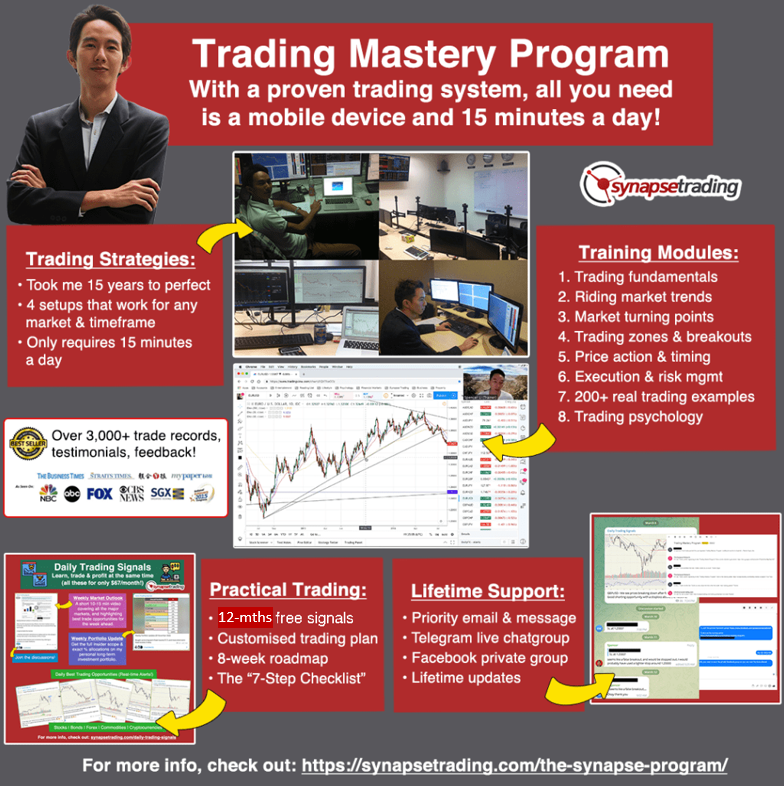 Our flagship mentoring program is suitable for both beginners and advanced traders, covering the 4 strategies which I used over the past 15 years to build up my 7-figure personal trading portfolio.
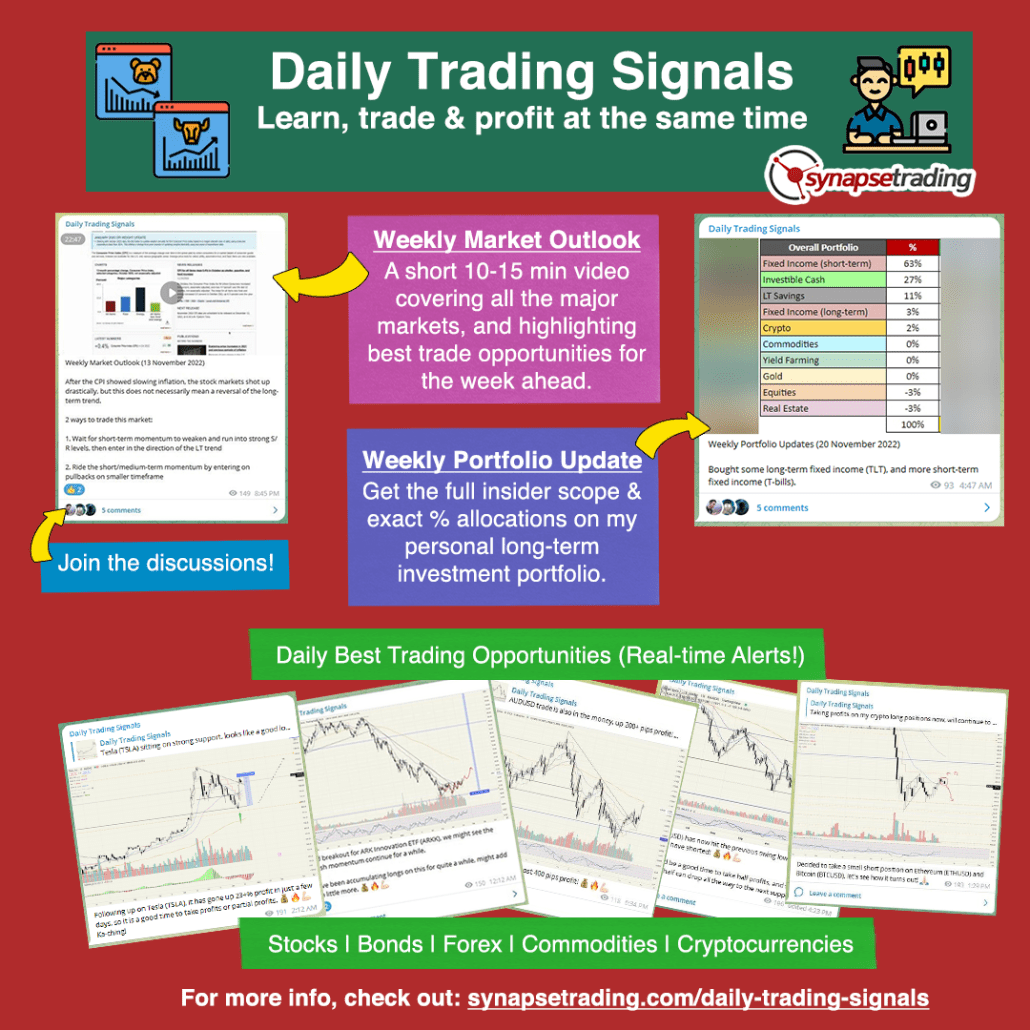 If you're looking for the best trading opportunities every day across various markets, and don't want to spend hours doing the research yourself, check out our private Telegram channel!

Trackbacks & Pingbacks
[…] A Trader’s Guide to Behavioral Finance and Trading Psychology (pillar) · Overconfidence bias in trading · Confirmation bias in trading · Loss aversion and the disposition effect […]
Leave a Reply
Want to join the discussion?Feel free to contribute!