

Common Scams in Singapore: How Each One Works, and the Tell That Gives It Away
Want the daily routine? Get the free 15-Minute Swing Trader’s Checklist. Get it free →
The ten most common scams of 2025 from the police’s own figures, how each one runs, and what to do in the first hour if you paid
Published: 19 November 2026 · By Spencer Li, CFTe
People in Singapore reported 37,308 scam cases in 2025 and lost about S$913.1 million, according to the Singapore Police Force’s annual brief. That is down from S$1.11 billion in 2024, which sounds like good news until you divide it out and find it is still close to S$2.5 million a day.
So what do the common scams have in common? In 81.8% of cases, nobody hacked anything. The victim moved the money themselves, because someone talked them into it. That gives you one rule that covers almost every scam below: if a message asks you to move money, read out a code, or pay before you receive, stop and check through a channel you found yourself. The rest of this guide shows how each scam builds up to that ask, so you can see it coming earlier.
Which scams cost Singapore the most in 2025?
Here are the ten types with the most reported cases, straight from the police brief.
| Scam type | Cases in 2025 | Lost in 2025 | Average lost per case |
| E-commerce | 6,703 | S$16.7M | S$2,503 |
| Phishing | 6,264 | S$39.9M | S$6,384 |
| Job | 5,575 | S$123.5M | S$22,163 |
| Investment | 5,462 | S$336.2M | S$61,559 |
| Government official impersonation | 3,363 | S$242.9M | S$72,229 |
| Fake friend call | 1,551 | S$4.7M | S$3,056 |
| Sexual services | 1,150 | S$3.9M | S$3,464 |
| Insurance services | 1,003 | S$25.2M | S$25,125 |
| Loan | 935 | S$7.0M | S$7,515 |
| Internet love | 917 | S$24.9M | S$27,202 |
Source: SPF Annual Scam and Cybercrime Brief 2025, Annex C.
Look at the two columns side by side, because they tell different stories. E-commerce scams are the most common, but the average loss is about S$2,500, while investment scams are only fourth by count and still took S$336.2 million, the most of any type.
Now do the arithmetic. An investment scam takes about 25 times what an e-commerce scam takes, per case (S$61,559 against S$2,503). The common scams cost you a concert ticket, and the rarer ones cost you a deposit on a flat.
And the government impersonation scam has the highest average of all, at S$72,229 a case. Its case count more than doubled in a year, from 1,504 to 3,363.
Why do smart people fall for scams?
You might be thinking that this only happens to people who are careless, or to people who are not good with phones. The numbers say otherwise. The police brief shows 85.2% of 2025 victims were under 65, and adults aged 30 to 49 were the largest group, at 36.1%.
So it is not about intelligence. ScamShield’s own explanation is that scammers first push you into a “hot” state, which is fear or excitement strong enough to switch off the slow, careful part of your thinking. A call saying your bank account is linked to money laundering is fear. A chat group full of profit screenshots is excitement. Then they lean on the same levers any salesperson uses: authority, urgency, a small favour first, and a crowd that seems to agree.
Psychologists call the gap between how we decide when calm and how we decide when aroused the hot-cold empathy gap. When you are calm, you cannot imagine handing a stranger S$50,000. When you are scared or excited, the same act feels like the obvious next step. That is why the advice in this guide is mostly about adding a pause, because the pause lets you cool down before you act.
ScamShield also reports a finding from a police survey: people who accept that they can be fooled take more precautions. Which is quite a comforting thought, if you think about it.
How do investment scams work?
Investment scams get the most space here, because they take the most money and because this is the area we know best.
The police brief describes three ways in. Some victims are recommended an “opportunity” by a friend they met online. Some find it themselves, through an online search or an advertisement, often one using the face of a well-known person. And some are added to a chat group or channel full of members posting their gains.
From there, the script runs in four stages.
- A small first win. You put in a little, and you get a small return you can actually withdraw. That return is the bait, because it makes the platform feel real.
- A dashboard that only goes up. The police brief warns that scammers now ask victims to download shell investment apps, sometimes from the official app stores, that “show fictitious investment progress and returns”.
- Bigger deposits. Encouraged by the numbers, you add more, often by opening a new cryptocurrency account, buying crypto with money from your bank, and sending it to an address they give you.
- Fees to get out. When you try to withdraw, there is suddenly a “fee” or a “tax” to pay first. The police say this is usually the moment victims realise. By then, every payment has gone to the scammer.
The tell is in that dashboard. A real investment goes down some of the time. Any real trading account, run for long enough, shows losing days and losing months. A platform where the number only climbs, run by someone you have never met, is showing you a picture of money rather than money.
15+ years of trading, and “high returns, no risk” still gets one reply from me: show me the losing months.
What are the red flags before you invest?
The police list two red flags in plain words: “guaranteed or high returns at little or no risk”, and “pressure to act urgently citing time-limited offers”. Add a third from the same brief: the “false testimonies” that pull people in, which is why a group full of strangers celebrating is not evidence of anything.
A related trap is the pump-and-dump, where a group is told to buy one small, thinly traded share at the same time so the organisers can sell into the rise. We cover the signs in how to spot a pump-and-dump. And if the pitch is a trading bot or “AI” that trades for you, read what those offers really do first.
How do you check who you are dealing with?
The police give a three-step check, and it is worth doing in full.
- Look up the firm on the MAS Financial Institutions Directory, and the person on the Financial Institution Representatives Register.
- Meet the person at the firm’s own office, rather than a cafe or a video call.
- Match the name on their official ID to the register, and their face to the ID.
You can also search the MAS Investor Alert List. Do note its limits. MAS says the list “is not exhaustive”, so a name that is missing from it is not a sign it is safe. MAS also no longer adds the names of people who impersonate licensed firms, and tells you to “deal only through official channels” instead.
How does the government official impersonation scam work?
This one starts with a phone call about something you never did. The police brief describes the usual sequence: a “bank” or “card company” calls about a suspicious transaction on your credit card or insurance policy. You deny it, and they offer to put you through to the police. The “officer” then says your name has come up in a money-laundering case.
From there, you are told to move your money to a “safety account” for the investigation, or to hand over cash, gold bars, jewellery or watches to a courier, or leave them somewhere to be collected. In 2025 the police also saw victims told to open a new cryptocurrency account and send the money through it.
The tell is in the police’s own list. Singapore government officials will never, over a phone call:
- ask you to transfer money
- ask for your banking login details
- ask you to install an app from outside the official app stores
- transfer your call to the police
If the call does any of the four, hang up. The brief also notes that people aged 65 and above made up 34.0% of the victims of this scam, more than any other age group.
How do job scams work?
You see an offer to earn from home by doing simple tasks: reviewing hotels, rating apps, liking posts, or “boosting” products. The first few tasks pay a small commission, and it really arrives in your account, so by the time the bigger tasks appear you already trust the people behind them.
Then the higher-paying tasks require you to put money in first. Each round asks for more, and the commission you are owed keeps growing on screen, until withdrawals fail and the “employer” disappears. A newer version in 2025 asked victims to run an online shop, paying for each order out of their own pocket on the promise of a commission later.
The tell: a real job never asks you to pay to earn. Job scams took S$123.5 million in 2025, the third-highest loss of any type.
How do online shopping scams work?
These are the most common scams in Singapore by number of cases. You find a good deal, often for something that is hard to get, and the seller asks for full payment or a deposit by bank transfer before any meet-up, and then the seller goes quiet.
In 2025 the most common item was Pokémon trading cards, at 13.6% of e-commerce cases, up from 1.0% the year before. Sellers get hit too. A “buyer” sends a fake screenshot as proof of payment, or a link to “collect your money” that is really a page to steal your card details.
The tell: you pay in full, by transfer, to someone you cannot see, for something you cannot see. Where you can, use a platform’s own protected checkout, or meet and pay on the spot.
How do phishing scams work?
Most phishing in 2025 did not need you to give away a password. You click an advert for a deal, say a cheap transport card or a food voucher, and pay on what looks like a real checkout page. The page asks for your card details and then the one-time password (OTP) or a digital token approval. With those, the scammer can add your card to their own phone wallet and spend on it.
The police counted 2,670 cases in 2025 that started from a social media advert, with S$4.6 million lost.
The tell: read the approval before you give the OTP. The bank’s message says what you are approving. If it describes anything other than the purchase you meant to make, stop.
What about the other common scams?
- Fake friend call. A message from an “old friend” on a new number, who later needs a loan. Call the number you already have saved.
- Loan scams. A licensed moneylender does not collect a “processing fee” before paying out the loan. A fee first means a scam.
- Internet love scams. Someone you have never met in person needs money for an emergency, a customs fee or a ticket to visit. The average loss was S$27,202.
- Changed bank details. An email from a supplier or boss says the payment account has changed. Call a number you already had to confirm, never the one in the email.
- Insurance services scams. A new entry in the top ten for 2025, with 1,003 cases and S$25.2 million lost.
What should you set up once, before anything happens?
This takes about an hour, and most of it is free.
- The ScamShield app. It filters scam messages and lets you check a number or a link. The police brief counts 1.53 million users.
- Money Lock at your bank. It locks part of your savings so it cannot be moved through digital banking. By the end of 2025, at least 479,000 customers had locked close to S$44 billion.
- Overseas call blocking. Every telco offers it. Do note it also blocks genuine calls from abroad, so switch it off before you travel.
- Card alerts by SMS, for every charge, and check your statement.
- CPF protection. Since February 2026, CPF members aged 21 and above can name up to two Trusted Contacts, who get copies of key transaction alerts but cannot see or move anything. Members aged 55 and above can turn on the CPF Safety Switch, which stops withdrawals at once.
- Two-factor login and a different password on every account that matters.
Should you ever lend your bank account or Singpass?
No, not even to a friend, and not for a fee. Scam syndicates move stolen money through other people’s bank accounts, SIM cards and Singpass logins. From 30 December 2025, people who give theirs away can be caned up to 12 strokes, on top of jail and fines, and can be barred from banking services and new phone lines. The police investigated more than 7,000 suspected mules and scammers in 2025.
What should you do if you have already paid?
ScamShield gives four steps, in this order.
- Call your bank immediately, on the number on your card or the bank’s own website. Ask it to stop the transfer and freeze what it can. Speed matters, because money that has moved on is much harder to recover.
- Make a police report online through I-Witness, at a neighbourhood police centre, or on the Police Hotline at 1800-255-0000. Call 999 if it is urgent.
- Tell your contacts and secure the account if a login was taken: change the password and turn on two-factor login.
- Report the scammer to the platform where they found you.
Keep every message, screenshot and transfer record, even if it is embarrassing. They are the trail.
Not sure whether it is a scam at all? Call the ScamShield Helpline at 1799, any time of day.
How do you help your parents?
The police figures make the case. People aged 65 and above were 14.8% of victims in 2025, but they lost the most per person, an average of S$37,053. Their most common scams were investment scams (22.5%) and government official impersonation (21.0%).
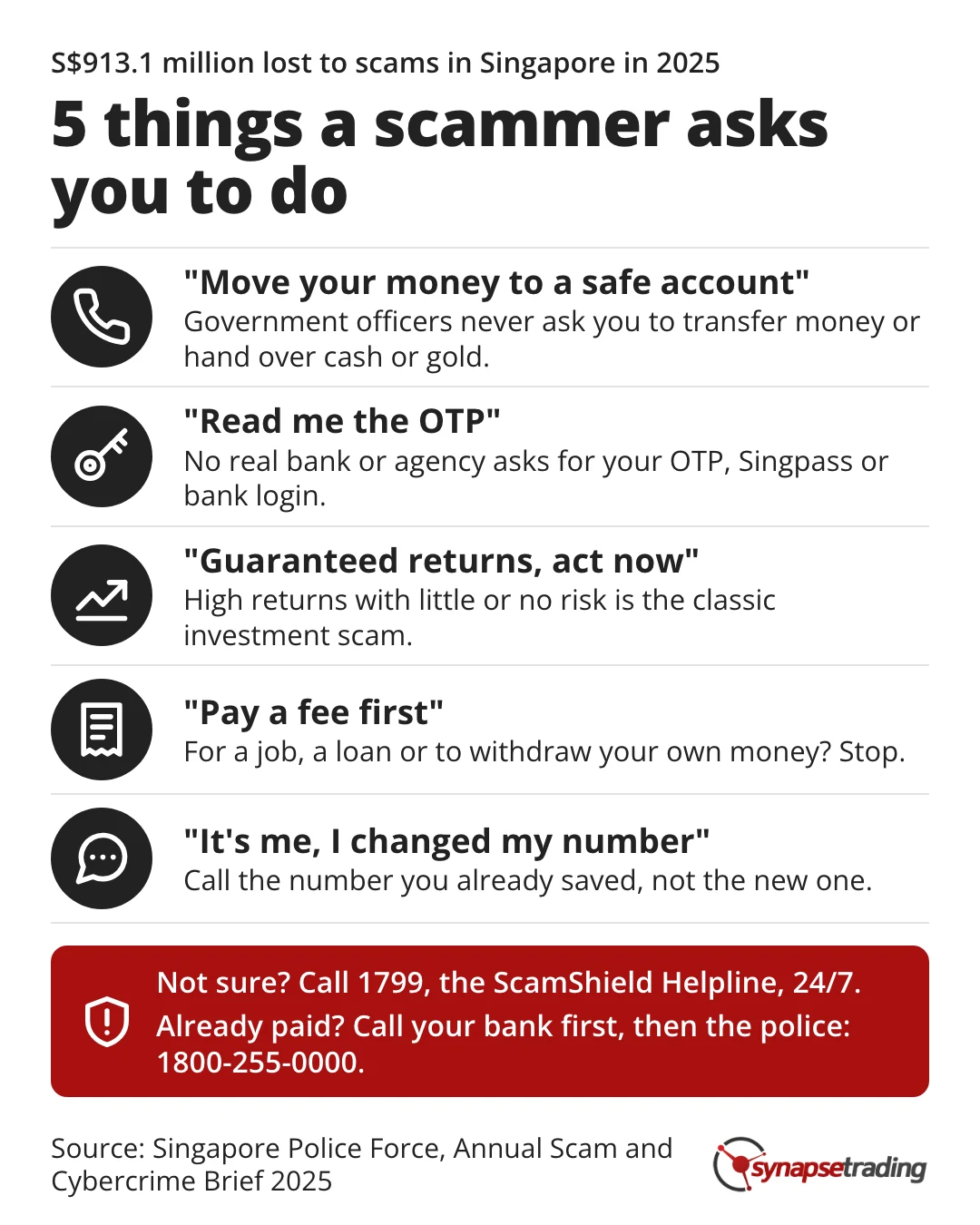
So a lecture is less useful than a habit, because a habit still works on the day they are scared and you are not there. Agree, as a family, that anyone about to send money to someone new shows another family member first. Put the ScamShield app on their phone. And send them something short they will actually read. We made a one-image card with the five asks every scammer makes, which you can forward on WhatsApp, and a quick quiz with ten real-style messages to judge.
Take the Spot the Scam quiz: ten messages, scam or safe, with the tell shown after each one. No sign-up.
So how do you spot a scam?
You watch for the ask. Every scam in this guide, however long the story in front of it, ends in one of three requests: move your money, read out a code, or pay before you receive. The story in front of it changes every year, from a police officer to a hotel review job to a stock group, and the ask never does.
Which of those three requests have you been sent this month? And who in your family would you most want to read this?
FAQ
What is the most common scam in Singapore?
By number of cases, e-commerce scams, with 6,703 cases in 2025. By money lost, investment scams, at about S$336.2 million.
How much did Singapore lose to scams in 2025?
About S$913.1 million across 37,308 scam cases, down from about S$1,112.4 million in 2024, according to the police’s annual brief. The police recovered about S$140.5 million.
Do government officers ever ask you to transfer money?
No. The police say Singapore government officials will never ask you to transfer money, give your banking login, install an app from an unofficial store, or transfer your call to the police, over a phone call.
How do I check if an investment firm is real?
Look it up on the MAS Financial Institutions Directory, and the person on the Financial Institution Representatives Register. A name missing from the MAS Investor Alert List does not mean it is safe, because MAS says the list is not exhaustive.
What number do I call to check a scam?
The ScamShield Helpline, 1799, open 24 hours. To report one, call the Police Hotline at 1800-255-0000, or 999 if it is urgent.
About the author. Spencer Li is The 15-Minute Trader and the founder of Synapse Trading. He is a Certified Financial Technician (CFTe) with 15+ years of trading, run from 70+ countries. He holds a B.Acc and B.BM from SMU. Every trade he takes is public, dated, losses left in. He teaches rules-based swing trading in 15 minutes a day, one system for any market.
Educational content only, not personalised financial advice. Trading involves risk of loss. Past results are not indicative of future performance. Synapse Trading is not licensed or regulated by MAS.
Want the daily routine? Enter your email for the free 15-Minute Swing Trader's Checklist.
Free 5-page PDF, then occasional trading emails. Education only, not financial advice. Unsubscribe anytime. Kit stores your email in the US: see our privacy policy.
Want to learn the full method? The Trading Mastery Program teaches the 4 strategies I have traded since 2011. It suits beginners and experienced traders.
Rather follow the trades as they happen? Daily Trading Signals is our Telegram channel: my trade ideas with entry, stop and exit, and every trade is public.
Questions about this post? Ask in the free Telegram channel →
Educational content only, not personalised financial advice. Trading carries risk, including loss of capital. Past performance is not indicative of future results. Synapse Trading is not licensed or regulated by MAS.
