
What Is a SPAC? How It Differs From an IPO, and the Risks for Investors
Last updated: 8 August 2026 · By Spencer Li, CFTe
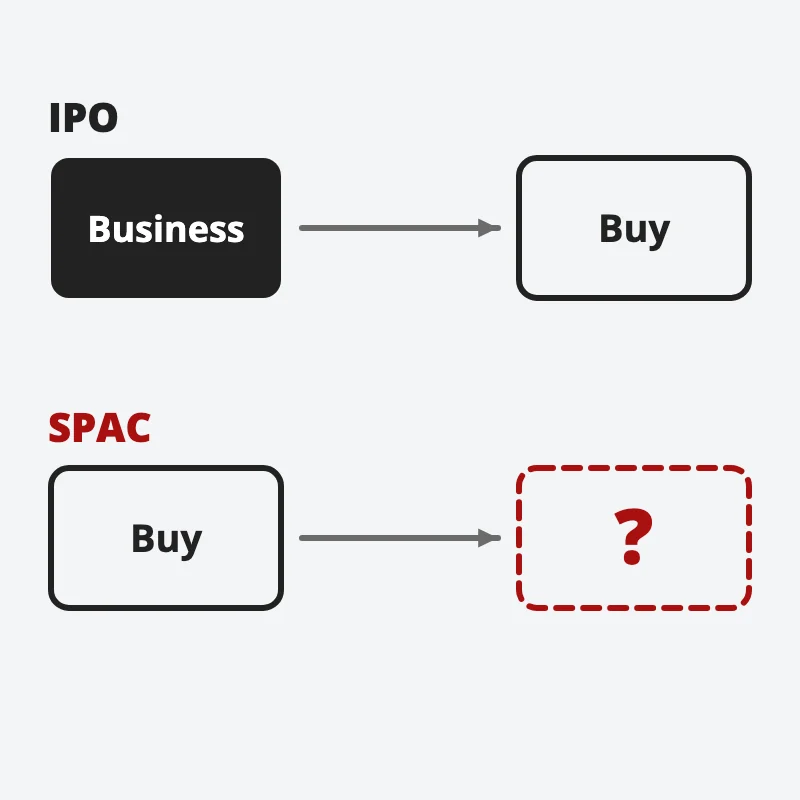
A SPAC (special purpose acquisition company) is a shell company with no products and no operations that raises money from public investors through its own IPO, holds that cash in trust, and then uses it to acquire a private company and take it public. It is also called a “blank check company,” because when you buy in, you do not yet know which business it will buy. A SPAC has 24 months to find and complete a deal. If it does, the target company becomes publicly listed without running a traditional IPO. If it fails, the cash is returned and the SPAC is wound up. The trade-off is speed for certainty: a SPAC merger is faster and cheaper than a normal IPO (months instead of well over a year), but you are trusting the sponsors to pick a good company on your behalf, sight unseen. Personally, I am not a fan, for exactly that reason.
Here is what a SPAC actually is, how it differs from a regular IPO, and where the real risks sit for an investor.
What does “going public” or “IPO” mean?
Before you can understand a SPAC, you need the traditional route it is competing with.
Every company, big or small, needs one thing to survive: capital. Funds to run operations, pay staff, repay loans. When profits fall short or a company needs to grow faster than its cash allows, it raises money. For many private companies, going public is the most attractive way to do that.
When a private company goes public, it opens the door for new investors by selling them shares. Each investor pays a set sum and owns a tiny slice of the business. It is a win-win in theory: the company raises capital, and the investors get a claim on future profits (often paid out as dividends).
“Going public” has a formal name: an Initial Public Offering, or IPO (the first time a private company sells its shares to the public). That is the traditional path.
What is the downside of a traditional IPO?
Going public the old-fashioned way works, but the IPO process is slow and expensive.
If you need capital urgently (say, to pay off debt), filing for an IPO is an awkward fit. There is a long list of disclosures: your prospects, your finances, the whole shebang. Before you ever pitch a future investor, you have to work through investment banks, risk assessors, and underwriters. Multiple checkpoints, all of which you must clear before you can list.
And because there are so many checkpoints, the odds of rejection are higher, on top of the significant cost of becoming a fully compliant public company. If you are already cash-strapped, how do you bear that cost?
So there is real demand for a faster, cheaper way to go public. That is where the SPAC comes in.
What is a SPAC, exactly?
A SPAC (special purpose acquisition company) is a quicker alternative for a private company to go public.
It is formed by a group of investors, business owners, industry experts, and high-net-worth individuals (the “sponsors”). These people raise money so that a private company can become public without the full traditional IPO grind.
A SPAC is also called a “blank check company” or “shell company,” because it sells no product, provides no service, and has no commercial operations of its own. So how does it make money? It raises capital through its own IPO, then uses that money to acquire a private company.
The cash raised sits in a trust account (an interest-bearing account, so the money earns interest while it waits) until the SPAC finds a suitable company to acquire. That waiting period is capped: every SPAC must find a target and complete a deal within 24 months.
What if it cannot find a good company in time? Then the cash in trust is returned to investors, and the SPAC ceases to exist.
If the SPAC does complete an acquisition within the 24 months, its backers have two choices: redeem their SPAC shares and book a profit, or convert their SPAC shares into shares of the newly merged company.
Either way, a SPAC merger benefits both sides. The private firm goes public, gets listed, and gains access to liquidity. The SPAC’s investors become shareholders in the newly public business.
SPAC vs IPO: what is the actual difference?
Both routes end with a private company trading on a public exchange. They get there very differently. Here is the side-by-side.
| Traditional IPO | SPAC merger | |
|---|---|---|
| How it works | Company sells its own shares directly to the public for the first time | Shell company raises cash via IPO, then acquires a private firm to take it public |
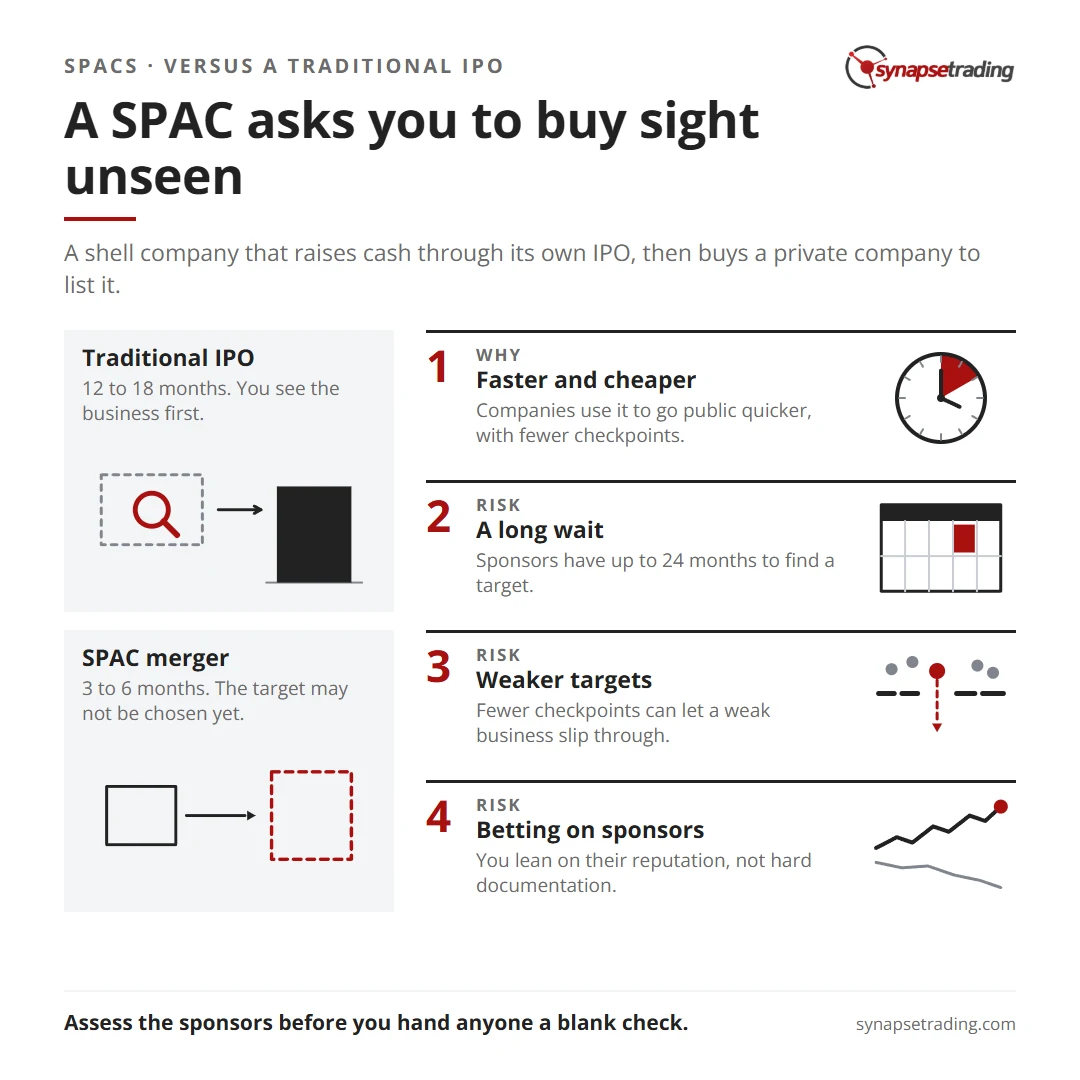
| Typical timeline | 12 to 18 months | 3 to 6 months |
| Cost / barrier | High; smaller companies often cannot afford it | Lower; shares typically priced at a fixed $10 |
| Disclosure / scrutiny | Heavy: banks, underwriters, risk assessors, full disclosures | Lighter; fewer checkpoints |
| Pricing power | Company must set a price that is neither too high nor too low | Target company can negotiate its own valuation with the sponsors |
| What you know going in | You see the business and its financials before you buy | You buy first; the target may not be chosen yet (a “blank check”) |
The key line for an investor: in a normal IPO you are buying a known business; in a SPAC you are often buying the sponsors’ promise to find one.
What are the benefits of SPACs?
Several real advantages explain why companies use them.
Quick and streamlined. A traditional IPO usually takes 12 to 18 months. A SPAC merger takes only 3 to 6. If a company needs money urgently, that speed matters. And any company can go this route regardless of size or track record. Growing firms that struggle to access liquidity because they lack a proven history do not hit that wall with a SPAC.
Cheaper to go public. A traditional IPO is expensive, and small companies often cannot afford it, so going public stays a pipe dream for many. The SPAC route is cheaper. SPACs typically price their shares at a fixed $10, set in stone, which lets a large pool of public investors buy in and the company raise what it needs.
More pricing flexibility. SPACs are more liberal on price. The target company gets to negotiate and set its own valuation with the sponsors, which is not how a traditional IPO works. In a normal IPO the company must price neither too high nor too low, and runs the risk of leaving money on the table. SPAC valuation risk on that front is lower.
Access to operational expertise. SPAC sponsors are usually experienced operators who pick a target from an industry they know. So a small, growing firm that gets acquired inherits that expertise, and the sponsors’ track record lends the deal credibility and investor confidence.
What are the risks of investing in a SPAC?
SPACs are often pitched to companies as a low-risk way to list. For the investor on the other side, the risks are real.
A long waiting period. Sponsors have up to 24 months to find a target. Invest early and you may wait the full two years before you see any return at all. Worse, the SPAC might never find a suitable company in that window, which means two years you could have spent on other opportunities, gone.
No idea what you are actually buying. When the SPAC is formed, the sponsors do not yet know which company they will acquire. So as an investor, you cannot know your likely return either. And the 24-month clock cuts against you: sponsors under deadline pressure sometimes accept a poor deal rather than no deal, and a bad acquisition flows straight through to your returns.
Higher chance of a low-quality target. One reason companies choose SPACs is the lighter screening. Fewer checkpoints means a target can slip through that would not have cleared a full IPO’s scrutiny. If the acquired business is weak, the returns will be too.
Heavy reliance on the sponsors’ reputation. With no operating business and often no named target, you are largely betting on the sponsors’ image. High-profile names draw enthusiastic money, but beyond that reputation there is little hard documentation to lean on, which is a thin basis for a real investment.
Where the human edge comes in
A SPAC strips most of the normal homework off the table. There is no operating history to read, often no target to analyse, and a fixed $10 price that tells you nothing about value. What is left is judgment: can you assess the sponsors, the incentive to close a bad deal before the clock runs out, and whether “trust me, I will find something good” is worth your capital for two years?
That assessment is the part no screener or hype cycle can do for you. The pattern (a clean, cheap, fast way to go public) is the easy story to sell. Deciding when the structure quietly favours the sponsors over you is the Human Edge, and it is the one piece of this you should never outsource.
Personally, I am not a big fan of SPACs. I prefer to keep control over my own investments rather than hand someone a blank check and hope they pick well on my behalf. That is a personal preference, not a rule. Plenty of good companies have listed through SPACs. But “I cannot yet see what I am buying” is a hard starting point for me, and I would rather analyse a business I can actually see.
FAQ
What is a SPAC in simple terms?
A SPAC is a shell company with no products or operations that raises money from public investors, holds it in trust, and then uses it to buy a private company and take it public. Because you invest before the target is chosen, it is nicknamed a “blank check company.”
What is the difference between a SPAC and an IPO?
In a traditional IPO, a company sells its own shares to the public and you can see the business before you buy. In a SPAC, a shell company raises the cash first and acquires a private firm later, so you often invest before knowing the target. SPAC mergers are faster (3 to 6 months vs 12 to 18) and cheaper, but with lighter scrutiny.
How long does a SPAC have to find a company?
A SPAC has 24 months to find a target and complete an acquisition. If it fails, the cash held in trust is returned to investors and the SPAC is dissolved.
Why are SPACs risky for investors?
The main risks are: you may wait up to two years for any return, you do not know which company will be acquired when you invest, lighter screening can let a weak target through, and you are leaning heavily on the sponsors’ reputation rather than hard documentation.
Are SPACs a good investment?
That depends on the sponsors and the deal, and it is your call, not advice. Some strong companies have gone public through SPACs. Personally I prefer investments where I can analyse the business before I buy, rather than committing capital to a blank check.
Now that you can answer “what is a SPAC” and explain how it differs from an IPO, the more useful question is how you size and screen any speculative position like this. For the foundations, read the pillar: The Beginner’s Guide to Investing and Trading.
Want a system instead of a hype cycle? Grab the free 15-Minute Swing Trading Starter Kit. It is the exact routine I use to scan once a day and trade any market in 15 minutes, without betting on blank checks.
About the author. Spencer Li is The 15-Minute Trader and the founder of Synapse Trading. He is a Certified Financial Technician (CFTe) with 15+ years of trading, run from 70+ countries. He holds a B.Acc and B.BM from SMU. Every trade he takes is public, dated, losses left in. He teaches low-risk swing trading in 15 minutes a day, one system for any market.
Education, not financial advice. Synapse Trading is not licensed by MAS to advise on investment products. Trading carries risk of loss; past performance is not indicative of future results.
Related
The Beginner’s Guide to Trading & Technical Analysis · How to Find Undervalued Stocks for Investment · Fundamental vs technical analysis