Seems like nowadays, everyone is talking about the Metaverse, and every company is following Facebook’s (now called Meta) lead in pivoting to a Metaverse company.
If you have watched movies/shows like “Ready Player One” or “Sword Art Online”, you will have a pretty good idea.
The origin of the term comes from science-fiction writer, Neal Stephenson, who coined the term “metaverse” in his 1992 novel “Snow Crash,” which envisions a virtual reality-based successor to the internet. In the novel, people use digital avatars of themselves to explore the online world, often as a way of escaping a dystopian reality.
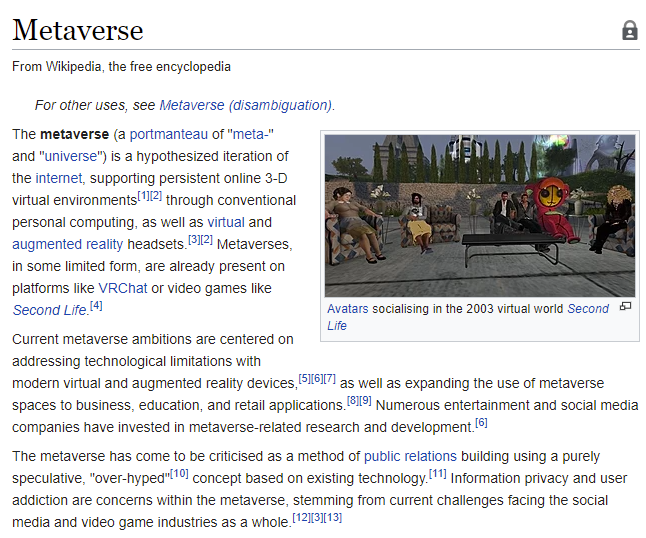
In short, it is like creating a virtual world which mimics the actual world, so activities like socialising, learning, gaming, working which you normally do in the real world, can also be done in the virtual world.
By now, you probably get the idea that this is something big, judging by how every major company is looking to get a slice of the pie.
But the big question is, what is the best way to invest in the Metaverse?
If you are not an expert in the industry, it will be hard to pick the correct stocks that give the best exposure, and have the most potential.
So here are some easy ways to do it:
Metaverse Index for Stocks (META)
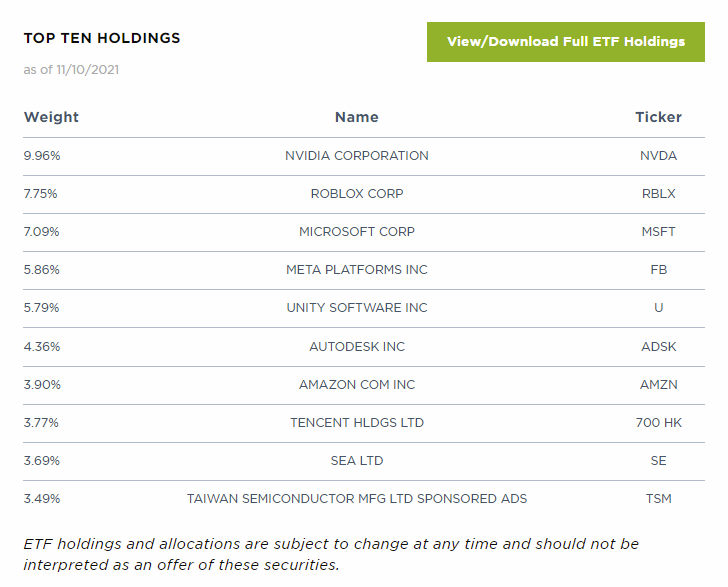
The first way to get exposure is to invest in stocks that are related to developing the Metaverse, and an easy way to do it is via an ETF (exchange-traded fund) which allows you get diversified exposure without needing to do much research.
Here is the current most popular ETF:
The Ball Metaverse Index is the first index globally designed to track the performance of the Metaverse. The Index consists of a tiered weight portfolio of globally-listed companies who are actively involved in the Metaverse.
Besides stocks, there is another possibility that the Metaverse might develop independently in the crypto space, via DAOs or decentralised projects.
The metaverse is a broad term to define the ever-expanding virtual reality worlds where players can create an avatar, buy land, build experiences, import NFTs, and trade with other users. Here are some projects and tokens:
CUBE is the ERC-20 token native to Somnium Space, a virtual world that offers both community-led events and an in-game economy. CUBE can be used to purchase virtual assets and pay for goods and services in the metaverse. Participants can join via virtual reality (VR) headsets or mobile and web browsers.
MANA is the ERC-20 token used to pay for goods and services in Decentraland. In Decentraland, users connect and interact with each other, create content, and play games. It even has a virtual economy where users can monetize the content and applications they build.
SAND is the ERC-20 token used in The Sandbox virtual world. The Sandbox virtual world is made up of LAND – digital pieces of real estate – that players can buy, and on which they can build games and other virtual experiences.
So it makes sense to get some exposure to this as well.
The easiest way to do it is also via an “ETF”, which is not really an ETF but it is a token which mimics the performance of a variety of Metaverse-related projects.
Here is one such index:
The Metaverse Index (MVI) is designed to capture the trend of entertainment, sports and business shifting to take place in virtual environments.
In conclusion, these are the 2 easiest ways to get exposure to both stocks and crypto in the Metaverse space, for people who do not want to spend too much time or effort doing rsearch.
If you interested to take it to the next level, then you can do more precise targeting by buying specific stocks and projects, but that will involve more research.
https://synapsetrading.com/wp-content/uploads/2026/10/invest-metaverse-etfs-card.webp6301200Spencer Lihttps://synapsetrading.com/wp-content/uploads/2026/10/synapse-logo-horizontal-light.pngSpencer Li2021-11-12 11:48:432026-08-11 17:03:24Easiest Way to Invest in the Metaverse (Stocks & Crypto)
What Is the Function of Each Cryptocurrency? Top 10 Coins, Explained
Last updated: 29 September 2026 · By Spencer Li, CFTe
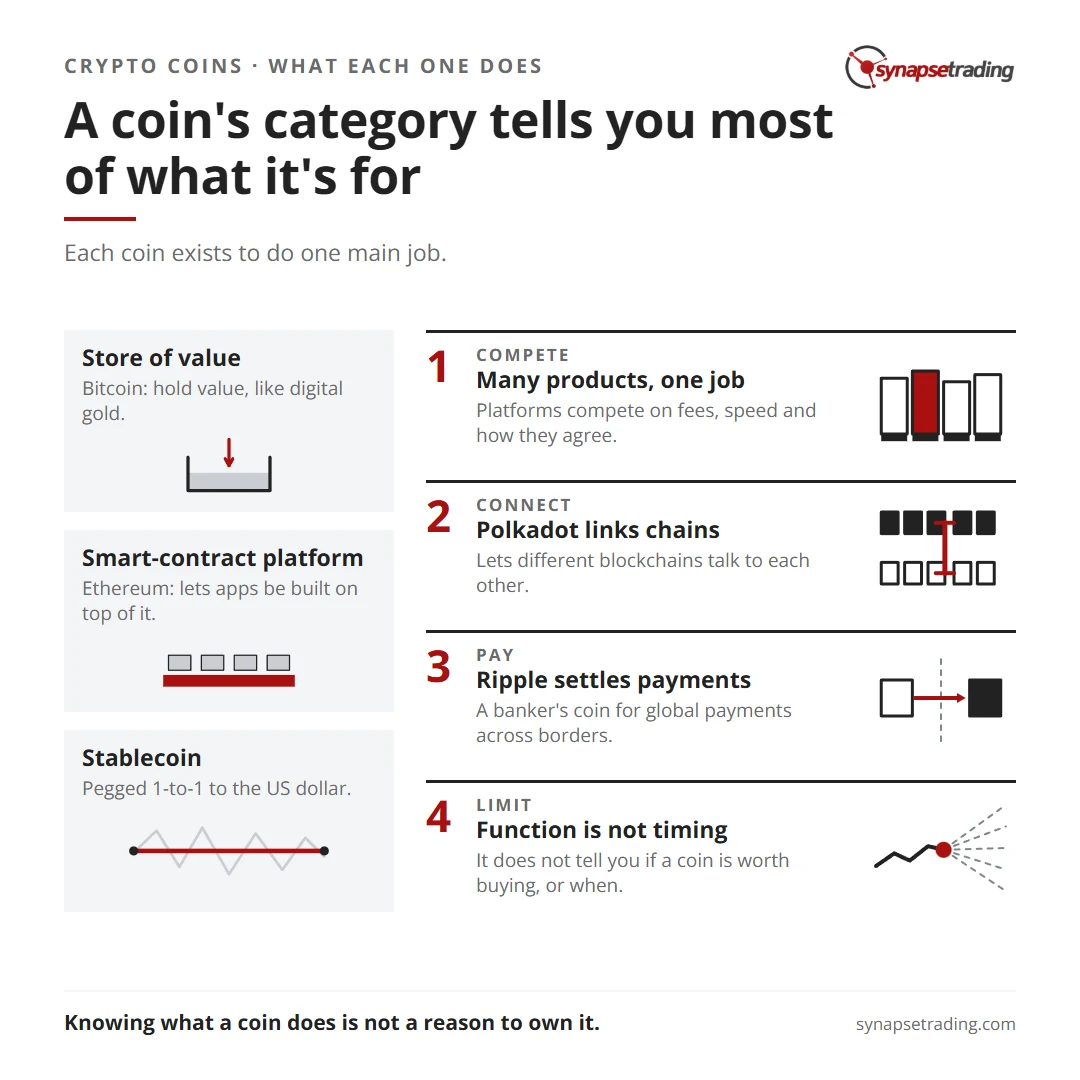
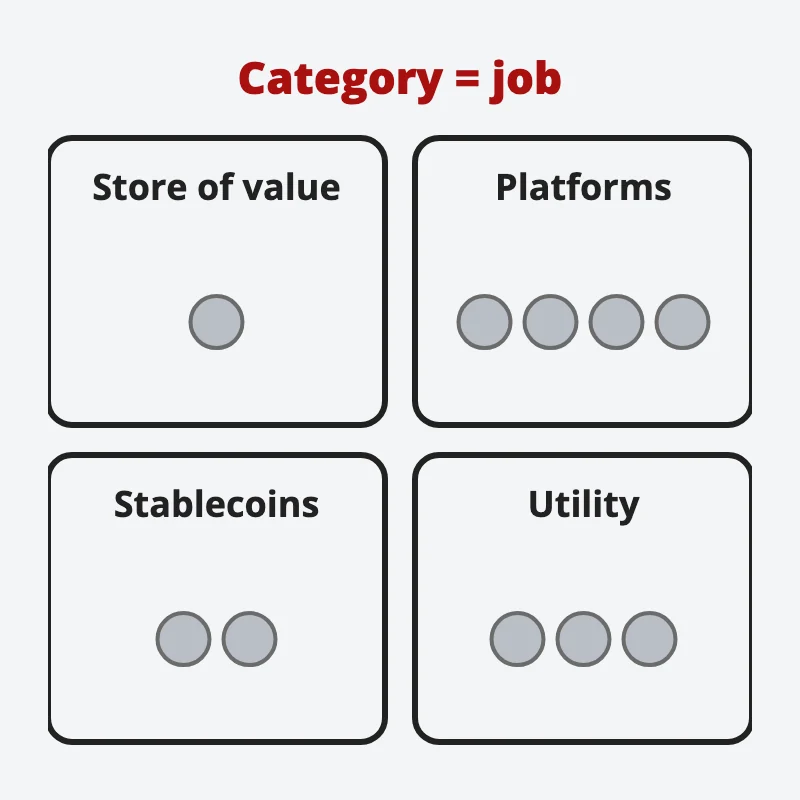
Each cryptocurrency coin exists to do one main job, and the top coins split into four buckets: a store of value (Bitcoin), smart-contract platforms that let apps be built on top of them (Ethereum, Cardano, Solana, Polkadot), stablecoins pegged to the US dollar (Tether, USD Coin), and utility or exchange coins tied to a specific business or use (Binance Coin, Ripple, Dogecoin). In short: Bitcoin is digital gold, Ethereum is a programmable platform, stablecoins are dollar substitutes that live on a blockchain, and the rest each solve a narrower problem (cross-border payments, lower fees, chains talking to each other, or simply a meme that took off). If you only remember one thing, remember that a coin’s category tells you most of what it is for.
Here is the function of each of the top 10 coins by market capitalization, one line each, then a table you can keep.
The top 10 cryptocurrency coins and what each one does
Coin
Ticker
Category
Primary function
Bitcoin
BTC
Store of value
A store of wealth, digital gold
Ethereum
ETH
Smart-contract platform
Decentralized platform that lets apps be built on top of it
Cardano
ADA
Smart-contract platform
Smart-contract platform with lower fees, aimed at specific use cases
A banker’s coin, used to settle global payments across borders
Solana
SOL
Smart-contract platform
Smart-contract platform using proof of history and proof of stake instead of proof of work
Polkadot
DOT
Interoperability protocol
Multi-chain protocol that lets different blockchains talk to each other
Dogecoin
DOGE
Meme coin
A meme coin
USD Coin
USDC
Stablecoin
Pegged 1-to-1 to the US dollar
The rankings shift over time, and coins move up and down the list, so treat this as the function reference. A coin’s job rarely changes; its price and rank do.
A coin’s category tells you most of what it is for.
What is a store-of-value coin? (Bitcoin)
Bitcoin (BTC) is the original cryptocurrency, and its job is simple: hold value. People call it digital gold because the supply is capped and nobody can print more of it on a whim. You are not really buying Bitcoin to build an app on it. You are holding it as a store of wealth.
That single function is why Bitcoin tends to be the reference point for the whole market. When people ask “what is crypto doing today,” they usually mean Bitcoin first.
What is a smart-contract platform? (Ethereum, Cardano, Solana, Polkadot)
A smart contract (code that runs automatically on a blockchain when its conditions are met) is what turns a coin from “money” into “a platform.” Ethereum (ETH) is the big one here: it is a decentralized platform that lets developers build apps on top of it, and the coin is the fuel that pays for running them.
The others in this bucket each pitch a different trade-off:
Cardano (ADA) is a smart-contract platform with lower fees, aimed at specific use cases.
Solana (SOL) is a smart-contract platform that uses proof of history and proof of stake (two ways of agreeing on the ledger) instead of the older proof of work, which is part of why it markets itself on speed.
Polkadot (DOT) sits one level up. It is a multi-chain protocol whose job is to let different blockchains talk to each other, rather than being a single app platform on its own.
Do note that, “smart-contract platform” is a category with many products in it. These coins compete on fees, speed, and how they reach agreement. They all do much the same job.
What is a stablecoin? (Tether, USD Coin)
A stablecoin is a coin pegged to a stable asset so its price does not swing. Both of the stablecoins in the top 10 are pegged 1-to-1 to the US dollar:
Tether (USDT) is pegged 1-to-1 to the US dollar.
USD Coin (USDC) is also pegged 1-to-1 to the US dollar.
The function is the same for both: give you a dollar substitute that lives on a blockchain, so you can hold “cash” inside the crypto system without converting back to a bank account every time. People use them to park value between trades.
What about exchange coins, payment coins, and meme coins? (Binance Coin, Ripple, Dogecoin)
These three do not fit the buckets above, and each has its own narrow job:
Binance Coin (BNB) is owned by the largest crypto exchange, Binance. Its function is tied to that business and its ecosystem.
Ripple (XRP) is a banker’s coin. Its job is to settle global payments across borders.
Dogecoin (DOGE) is a meme coin. That is the honest description, and it is worth being honest about it.
The one thing the category does not tell you
Knowing a coin’s function tells you what it is for. It does not tell you whether it is worth buying, or when. A scanner can sort all ten of these into buckets in a second; it will not tell you which one fits your plan, your risk, or your timing. That judgment is yours, and it is the first of the Five Edges that no tool trades for you.
Personally, I treat the function as step one, the homework, and the actual decision (size, entry, exit) as a separate question entirely. Understanding what a coin does is not the same as having a reason to own it.
FAQ
What is the function of Bitcoin versus Ethereum?
Bitcoin (BTC) is a store of value, often called digital gold. Ethereum (ETH) is a decentralized smart-contract platform that lets apps be built on top of it. One is meant to hold value; the other is meant to run code.
What is a stablecoin, and which top coins are stablecoins?
A stablecoin is a coin pegged to a stable asset so its price stays flat. In the top 10, Tether (USDT) and USD Coin (USDC) are both stablecoins, each pegged 1-to-1 to the US dollar.
What is the difference between a coin and a smart-contract platform?
A plain coin mainly moves or stores value. A smart-contract platform (Ethereum, Cardano, Solana) also lets developers build apps that run automatically on the blockchain. Polkadot is a related case: its job is to connect different blockchains rather than host apps directly.
Is Dogecoin a serious cryptocurrency?
Dogecoin (DOGE) is a meme coin. It trades like any other coin, but its origin and main identity are as a meme rather than a specific technical use case.
Do these crypto functions change over time?
A coin’s core function rarely changes; what changes is its price and its rank by market capitalization. Use the function as a stable reference and check current rankings separately.
New to all this? Grab the free 15-Minute Swing Trading Starter Kit. It’s the exact routine I use to scan once a day and trade any market, crypto included, in 15 minutes.
About the author. Spencer Li is The 15-Minute Trader and the founder of Synapse Trading. He is a Certified Financial Technician (CFTe) with 15+ years of trading, run from 70+ countries. He holds a B.Acc and B.BM from SMU. Every trade he takes is public, dated, losses left in. He teaches low-risk swing trading in 15 minutes a day, one system for any market.
Education, not financial advice. Synapse Trading is not licensed by MAS to advise on investment products. Trading carries risk of loss; past performance is not indicative of future results.
https://synapsetrading.com/wp-content/uploads/2026/10/function-cryptocurrency-coin-card.webp6301200Spencer Lihttps://synapsetrading.com/wp-content/uploads/2026/10/synapse-logo-horizontal-light.pngSpencer Li2021-09-20 17:54:322026-10-22 13:32:25Primary Function of the Top 10 Cryptocurrency Coins
If you are trading forex or CFDs, most brokerages offer quite similar rates due to the competitive industry. Just make sure you pick a broker which is regulated by an established regulator, such as:
UK Financial Conduct Authority (FCA)
Australian Securities and Investment Commission (ASIC)
Monetary Authority of Singapore (MAS)
If you are based in the US, you can use Interactive Brokers for forex and CFD trading, but I find it slightly less user-friendly.
Stocks, Stock Indices, ETFs, REITs
If you are looking to buy stocks/ETFs/REITs from around the world, or trade individual stocks actively, then I would recommend Interactive Brokers for its low commissions. If you are outside the US, you can also consider Saxo Markets.
If you are looking to buy or trade stocks/ETFs/REITs in the Singapore stock market only, then I would suggest Tiger Brokers or Moomoo.
Cryptocurrencies
If you are looking to buy and own cryptocurrencies directly, you can use a crypto brokerage such as Gemini.
If you don’t mind buying cryptocurrencies indirectly, you can buy crypto trusts or ETFs using Interactive Brokers or Saxo Markets for long-term investment.
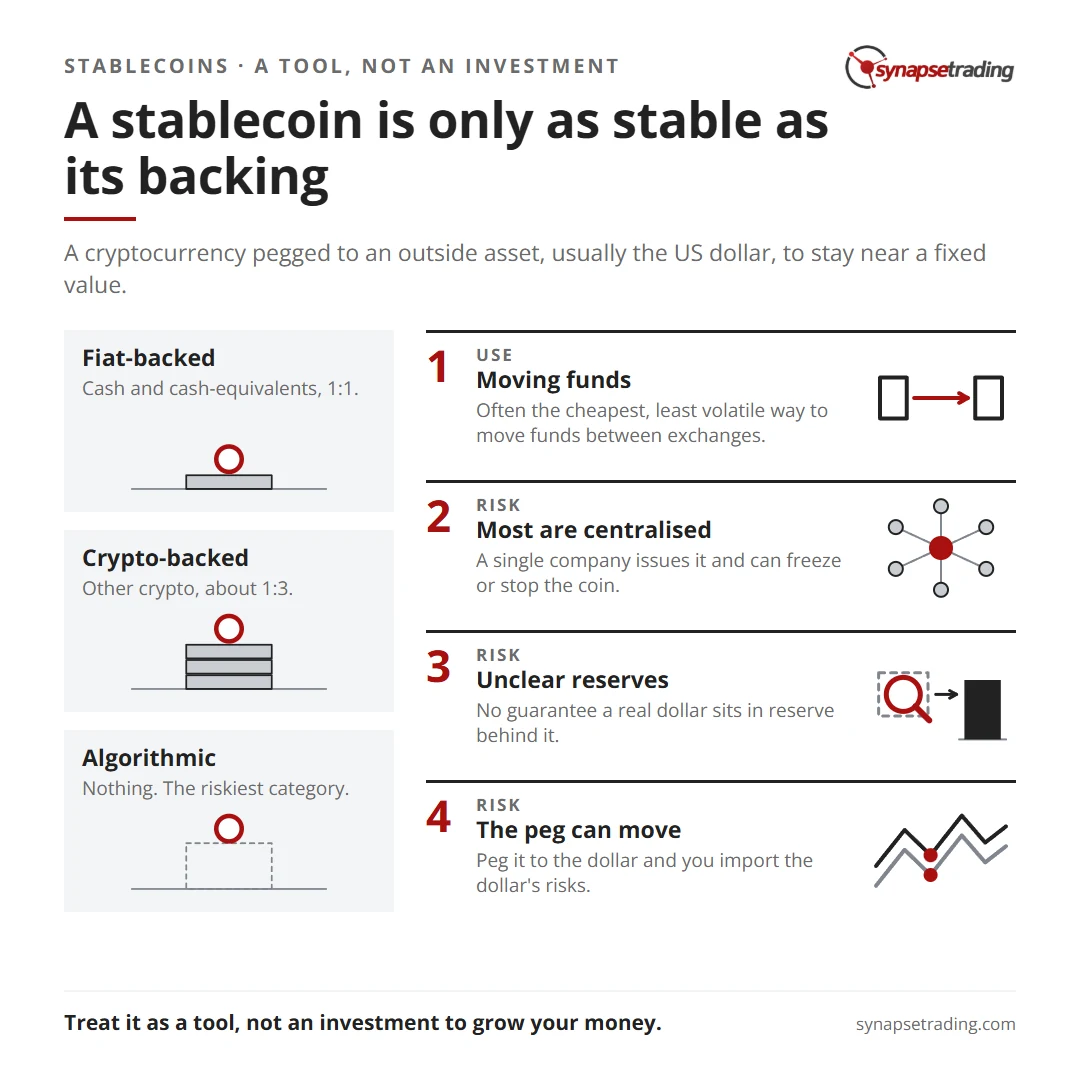
A stablecoin is a cryptocurrency pegged to an outside asset (usually the US dollar) so its price stays near a fixed value instead of swinging like Bitcoin. The best-known ones are Tether (USDT) and USD Coin (USDC), both pegged 1:1 to the dollar and used mainly as a stable place to park funds between trades, move money across exchanges cheaply, and reduce volatility. They are useful tools, but they are not “risk-free.” A stablecoin is only as stable as the asset behind it and the company holding the reserve. Where they earn their place is as plumbing: cheap, fast transfers and a parking spot during volatility.
Here is what stablecoins are, the four most cited names, the real risks, and when (and when not) to use them.
What is a stablecoin, and how does it stay stable?
A stablecoin is a non-volatile cryptocurrency pegged to an external real-world asset, most often a fiat currency (a government-issued currency like the US dollar). The idea is simple. If one token is backed 1:1 by US dollars, then one token should always be worth about $1, in cash or cash-equivalents and very short-term government securities.
That peg is what removes the wild price swings. With a normal cryptocurrency, the value can plummet at any time. With a fiat-backed stablecoin, the value is meant to stay flat by design, hence the word “stable.”
The backing is the whole point. For every stablecoin in circulation, the issuer is supposed to hold an equivalent asset in reserve. A well-run issuer has that reserve overseen by an independent custodian and audited regularly to prevent fraud. When this works, it is one of the more reliable corners of crypto. When it does not, you get the problems we cover further down.
Do note that, for now, you mostly cannot spend stablecoins on everyday purchases. They are not yet a widely accepted mode of payment. In practice, traders buy and hold them inside the crypto system, using other cryptocurrencies, as a stable base rather than as walking-around money.
What are the types of stablecoins?
Not all stablecoins are pegged to fiat. They split into a few categories based on what backs them, and the backing tells you a lot about the risk.
Type
What backs it
Collateral ratio
Example tokens
Fiat-backed
Cash and cash-equivalents (e.g. US dollars)
1:1
USDT, USDC
Metal-backed
Precious metals (gold, silver)
1 token = a fixed weight (e.g. 1g gold)
Tether Gold (XAUT), PAX Gold (PAXG), Digix Global (DGX)
Crypto-backed
Other cryptocurrencies, over-collateralised
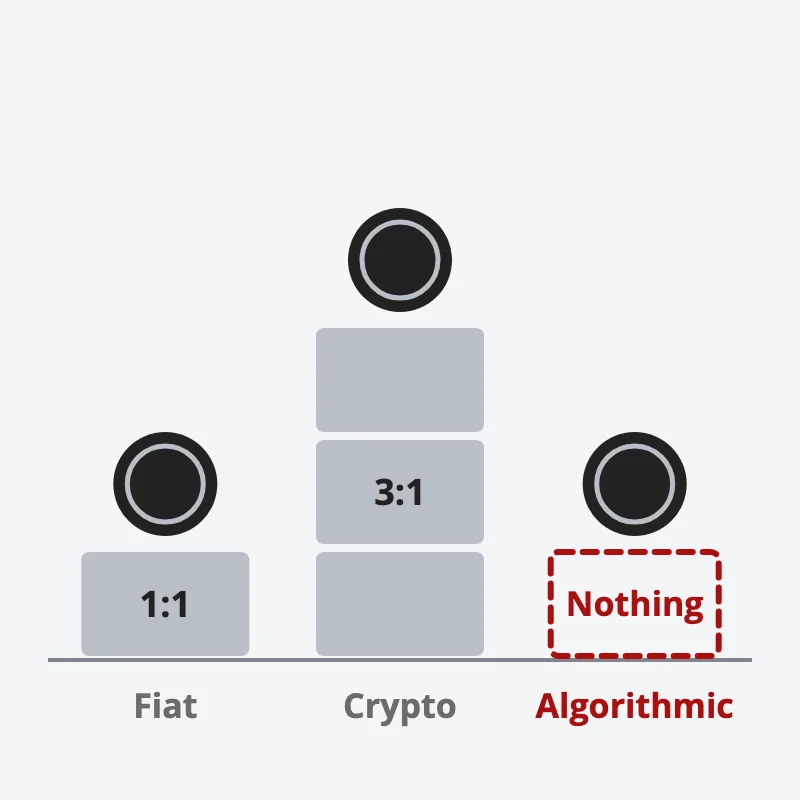
About 1:3 ($3 of crypto per $1 of coin)
DAI
Algorithmic
Nothing. An algorithm controls supply
No collateral
(the riskiest category)
A few notes on the trickier ones.
Metal-backed coins track a commodity instead of a currency. One token equals a fixed weight of gold, and like fiat-backed coins they keep reserves behind the tokens.
Crypto-backed coins solve the volatility problem with over-collateralisation. Because the backing (crypto) is itself volatile, the issuer holds far more than 1:1. A roughly 3:1 ratio means $3 of crypto sits in reserve for every $1 of stablecoin, giving a buffer if the collateral drops.
Algorithmic coins are backed by nothing physical. An algorithm expands and contracts the supply to push the price back toward the peg. When demand rises and the price climbs, the algorithm issues more coins to bring it down; when demand falls, it removes supply. This is the category to treat with the most caution. Several high-profile algorithmic coins have lost their peg badly, and “the maths will hold the price” is a promise that only works until it suddenly does not.
A stablecoin is only as stable as the asset behind it.
Why do traders use stablecoins?
Beyond a steady value, stablecoins carry a few practical advantages that come from living on a blockchain.
Because they are part of decentralised finance (DeFi, financial services run on blockchains instead of through banks), there is no intermediary institution sitting in the middle of a transfer. You move value directly, without a third party’s permission, and without a third party’s fee. You still pay a small network fee to use the blockchain, but not a bank’s cut on top.
Those blockchain networks are public ledgers that record every transaction for anyone to audit and inspect. That transparency is genuinely useful, and traders value it.
Most importantly for an active trader, the transfers are simple, fast, and not boxed in by geography. If you are moving funds between exchanges or in and out of positions, a stablecoin is often the cheapest and least volatile way to do it.
The four most-cited stablecoins to know
There are roughly 200 stablecoins in existence, released or in development, and most of them you will never need to think about. A handful carry almost all the real volume. Here are the four names that come up most, with what to know about each.
1. Tether (USDT)
Tether is a fiat-collateralised, blockchain-based stablecoin, pegged 1:1 to the US dollar, so 1 USDT is meant to equal $1. It launched in 2014 (originally as RealCoin, then renamed Tether) and has grown into a major source of liquidity for the entire crypto market. You can buy it on most large exchanges. It is the most-used stablecoin by a wide margin, which is also why its reserve transparency gets the most scrutiny (more on that below).
2. USD Coin (USDC)
USDC is also pegged 1:1 to the US dollar. It was created through a collaboration between Coinbase (a well-known US exchange) and Circle (a Boston-based payments technology company), and the tokens you hold are ERC-20 tokens, the standard token format on the Ethereum blockchain.
USDC’s selling point is regulatory cleanliness. It operates under US money-transmission rules, its reserves are audited regularly by a major accounting firm, and the attestation reports are published publicly. For traders who care most about reserve transparency, USDC is usually the first name mentioned.
3. Binance USD (BUSD)
BUSD was a fiat-backed stablecoin pegged 1:1 to the US dollar, issued by Paxos (a New York-regulated blockchain firm) in partnership with Binance, and approved by the New York State Department of Financial Services. It was known for fast, flexible transactions.
I am keeping it on this list because you will still see it referenced everywhere, but with an important update: issuance of new BUSD was wound down in 2023 after the New York regulator directed Paxos to stop minting it. The lesson is the useful part. Even a regulated, well-run stablecoin can be switched off by the authority that approved it. That is a centralisation risk you do not get with the assets stablecoins are meant to imitate.
4. Dai (DAI)
DAI is the odd one out, and the most interesting. It is an ERC-20 token, but instead of one company holding dollars in a bank, DAI is backed by a basket of cryptocurrencies locked in smart contracts (self-executing code on the blockchain), over-collateralised to hold a roughly 1:1 value against the US dollar.
That makes it far more decentralised than the others. There is no single company that can be fined, fail, or be told to stop. For users in countries with unstable, depreciating currencies, DAI offers a form of financial inclusion: a dollar-like store of value they can reach without a traditional bank.
What are the risks of stablecoins?
Stablecoins were built to fix volatility, but they bring their own problems. These three matter most.
1. Most are centralised. This is the big one, and it is almost the opposite of what people come to crypto for. A typical fiat-backed stablecoin is owned and issued by a single company. Tether (USDT) is issued by Tether Limited, which controls the supply and distribution of the coin. If that company fails, freezes, or is shut down, the value of its coin is at risk, and that is a real loss for holders. BUSD above is the live example of this exact risk playing out.
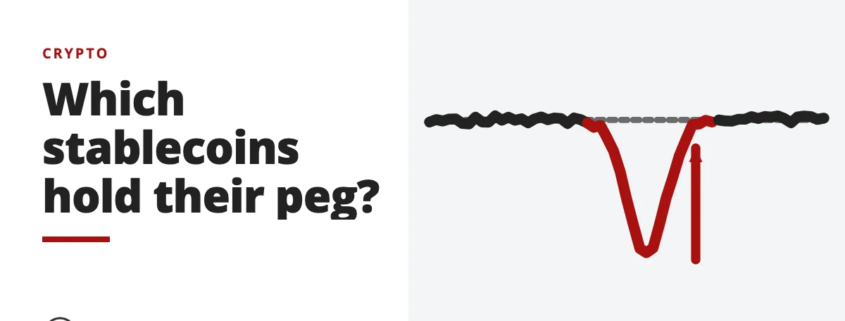
2. Reserves are not always transparent. You buy a stablecoin trusting that a real dollar (or real asset) is sitting in reserve behind it. There is no guarantee that it actually is. Tether is the case in point: in 2018 it was fined over its reserve disclosures, and the coin briefly slipped off its peg before recovering. “Trust us, the money is there” is not the same as “here is the audit.”
3. The underlying asset can move too. A stablecoin is only as stable as what it is pegged to. Peg it to the US dollar and you have imported the dollar’s exposure to inflation, economic downturns, and black-swan events. A sudden dollar crash is highly unlikely, but “unlikely” is not “impossible.” A stablecoin is only as stable as the external asset behind it.
Are stablecoins a good investment?
Here is my honest take. There is no such thing as a “risk-free” investment in crypto, and stablecoins do not change that. Before you put money into an entirely new digital financial system, you are taking a leap of faith, peg or no peg.
Where stablecoins do earn their place is as a tool:
Moving funds. If you are pushing a lot of money through crypto exchanges, stablecoins cut transaction costs and reduce volatility during the transfer.
Storing value in a weak-currency country. If your home currency is depreciating, a dollar-pegged stablecoin can be a way to preserve purchasing power without a traditional bank.
That distinction (tool versus investment) is itself a small example of the trader’s edge. A screener can tell you a coin is pegged to the dollar in a second. It will not tell you whether parking capital in it actually fits what you are trying to do, or whether you are just storing risk in a different wrapper. That judgment, knowing what a tool is for and refusing to mistake it for an opportunity, is the part worth learning, and it is the first of the Five Edges no algorithm trades for you.
For the bigger picture on how stablecoins fit into crypto and DeFi, read the pillar: The Ultimate Guide to Blockchain and Cryptocurrencies.
FAQ
What is the safest stablecoin?
There is no perfectly “safe” stablecoin, but the ones most often cited for reserve transparency are the large fiat-backed coins whose reserves are audited regularly and published, like USDC. Safety here means clear, public proof of reserves and regulatory oversight. Neither guarantees you against loss.
Are stablecoins a good investment?
For capital growth, no. A stablecoin is designed to hold a fixed value, so it is not built to appreciate. It is better understood as a tool for moving funds cheaply, reducing volatility between trades, or storing dollar-value in a weak-currency country, rather than as an investment to grow your money.
What is the difference between USDT and USDC?
Both are pegged 1:1 to the US dollar. USDT (Tether) is the larger and more liquid, used widely as crypto-market plumbing. USDC (issued via Coinbase and Circle) is usually seen as the more transparent on reserves and regulatory compliance. Many traders hold both for different reasons.
Can a stablecoin lose its peg?
Yes. Stablecoins can and do slip off their peg, especially algorithmic ones with no real collateral. Even reserve-backed coins can wobble during a confidence shock or a reserve scare. A stablecoin is only as stable as the asset behind it and the trust in the issuer holding it.
Are stablecoins centralised?
Most fiat-backed ones are. Coins like USDT and USDC are issued by single companies that control supply and can freeze or stop the coin, which is a centralisation risk. DAI is the main exception, backed by a basket of crypto in smart contracts rather than by one company.
Now that you have the four names, the types, and the real risks, what is your view? Do you treat stablecoins as a useful tool, or do you skip them entirely? Let me know in the comments.
Want a simple system for the rest of your crypto? Grab the free 15-Minute Swing Trading Starter Kit. It is the exact routine I use to scan once a day and trade any market, crypto included, in 15 minutes.
About the author. Spencer Li is The 15-Minute Trader and the founder of Synapse Trading. He is a Certified Financial Technician (CFTe) with 15+ years of trading, run from 70+ countries. He holds a B.Acc and B.BM from SMU. Every trade he takes is public, dated, losses left in. He teaches rules-based swing trading in 15 minutes a day, one system for any market.
Education, not financial advice. Synapse Trading is not licensed by MAS to advise on investment products. Trading carries risk of loss; past performance is not indicative of future results.
https://synapsetrading.com/wp-content/uploads/2026/10/best-stablecoin-crypto-card.webp6301200Spencer Lihttps://synapsetrading.com/wp-content/uploads/2026/10/synapse-logo-horizontal-light.pngSpencer Li2021-08-06 06:00:372026-10-22 13:32:28What are the Best Stablecoins and are they a Good Crypto Investment?
What Is DeFi (Decentralised Finance), and Will It Replace Banks?
Last updated: 12 October 2026 · By Spencer Li, CFTe
Decentralised finance, or DeFi, is a financial system that lets people lend, borrow, trade, and earn without a bank or any central middleman in between. Instead of a bank holding your money and approving your transactions, the rules run automatically as code on a blockchain (a public, shared digital ledger that records every transaction across many computers). The honest answer to “will it replace banks?” is: not yet, and maybe not fully. DeFi fixes two real problems with traditional banking, a lack of transparency and the risk of data breaches. But it brings its own problems, mainly crypto volatility, hacking risk, and almost no regulation. So today it works best as a parallel system for people who want full control of their money, not as a wholesale replacement for the banking system most of us still rely on.
Here is how it actually works, what it does well, where it breaks, and why I would not bet the house on it yet.
Why do we even need an alternative to banks?
We currently run on a centralised financial system, often shortened to CeFi (centralised finance), where power sits with a few central authorities. Banks, credit unions, and insurance companies control the services, and we are largely at their mercy for investing, lending, borrowing, and everyday money matters.
To be fair, this system is trusted for a reason. When you deposit money, the bank takes responsibility for it. Regulators set the standards and make everyone follow them. For most people, most of the time, that reliability is exactly what you want.
That being said, the centralised system is not without flaws. There are two big ones.
1. Lack of transparency. When you deposit money in a bank, it does not sit locked in a box only you can open. The bank lends it out to someone else, because that is how banks make money. They are responsible for getting it back, and they will return your money even if the borrower defaults. But you never really know what is happening with your money or who it was lent to.
2. Data breaches. A centralised system is a single big target. There have been many cases where people’s confidential information and money were stolen. The same centralisation also makes the system vulnerable to wider financial crises, the kind of economic downturns that rattle everything at once.
DeFi is often pitched as the cure for these two specific maladies. Let’s see how.
What is DeFi (decentralised finance), and how does it work?
A decentralised financial system is an alternative to the centralised one. It lets financial transactions happen without a third-party financial institution in the middle. Think of it as a digital ecosystem offering services much like a bank does, except the services are handled by code rather than by a person.
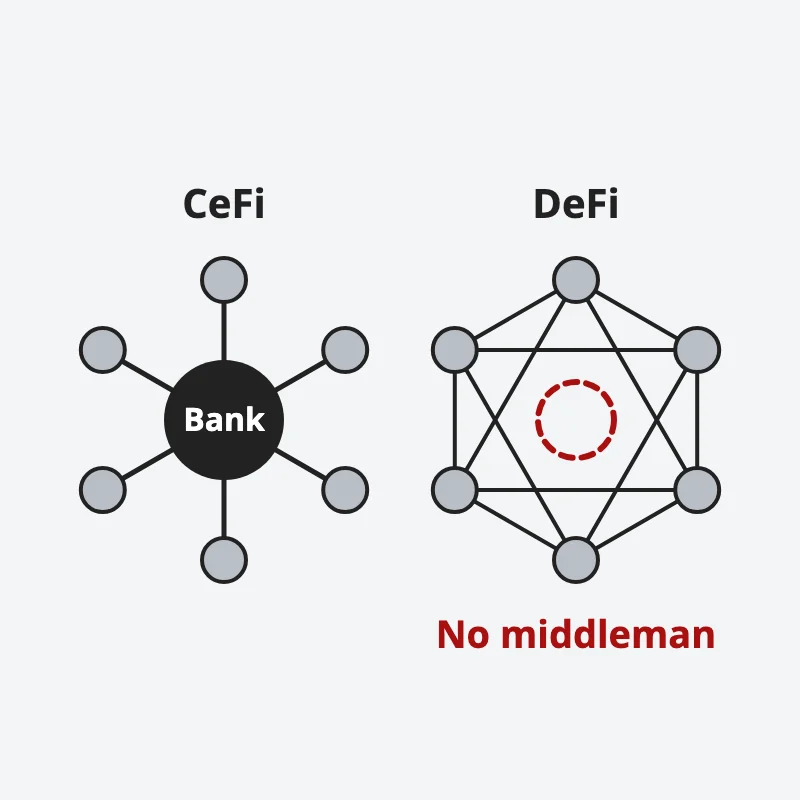
CeFi routes every transaction through a bank; DeFi lets people deal directly, with no middleman.
The key difference is what it is built on. DeFi runs on top of a blockchain network. A blockchain is a decentralised, distributed, and usually public digital ledger that records transactions across all the computers on its network.
The reason this matters is that the records are very hard to tamper with. Transactions are stored in “blocks,” and a block cannot be quietly edited after the fact without breaking every block that came after it. In plain terms, it is extremely hard to game the system.
So DeFi takes direct aim at the two CeFi flaws above. Because each transaction is recorded on a public ledger, you can see exactly where your money is and what it is doing. And because the record is so hard to fake, your money is harder to quietly mishandle.
CeFi vs DeFi: a side-by-side comparison
Here is the cleanest way to hold the two systems next to each other.
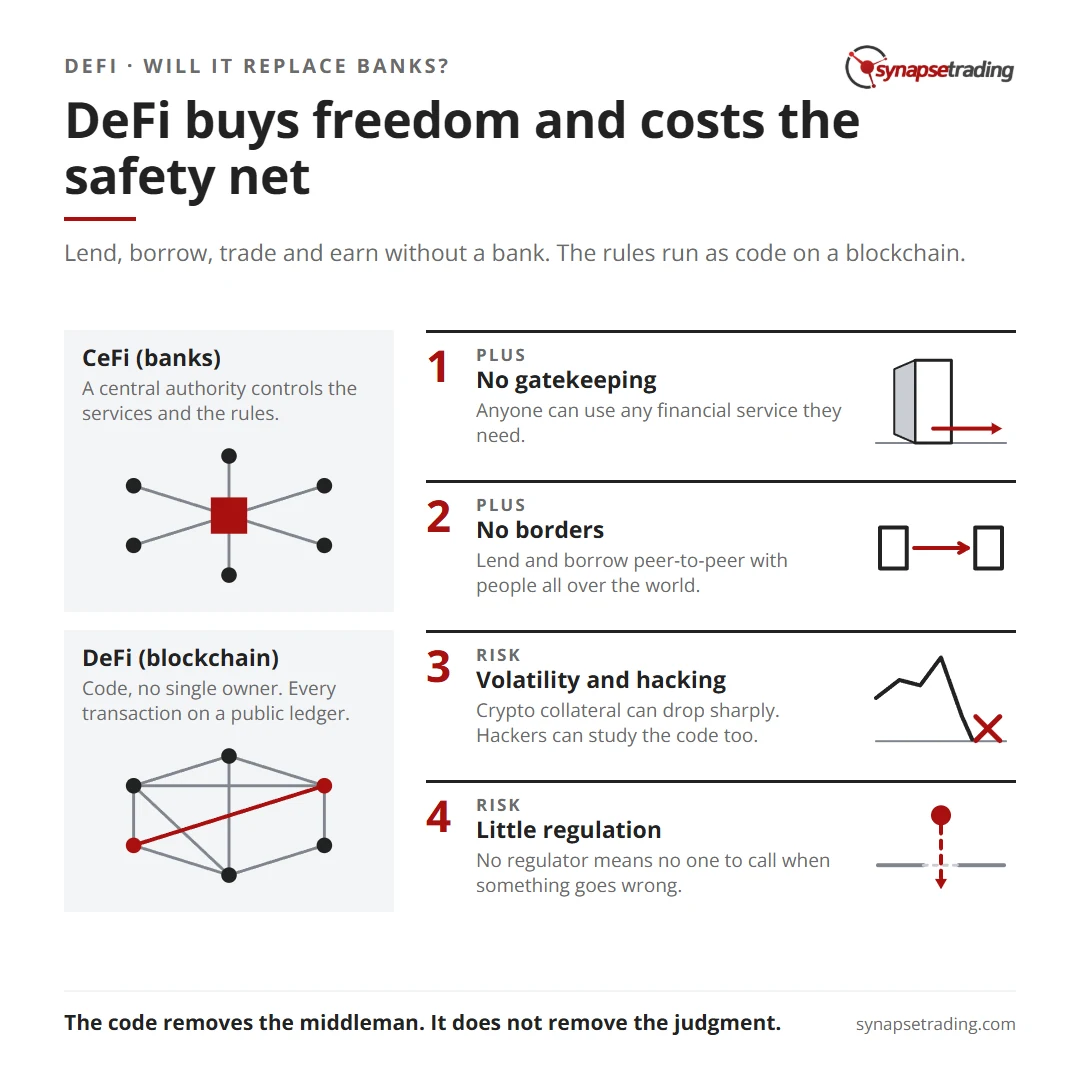
CeFi (banks)
DeFi (blockchain)
Who is in control
A central authority (bank, regulator)
Code (smart contracts), no single owner
Transparency
Low, you can’t see where your money goes
High, every transaction is on a public ledger
Reliability
High, established and regulated
Improving, but still young
Geographic limits
Yes, restrictions on cross-border lending
No, anyone, anywhere, peer-to-peer
Main risks
Data breaches, financial crises
Volatility, hacking, no regulation
What you transact in
Real-world money and assets
Mostly crypto assets (e.g. Bitcoin)
Oversight
Strong regulation
Little to none
The table makes the trade-off obvious. DeFi buys you transparency and freedom; it costs you the safety net of regulation. Which side of that trade you want depends entirely on how much control you are willing to manage yourself.
What are the advantages of DeFi?
Beyond fixing transparency, DeFi brings a few things a bank simply cannot.
1. No censorship. Unlike CeFi, DeFi does not gatekeep. Anyone can use any financial service they need. That is a big deal, especially for the underbanked, people who can’t easily get a normal bank account.
2. No geographical restrictions. You can transact with people all over the world. A centralised system usually won’t let you freely lend to or receive money from someone in another country. DeFi users can do worldwide peer-to-peer (P2P) lending and borrowing directly. Do note that, for now, this mostly works with crypto assets, the most famous being Bitcoin (BTC), rather than real-world assets like gold or property.
What are the disadvantages of DeFi?
I want to be balanced here, because the hype usually skips this part. DeFi has four real weaknesses.
1. It is reliant on technology. Because the whole thing is digital, it lives or dies by its tech. That means serious technical risk. One bad glitch and the system can come crashing down.
2. Cryptocurrencies are volatile. Major cryptocurrencies swing hard, which makes the system unpredictable. Even if you borrow a stablecoin, you usually post crypto as collateral, and that collateral’s value is not fixed. It can drop sharply at any time and trigger problems.
3. There is hacking risk. The same transparency that makes DeFi trustworthy cuts both ways. Smart contracts can be read and audited by anyone, which means hackers can study them too. The possibility of manipulation has not gone to zero.
4. There is little oversight or regulation. This is the biggest one. So much of the public depends on the centralised system that a full switch to DeFi feels unrealistic right now. No regulator also means no one to call when something goes wrong.
What is Ethereum, and what are smart contracts?
You cannot talk about DeFi without Ethereum. Ethereum is one of the most popular blockchain platforms, a decentralised public ledger that lets people run decentralised applications (dApps, apps with no central server or owner). It has its own cryptocurrency, Ether (ETH), and its own programming languages, Solidity and Vyper. After Bitcoin, Ether is the most popular cryptocurrency in the world and ranks second by market value.
Since no bank sits in the middle of a DeFi transaction, something has to enforce the rules. That something is a smart contract. A smart contract is a piece of code, not controlled by any central authority, that runs automatically when preset conditions are met. Once it is deployed on the network, it cannot be changed.
Like a traditional contract, a smart contract lays down the rules of a deal, but it enforces them by itself. For example, if a borrower fails to repay a loan from another Ethereum user, the borrower’s collateral is automatically liquidated and the loan is settled. No phone calls, no debt collector. In the world of DeFi, smart contracts stand in for all the financial institutions.
What are the most popular DeFi applications?
Three categories cover most of what people actually use.
1. Decentralised exchanges (DEXs). A DEX works like a marketplace where buyers and sellers connect and trade cryptocurrencies (and fiat, meaning government-issued money like USD) without a central authority. The whole process is non-custodial and runs through smart contracts, so no third party ever owns your assets.
2. Peer-to-peer (P2P) lending platforms. Need a loan? You can approach another user directly and skip the middleman. Because both sides rely on smart contracts, the room for fraud is very small.
3. Stablecoins. Stablecoins were created to answer crypto’s volatility problem. A stablecoin is a cryptocurrency, like Bitcoin or Ether, with one difference: it is pegged to the value of something stable, usually a fiat currency, sometimes a commodity like a precious metal. DAI is one of the most popular, with 1 DAI trading at roughly $1.
Will DeFi take over the traditional financial system?
It is fair to say DeFi has genuinely changed the financial landscape, and rightly so. It hands people control of their own money, it adds efficiency and transparency, and it has cut the room for corruption and fraud. On those terms, it looks like one of the better-designed financial systems we have.
Having said that, the system is still in its relative infancy, and the disadvantages above are real. Volatility, hacking, and the near-total lack of regulation are not small footnotes.
Personally, here is where I land. DeFi will keep developing fast, and if it closes the current gaps, especially around stability and oversight, there is a real chance it grows into a much larger part of the global financial system. But “replace banks entirely, soon” is a much stronger claim than the evidence supports today.
And this is the part the technology cannot do for you. Blockchain can guarantee that a transaction is recorded honestly; it cannot tell you whether a given token is a real opportunity or a rug-pull dressed up in a nice whitepaper. The code removes the middleman. It does not remove the judgment. That judgment, deciding what is actually worth your capital, is the human edge no smart contract trades for you.
FAQ
What is DeFi in simple terms?
DeFi (decentralised finance) is a way to use financial services like lending, borrowing, and trading without a bank or central middleman. The rules run automatically as code (smart contracts) on a blockchain, a public ledger that records every transaction.
Is DeFi safe?
It is transparent but not risk-free. DeFi removes the bank as a single point of failure, but it adds its own risks: crypto price volatility, smart-contract hacking, and almost no regulation, which means little recourse if something goes wrong.
What is the difference between CeFi and DeFi?
CeFi (centralised finance) runs through banks and regulators who control your money and the rules. DeFi runs on a blockchain with no central owner, so transactions are transparent and borderless, but unregulated.
What is a smart contract?
A smart contract is code on a blockchain that runs automatically when preset conditions are met. It enforces the terms of a deal by itself, with no central authority. Once deployed, it cannot be changed. In DeFi, smart contracts do the job banks normally do.
Will DeFi replace banks?
Not in the near term. DeFi solves transparency and access, but volatility, hacking risk, and the lack of regulation make a full replacement unlikely soon. It is better viewed as a parallel system than a wholesale replacement.
Now that you have the full picture of DeFi, its strengths and its real weaknesses, what do you think? Will it take over the traditional financial system, or stay a parallel option? Let me know in the comments.
Want a simple system instead of the hype? Grab the free 15-Minute Swing Trading Starter Kit. It’s the exact routine I use to scan once a day and trade any market in 15 minutes.
About the author. Spencer Li is The 15-Minute Trader and the founder of Synapse Trading. He is a Certified Financial Technician (CFTe) with 15+ years of trading, run from 70+ countries. He holds a B.Acc and B.BM from SMU. Every trade he takes is public, dated, losses left in. He teaches rules-based swing trading in 15 minutes a day, one system for any market.
Education, not financial advice. Synapse Trading is not licensed by MAS to advise on investment products. Trading carries risk of loss; past performance is not indicative of future results.
https://synapsetrading.com/wp-content/uploads/2026/10/decentralised-finance-defi-card.webp6301200Spencer Lihttps://synapsetrading.com/wp-content/uploads/2026/10/synapse-logo-horizontal-light.pngSpencer Li2021-08-04 20:49:322026-10-22 13:32:30What is Decentralised Finance (DeFi) and is it the Future of Finance?