

What is Tether (USDT) Stablecoin, and is it a Good Investment?
Want the daily routine? Get the free 15-Minute Swing Trader’s Checklist. Get it free →
What Is Tether (USDT)? A Plain-English Guide to the Biggest Stablecoin
Last updated: 19 October 2026 · By Spencer Li, CFTe
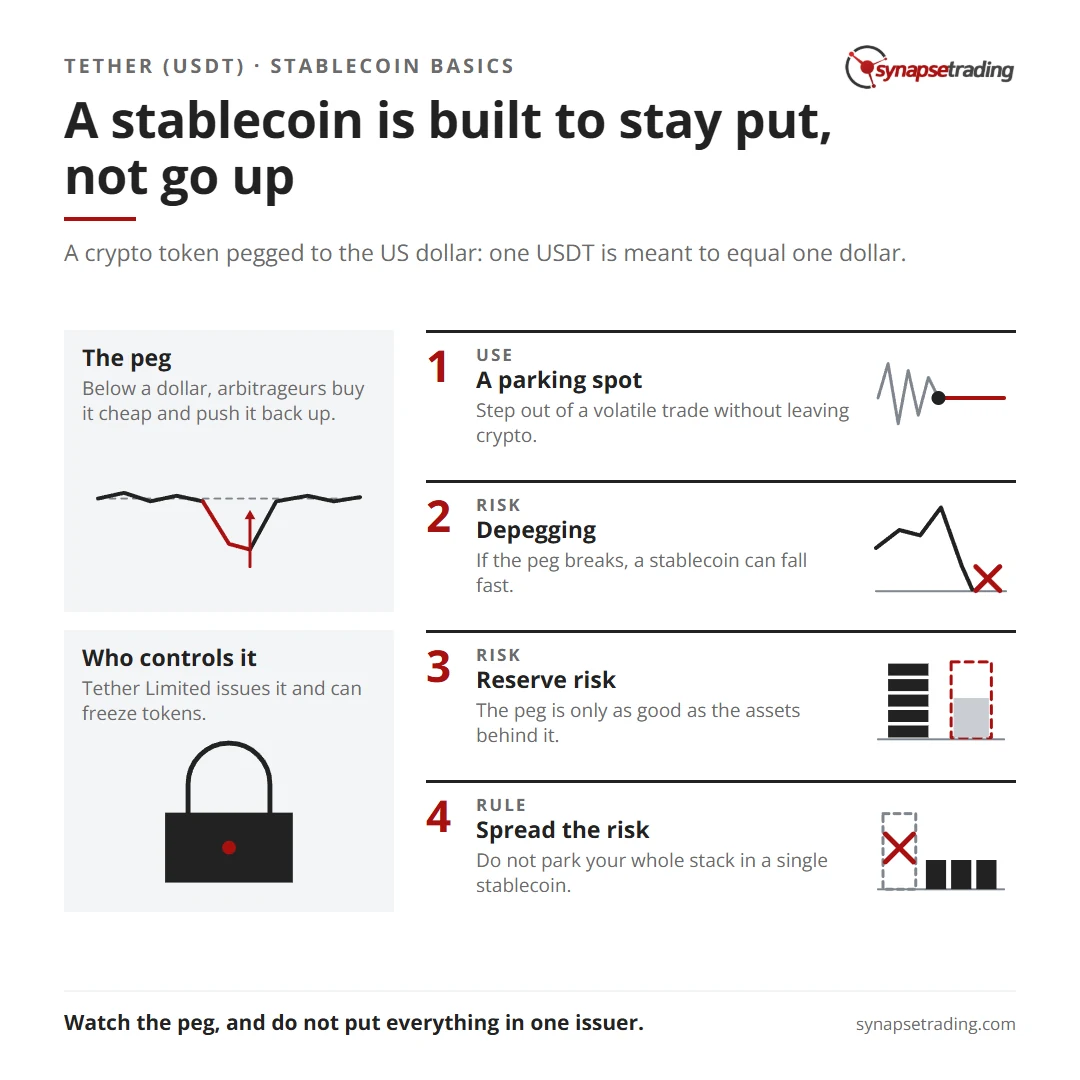
Tether (USDT) is the largest stablecoin in the world, a cryptocurrency designed so that one USDT is always worth about one US dollar. A stablecoin is a crypto token pegged to a stable asset (here, the US dollar), so it does not swing in price the way Bitcoin or Ethereum do. Tether holds it near one dollar by claiming to back every coin in circulation with reserves of roughly equal value. In practice, traders use USDT as a place to park money between trades, to move dollars between exchanges quickly, and to buy other cryptocurrencies. It is the most widely accepted stablecoin and the most liquid. Is it a good investment? Honestly, that is the wrong question. A stablecoin is not built to go up. It is built to stay put. You hold USDT to avoid volatility and stay flexible; it earns you nothing on its own. The real things to weigh are whether the peg holds and whether the reserves are really there.
Here is the full picture: what a stablecoin is, how Tether works, the case for using it, and the risks nobody likes to mention.
What is a stablecoin?
A stablecoin is a digital asset pegged to something with a stable value, usually the US dollar. The whole point is to avoid the wild price swings of the crypto market while keeping the convenience of blockchain (the shared, tamper-resistant ledger that records every transaction).
Think of it as a dollar that lives on the blockchain. Bitcoin can move 10% in a day. A stablecoin is supposed to sit at one dollar and stay there.
That stability is what makes it useful. A currency that swings around is hard to spend, save, or settle a trade in. A stablecoin is meant to be boring on purpose, which is exactly what you want when you are using it to hold value, move money, or settle a transaction.
What is Tether (USDT), and how does it work?
Tether is a stablecoin pegged to the US dollar, so one USDT is meant to equal one US dollar. It was first issued in 2014 and is run by a company called Tether Limited. The token is now issued across several blockchains, including Ethereum and Tron, not just the original Omni Layer it launched on.
It works like any other crypto token. You can send USDT to another person, use it to pay for goods or services, or store it in a digital wallet (software that holds your crypto, a bit like an online bank account). Every transaction is recorded on the blockchain.
The model is simple in theory. Tether Limited says each USDT in circulation is backed by reserves it holds, mostly cash and US Treasury bills. So in principle every coin is matched by about a dollar of real assets somewhere. That backing is what is supposed to keep the price glued to one dollar: if USDT ever drifts below a dollar, arbitrageurs (traders who profit from price gaps) buy it cheap and redeem it for the full dollar, which pushes the price back up.
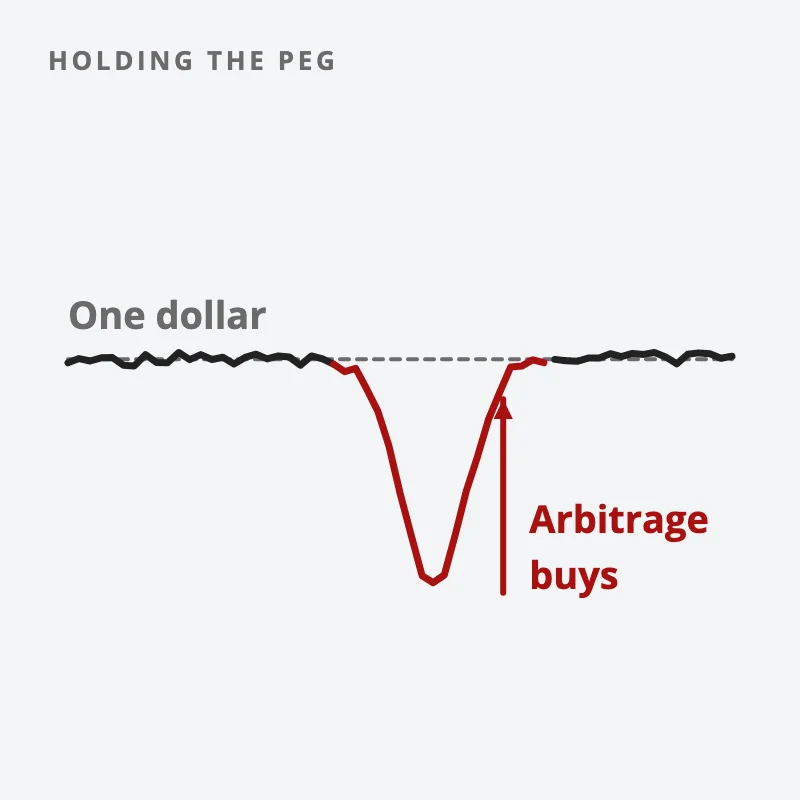
Do note that the redemption process is not as frictionless as the original pitch suggests. Direct redemption with Tether is mainly for large, verified accounts and carries minimums and fees. Most ordinary users never redeem with Tether at all. They just sell USDT for dollars on an exchange. That distinction matters more than it sounds, and we will come back to it under risks.
Why traders use Tether
Tether is the default stablecoin for most of the crypto market, and the reasons are practical rather than exciting. Here is the honest case for it.
| Reason | What it means for you | The honest caveat |
|---|---|---|
| Stability | Sits near one dollar, so you can step out of a volatile trade without leaving crypto | “Near” one dollar, give or take a fraction of a cent. It has wobbled before |
| Liquidity | The most traded stablecoin, so you can move in and out fast | Liquidity can dry up in a panic, which is the worst time |
| Accepted everywhere | Most exchanges take USDT, so it is the easiest bridge to buy Bitcoin, Ethereum and the rest | Wide acceptance is not the same as safety |
| Transparency | Tether publishes regular reserve attestations | Attestations are snapshots and fall short of a full independent audit. Read the difference |
| Speed and ease | All you need is a wallet and an internet connection. No mining, no complexity | Speed cuts both ways. A bad transfer is irreversible |
A few of these deserve a closer look, because the original pitch around stablecoins tends to oversell them.
On transparency, be precise. Tether publishes attestations: a third party confirms what the reserves looked like at a single point in time. That is genuinely more than nothing, and Tether’s reporting has improved over the years. But an attestation is not a full audit, where an auditor stands behind the numbers over a whole period. If someone tells you Tether is “fully audited”, they are overstating it. Know what you are actually getting.
On liquidity, USDT really is deep and easy to trade in normal conditions. The catch is that liquidity is highest exactly when you do not need it and thinnest in a crisis, when everyone wants out at once. Plan for the bad day.
One correction worth making plainly: USDT is not decentralized. Tether Limited issues it, controls the supply, and can freeze tokens at specific addresses when asked by law enforcement. That centralization is a feature for compliance and a risk for anyone who assumed crypto means “no one can touch my coins”. Both things are true at once.
The risks nobody likes to mention
Every stablecoin carries risk, and pretending otherwise is how people get hurt.
The first is hacking, the standard crypto risk. The exchanges and wallets where you hold USDT absolutely have been hacked. Where you keep it matters as much as what it is.
The second, and the big one, is depegging. Because USDT is pegged to the dollar, the whole thing rests on that peg holding. If confidence cracks and the peg breaks, a stablecoin can fall fast. We saw the worst version of this with Terra USD (UST) in 2022, which spiralled toward zero in days. Tether is a very different design from UST, and it has defended its peg through several scares, briefly dipping below a dollar and recovering. But “it held last time” is a hope, and nothing guarantees it holds next time.
The third is reserve risk, which is really the depeg risk underneath the depeg risk. The peg is only as good as the assets behind it. If you cannot fully verify the reserves, you are trusting Tether Limited. That trust has mostly been rewarded, and it has also been questioned, including a past settlement with regulators over how reserves were once represented. None of this means avoid it. It means size it like a position with counterparty risk.
Where the human edge comes in
A screen will tell you USDT is sitting at one dollar in a tenth of a second. What it will not tell you is when “one dollar” has quietly become a crowded exit. The data is free. The judgment to not park your whole stack in a single stablecoin, to spread counterparty risk, and to treat a peg as a promise rather than a law, that is the part no tool supplies for you. That judgment is the first of the Five Edges that AI cannot trade for you.
So is Tether a good investment?
Reframe it. Tether is not really an investment, because it is not designed to go up. It is the blue-chip parking spot of the crypto world, a way to hold value in dollars without leaving the blockchain. If you are reaching for a stablecoin specifically to chase high yields, understand that the higher the advertised yield, the higher the risk you are taking on, and the peg you are leaning on may be flimsier than Tether’s.
Keep an eye on the peg, do not concentrate everything in one issuer, and you have used the tool correctly.
FAQ
Is Tether (USDT) safe?
It is the most established and most liquid stablecoin, and it has defended its dollar peg through multiple scares. But it is not risk-free: the main risks are depegging and reserve quality, and you are trusting Tether Limited to back every coin. Treat it as a low-volatility holding with counterparty risk.
Is one USDT always worth one US dollar?
That is the goal, and it usually trades very close to one dollar. It has briefly slipped below the peg during market panics and then recovered. “Pegged” means “designed to stay at a dollar”. Nothing legally fixes it there.
Is Tether decentralized?
No. Tether Limited issues USDT, controls its supply, and can freeze tokens at specific wallet addresses. It runs on decentralized blockchains, but the token itself is centrally controlled.
Is Tether fully audited?
Not in the strict sense. Tether publishes regular reserve attestations, which are third-party snapshots of the reserves at a point in time. That is more disclosure than some rivals provide, but it is not the same as a continuous independent audit. Know the difference before you rely on the word “transparent”.
How do I buy Tether (USDT)?
Register and verify an account on an exchange licensed where you live, then buy USDT with fiat currency or by swapping another cryptocurrency. Most people then hold it in an exchange or self-custody wallet rather than redeeming directly with Tether.
Now that you know what Tether is and where its risks sit, how do you use stablecoins in your own setup? Let me know in the comments.
If you want the bigger picture on crypto and DeFi, read the pillar: The Ultimate Guide to Blockchain and Cryptocurrencies.
Want a system, not just another coin to watch? Grab the free 15-Minute Swing Trading Starter Kit. It is the exact routine I use to scan once a day and trade any market in 15 minutes.
About the author. Spencer Li is The 15-Minute Trader and the founder of Synapse Trading. He is a Certified Financial Technician (CFTe) with 15+ years of trading, run from 70+ countries. He holds a B.Acc and B.BM from SMU. Every trade he takes is public, dated, losses left in. He teaches rules-based swing trading in 15 minutes a day, one system for any market.
Education, not financial advice. Synapse Trading is not licensed by MAS to advise on investment products. Trading and crypto carry risk of loss; past performance is not indicative of future results.
Related
The Ultimate Guide to Blockchain and Cryptocurrencies · What is DeFi and how does it work · Bitcoin vs Ethereum · How to store crypto safely
Want the daily routine? Enter your email for the free 15-Minute Swing Trader's Checklist.
Free 5-page PDF, then occasional trading emails. Education only, not financial advice. Unsubscribe anytime. Kit stores your email in the US: see our privacy policy.
Want to learn the full method? The Trading Mastery Program teaches the 4 strategies I have traded since 2011. It suits beginners and experienced traders.
Rather follow the trades as they happen? Daily Trading Signals is our Telegram channel: my trade ideas with entry, stop and exit, and every trade is public.
Questions about this post? Ask in the free Telegram channel →
Educational content only, not personalised financial advice. Trading carries risk, including loss of capital. Past performance is not indicative of future results. Synapse Trading is not licensed or regulated by MAS.

