

How to Invest in the Metaverse with ETFs, and What Happened to the 2021 Funds
Want the daily routine? Get the free 15-Minute Swing Trader’s Checklist. Get it free →
By Spencer Li, CFTe · Last updated: 26 October 2026
The simplest way to invest in the metaverse has been a theme ETF, which is one fund that holds a basket of the companies building it. When I first wrote this post in November 2021, there were two easy routes, a stock ETF from Roundhill that then traded under the ticker META, and a crypto index token from Index Coop called MVI. As at 27 October 2026, the stock ETF still trades, but under the ticker METV, with a new name and, since 1 October 2026, a new strategy. The crypto index has been shut down. So this post is about what those two funds actually did, and what to check before you buy any theme fund, rather than a pick.
This was the question I put to my followers at the time.
Have you positioned your portfolio for the Metaverse? https://t.co/BcjivQzjKv
— Spencer Li (@SynapseTrading) November 10, 2021
What is the metaverse?
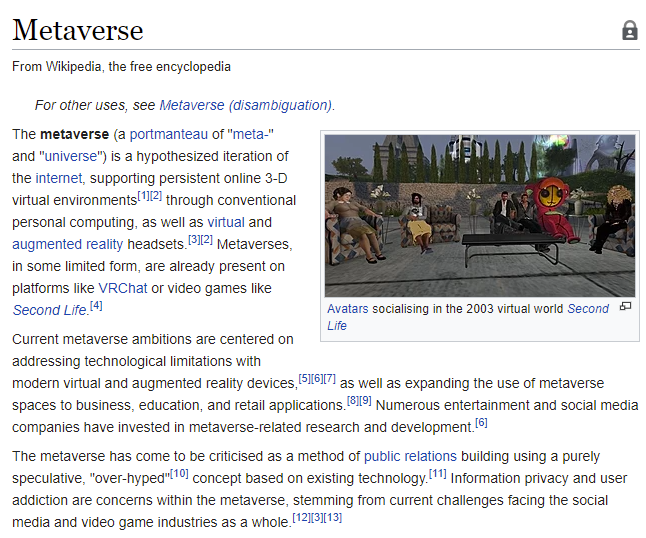
The word comes from Neal Stephenson’s 1992 science-fiction novel Snow Crash, where people move through one shared virtual world as avatars. If you have watched Ready Player One, you will have a pretty good picture of it.
In plain terms, it is a virtual world that copies the real one. The things you normally do in person, like meeting friends, learning, playing and working, can happen there too.
The idea went mainstream on 28 October 2021, when Facebook renamed its parent company Meta. In the same announcement, it said it would report a separate business called Reality Labs, and that it planned to trade under a new ticker it had reserved, MVRS. Within weeks, everyone wanted to know how to own a piece of the theme, and that was the question this post first set out to answer.
What was the metaverse ETF in 2021?
The stock route in 2021 was the Roundhill Ball Metaverse ETF. It launched at the end of June 2021 and tracked the Ball Metaverse Index, a weighted basket of listed companies involved in the metaverse. Its ticker was META.

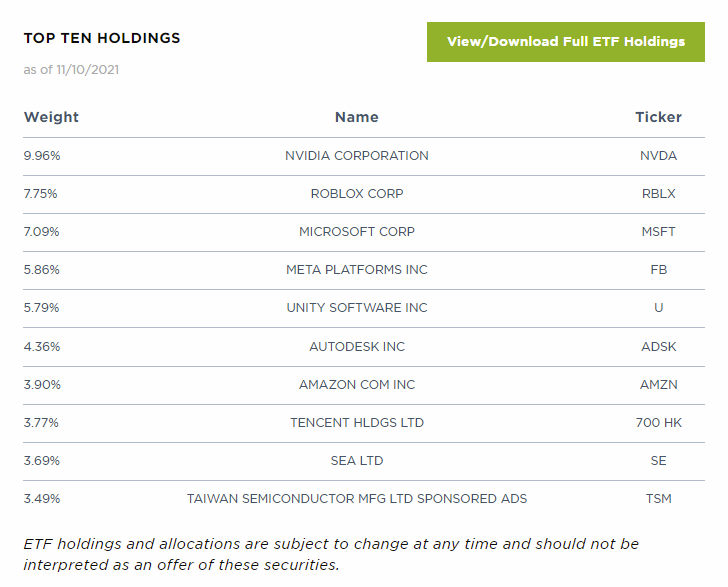
Both screenshots are from November 2021. The ticker, the index and the holdings on them have all changed since, so please read them as a record of the time, and not as today’s fund.
The first change came early. Roundhill moved the fund’s ticker from META to METV at the open on 31 January 2022.
What is the Roundhill Metaverse ETF today?
Here is the fund as its issuer describes it, with the date of each source.
| What | METV today | Source and date |
|---|---|---|
| Name | Roundhill Metaverse ETF, renamed from Roundhill Ball Metaverse ETF on 1 October 2026 | Factsheet, 30 September 2026 |
| Ticker and exchange | METV, NYSE Arca | Roundhill fund page, fetched 27 October 2026 |
| Strategy | Actively managed since the close on 30 September 2026, no longer tracking the Ball Metaverse Index | Prospectus supplement, 22 September 2026 |
| Expense ratio | 0.59% a year | Roundhill fund page, fetched 27 October 2026 |
| Fund size | $227.0 million | Factsheet, 30 September 2026 |
| Number of holdings | 28 | Factsheet, 30 September 2026 |
The switch to active management is the bigger change. Until 30 September 2026, the fund followed an index with set rules, but from 1 October a manager picks the holdings, so what you own now depends on their calls rather than on a published formula.
Its ten biggest holdings on 30 September 2026 were Roblox, Take-Two Interactive, Meta Platforms, Apple, NVIDIA, Microsoft, NetEase, Coinbase, Circle Internet Group and Krafton. Each was between about 4% and 7% of the fund.
It also carries some crypto. The factsheet says the fund may get crypto exposure through exchange-traded products. At the end of 2025, two of its ten biggest positions were Ether and Solana staking ETFs run by 3iQ, at 6.8% and 6.7% of the fund.
If you would rather follow a short routine than a long list of themes, my free 15-minute swing trader checklist is the one I use myself.
How did the metaverse ETF actually perform?
These are the fund’s own calendar-year returns at net asset value, from its prospectus.
| Year | METV total return |
|---|---|
| 2022 | -52.44% |
| 2023 | +60.37% |
| 2024 | +25.05% |
| 2025 | +30.69% |
| 2026, to 31 March | -15.68% |
The 2022 loss is the number to sit with. A fall of 52.44% needs a gain of about 110% just to get back to where you started. That is a long way back. The next three years were strong, yet chaining all four years together gives a total of only about 25%, from the start of 2022 to the end of 2025.
Over the longer stretch, the fund’s annual report gives a return of 5.16% a year from launch to 31 December 2025. The broad Solactive GBS Global Markets All Cap index it lists as its comparison returned 9.25% a year over the same period. On the factsheet dated 30 September 2026, the fund shows 2.03% over one year and 6.62% a year since launch.
What happened to the metaverse crypto index, MVI?
The crypto route was the Metaverse Index, or MVI, from a group called Index Coop. It was a token rather than a fund, built to track a basket of metaverse projects, such as MANA, the currency of the virtual world Decentraland.


As at 27 October 2026, Index Coop’s own product page says, “This page contains legacy product information. The product has been sunset.” The page still lists the yearly streaming fee of 0.95% that holders paid while it ran. The old link in this post, indexcoop.com/mvi, now returns an error page. So both screenshots above show a product that no longer runs.
I could not find the closing date on the issuer’s page, so I have left it out. My 2021 version also described two other tokens, SAND and CUBE. I could not check them on their own sites this time, so they are gone from this post too.

If you would like to learn more about crypto & DeFi, also check out: “The Ultimate Guide to Blockchain & Cryptocurrencies”
What if the fund you buy closes?
In February 2025, a trader on Reddit’s r/ETFs asked for help because their metaverse ETF had “stopped being tradable”. They were a beginner, and they suddenly had a deadline to get their money out.
That fear is fair, and my own 2021 post proves it. Of the two vehicles I wrote about, one has been sunset, and the other has a new ticker, a new name and a new strategy, all as at 27 October 2026. Theme funds come and go with the theme. The issuer can change a fund after you buy it, and the notice usually sits in a prospectus supplement that very few holders read.
So these are the things I would check on any theme fund, using the issuer’s own page.
- The name and ticker. Check that it still trades under the ones you know.
- Any supplement. Look for a filing that changes the index, the strategy or the name.
- The money in it. See whether it is growing or shrinking. METV went from about $277 million at the end of 2025 to $227.0 million on 30 September 2026.
- The yearly charge. Note the expense ratio, and whether it has moved.
- The holdings. Compare what it holds today with the theme on its label.
What does a 1978 rule about technology say about theme funds?
In 1978, a futurist called Roy Amara, who led the Institute for the Future, put a pattern into one line. “We tend to overestimate the effect of a technology in the short run and underestimate the effect in the long run.” It became known as Amara’s law.
The metaverse funds look like the short-run half of that line. The stock ETF launched in mid-2021, when the theme was new. It then lost more than half its value in 2022, and the crypto index did not survive.
Whether the long-run half comes true, nobody can tell from a fund page. But a theme ETF quietly asks you to be right on both halves at once, the story and the timing. And as METV shows, the fund itself can change before the long run arrives.
How do I treat a theme like this as a trader?
I trade rules-based swing trades, so for me a theme is a place to look, rather than a reason to buy. In my course on tech investing, METV sits in a list of tech ETFs that I go through with chart analysis, next to the likes of QQQ and ICLN. The chart is what that lesson works from, and the label on the fund is just where you start.
For a long-term investor, the useful questions are about you. How much of your money could you watch fall by half, as METV did in 2022, without selling at the bottom, and would you still want to hold the fund if it changed its strategy five years after you bought it?
A routine makes those checks easier to keep, and the free 15-minute swing trader checklist is the one I run every day.
FAQ
Does the Roundhill META ETF still exist?
Yes, under a different ticker and name. It moved from META to METV on 31 January 2022, and on 1 October 2026 it was renamed the Roundhill Metaverse ETF and became actively managed.
What is METV’s expense ratio?
It is 0.59% a year, on Roundhill’s fund page as fetched on 27 October 2026. Its annual report gives costs of 0.58% for 2025.
Is the Metaverse Index, MVI, still available?
No. As at 27 October 2026, Index Coop’s page says the product “has been sunset”.
How have metaverse ETFs performed?
METV lost 52.44% in 2022, then gained in each of 2023, 2024 and 2025. From launch to 31 December 2025, it returned 5.16% a year, against 9.25% a year for the broad index it compares itself with.
What is the best metaverse ETF?
This post does not pick one. The fund from my 2021 post is now METV, and the questions that matter are what it holds today, what it charges and whether its strategy has changed.
Can you invest in the metaverse through crypto?
Some tokens are tied to virtual worlds, such as MANA in Decentraland. The one-token index from this post, MVI, has been sunset.
Did you buy a metaverse fund in 2021, and do you still hold it? Let me know in the comments.
If the crypto side interests you, I compare spot bitcoin ETFs by their fees and explain how an Ethereum ETF works. For how the metaverse looked in 2021 from the inside, there is my write-up of a crypto and NFT poker night. The rest are collected in my free trading guides.
And if you want a routine that reads the market in 15 minutes without chasing the next theme, grab the free 15-minute swing trader checklist.
About the author. Spencer Li is The 15-Minute Trader and the founder of Synapse Trading. He is a Certified Financial Technician (CFTe) with 15+ years of trading, run from 70+ countries. He holds a B.Acc and B.BM from SMU. Every trade he takes is public, dated, losses left in. He teaches rules-based swing trading in 15 minutes a day, one system for any market.
Education, not financial advice. Synapse Trading is not licensed by MAS to advise on investment products. Trading carries risk of loss, and past performance is not indicative of future results.
Want the daily routine? Enter your email for the free 15-Minute Swing Trader's Checklist.
Free 5-page PDF, then occasional trading emails. Education only, not financial advice. Unsubscribe anytime. Kit stores your email in the US: see our privacy policy.
Want to learn the full method? The Trading Mastery Program teaches the 4 strategies I have traded since 2011. It suits beginners and experienced traders.
Rather follow the trades as they happen? Daily Trading Signals is our Telegram channel: my trade ideas with entry, stop and exit, and every trade is public.
Questions about this post? Ask in the free Telegram channel →
Educational content only, not personalised financial advice. Trading carries risk, including loss of capital. Past performance is not indicative of future results. Synapse Trading is not licensed or regulated by MAS.

