

Best Trading Tips & Quotes from Richard Dennis

Join our Telegram channel for more market analysis & trading tips: t.me/synapsetrading
Richard Dennis Trading Rules: What the Turtle Trader Can Teach You
Last updated: 3 July 2026 · By Spencer Li, CFTe
Richard Dennis was a commodities speculator nicknamed the “Prince of the Pit” who turned a few hundred dollars of borrowed money into more than $200 million, and his most-quoted lesson is that discipline beats rules: “Almost anybody can make up a list of rules that are 80 percent as good as what we taught people. What they couldn’t do is give them the confidence to stick to those rules even when things are going bad.” Dennis was a trend follower who let winners run and cut losers fast. He believed crowds are usually wrong, that you should expect the unexpected and size for the extreme, and that you should never put your stop where everyone else puts theirs. He proved discipline can be taught when he ran the Turtle Traders experiment: he handed his rules to a group of beginners, and many of them went on to trade profitably.
If you only take one thing from him, take this: the edge was never the rules. The edge was sticking to them when it hurt.
Here are the numbers behind the legend, the best of his quotes, and what each one actually means for how you trade.
Who was Richard Dennis?
Richard J. Dennis started by borrowing $1,600 from his family. After spending $1,200 on a seat at the MidAmerica Commodity Exchange, he was left with $400 in trading capital.
In 1970, his trading grew that to $3,000. By 1973, his capital was over $100,000. He made a profit of $500,000 trading soybeans in 1974, and by the end of that year he was a millionaire, just short of twenty-six years of age. By 1980, his capital had grown to over $200 million.
He is best known to most traders for the Turtle Traders experiment, in which he recruited a group of complete beginners (the “Turtles”), taught them a mechanical trend-following system, and bet his partner that he could turn ordinary people into profitable traders. He won the bet. That experiment is the living proof behind almost everything he said about discipline.
Richard Dennis’s best trading quotes, and what each one means
I have grouped his best lines under the four ideas he kept coming back to: discipline, risk, trend following, and crowd psychology. The quotes are his, word for word. The plain-English lesson next to each one is mine.
On discipline and consistency
“I always say that you could publish trading rules in the newspaper and no one would follow them. The key is consistency and discipline. Almost anybody can make up a list of rules that are 80 percent as good as what we taught people. What they couldn’t do is give them the confidence to stick to those rules even when things are going bad.”
This is the whole game in one paragraph. Your strategy is probably good enough already. The reason you are not making money is that you abandon it the moment it stops working for a few trades. Consistency is the rare part, not the rules.
“When things aren’t going right, don’t push, don’t press.”
A drawdown is not the moment to trade bigger to win it back. It is the moment to trade smaller, or not at all.
“When you are getting beat to death, get your head out of the mixer.”
Same idea, blunter. Step away. The market will still be there tomorrow.
“I learned to avoid trying to catch up or double up to recoup losses. I also learned that a certain amount of loss will affect your judgment, so you have to put some time between that loss and the next trade.”
Revenge trading is the fastest way to turn a bad day into a blown account. Dennis built a cooling-off period into his own process on purpose. Personally, I do the same: after a painful loss I close the platform.
On risk and capital preservation
“You have to minimize your losses and try to preserve capital for those very few instances where you can make a lot in a very short period of time. What you can’t afford to do is throw away your capital on suboptimal trades.”
Most of your profit comes from a small number of trades. Your job between those trades is to still be in the game when one shows up. Skip the marginal setups.
“You should always have a worst case point. The only choice should be to get out quicker.”
Decide where you are wrong before you enter. The only acceptable adjustment is to exit sooner, never later.
“Trade small because that’s when you are as bad as you are ever going to be. Learn from your mistakes.”
When you are new, you are at your worst. So bet the least. The point of small size early is not the money, it is buying yourself enough time to learn without being knocked out.
“You should expect the unexpected in this business; expect the extreme. Don’t think in terms of boundaries that limit what the market might do. If there is any lesson I have learned in the nearly twenty years that I’ve been in this business, it is that the unexpected and the impossible happen every now and then.”
This is why position sizing matters more than entries. Size as if the worst case can happen, because every now and then it does.
“In the real world, it is not too wise to have your stop where everyone else has their stop.”
Obvious levels (the round number, the prior low) are where the crowd’s stops cluster, and where price gets pushed to trigger them. Give your stop a little more room than the obvious spot.
On trend following
“The market being in a trend is the main thing that eventually gets us in a trade. That is a pretty simple idea. Being consistent and making sure you do that all the time is probably more important than the particular characteristics you use to define the trend. Whatever method you use to enter trades, the most critical thing is that if there is a major trend, your approach should assure that you get in that trend.”
The exact entry signal matters less than this: do not miss the big trend. Pick any reasonable method, then apply it every single time so you are guaranteed to be on board when the real move comes.
“A good trend following system will keep you in the market until there is evidence that the trend has changed.”
Do not exit on a hunch or a scary candle. Exit when the trend itself gives you evidence it is over.
“When you have a position, you put it on for a reason, and you’ve got to keep it until the reason no longer exists.”
Write down why you took the trade. Hold it until that reason is gone, no sooner and no later.
“There are lots more false breakouts, perhaps because there are more computer-based trend followers.”
He said this decades ago, and it is more true now. With more algorithms hunting the same obvious breakouts, false breaks are common. Wait for confirmation instead of chasing the first push past a level.
“I could trade without knowing the name of the market.”
His system read price and trend, not the story behind the company. The chart told him what he needed. One system, any market.
On crowds and psychology
“Trading has taught me not to take the conventional wisdom for granted. What money I made in trading is testimony to the fact that the majority is wrong a lot of the time. The vast majority is wrong even more of the time. I’ve learned that markets, which are often just mad crowds, are often irrational; when emotionally overwrought, they’re almost always wrong.”
The crowd is usually wrong, and most wrong exactly when it is most certain. That is your opportunity, but only if you have the discipline to act against it.
“Trading decisions should be made as unemotionally as possible.”
Emotion is the enemy of consistency. A mechanical, written plan exists precisely to take the feeling out of the moment.
“It is misleading to focus on short-term results.”
A handful of trades tells you almost nothing. Judge a strategy over a large sample, not over your last five trades.
The quotes at a glance
| Theme | The quote (short) | What to do with it |
|---|---|---|
| Discipline | Rules are easy, sticking to them is rare | Trust your plan through the bad patch |
| Risk | Preserve capital for the few big trades | Skip marginal setups |
| Risk | Always have a worst case point | Set the stop before you enter |
| Risk | Expect the extreme | Size for the worst case |
| Trend | Do not miss the major trend | Apply your entry method every time |
| Trend | Hold until the reason is gone | Exit on evidence, not on fear |
| Crowd | The majority is usually wrong | Act against consensus, with discipline |
| Crowd | Decide unemotionally | Use a written, mechanical plan |
Where the human edge comes in
Every one of Dennis’s rules can be coded today. A computer can trail a trend, fire a stop, and size a position faster and more reliably than I can. That part is solved. What no system supplies for you is the confidence to keep following the rules through a losing streak, or the restraint to sit out when there is nothing to do. Dennis said it himself: anyone can write rules 80 percent as good as his, and almost no one can stick to them. The rules are the easy 80 percent. The discipline to hold the line when it hurts is the human edge, and it is the part of trading worth practising every day.
FAQ
Who was Richard Dennis?
Richard Dennis was an American commodities trader nicknamed the “Prince of the Pit.” He turned a small amount of borrowed capital into over $200 million by 1980, and is best known for the Turtle Traders experiment, in which he taught a mechanical trend-following system to a group of beginners and made many of them profitable.
What was Richard Dennis’s trading strategy?
He was a trend follower. He entered in the direction of a major trend, let winners run until the trend showed evidence of changing, cut losers quickly at a predefined worst-case point, and traded the same rules consistently across many markets.
What is Richard Dennis’s most famous quote?
The most-cited one is about discipline: “Almost anybody can make up a list of rules that are 80 percent as good as what we taught people. What they couldn’t do is give them the confidence to stick to those rules even when things are going bad.”
What were the Turtle Traders?
The Turtles were a group of beginners Dennis recruited and trained in his trend-following system, as a bet that great traders could be made, not just born. Many of them went on to trade profitably, which is why his ideas on discipline are taken seriously.
What can a beginner learn from Richard Dennis today?
Three things: trade small while you are still learning, preserve your capital for the few trades that pay big, and follow your plan consistently even when it is uncomfortable. The edge is in the discipline, not the rules.
Now that you have Dennis’s best lessons in one place, which quote hits hardest for how you trade right now? Let me know in the comments.
And if you want more of these from the traders worth learning from, read the roundup: Best Trading Tips and Quotes from Legendary Top Traders.
Want the discipline part made simple? Grab the free 15-Minute Swing Trading Starter Kit. It’s the exact once-a-day routine I use to follow one system across any market in 15 minutes, so the rules run themselves and you only have to show up.
About the author. Spencer Li is the founder of Synapse Trading and a Certified Financial Technician (CFTe) with 15+ years of trading across stocks, forex, crypto, commodities, and bonds. His trade log is public: every trade since April 2024, dated, losses left in. He has taught a 15-minute daily trading routine since 2014, one system for any market.
Education, not financial advice. Synapse Trading is not licensed by MAS to advise on investment products. Trading carries risk of loss; past performance is not indicative of future results.
Related
Best Trading Tips and Quotes from Legendary Top Traders · What is trend following? · How to set a stop loss · Position sizing and risk management
Want our free trading resources by email? Leave your address below.
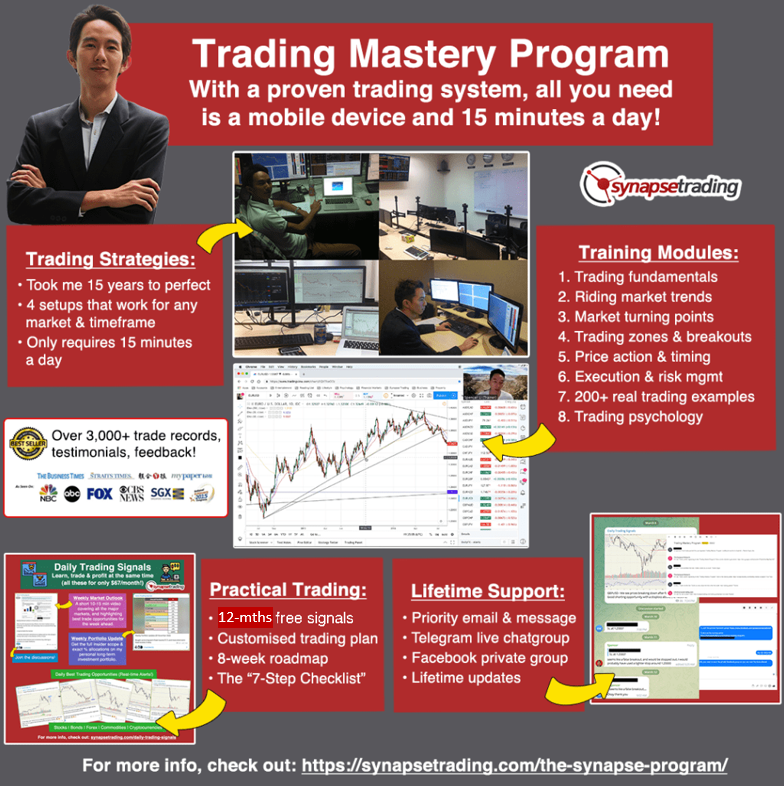 Our flagship mentoring program is suitable for both beginners and advanced traders, covering the 4 strategies which I used over the past 15 years to build up my 7-figure personal trading portfolio.
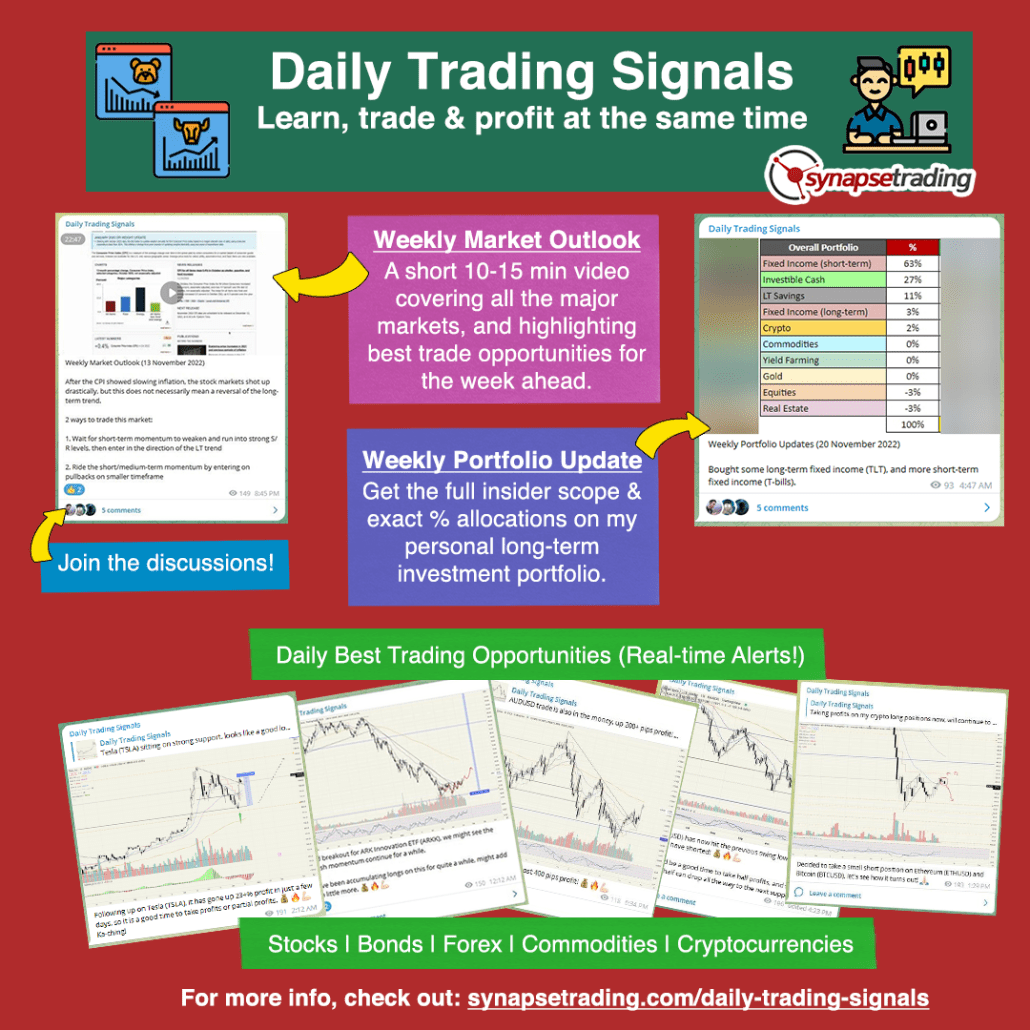 If you're looking for the best trading opportunities every day across various markets, and don't want to spend hours doing the research yourself, check out our private Telegram channel!










Great Tip❤️