

How Much Capital Do You Need to Start Trading? How to Find Your Own Number
Want the daily routine? Get the free 15-Minute Swing Trader’s Checklist. Get it free →
By Spencer Li, CFTe · Last updated: 26 October 2026
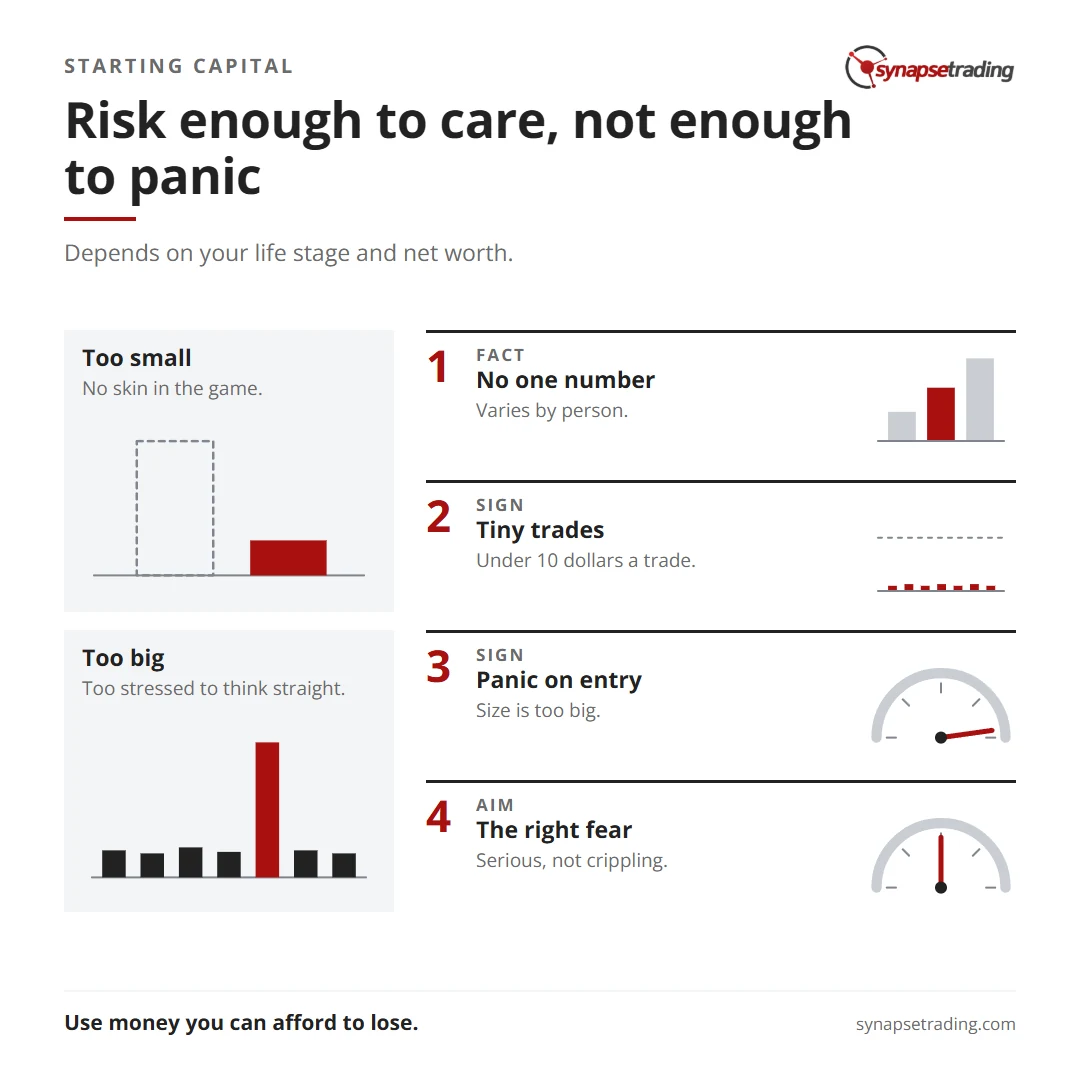
There is no single number, and the broker’s account minimum no longer decides it for most people. Interactive Brokers Singapore, for example, listed its account minimum as USD 0 when I checked on 26 October 2026. So the useful question is what amount is right for you. My answer has not changed since I first wrote this post in 2021. You should find an amount that is not so large that you cannot afford to lose it, yet not so small that you have no “skin in the game”. In practice, that means money you could lose in full without touching your rent, your savings or anything you owe, and enough that losing it would actually sting.
Why is there no single right number?
If you ask a multi-millionaire, he will think that starting with $10,000 is too little to bother with. If you ask a student, $10,000 might be his entire life savings.
It is the same number, and it means two completely different things. So the amount of starting capital depends on your stage of life and your current net worth, and any figure you read online, including the round ones in this post, is only a placeholder for your own.
The mistake many new traders make is hunting for the number, as if there were a correct answer printed at the back of the textbook. What they are really looking for is a feeling, the right amount of risk for their own situation, and that is something only they can measure.
What does “skin in the game” mean for a trader?
If you have played any game of chance, such as poker, you already understand this. When the bets are too tiny, nobody takes the game seriously, because there is no real risk involved. People call silly hands, bluff for fun and fold whenever they get bored.
Trading works the same way. If your capital is too small, and every trade gives you a profit or loss of less than 10 dollars, you probably will not take your trading decisions very seriously. You skip the checklist, you take the trade you would never take with real money, and you learn very little from either the wins or the losses. Hence, there needs to be a certain amount of money involved to make you take your trades seriously.
Daniel Kahneman, the psychologist who won a Nobel prize in economics, described a simple test that shows why. Picture a coin toss. Tails, you lose $100. Heads, you win $150. The odds favour you, and most people still turn it down, because a loss hurts more than an equal gain pleases. Across several experiments, he wrote, this “loss aversion ratio” usually lands somewhere between 1.5 and 2.5.
That fear of losing is the thing you are really learning to manage, and it only shows up when the money is real. A demo account teaches you which buttons to press, which is useful. It cannot teach you what your hands do when a real loss is sitting on the screen.
If you are learning to take each trade seriously, grab my free 15-minute swing trader checklist.
How much fear is the right amount?
In 1908, two psychologists named Robert Yerkes and John Dodson ran a study on Japanese dancing mice, and found something that has been borrowed by coaches, teachers and exam-stressed students ever since. A little stress improved performance. Past a certain point, more stress made it worse.
That curve is the whole answer to the capital question, drawn as a hill. Too little at stake, and you are at the bottom left, bored and careless. Too much at stake, and you have gone over the top and down the other side, where the fear makes the decisions for you. The right amount of capital puts you near the top of the hill, alert and serious, but still able to think.
In the 2021 version of this post, I put the warning sign this way: “if you start panicking the moment you place a trade, then most likely your trading size is too big.” I still think that is the most honest test there is. If the bets are too big, for example a few thousand dollars on every trade, you will most likely be too stressed about losing to make rational decisions.
The trading psychologist Mark Douglas went further. “Ninety-five percent of the trading errors you are likely to make,” he wrote, “… will stem from your attitudes about being wrong, losing money, missing out, and leaving money on the table.” He called these the four primary trading fears. An account that is too big for you feeds all four of them at once, which is why the fear does more damage than any bad chart reading. I cover the rest of his argument in my Trading in the Zone summary.
Do you still need USD 25,000 to day trade?
For years, one of the most quoted numbers in this debate was USD 25,000. Under a FINRA rule in the US, a “pattern day trader”, someone who kept buying and selling the same stock on the same day in a margin account, had to keep at least that much equity in the account.
That rule is on its way out. On 14 April 2026, the US Securities and Exchange Commission approved FINRA’s change to remove the pattern day trader provisions, including “the minimum equity requirement of $25,000”, and replace them with intraday margin standards. Brokers were allowed to phase the change in over up to 18 months, so what applies to your account depends on your broker.
FINRA’s own investor page, dated 4 June 2026, now says that to trade on margin, “you must maintain a minimum of $2,000 in equity in your margin account”, and that brokers may set higher house requirements.
Do note that the old rule only ever applied to day trades in a margin account. A swing trader who holds positions for days or weeks was never caught by it, so for most of the people who ask me this question, the USD 25,000 figure did not apply to them at all.
Is $100 to $500 enough to start?
On 12 February 2026, a trader on Reddit’s r/swingtrading asked: “Is it possible to trade with at least $100-500?” They had been paper trading, felt ready for real money, and had heard from many people that small accounts will almost always lose.
It is possible. Here is a concession with a date on it, because the costs argument against small accounts is much weaker than it used to be. As at 26 October 2026, Interactive Brokers Singapore listed no account minimum and no inactivity fee. On its fixed-price plan, US shares cost USD 0.005 a share with a USD 1.00 minimum per order, so a USD 200 order pays 0.5% to get in and another 0.5% to get out. Its Lite plan, which it offers to Singapore retail investors, listed USD 0 commission on US shares. So the fee on a small account can be close to nothing now, depending on the plan you pick.
But the people warning that reader were pointing at something real, even if they had the reason wrong. A small account rarely loses because of fees. It loses because a move of a few dollars feels like nothing, so the trader is still playing poker for matchsticks. And it cannot pay anyone a living, so the temptation is to size up too fast and jump straight over the top of the fear curve.
So I would treat a small account as a classroom. You need roughly 100 to 200 trades before you can fairly judge whether a system works, and a small account is a cheap place to collect them, as long as each loss still stings a little. Once those trades give you a record you trust, the capital can grow to meet it.
If you are starting small, the free 15-minute swing trader checklist is a good place to begin.
How do you find your own number?
Here is the test, in three questions. Run your number through all three before you fund the account.
- Can you lose all of it? The money should sit apart from your rent, your savings and anything you owe. Assume it could go to zero while you learn, because for a while it might.
- Would losing it sting? If a losing trade does not register at all, the amount is too small to teach you anything about fear.
- Can you think clearly with it on the line? If you start panicking the moment you place a trade, the amount, or the size of each trade, is too big. Cut it back until you can think again.
Your number sits somewhere between the first two answers, and the third one tells you when you have overshot. For how to size each trade once the account is open, read my guide to money management and position sizing, and to see which trading style fits the capital and time you have, read the different styles of trading.

If you would like to learn how to get started in trading, also check out: “The Beginner’s Guide to Trading & Technical Analysis”
FAQ
What is the minimum amount of money needed to start trading?
Many brokers now have no account minimum at all. Interactive Brokers Singapore listed USD 0 when checked on 26 October 2026. The better question is the right amount for you, small enough to lose in full and large enough that the loss is felt.
Is $10,000 enough to start trading?
It depends on your stage of life and net worth. To a student it can be a life’s savings, far too much to risk while learning. To someone with a large net worth it may be too little to take seriously.
Do I still need $25,000 to day trade US stocks?
The SEC approved the removal of the USD 25,000 pattern day trader minimum on 14 April 2026, with brokers allowed up to 18 months to phase the change in. FINRA now lists a USD 2,000 minimum equity to trade on margin, and your broker may ask for more.
How do I know if my trading size is too big?
If you start panicking the moment you place a trade, it is too big. A little fear keeps you careful, and too much of it makes the decisions for you.
Should beginners start with a demo account or real money?
A demo account is useful for learning the mechanics, and it cannot teach you to handle a real loss. Start on demo to learn the buttons, then move to a small real amount you can afford to lose.
Can you swing trade with a small account?
Yes. Swing traders were never caught by the old pattern day trader rule, and commissions on small orders can be low or zero. The main risk of a small account is that losses feel too small to take seriously.
What was your starting amount, and did it feel too small, too big or about right? Did you ever size up too fast after a good month? Let me know in the comments.
For the wider picture, start with my free trading guides.
And when you are ready to start, grab the free 15-minute swing trader checklist.
About the author. Spencer Li is The 15-Minute Trader and the founder of Synapse Trading. He is a Certified Financial Technician (CFTe) with 15+ years of trading, run from 70+ countries. He holds a B.Acc and B.BM from SMU. Every trade he takes is public, dated, losses left in. He teaches rules-based swing trading in 15 minutes a day, one system for any market.
Education, not financial advice. Synapse Trading is not licensed by MAS to advise on investment products. Trading carries risk of loss, and past performance is not indicative of future results.
Want the daily routine? Enter your email for the free 15-Minute Swing Trader's Checklist.
Free 5-page PDF, then occasional trading emails. Education only, not financial advice. Unsubscribe anytime. Kit stores your email in the US: see our privacy policy.
Want to learn the full method? The Trading Mastery Program teaches the 4 strategies I have traded since 2011. It suits beginners and experienced traders.
Rather follow the trades as they happen? Daily Trading Signals is our Telegram channel: my trade ideas with entry, stop and exit, and every trade is public.
Questions about this post? Ask in the free Telegram channel →
Educational content only, not personalised financial advice. Trading carries risk, including loss of capital. Past performance is not indicative of future results. Synapse Trading is not licensed or regulated by MAS.

