

The 3 Ms of Trading: Method, Money and Mindset, and Which One Deserves Most of Your Time
Want the daily routine? Get the free 15-Minute Swing Trader’s Checklist. Get it free →
By Spencer Li, CFTe · Last updated: 26 October 2026
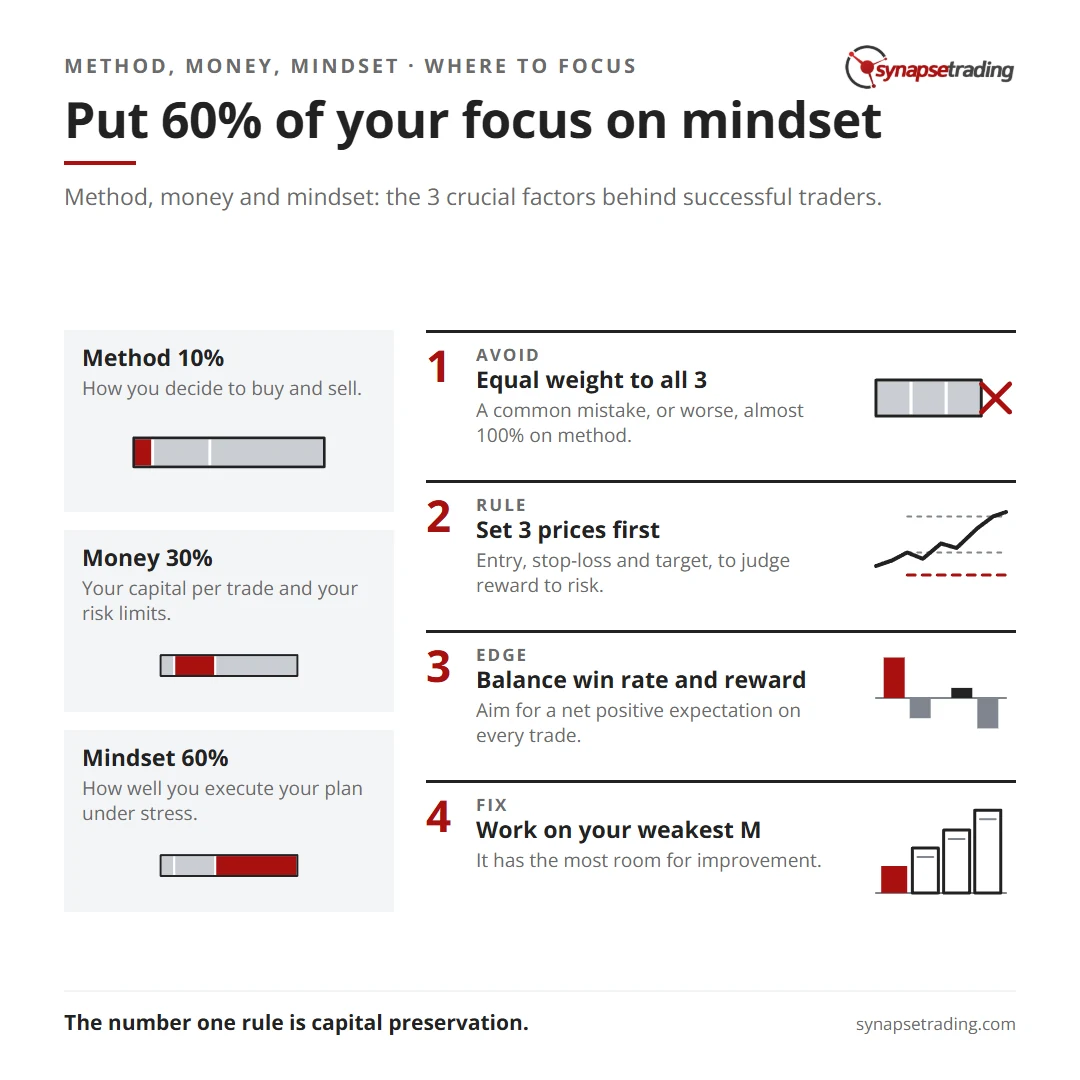
The 3 Ms of trading are Method, Money and Mindset. Method is how you decide what to buy and sell, Money is how much you risk on each trade, and Mindset is whether you actually follow your plan when real money is on the line. You need all three, but they do not deserve equal time. Personally, I weight them at roughly 10% Method, 30% Money and 60% Mindset, and most beginners do almost exactly the reverse.
Where do the 3 Ms come from?
The idea is older than most of the traders using it. Dr Alexander Elder made it famous with Trading for a Living in 1993. In his 2014 rewrite he describes trading as a stool with three legs, Mind, Method and Money, where you “remove one and the stool will fall.” The same edition adds record-keeping as a fourth factor that ties the other three together.
I first read Elder as a university student around 2008, alongside Mark Douglas and a pile of other trading books. One line from him stayed with me much longer than any of his charts. He said the breakthrough in his own career came when he “realized that the key to winning was inside my head and not inside a computer.”
In 2022 I wrote in my Telegram channel that “trading always boils down to the 3 Ms – methodology to analyse markets, money management, and mindset.” I still think that is true, and the rest of this post explains why the three get such different weights.
Why does Method get only 10%?
Here is an odd fact for a trading educator to admit. The cheapest part of trading is the strategy.
Mark Douglas made the same point back in 1990, in The Disciplined Trader. He told new traders to buy a system rather than build one, because a workable method “does not have to be expensive”, and almost any of the technical analysis books on the shelf would do. His reasoning was that building your own system makes you want to make money from it straight away, before you have learned to execute it properly.
So Method covers your analysis and your setups, whether you read price charts, the fundamentals of the business underneath, or some mix of the two. Almost every strategy is a version of one of the four types of trading strategies, and a decent one can be found in a book, a course or a free video in an afternoon.
That is exactly why it gets the smallest share. A method is easy to copy, and so it rarely explains why two traders with the same rules end up with very different results.
What does Money management actually decide?
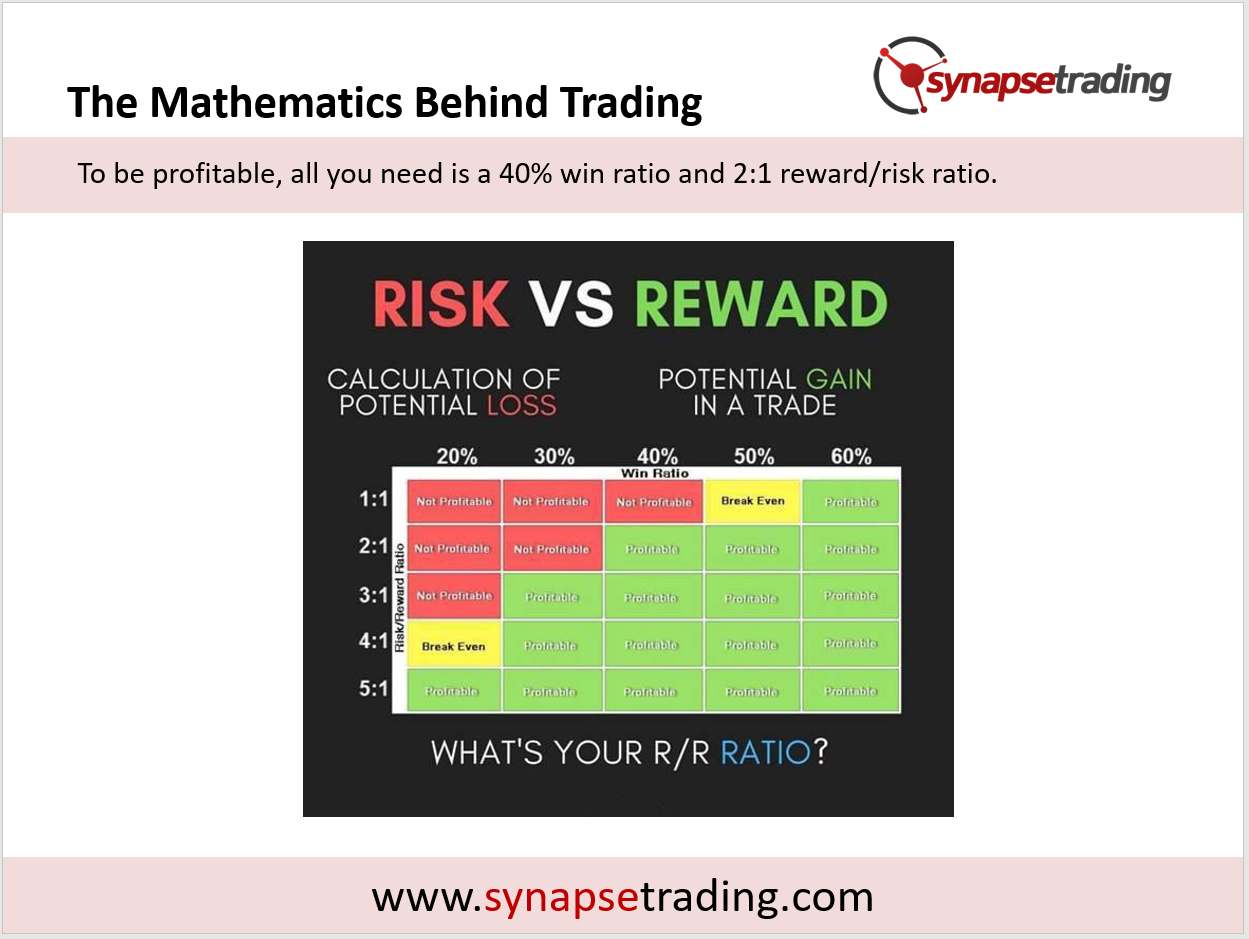
Before every trade, three numbers get decided. The entry price is where you get in, the stop loss is where you admit the idea was wrong, and the target is where you plan to take the profit. Together they give you the reward-to-risk ratio, which is the reward you are aiming for divided by the amount you stand to lose.

Once you have that ratio, you can see why being right most of the time is optional. Suppose your trades hit their target 40% of the time, and each winner pays twice what each loser costs. Over 10 trades, the arithmetic looks like this.
4 winners × 2 = +8
6 losers × 1 = −6
That leaves you 2 units ahead, even though you were wrong 6 times out of 10. Do note that this is before commissions and slippage, and Elder reminds his readers that those costs make trading a minus-sum game, where winners collect less than losers pay in. So the margin in a real account is thinner than the table makes it look.
The other half of Money is survival. Elder has an image for it that runs through Come Into My Trading Room, his 2002 book. He tells you to “think of the way a submarine is divided into many compartments so that it won’t sink if one section becomes flooded.” One bad trade should flood one compartment, never the whole boat.
I have said a version of this in my weekly outlook more than once. On 30 May 2026 I talked about a position in one of the quantum computing stocks that looked ready to break out. I told viewers they “might want to reduce the position size” for that kind of stock, because these are “stocks that can really fluctuate a lot.” The setup was the same as any other. The size was the thing that had to change.
If you would rather run all of this as a short daily routine than a long evening at the screen, my free 15-minute swing trader checklist is the one I use myself.
Isn’t a lot of “trading psychology” just bad sizing?
In May 2026, a trader on Reddit’s r/Daytrading pushed back on the whole idea: “A lot of trading psychology is just bad sizing.”
They make a fair point, and I agree with more of it than you might expect. If one stop makes you angry enough to move the next one, the position was probably too big for you. Douglas said much the same in 1990. The amount you risk per trade, he wrote, “should be an amount that you are completely comfortable with, at least at first.” He also told new traders to “keep your contract size light.”
So I should concede something about my own numbers. The 10/30/60 split has sat on this post since 2021, and it is a weighting from experience rather than a measurement. Nobody has run the experiment, and I would not pretend it splits that neatly for every trader.
But a smaller position does not press the button for you. Plenty of traders size their trades sensibly and still skip the next valid signal after a losing streak, or take profit early because a green number feels too good to give back. Sizing makes the fear smaller, and the rest of the job still sits with you.
Why does Mindset get 60%?
Suppose I offer you a coin toss. Tails, you lose USD 100. Heads, you win USD 150.
The odds are in your favour, and most people still say no. Daniel Kahneman used bets like this to study how people weigh losses, and he wrote them up in Thinking, Fast and Slow in 2011. When people are asked how big the win must be to balance a USD 100 loss, he reported, “for many people the answer is about $200, twice as much as the loss.” Across experiments, he wrote, the loss aversion ratio “is usually in the range of 1.5 to 2.5.”
Now put that brain in front of the 40% system from the section above. The maths says you come out ahead, but you will lose 6 trades out of every 10, and each of those losses will feel roughly twice as heavy as a win of the same size. That is a hard thing to sit through, and most people do not. Douglas put it bluntly: “rarely will the typical trader stay with his system beyond two or three losses in a row,” and yet a run of two or three losses is completely normal for most systems.
So the trader with a perfectly good method quits it at exactly the wrong moment, and then goes looking for a new method, which takes them straight back to the 10% they already had. That loop, more than any bad indicator, is how a perfectly decent account slowly gets wiped out.
In Investment Psychology Explained, published in 1991, Martin Pring quotes the advice Paul Tudor Jones once gave a novice: “Don’t focus on making money, focus on protecting what you have.” I find it easier to follow when I treat the goal for the day as following the plan well, and let the money take care of itself over a few hundred trades.
If you want to go deeper into the biases behind this, I wrote a full guide to trading psychology, and Elder’s own system is in my summary of Trading for a Living.
The 3 Ms side by side
| The M | What it covers | My rough weighting | Why |
|---|---|---|---|
| Method | Your analysis and setups, technical, fundamental or both | ~10% | Easy to find and easy to copy |
| Money | Entry, stop and target before each trade, reward-to-risk, how much of the account is at risk | ~30% | It keeps you in the game long enough for the method to work |
| Mindset | Following the plan under stress, through fear, greed and losing streaks | ~60% | It decides whether the other two ever get used |
How do you find your weakest M?
The fastest way to improve is to work on whichever M you are weakest at, because that is where the most room for improvement sits. Your strongest M is usually the one you enjoy, which is exactly why it keeps getting the extra hours.
A simple test is to look back at your last 20 trades and ask three questions.
- Did you follow your own plan, or improvise halfway through the trade? If you improvised, your weak M is Mindset.
- Did one or two oversized losers wipe out a string of decent trades? Then your weak M is Money, and my guide to money and risk management is the place to start.
- Can you explain why you took each trade with the same reason each time? If the reasons change from trade to trade, your weak M is Method.
Most traders end up very good at reading charts and quite poor at the other two. If that sounds like you, you already know where the next few months should go, and my free trading guides cover all three in order.
Habits are easier to keep with a routine, and the free 15-minute swing trader checklist is the routine I run every day.
FAQ
What are the 3 Ms of trading?
Method, Money and Mindset. Method is your strategy for deciding entries and exits, Money is your risk and position size, and Mindset is how well you execute the plan under pressure.
Who came up with the 3 Ms of trading?
Dr Alexander Elder set them out in Trading for a Living in 1993, as Mind, Method and Money. His 2014 rewrite adds record-keeping as a fourth factor.
Which of the 3 Ms is most important?
Mindset, in my view. I weight it at about 60% of the work, against 30% for Money and 10% for Method, because your analysis is only useful if you can act on it during a losing streak.
Can a system that is right only 40% of the time still come out ahead?
On paper, yes. In this made-up example, if each winner is twice the size of each loser, 10 trades give 4 wins worth 8 units and 6 losses worth 6, so you are 2 units ahead before costs. Commissions and slippage shrink that margin.
Is trading psychology just bad position sizing?
Partly. A position that is too big makes every emotion louder, so fixing size often fixes a lot of the panic. It does not fix skipping signals or quitting a system after a normal losing streak.
Which M should a beginner work on first?
Whichever one you are weakest at. For most beginners that turns out to be Money and Mindset, because the first year usually goes on collecting methods.
Which of the 3 Ms do you think is your weakest right now, and which one would change your results the most if you fixed it? Let me know in the comments.
And if you want a routine that keeps all three in place in 15 minutes a day, grab the free 15-minute swing trader checklist.

If you would like to learn how to get started in trading, also check out: “The Beginner’s Guide to Trading & Technical Analysis”
About the author. Spencer Li is The 15-Minute Trader and the founder of Synapse Trading. He is a Certified Financial Technician (CFTe) with 15+ years of trading, run from 70+ countries. He holds a B.Acc and B.BM from SMU. Every trade he takes is public, dated, losses left in. He teaches rules-based swing trading in 15 minutes a day, one system for any market.
Education, not financial advice. Synapse Trading is not licensed by MAS to advise on investment products. Trading carries risk of loss, and past performance is not indicative of future results.
Want the daily routine? Enter your email for the free 15-Minute Swing Trader's Checklist.
Free 5-page PDF, then occasional trading emails. Education only, not financial advice. Unsubscribe anytime. Kit stores your email in the US: see our privacy policy.
Want to learn the full method? The Trading Mastery Program teaches the 4 strategies I have traded since 2011. It suits beginners and experienced traders.
Rather follow the trades as they happen? Daily Trading Signals is our Telegram channel: my trade ideas with entry, stop and exit, and every trade is public.
Questions about this post? Ask in the free Telegram channel →
Educational content only, not personalised financial advice. Trading carries risk, including loss of capital. Past performance is not indicative of future results. Synapse Trading is not licensed or regulated by MAS.

