
Should I Start with Trading or Investing? A Simple Rule for Small Capital
Want the daily routine? Get the free 15-Minute Swing Trader’s Checklist. Get it free →
By Spencer Li, CFTe · Last updated: 26 October 2026
If you are starting with a small sum of money, start by learning to trade, and add long-term investing once your capital reaches about SGD 100,000. After that, run both side by side. The reason is arithmetic rather than appetite for risk. A small portfolio compounding at a few percent a year takes decades to grow into anything meaningful, so the early years are better spent building a skill that can produce cashflow, which you then feed into the long-term portfolio.
Trading is not the safer choice, and I will come back to that, because many beginners lose money while they learn. But it is the faster one to learn while your account is small, and it is the one that compounding cannot do for you.
Why does a small account change the answer?
Most people meet this question holding one lump of savings, a full-time job and a vague feeling that they should do something with the money, and since they cannot do everything at once, they pick one.
And the first instinct is usually to “play it safe”. You have heard the Warren Buffett stories, you have heard that trading is risky, so you put the money into bonds or an ETF and let it sit. It feels responsible. In one sense it is.
The problem is the pace. Unless you start with a large amount, you will spend a whole lifetime building a decent-sized portfolio this way, and most of that lifetime goes on waiting for the base to get big enough to matter. Suppose you grow your money at a compounded 3% a year, with no losses at all. It takes 24 years just to double it.
24 years, and that is the clean version.
So what happens if a market crash catches you somewhere in the middle? The clock does not stop. It goes backwards, and the lifetime gets longer.
I made a short video on this question a few years ago, and the logic has not changed since.
How long does safe money take to double?
There is a quick way to check my 24 years, and it is older than the stock market. Divide 72 by the yearly return, and you get roughly the number of years it takes your money to double. At 3% a year, 72 divided by 3 gives 24.
The rule of 72 turns up in a book printed in Venice in 1494, the Summa de arithmetica by Luca Pacioli. Pacioli is better known as the father of accounting, because the same book carried one of the first published descriptions of double-entry bookkeeping, the debits-and-credits system every accountant still learns. As someone who sat through an accountancy degree, I find it quite funny that the shortcut arrived as an aside. Pacioli did not even explain it, which suggests merchants were already using it long before he wrote it down.
More than 500 years later the rule still works, and it still delivers the same bad news to small savers.
Take the Singapore Savings Bond on offer for November 2026. According to MAS, as at 26 October 2026, it pays 1.67% in its first year and averages 2.45% a year if you hold it for the full 10 years. Run that through the rule of 72 and your money doubles in about 29 years.
On SGD 10,000, that is SGD 20,000 by the time a 30-year-old turns 59.
Do note that this is a perfectly sensible place to park money you cannot afford to lose. It is just a very slow way to build a portfolio from a small base. If you would like a daily routine that fits around a full-time job, my free 15-minute swing trader checklist is the one I use myself.
What does trading add that investing cannot?
Investing and trading do different jobs. See the jobs, and the order is obvious.
Investing is a compounding machine. You buy good assets, hold them for years, and the returns build on themselves. The machine is powerful, but its output depends almost entirely on how much fuel you put in, which is why a 10% year on SGD 5,000 comes to SGD 500, a nice dinner rather than a life change.
Trading is a skill. Done with proper risk management, it can produce cashflow that has nothing to do with the size of your long-term portfolio. You then feed that cashflow into the portfolio, so it grows faster than its own returns would allow, which is why I put trading first while the tank is still small.
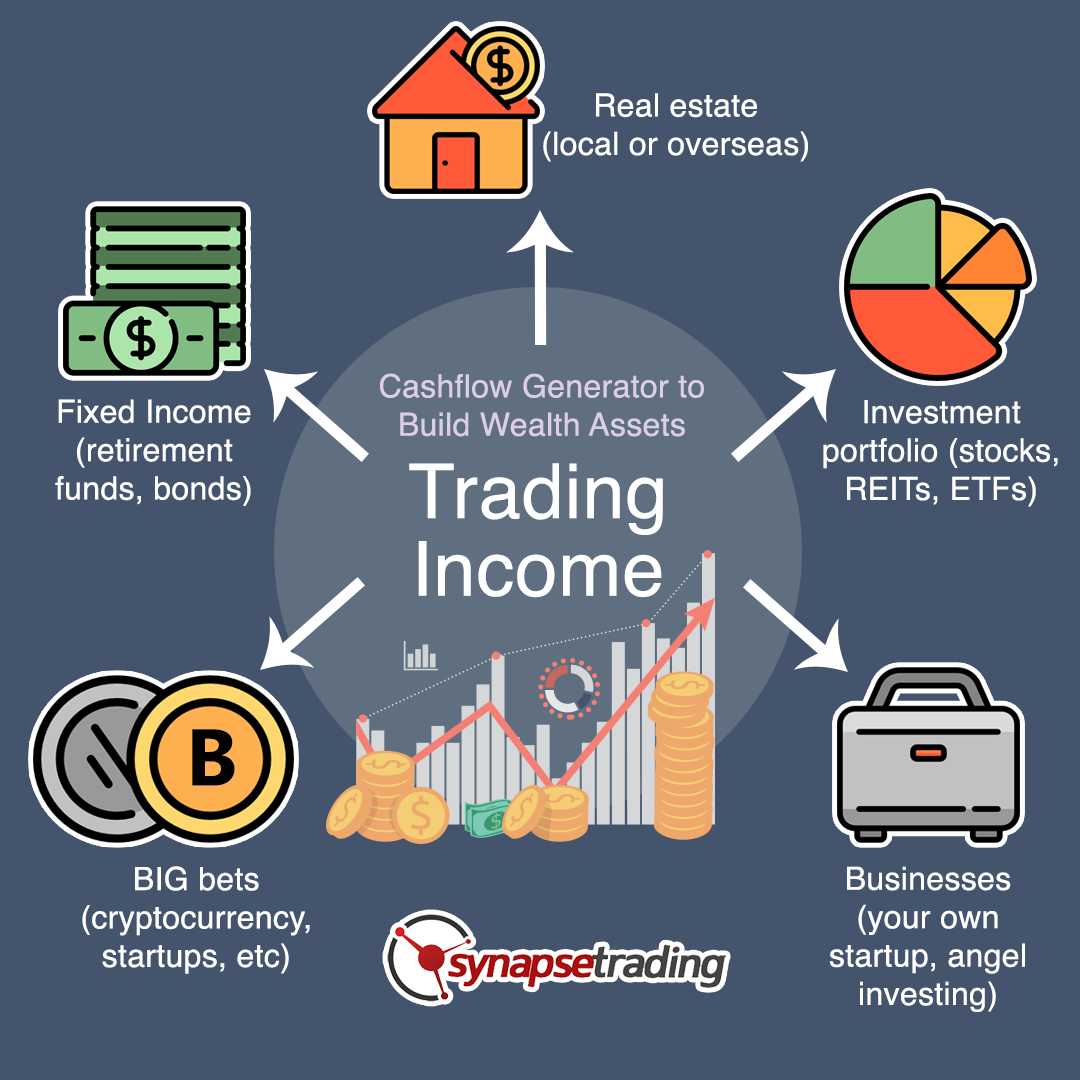
The word I would underline is “can”. Results vary from trader to trader, and many beginners lose money while they learn. So trading first means learning first, with small amounts, before you trust it with anything that matters.
Why wait until SGD 100,000 to invest?
As a simple rule, I suggest focusing on trading until you have about SGD 100,000 of capital, and only then starting to invest as well.
The threshold comes from the same arithmetic. Below it, compounding is working with too little fuel, and your effort earns more as skill than as returns on a small base. Above it, a decent year in the portfolio finally moves the needle in dollar terms, so it is worth running both.
| Trading | Investing | |
|---|---|---|
| Main job | Build a skill that can produce cashflow | Grow wealth over many years |
| Time horizon | Days to weeks per position | Years to decades |
| Best fit | A smaller account, under about SGD 100,000 | A larger base, about SGD 100,000 and up |
| What it solves | Slow compounding on a small account | Long-run growth once the base is big enough |
| Main risk | Losses during the learning years | Long drawdowns, and time itself |
Hence the two complement each other once you have the base. The trading feeds the portfolio, and the portfolio does the slow compounding that trading was never meant to do.
It is a rule of thumb. It decides where your attention goes first. If you want to work out how much you need to begin trading at all, I go through it in how much capital you need to start trading.
Doesn’t trading just lose most people money?
On 10 September 2026, a trader on Reddit’s r/investing asked the question better than most textbooks. They had mostly invested and kept a small slice for swing trading, and wanted to know “what happens in practice once you include mistakes, time, stress”.
That is the right worry, and the research does not flatter traders. Brad Barber, Terrance Odean and two colleagues studied every day trader in Taiwan from 1992 to 2006, in a paper first circulated in 2011 and published in 2014. In a typical year, only about 13% of them made a profit after fees. Fewer than 1% did it consistently, year after year.
Day trading is not what I teach, and swing trading over days and weeks is gentler on fees and on your nerves. But I will not pretend the gap is large enough to make those numbers irrelevant. Plenty of people who start trading lose money first, some of them for good, and the fear of being in that group is healthy.
So my answer to “mistakes, time, stress” is the order of things rather than a promise. Learn on small amounts, follow written rules so that every mistake is cheap and you can see exactly where it happened. And keep the long-term money somewhere boring while you do it.
How do I run trading and investing side by side?
In my weekly outlook on 5 February 2026, gold had just dropped about 20%, and I wore both hats in the same breath. “I only bought some for my long term portfolio,” I told viewers, and said I would keep adding slowly if it fell further.
For trading, I passed. As I put it in the video, “for trading wise, it doesn’t look like it’s that great a trade.”
Same market, same day, two different answers. Both were right for their job. The portfolio asks whether an asset is worth owning for years. The trade asks whether there is a clean setup this week with a sensible place to be wrong. Most beginners blur the two, which is how a bad trade turns into a “long-term investment” the moment it starts losing.
I once wrote in my trading channel, “be careful not to mix up trading and investing”, and I still mean it. My trading setups are for trading, and my investing follows a completely different approach, so I never have to argue with myself about which hat I am wearing. If you want a routine that keeps the trading side to 15 minutes a day, grab the free 15-minute swing trader checklist.
Where do you start if you pick trading first?
The next step is learning to read a chart, because every trading decision starts there. My plain-English guide to what technical analysis is covers the basics, and the beginner’s guide below puts them in order.

If you would like to learn how to get started in trading, also check out: “The Beginner’s Guide to Trading & Technical Analysis”
When you want more after that, my free trading guides collect the rest in one place.
FAQ
Should I start with trading or investing as a beginner?
If your starting capital is small, start by learning to trade, with small amounts. Slow compounding takes decades to build a meaningful portfolio from a small base, while trading is a skill that can produce cashflow you feed into a long-term portfolio. Add investing once your capital is larger.
How much capital should I have before I start investing as well?
My rule of thumb is about SGD 100,000. Below that, your effort usually earns more as a skill than as returns on a small portfolio. Above it, run trading and investing side by side.
Why not just put everything in bonds or ETFs?
You can, and for money you cannot afford to lose it is sensible. It is just slow. At 3% a year with no losses, money takes 24 years to double, and the November 2026 Singapore Savings Bond averages 2.45% a year over 10 years, according to MAS as at 26 October 2026.
What is the rule of 72?
Divide 72 by the yearly return to estimate how many years your money takes to double. At 3% it is 24 years. It appears in Luca Pacioli’s Summa de arithmetica, printed in Venice in 1494.
Is trading riskier than investing?
Both carry risk of loss, and many beginners lose money while they learn to trade. The case for trading first is about sequence. With a small account, the bigger risk is that slow compounding never builds anything meaningful.
Can I do trading and investing at the same time?
Yes, and that is the goal once you have the base. Give each its own rules, so a losing trade never turns into a long-term holding by accident.
Which did you start with, and if you could go back, would you pick the same order? Let me know in the comments.
And if you decide to start with trading, the free 15-minute swing trader checklist is the routine I run every day.
About the author. Spencer Li is The 15-Minute Trader and the founder of Synapse Trading. He is a Certified Financial Technician (CFTe) with 15+ years of trading, run from 70+ countries. He holds a B.Acc and B.BM from SMU. Every trade he takes is public, dated, losses left in. He teaches rules-based swing trading in 15 minutes a day, one system for any market.
Education, not financial advice. Synapse Trading is not licensed by MAS to advise on investment products. Trading carries risk of loss, and past performance is not indicative of future results.
Want the daily routine? Enter your email for the free 15-Minute Swing Trader's Checklist.
Free 5-page PDF, then occasional trading emails. Education only, not financial advice. Unsubscribe anytime. Kit stores your email in the US: see our privacy policy.
Want to learn the full method? The Trading Mastery Program teaches the 4 strategies I have traded since 2011. It suits beginners and experienced traders.
Rather follow the trades as they happen? Daily Trading Signals is our Telegram channel: my trade ideas with entry, stop and exit, and every trade is public.
Questions about this post? Ask in the free Telegram channel →
Educational content only, not personalised financial advice. Trading carries risk, including loss of capital. Past performance is not indicative of future results. Synapse Trading is not licensed or regulated by MAS.

