

How to Profit from Inflation? (With 33 Types of Asset Investments)
Want the daily routine? Get the free 15-Minute Swing Trader’s Checklist. Get it free →
How to Profit from Inflation: The Best Assets to Protect Your Money
Last updated: 9 September 2026 · By Spencer Li, CFTe
To profit from inflation, you hold assets whose value or income rises alongside prices, instead of holding cash that quietly loses purchasing power. The most reliable inflation hedges fall into three buckets: real assets (real estate, commodities, gold, agricultural land, infrastructure), inflation-linked bonds (TIPS and floating-rate notes, whose payouts move with rates), and equities with pricing power (companies that can pass higher costs on to customers, plus REITs, resource and infrastructure stocks). No single asset is a guaranteed win, and many of these only preserve your purchasing power rather than grow it. The honest goal here is defence first: stop inflation from eroding what you have, then look for the assets that genuinely benefit when prices rise.
Here is what inflation actually is, why it hits some people harder than others, and the full menu of assets people use to hedge it.
What is inflation?
Inflation is when the overall price of things goes up over time, so the same amount of money buys less. If a basket of groceries that cost you $100 last year costs $107 this year, that is inflation, and your $100 note is now worth less in real terms.
A few things can drive it: more demand chasing the same goods, higher production costs, or simply more money in the system. It can also show up when supply shrinks, for example during a war or a supply shock.
We measure it with the consumer price index (CPI, a tracked basket of things households typically buy). The percentage change in that basket over a period is the inflation rate. The Federal Reserve (the central bank in the US) leans on that rate when setting monetary policy.
Economists usually split inflation into three types:
- Demand-pull (more demand than supply can meet)
- Cost-push (rising production costs get passed on)
- Structural (deeper problems in the economy, like poor resource use or chronic shortages)
Is inflation good or bad for the economy?
It is genuinely both, which is why it is so often misunderstood.
On the upside, mild inflation can nudge growth. If people expect prices to rise, they spend and invest sooner rather than later. It also quietly shrinks the real burden of debt, because the dollars you repay later are worth less than the ones you borrowed.
On the downside, inflation breeds uncertainty. When prices are hard to predict, people hesitate to make long-term plans, and that hesitation is its own drag on the economy. It also lands unevenly. People on low or fixed incomes feel it most, because their income does not stretch to cover the rising cost of living.
To keep prices stable, central banks use monetary policy, which means controlling the supply of money and credit. The Federal Reserve has three main levers: interest rates, reserve requirements, and open market operations.
How to profit from inflation: the asset menu
There is no single “inflation trade.” What works is owning the right mix of assets that either hold their value, pay income that keeps up with rising prices, or directly benefit when the cost of living climbs.
I have grouped the full menu below into four buckets so you can see the logic instead of staring at a flat list. Read the “Why it hedges” column carefully, because the reasoning is what tells you whether an asset fits your situation.
| Asset | Bucket | Why it hedges inflation |
|---|---|---|
| Cash | Defensive | Preserves purchasing power short term, but its real value erodes if you hold too much for too long. Reassess the amount you hold. |
| High-yield savings accounts | Defensive | Pay more interest than a standard savings account. Rarely fully offset inflation, but soften the erosion. |
| Fixed deposits (term deposits) | Defensive | Fixed term, fixed rate, low risk. A parking spot. |
| Stocks (general) | Equities with pricing power | Volatile short term, but have historically performed well over the long run. Companies can pass higher costs to customers. |
| Small cap stocks | Equities with pricing power | Smaller companies are more sensitive to the economy and can outperform large caps in inflationary periods. |
| Emerging market stocks | Equities with pricing power | Markets like China and India may be less affected by rising domestic costs at home. |
| High dividend-yielding stocks | Equities with pricing power | A steady income stream that helps offset the hit to purchasing power. |
| Infrastructure stocks | Equities with pricing power | Utilities and transport firms can pass higher costs through to consumers. |
| Natural resource stocks | Equities with pricing power | Oil, gas, and mining firms benefit when commodity prices rise and demand stays steady. |
| International stocks | Equities with pricing power | Foreign firms may dodge domestic cost pressure. Mind currency risk and political risk. |
| Preferred stocks | Equities with pricing power | Fixed dividend, priority over common stock in a wind-up. Steadier income, less inflation-sensitive than common stock. |
| Real estate | Real assets | Property values tend to rise over time, and as living costs climb, so can the asset. |
| Agricultural land | Real assets | Land values tend to rise, and food demand stays stable even in hard times. |
| Timberland | Real assets | Steady demand for wood products, and the land itself can appreciate. |
| Commodities (gold, oil, agriculture) | Real assets | Prices tend to rise directly with the cost of living. A classic hedge. |
| Infrastructure bonds | Inflation-linked / income | Fund roads, bridges, airports. Steady income, and the underlying assets can appreciate. |
| Floating rate bonds / notes (FRNs) | Inflation-linked / income | Pay a variable rate tied to a benchmark, so income rises as market rates rise. |
| Treasury Inflation-Protected Securities (TIPS) | Inflation-linked / income | US government bonds engineered to return above the inflation rate. |
| Inflation-linked bonds (linkers) | Inflation-linked / income | Returns are tied directly to the inflation rate. Issued by governments or corporates. |
| Corporate bonds | Inflation-linked / income | Steady income, but check the issuer’s creditworthiness. Value can still be dented by inflation. |
| Municipal bonds | Inflation-linked / income | Often tax-free income from state and local government projects. Check the issuer’s credit. |
| Index funds (general) | Funds | Track an index like the S&P 500. Diversified, good for long-term holders. |
| Real asset funds | Funds | Hold physical assets (property, commodities, infrastructure) that can appreciate with inflation. |
| Balanced funds | Funds | A mix of stocks, bonds, and other assets for diversification and steadier results. |
| Infrastructure funds | Funds | Hold utilities, transport, and infrastructure bonds. Steady income plus appreciation potential. |
| Commodity funds | Funds | Hold a basket of commodities, so they ride rising commodity prices. |
| Real estate investment trusts (REITs) | Funds | Own and operate property. Steady income, and real estate tends to appreciate. |
| Floating rate loan funds | Funds | Hold variable-rate loans, so income rises with rates and inflation bites less. |
| Municipal bond funds | Funds | A basket of munis. Often tax-free income, less inflation-sensitive than other bonds. |
| Collectible assets (art, antiques, rare coins) | Alternatives | Can appreciate, especially in inflationary times. Hard to value and price; expect big swings. |
| Alternative investments (hedge funds, private equity) | Alternatives | Potential for higher returns and lower inflation sensitivity. Illiquid and riskier; not for everyone. |
| Cryptocurrencies (e.g. Bitcoin) | Alternatives | Some see them as a hedge because they are not tied to fiat currency. Highly volatile. |
| Master limited partnerships (MLPs) | Alternatives | Own energy assets like pipelines. Steady income, and energy demand stays stable. |
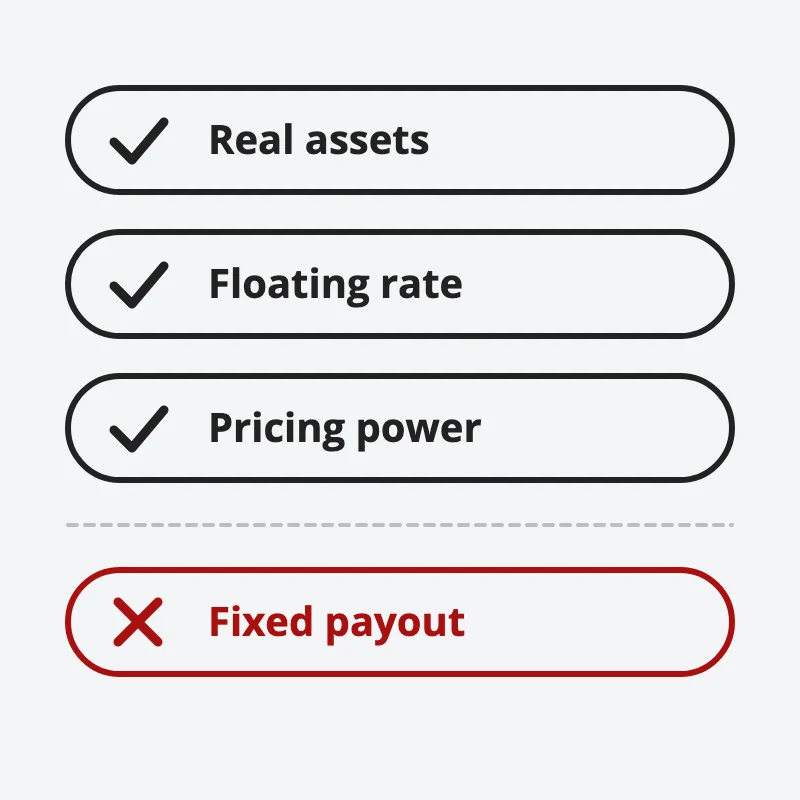
The pattern under all of this is simple. The assets that hedge inflation best are the ones that either own something real, lend at a rate that floats up with inflation, or sell something whose price they can raise. The assets that lose to inflation are the ones with a fixed payout and nothing real behind them.
Defence versus offence: an honest distinction
Here is the part most “profit from inflation” articles skip.
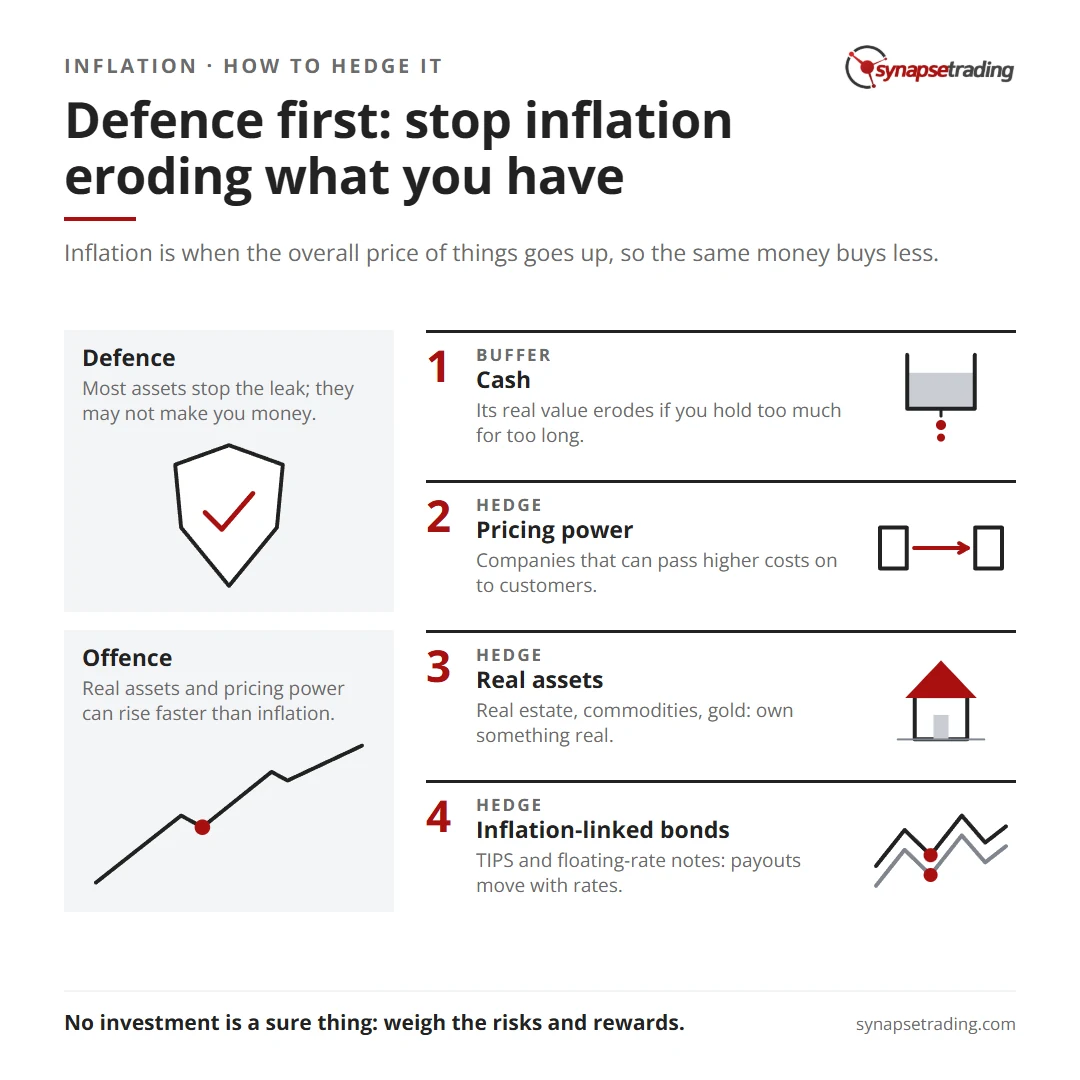
Most of the assets above defend your purchasing power. They stop the leak. They do not necessarily make you money. Holding cash in a high-yield account or buying TIPS is defence: you are trying not to fall behind.
A smaller set can actually outperform. Real assets and equities with genuine pricing power can rise faster than inflation, not just keep pace with it. That is offence.
Do note that, the two are different jobs, and you size them differently. Mixing them up is how people convince themselves a savings account is an “inflation strategy” when it is really just a slower way to lose.
Where the human edge comes in
A screener will hand you a list of “inflation hedges” in a second. That part is now free. What it will not do is tell you how much cash you can stand to hold without bleeding real value, which of these assets actually fits your time horizon and risk tolerance, or when an inflation theme is already priced in and the crowd is late. The list is the easy part. Judgment, sizing each position for the volatility it carries, and knowing which hedge the moment actually calls for is the work. That is the first of the Five Edges that no tool can trade for you.
Concluding thoughts
Inflation cuts both ways for an economy, and it quietly cuts into your personal finances whether you act or not.
Once you understand the menu, holding the right cash buffer, owning real assets and quality equities, or adding inflation-linked bonds, you can take real steps to protect the purchasing power of your wealth. Just keep two things in mind. Some of these strategies only minimise the damage rather than turn a profit. And no investment is a sure thing, so weigh the risks and rewards before you commit a single dollar.
FAQ
What is the best investment during inflation?
There is no single best one. Over the long run, real assets (real estate, commodities, gold) and equities with pricing power tend to perform well, while inflation-linked bonds like TIPS are built specifically to return above the inflation rate. The right mix depends on your time horizon and risk tolerance.
Is cash a good hedge against inflation?
Cash preserves purchasing power in the very short term and gives you flexibility, but its real value erodes the longer you hold it during inflation. A high-yield savings account softens the erosion, but rarely offsets inflation fully. Treat cash as a buffer.
How do TIPS protect against inflation?
Treasury Inflation-Protected Securities (TIPS) are US government bonds engineered to deliver a return above the rate of inflation, so their payout rises as inflation rises. That makes them one of the few assets designed from the ground up to hold real value when prices climb.
Why does real estate hedge against inflation?
Property values and rents tend to rise over time, often in line with the rising cost of living, so the asset and its income can keep pace with inflation. REITs (real estate investment trusts) give you similar exposure without owning a building directly.
Can stocks beat inflation?
Historically, stocks have outperformed inflation over the long run, because companies can pass higher costs on to customers through higher prices. They are volatile in the short term, so they suit long-term holders rather than anyone who needs the money soon.
Now that you have the full menu, which of these assets are you planning to add to your portfolio? And is there an inflation hedge I have missed? Let me know in the comments.
If you want the bigger picture on building a portfolio that holds up across different market conditions, read the pillar: The Definitive Guide to Investing and Building Wealth.
Want a simple system instead of a 30-item shopping list? Grab the free 15-Minute Swing Trading Starter Kit. It is the exact routine I use to scan once a day and trade any market in 15 minutes.
About the author. Spencer Li is The 15-Minute Trader and the founder of Synapse Trading. He is a Certified Financial Technician (CFTe) with 15+ years of trading, run from 70+ countries. He holds a B.Acc and B.BM from SMU. Every trade he takes is public, dated, losses left in. He teaches low-risk swing trading in 15 minutes a day, one system for any market.
Education, not financial advice. Synapse Trading is not licensed by MAS to advise on investment products. Trading carries risk of loss; past performance is not indicative of future results.
Related
The DIY Guide to Building Your Investment Portfolio · The 5 Major Types of REITs to Have in Your Portfolio · How to Split Stocks and Bonds · Should You Own Gold? What It Does in a Portfolio, and How to Hold It From Singapore
Want the daily routine? Enter your email for the free 15-Minute Swing Trader's Checklist.
Free 5-page PDF, then occasional trading emails. Education only, not financial advice. Unsubscribe anytime. Kit stores your email in the US: see our privacy policy.
Want to learn the full method? The Trading Mastery Program teaches the 4 strategies I have traded since 2011. It suits beginners and experienced traders.
Rather follow the trades as they happen? Daily Trading Signals is our Telegram channel: my trade ideas with entry, stop and exit, and every trade is public.
Questions about this post? Ask in the free Telegram channel →
Educational content only, not personalised financial advice. Trading carries risk, including loss of capital. Past performance is not indicative of future results. Synapse Trading is not licensed or regulated by MAS.

