

Why 14% of Young Singaporeans Expect Never to Retire, and What Has Changed Since 2016
Want the daily routine? Get the free 15-Minute Swing Trader’s Checklist. Get it free →
By Spencer Li, CFTe · Last updated: 26 October 2026
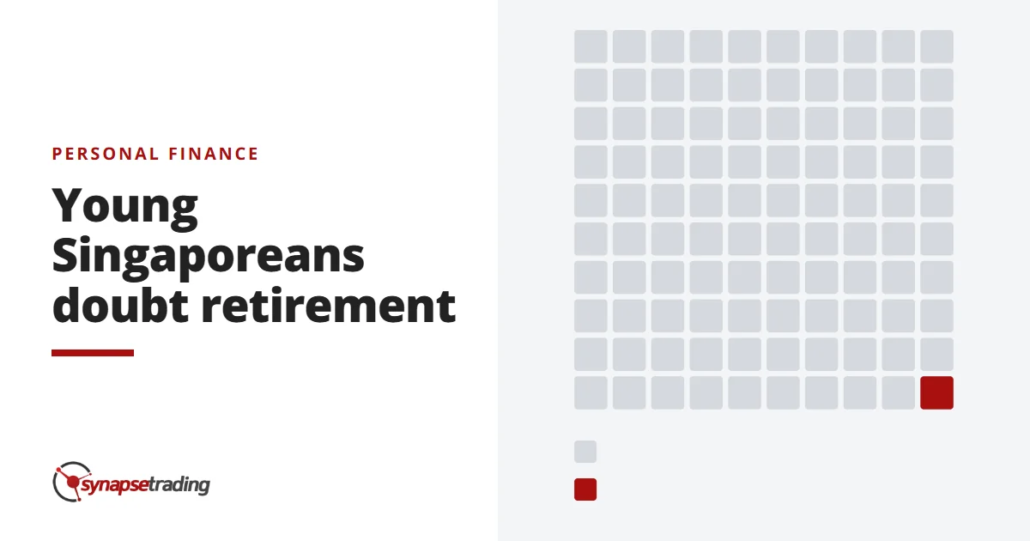
In 2016, 14% of young working Singaporeans told a ManpowerGroup survey that they expected to work until the day they die. Bloomberg reported it in May that year, and the figure put Singapore in a three-way tie for 4th among the countries shown, behind Japan, China and Greece. My guess at the time was a mix of inflation, spending habits and the cost of living. Ten years on, prices in Singapore are up about 19%, and CPF LIFE now puts a floor under retirement of roughly $950 to $3,440 a month from age 65, depending on how much you set aside at 55.
That is a long way from “never”, but it is also not the whole answer, so let me go through what the survey actually said and what has changed since.
What did the survey actually find?
I first saw the story at the gym in May 2016. My trainer was taking a break, I was scrolling the news, and a Bloomberg headline about millennials working themselves to death caught my eye. I wrote it up the next day.
The study behind it was a report called “Millennial Careers: 2020 Vision” from ManpowerGroup, the workforce company. A research firm called Reputation Leaders ran the fieldwork between February and April 2016, surveying 19,000 working millennials across 25 countries, all born between 1982 and 1996 and aged 20 to 34 at the time.
Across the whole survey, 12% said they would likely work until the day they die, and 27% expected to work past 70.
| Country | Expect to work until they die |
|---|---|
| Japan | 37% |
| China | 18% |
| Greece | 15% |
| Canada | 14% |
| India | 14% |
| Singapore | 14% |
| United Kingdom | 12% |
| United States | 12% |
| Spain | 3% |
In my original post I wrote that “Singapore ranks 4th in world!” That was fair, though it is more accurate to say Singapore tied for 4th with Canada and India. The other thing worth knowing is who was asked. The report says the 19,000 included an independent sample of 11,000 working millennials, plus more than 8,000 of ManpowerGroup’s own millennial staff, so it is a big survey with a slightly unusual mix.
Why did so many young Singaporeans say never?
Back in 2016 I put it down to three things: “a combination of inflation, spending habits, and cost of living.” Of the three, inflation is the easiest to underestimate, because you never see it happen on a single day.
Singapore’s Department of Statistics keeps a consumer price index going back decades. On its current series, the all-items index stood at 84.6 in 2016 and 100.9 in 2025, a rise of about 19% over nine years.
Now put that into your own money. Say you kept $1,000 in cash in 2016 and never touched it.
By 2025, that same $1,000 bought only about $838 worth of the same things.
Nothing was stolen. The balance never moved, which is exactly why it is so easy to miss. A millennial who was 25 in 2016 and saving hard into a near-zero account was quietly falling behind, and some of the “never” in that survey may well have been people doing this sum in their heads. I wrote more about how different assets behave when prices rise in my post on inflation hedges.
Spending habits and the cost of living are harder to pin to one number, and they look very different from one household to the next. What they share with inflation is that they eat the gap between what comes in and what stays.
What does CPF actually pay you in retirement?
Here is the odd thing about the word “never” in Singapore. For most working Singaporeans, CPF is already building a retirement income in the background, whether they think about it or not.
CPF LIFE turns the savings in your Retirement Account into a monthly payout for life, starting from age 65. According to the CPF Board’s page, last updated on 21 September 2026, someone turning 55 in 2026 can expect roughly the following.
| Set aside at 55 (2026) | Estimated monthly payout from 65 |
|---|---|
| Basic Retirement Sum, $110,200 | about $950 |
| Full Retirement Sum, $220,400 | about $1,780 |
| Enhanced Retirement Sum, $440,800 | about $3,440 |
Do note that these are CPF’s own estimates for a male member on the CPF LIFE Standard Plan, and your figure depends on your plan and your savings. The point is that the floor is real, and it lasts as long as you do. For many people the honest answer to “will I ever retire?” is probably “yes, but on less than I would like”, which is a very different problem from “never”, and one you can work on.
In October 2026, a trader on Reddit’s r/singaporefi asked a question that cuts straight through all of this: “retirement if I may never earn more than 2.8k per month.”
That is a fair challenge, and my 2016 post did not answer it. I listed spending habits as one of the causes, and for someone earning $2,800 a month that framing was too easy. At that income the gap between what comes in and what goes out is thin, and no budgeting trick turns a thin gap into a thick one. What still helps is that CPF keeps contributing alongside your pay, that a small gap invested early has more years to grow, and that skills which raise your income over time widen the gap from the other side. If you want to see how the monthly sums stack up, I worked through them in how much you need to save each month to reach $1M.
If you want a short routine to go with the long-term plan, the free 15-minute swing trader checklist is the one I use myself.
Why is it so hard to save for your future self?
In 1971 the philosopher Derek Parfit wrote about personal identity over time, and about the idea that we may not fully identify with the people we will become. It sounds like a seminar room idea, but it turns out to have a price tag.
In 2011, a team led by the psychologist Hal Hershfield published four studies in the Journal of Marketing Research. One of the co-authors was William Sharpe, the Sharpe of the Sharpe ratio. They let people meet realistic, age-progressed computer images of their own faces, some of them in virtual reality, and then gave them choices between money now and money later. In every study, the people who had met their older selves leaned more towards the later reward.
It offers one more way to read that 2016 survey. Some of the 14% may simply have been unable to picture a 65-year-old version of themselves who stops working, so the honest answer felt like “never”. Saving for retirement is, in a sense, a gift to someone you have not met yet, and it is much easier to give when that person feels real.
What can you actually control?
My one-line conclusion in 2016 was that saving and investing, along with financial literacy, were “so important in this time and age.” That still holds up, so here is a little more detail on each part.
- Saving the gap. You cannot control inflation, and you have limited control over the cost of living. You can decide what happens to the difference between what you earn and what you spend, and move it somewhere safe the day you are paid.
- Investing the gap. Cash that earns close to nothing loses buying power over the years, as the price index showed. Putting long-term money to work in assets you understand is how you try to stay ahead of it, with the risk of loss that comes with that.
- Building the literacy. You do not need to become a full-time trader. You need enough understanding to avoid the expensive mistakes, such as products you cannot explain or advice you cannot check. My free trading guides are a good place to start.
It also helps to keep two pots apart, an emergency fund for life and a war chest for opportunities, which I explained in my three practical tips for early financial freedom.
If you want a routine that keeps these habits going without hours at the screen, the free 15-minute swing trader checklist is the one I run every day.
FAQ
What percentage of young Singaporeans expect never to retire?
In ManpowerGroup’s 2016 survey, 14% of working millennials in Singapore said they would likely work until the day they die. The global figure was 12%, and Japan was highest at 37%.
Where did Singapore rank in the ManpowerGroup survey?
Singapore tied for 4th with Canada and India at 14%, behind Japan at 37%, China at 18% and Greece at 15%.
Who counted as a millennial in the survey?
People born between 1982 and 1996, who were 20 to 34 when the survey ran in early 2016. In 2026 that group is 30 to 44.
How much will CPF LIFE pay me in retirement?
For someone turning 55 in 2026, the CPF Board estimates about $950 a month from 65 on the Basic Retirement Sum, $1,780 on the Full Retirement Sum and $3,440 on the Enhanced Retirement Sum. These are estimates for a male member on the Standard Plan.
How much has inflation reduced the value of cash since 2016?
Singapore’s consumer price index rose about 19% from 2016 to 2025, so $1,000 held as cash in 2016 bought roughly $838 worth of goods in 2025.
Is it possible to retire in Singapore on a normal income?
For most people, CPF LIFE provides a base income for life from 65. Retiring on more than that depends on the gap between what you earn and spend, and on how early that gap starts working for you.
So, would you have answered “never” in 2016, and would you answer it the same way today? Let me know in the comments.
If you want a closer look at why retirement keeps slipping for many Singaporeans, I covered it in 5 reasons you may never retire despite working harder.
And if you want a daily routine that fits around a full-time job, grab the free 15-minute swing trader checklist.
About the author. Spencer Li is The 15-Minute Trader and the founder of Synapse Trading. He is a Certified Financial Technician (CFTe) with 15+ years of trading, run from 70+ countries. He holds a B.Acc and B.BM from SMU. Every trade he takes is public, dated, losses left in. He teaches rules-based swing trading in 15 minutes a day, one system for any market.
Education, not financial advice. Synapse Trading is not licensed by MAS to advise on investment products. Trading carries risk of loss, and past performance is not indicative of future results.
Want the daily routine? Enter your email for the free 15-Minute Swing Trader's Checklist.
Free 5-page PDF, then occasional trading emails. Education only, not financial advice. Unsubscribe anytime. Kit stores your email in the US: see our privacy policy.
Want to learn the full method? The Trading Mastery Program teaches the 4 strategies I have traded since 2011. It suits beginners and experienced traders.
Rather follow the trades as they happen? Daily Trading Signals is our Telegram channel: my trade ideas with entry, stop and exit, and every trade is public.
Questions about this post? Ask in the free Telegram channel →
Educational content only, not personalised financial advice. Trading carries risk, including loss of capital. Past performance is not indicative of future results. Synapse Trading is not licensed or regulated by MAS.

