• Link to Facebook
  • Link to X
  • Link to Instagram
  • Link to Youtube
  • Link to LinkedIn
  • Link to Mail
Synapse Trading
  • Home
  • About
    • My Background
    • My Trading Journey
    • My Travel Log
    • Media & Interviews
  • Mentoring
    • Trading Mastery Program
    • Results & Testimonials
  • Signals
    • Telegram (Free to join!)
    • Daily Trading Signals
    • Daily Trading Signals (Results)
  • Resources
    • Free Trading Guides
    • Tools & Resources
    • Blog & Infographics
  • Contact
    • Contact Us
    • Partnership Opportunities
  • Click to open the search input field Click to open the search input field Search
  • Menu Menu
Spencer Li

5 Practical Tips on How to Trade on the Go (With 15 Minutes a Day)

Trading Tips
2016 07 10 10.20.49
Join our Telegram channel for more market analysis & trading tips: t.me/synapsetrading

Table of Contents

  • How to Trade on the Go: 5 Practical Tips to Trade in 15 Minutes a Day
    • Can you really trade while travelling?
    • The 5 tips at a glance
      • Tip 1: Make sure you have a good internet connection
      • Tip 2: Focus on a handful of setups and products
      • Tip 3: Use a larger timeframe to place your trades
      • Tip 4: Do not spend more than 15 minutes a day
      • Tip 5: Leverage on a good network of traders
    • How is this different from day trading?
    • FAQ
    • Related

How to Trade on the Go: 5 Practical Tips to Trade in 15 Minutes a Day

Last updated: 3 July 2026 · By Spencer Li, CFTe


You can trade on the go in 15 minutes a day by trading larger timeframes (1-hour and above), preparing a fixed watchlist before you travel, and only taking the few setups that jump off the chart. The reason it works is mechanical, not magical: on a daily or 4-hour chart you only need to check your positions a handful of times a day, your stops are wider, your size is smaller, and the small intraday wiggles stop mattering. So you stop staring at charts. You scan your watchlist in the spare pockets of time you already have (waiting for a bus, waiting for your food), and you are done. The whole thing rests on one habit: every trade gets a stoploss the moment it goes on, so a dropped connection or a flight can never hurt you.

I have traded across 48 countries doing exactly this. Here are the five tips that make it work, why each one matters, and where people get it wrong.

Can you really trade while travelling?

Yes, and it is easier than it sounds. In most countries you can get wifi or buy a local data plan, so as long as you have your phone, you can place trades as you move. The hard part is not access. The hard part is discipline: not over-trading, not chasing small timeframes, and not letting a patchy connection leave you holding an unprotected position.

The five tips below are the system I actually use on the road. They are deliberately boring, because boring is what survives a weak airport connection and a 14-hour time difference.

The 5 tips at a glance

TipWhat you doWhy it matters
1. Lock in a connectionUse hotel/cafe wifi or buy a local SIM; always have a stop in placeA dropped connection mid-trade is the one failure that can actually hurt you
2. Few setups, few productsPre-build a watchlist (mine is 20+ forex/commodity pairs)You scan in minutes and only ever take the best of the best
3. Trade larger timeframesNothing below the 1-hour; prefer 4-hour and dailyYou only need to check in every few hours, not every few minutes
4. Cap it at 15 minutes a dayUpdate positions in spare pockets of timeTrading fits around your life instead of swallowing it
5. Use a network of tradersLearn from other good traders’ actual tradesYou compress years of reps by watching how others read the same charts

Tip 1: Make sure you have a good internet connection

This is a no-brainer, but it is the one that bites people. The worst position to be in is sitting on open trades with no internet, unable to input your stoploss or your targets. Take full advantage of wifi hotspots at hotels and cafes. Better still, buy a local SIM card and data plan the moment you land.

And if your access is going to be intermittent, on a flight, for example, then the rule is simple: every trade already has a stoploss in place before you lose signal. Do that and a dead connection becomes a non-event. You are protected whether you are online or at 35,000 feet.

Tip 2: Focus on a handful of setups and products

You do not want to spend an hour browsing the markets, so prepare a simple watchlist beforehand. Personally, I focus on about 20+ forex and commodity pairs. That is small enough to scroll through all of them in a few minutes on my phone, and broad enough that something good usually turns up.

Because you are only taking a few trades, you get to be picky. You can take the best of the best. Here is my filter: when you see a genuinely good setup, it should jump off the chart and right into your face. You should feel the pull to take it. If you have to squint at the chart and think three times about whether it is a good trade, let it go. The trade you have to talk yourself into is usually the one that costs you.

A watchlist is also where a scanner earns its keep. A scanner (a tool that flags chart patterns automatically) will surface candidates for you in seconds. What it will not do is tell you which one is worth the risk and which to skip. That judgment is the first of the Five Edges a machine cannot trade for you, and it is exactly the muscle a tight watchlist trains.

Tip 3: Use a larger timeframe to place your trades

If you are on the move, you obviously cannot stare at charts all day. So you should not be using small-timeframe charts like the 5-minute or 15-minute. Personally, I would not recommend anything below the 1-hour.

Larger timeframes (1-hour, 4-hour, daily) mean you only check the charts at infrequent intervals: every hour, every four hours, or once a day. You stop worrying about your positions between checks, because your stops are naturally wider and your positions are correspondingly smaller. The small market fluctuations that would shake you out on a 5-minute chart simply do not reach you. This is the single change that makes “15 minutes a day” possible.

Tip 4: Do not spend more than 15 minutes a day

Once you are off the small timeframes, you no longer have to monitor the market constantly. You only have to periodically check and update your positions, and you can do that inside the “wasted” pockets of time you already have throughout the day.

Think about where those pockets are. Waiting for a bus, taxi, MRT, plane, or train. Waiting for your food to arrive. Instead of opening a mindless mobile game or scrolling random articles, open your trading app and update your positions. That is the whole routine. It is not that you find more time to trade. It is that trading stops asking for time you do not have.

Tip 5: Leverage on a good network of traders

Lastly, learn from other good traders. Watching how someone else reads the same chart, where they enter, where they cut, what they skip, is one of the fastest ways to hone your own skills. You compress a lot of reps by seeing real trades narrated, not just outcomes.

This is the one tip that does not depend on you being on the road. A network shortens the learning curve whether you are at home or in an airport lounge.

How is this different from day trading?

Day trading and “trade on the go” sit at opposite ends of the same spectrum. Day trading lives on small timeframes, demands constant screen time, and turns a handful of price ticks into your edge. Trading on the go does the reverse: it pushes you up to higher timeframes so that time at the screen stops being the input that matters. One asks you to be present all day. The other is built to survive you being absent most of it.

That is why the 15-minute routine is well suited to swing trading (holding positions for days to weeks), and poorly suited to scalping. If your method needs you watching every bar, you cannot do it from a moving train. If your method is patient, you can do it from almost anywhere.

FAQ

Can you really trade with just 15 minutes a day?
Yes, if you trade larger timeframes. On a 1-hour, 4-hour, or daily chart you only need to check your positions a few times a day, so the work compresses into short pockets of time. It does not work on 5-minute charts, where you have to watch constantly.

What timeframe is best for trading on the go?
Nothing below the 1-hour. The 4-hour and daily are better still. Larger timeframes mean wider stops, smaller positions, and infrequent check-ins, which is what lets you trade without staring at the screen.

How many instruments should I watch when trading on the go?
Keep it to a fixed, pre-built watchlist you can scan in a few minutes. I personally track 20+ forex and commodity pairs. A tight list forces you to take only the best setups instead of hunting the whole market.

What is the biggest risk of trading while travelling?
Losing your internet connection while holding an unprotected position. The fix is non-negotiable: every trade gets a stoploss the moment it goes on, so a dropped connection or a flight can never turn into an uncapped loss.

Is trading on the go suitable for beginners?
The mechanics (wider stops, fewer trades, higher timeframes) are actually beginner-friendly, but the setup-reading is not automatic. Start by learning to spot a small number of clean setups well before you try to do it from the road.


So which of the five do you already do, and which one are you missing? In my experience the missing one is almost always Tip 3, people keep drifting back down to the small timeframes and then wonder why trading eats their whole day.

If you want the bigger picture on how this fits a complete approach, read the pillar: The Definitive Guide to Swing Trading.

Want the exact routine? Grab the free 15-Minute Swing Trading Starter Kit. It is the same scan-once-a-day system I use to trade any market in 15 minutes, the one behind all five tips above.


About the author. Spencer Li is the founder of Synapse Trading and a Certified Financial Technician (CFTe) with 15 years of trading across stocks, forex, crypto, commodities, and bonds. His trade log is public, 404 trades, losses left in. He teaches low-risk swing trading in 15 minutes a day, one system for any market.

Education, not financial advice. Synapse Trading is not licensed by MAS to advise on investment products. Trading carries risk of loss; past performance is not indicative of future results.


Related

Definitive Guide to Swing Trading (pillar) · How to build a trading watchlist · Best timeframe for swing trading · How to set a stoploss


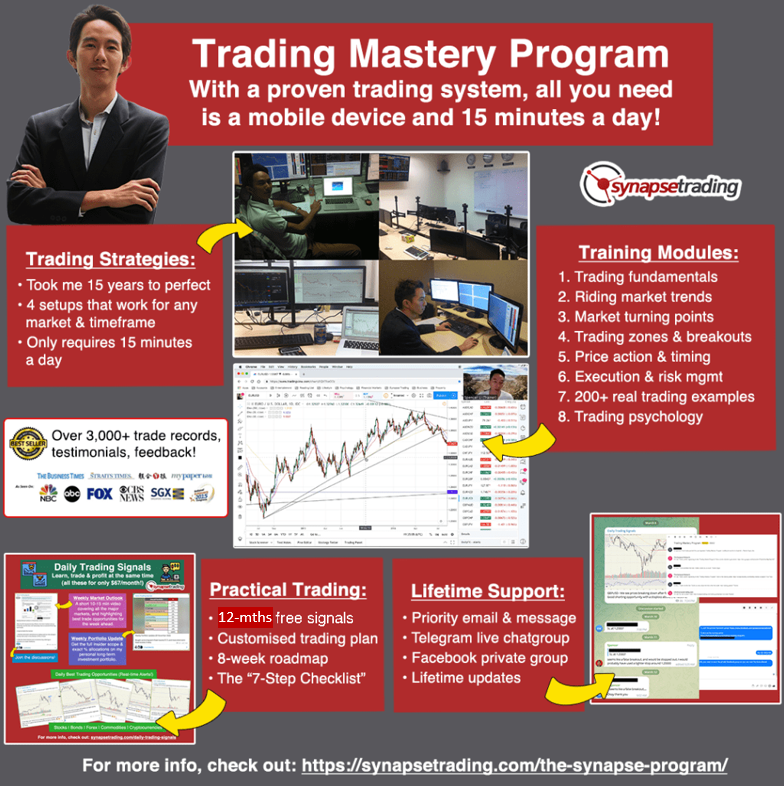
TMP Banner 010526 Our flagship mentoring program is suitable for both beginners and advanced traders, covering the 4 strategies which I used over the past 15 years to build up my 7-figure personal trading portfolio.
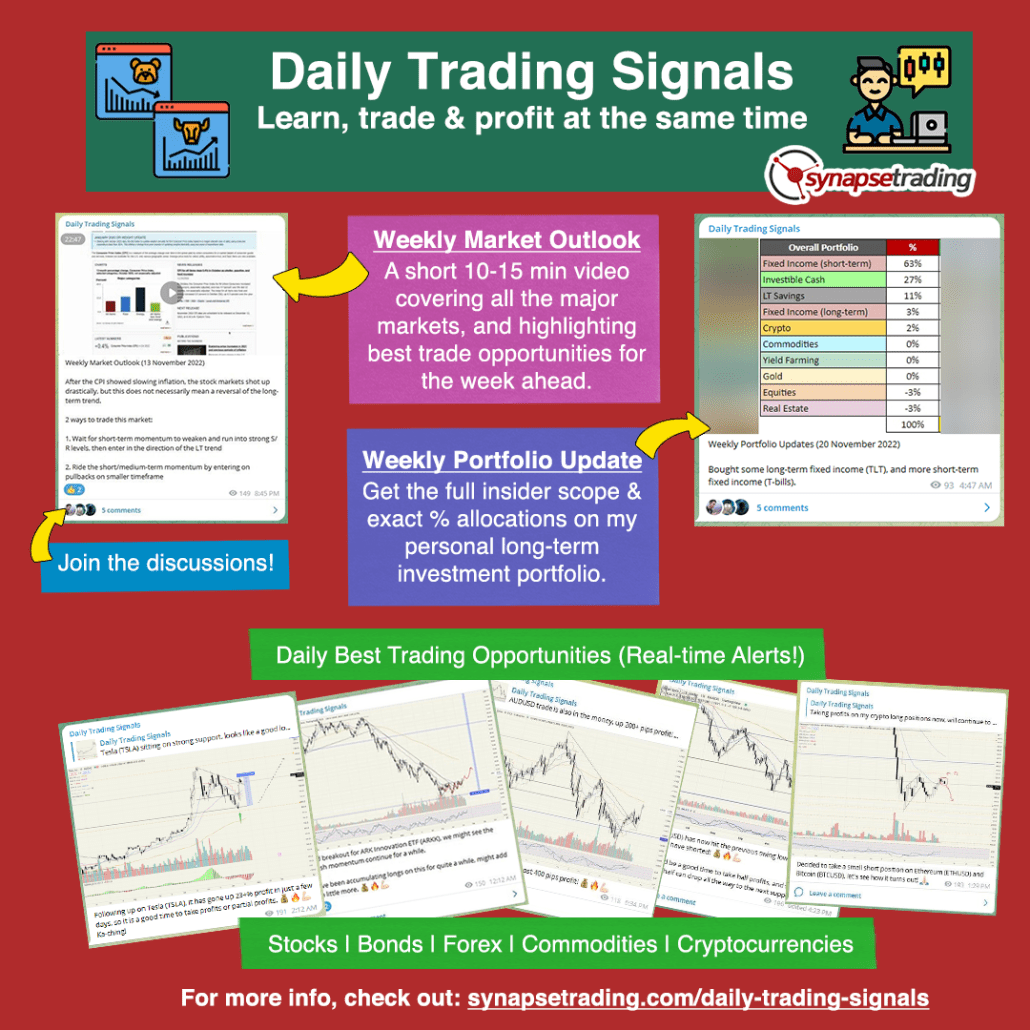
Daily Trading Signals Banner Updated If you're looking for the best trading opportunities every day across various markets, and don't want to spend hours doing the research yourself, check out our private Telegram channel!
0 Comments/by Spencer Li
Share this entry
  • Share on Facebook
  • Share on X
  • Share on WhatsApp
  • Share on Pinterest
  • Share on LinkedIn
  • Share on Tumblr
  • Share on Vk
  • Share on Reddit
  • Share by Mail
  • Visit us on Yelp
  • Link to Instagram
  • Link to Youtube
https://synapsetrading.com/wp-content/uploads/2016/07/2016-07-10-10.20.49.jpg 3024 4032 Spencer Li https://synapsetrading.com/wp-content/uploads/2019/10/logo.jpg Spencer Li2016-10-18 08:00:542026-07-06 00:31:555 Practical Tips on How to Trade on the Go (With 15 Minutes a Day)
You might also like
2015 11 10 03.51.37
My Massive Coin Collection from Every Country
Testimonial: “Not Found in Traditional Textbook Knowledge”
SMART Expo
Invited to Speak at the SMART Investment & International Property Expo – See You There!
Testimonial: “Putting it All Together in the Case Studies”
Testimonials: “Spencer is a Very Helpful and Responsible Person”
Tong Mun Kit
Testimonial: “Simple and yet Powerful”
2014 11 24 15.33.42
Testimonial: “Willing to Share his Experience as a HF Trader and an Ex-Fund Trader”
Us Trip 2 040918
Epic 1-Month Road Trip Across 9 US States & Canada!
0 replies

Leave a Reply

Want to join the discussion?
Feel free to contribute!

Leave a Reply Cancel reply

Your email address will not be published. Required fields are marked *

Free Trading Guides

Free Trading Guides

Blog Categories

  • Beginner's Guide
  • Blockchain & Crypto
  • Book Summaries
  • Candlestick Patterns
  • Economics & News Trading
  • Investing & Portfolio Management
  • Living Your Best Life
  • Market Analysis
  • News & Events
  • Price Chart Patterns
  • Promotions
  • Risk & Money Management
  • Stock Trading
  • Testimonials
  • Tools & Resources
  • Trading Psychology
  • Trading Strategies
  • Trading Tips
  • Travel & Lifestyle

Free Trading Guides

Free Trading Guides

Contact Us

Synapse Trading Pte Ltd
Registration No. 201316168H

Whatsapp: +65-8897-1204
Telegram: @iamrecneps
Email: info@synapsetrading.com

Links

Disclaimer
Privacy policy
Terms & Conditions
Contact us
Partnerships

© 2012-2024 Synapse Trading | All rights reserved | - powered by Enfold WordPress Theme
  • Link to Facebook
  • Link to X
  • Link to Instagram
  • Link to Youtube
  • Link to LinkedIn
  • Link to Mail
Link to: Testimonials: “Spencer is Very Knowledgeable and Able to Coach Very Well” Link to: Testimonials: “Spencer is Very Knowledgeable and Able to Coach Very Well” Testimonials: “Spencer is Very Knowledgeable and Able to Coach Very Well... Link to: Testimonials: “Helpful for a Beginner Who Has No Knowledge of Technical Trading” Link to: Testimonials: “Helpful for a Beginner Who Has No Knowledge of Technical Trading” Testimonials: “Helpful for a Beginner Who Has No Knowledge of Technical T...
Scroll to top Scroll to top Scroll to top