Why did a good jobs report push the market down in June 2026?
In early June 2026, the US jobs report came out, and the numbers were actually good.
So stocks should have gone up. They fell instead, and quite a bit.
When I recorded my weekly outlook a few days later, this was the first thing I talked about, because it looks strange until you see how traders were reading it. A strong jobs market meant the Federal Reserve had less reason to cut interest rates. And the market had already gone up a lot on the hope of those cuts, so good news for workers turned into bad news for share prices.
This is the part that catches most beginners out. They see a headline that says “strong jobs data”, they buy, and they watch their position fall with a mix of confusion and regret, because the headline was right and the trade was still wrong.
Hence, every release in this guide is really a question about the Fed. The jobs report and the inflation numbers matter because they change what the Fed is likely to do next, and the FOMC meeting matters because that is where the Fed actually does it.
Which economic releases move the markets the most?
Here are the three I watch most closely, with the Singapore times, since those are the hours when you will actually be awake and staring at the screen.
| Release | Who publishes it | What it measures | When it comes out | Singapore time | My full guide |
|---|
| NFP, the jobs report | US Bureau of Labor Statistics | Jobs added or lost last month, plus the unemployment rate | Usually the first Friday of the month, 8:30am New York time | 8:30pm, or 9:30pm from November to mid-March | The NFP guide |
| CPI, the inflation report | US Bureau of Labor Statistics | How fast consumer prices are rising | Around the middle of the month, 8:30am New York time, between the 10th and the 14th for every 2026 release | 8:30pm, or 9:30pm from November to mid-March | The CPI guide |
| FOMC, the rate decision | US Federal Reserve | Where the Fed sets interest rates, and what it signals next | 8 scheduled meetings a year, statement at 2pm New York time | 2am the next morning, or 3am from November to mid-March | The FOMC guide |
Do note that the Singapore times shift by an hour twice a year, because the US moves its clocks for daylight saving and Singapore does not.
What does the jobs report tell a trader?
The NFP counts how many jobs the US economy added or lost in the previous month. It is built from a survey of employers, while the unemployment rate in the same report comes from a separate survey of households.
It matters because jobs drive spending, spending drives inflation, and inflation decides what the Fed does with rates. So a jobs number far above what economists expected can move the market as much as a rate decision, and one far below can scare it just as quickly.
How does inflation data move the stock market?
Inflation is the other half of the Fed’s job, and the CPI is the number the whole market uses to judge it. The headline figure is only the start. The “core” number strips out food and energy, and the “supercore” number looks only at services and leaves out housing. Those are the parts the Fed watches most closely when it decides whether prices are really cooling.
And beyond the monthly number, inflation changes which assets tend to hold their value, which is why I have also written about what to own when prices keep rising.
Why does every trader watch the Fed?
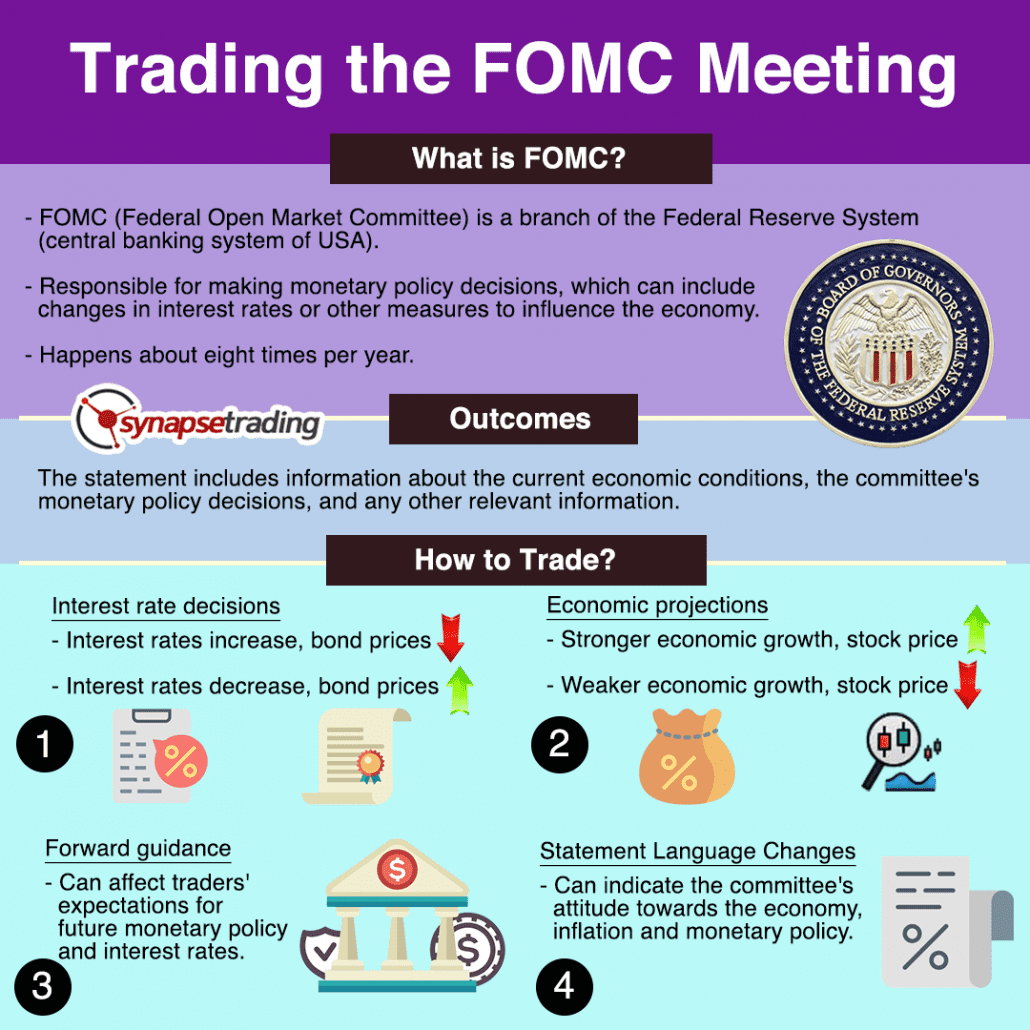
The FOMC is the committee inside the Federal Reserve that sets US interest rates, and it holds 8 scheduled meetings a year. Every other release in this guide feeds into this one decision, so the days around an FOMC meeting tend to be the most nervous of the month.
Rates also shape the bigger cycle. When rates rise, borrowing gets more expensive and the market’s appetite for risk shrinks. When they fall, the opposite happens. But the market moves well before the Fed does, which is exactly what happened in June 2026.
The yield curve is where you can see that bigger cycle most clearly, because when short-term rates rise above long-term ones, it has historically been one of the better-known warning signs of a recession ahead.
So how do you actually trade around the news?
Well, the honest answer is that most of the danger in news trading comes from treating the headline as a trading signal.
Personally, I use two rules, and I first wrote them down back in 2020, in a post about what to do when there is simply too much market news. The first is to separate facts from opinions. A jobs number or an inflation print is a fact. The TV analyst explaining what it means is giving an opinion, and a confident opinion can feel so much like data that it moves your money before you notice.
The second rule is to trade what you see, not what you think. The news can tell you why the market is moving, but the chart tells you whether to act, and keeping those two jobs separate is what stops a surprise headline from turning into a blown account.
In practice, that leaves a trader with three choices on a big release night. You can stay flat until the dust settles. You can trade the move after the number is out and the chart has shown its hand. Or you can hold a position through the release, with a size small enough that a surprise does not hurt. None of the three is right for everyone. The one that tends to hurt is a full-size position held with no plan, because a single surprise can wipe out weeks of careful trading.
If you trade currencies, news nights hit forex pairs hardest of all, so the Ultimate Guide to Forex Trading is the natural next read after this one.
Frequently asked questions about news trading
What is news trading?
News trading is trading around scheduled economic releases and central bank decisions, when prices tend to move the most. The biggest ones for most markets are the US jobs report, the CPI inflation report and the FOMC rate decision.
What time is the NFP released in Singapore?
The NFP comes out at 8:30pm Singapore time for most of the year, and at 9:30pm from November to mid-March, usually on the first Friday of the month.
Why does the market sometimes fall on good economic news?
Because the market trades what the news means for interest rates. Strong jobs or hot inflation data can mean the Fed keeps rates higher for longer, and that can push stocks down even when the economy looks healthy.
How many FOMC meetings are there each year?
The Fed holds 8 scheduled FOMC meetings a year, and the statement comes out at 2pm New York time, which is 2am or 3am the next morning in Singapore.
Is it safe to hold a trade through a big news release?
It carries more risk than a normal day, because prices can gap past your stoploss in a second. If you do hold through a release, keeping the position small is the simplest way to make sure a surprise does not do real damage.