

Confirmation Bias – I See Only What I Want to See!
Join our Telegram channel for more market analysis & trading tips: t.me/synapsetrading
Table of Contents
What Is Confirmation Bias in Trading (and How to Beat It)?
Last updated: 2026-06-14 · By Spencer Li, CFTe
Confirmation bias is the tendency to notice and trust information that supports what you already believe, while ignoring or explaining away anything that contradicts it. In trading, it is dangerous because a trader who has already decided “this is going up” will hunt for the indicators, news, and chart reads that agree, and quietly skip the ones that do not. The fix is not a smarter indicator. It is a habit of forced objectivity: record every signal a method gives you, the losses as well as the wins, and judge the method on the full record instead of the flattering half. If you only remember the trades that proved you right, you are not testing your edge. You are decorating your opinion.
Here is where the bias comes from, the three places it bites traders, and the one record-keeping habit that beats it.
What is confirmation bias?
Confirmation bias is a form of selective perception (your mind quietly filtering what you take in). It emphasises ideas that confirm your beliefs and devalues whatever contradicts them. You can think of it as a selection bias in how you collect evidence: you go looking for the proof that fits, and that is mostly what you find.
A simple everyday example. Say you believe more red cars drive past your house in summer than at any other time of year. That belief might be true. But it might just be confirmation bias: in summer you notice the red cars and overlook them the rest of the year, and over time that one-sided noticing hardens into a “fact” you would defend. You never actually counted.
Put another way, confirmation bias is our all-too-natural ability to convince ourselves of whatever we want to believe. We attach undue weight to events that corroborate the outcome we were hoping for, and we play down whatever contrary evidence shows up.
Why is confirmation bias dangerous for traders?
Because trading rewards being right and punishes being stubborn, and confirmation bias makes you feel right while you are being stubborn. A trader who is entrenched in an opinion will actively seek out the information that confirms it and ignore the information that does not. The feeling of conviction goes up. The quality of the decision goes down. Here are the three places it does the most damage.
| Where it bites | What it looks like | The fix |
|---|---|---|
| Indicator cherry-picking | You stack indicators until enough of them “agree” with the trade you already want, and you discount the ones flashing the opposite signal | Decide your indicators and rules before the trade, then read all of them, including the ones you do not like |
| Gurus and marketing gimmicks | A “sure-win” guru looks like a genius because you celebrate his hits and forget his misses (and so does he) | Demand the full track record, every call, scored. No full log, no credibility |
| Your own results | You remember the trades that proved you right and let the losers fade, so a mediocre method feels like a great one | Log every signal the method gives, win or lose, and grade it on the whole set |
The indicator trap
This bias is especially nasty for traders who lean heavily on indicators, because many indicators give conflicting signals at the same time. If you have already chosen a direction, it is not hard to find the two or three indicators that support it and treat the rest as noise. You are not analysing the market anymore. You are assembling a defence for a verdict you already reached.
The guru trap
The second hazard is marketing gimmicks and market gurus, the ones who make a lot of (often absurd) forecasts based on a “sure-win” method. To a newer trader they can look like they have a very high hit rate. Mostly that is because people want to believe the guru, so they celebrate his correct predictions and conveniently ignore the less-accurate or completely-off ones. The guru rarely keeps the receipts, and neither does the audience. Same bias, pointed outward.
What is the best solution for confirmation bias in trading?
Objectivity. You have to be willing to see both sides of the coin instead of only the side you like.
The most practical version of that is simple to say and hard to do: if you want to test whether a method works, record every single signal it produces, the gains and the losses, and not just the instances where it worked. The losers are not an embarrassment to hide. They are half the data. A method judged only on its winners is not a tested method. It is a story.
This is exactly why my own trade log is public, all of it, losses left in. Not because the losing trades are flattering, but because a record that quietly drops them tells you nothing true about the edge.
As Francis Bacon put it four hundred years ago:
“It is the peculiar and perpetual error of the human understanding to be more moved and excited by affirmatives than by negatives.”
That is confirmation bias, named long before anyone called it that.
Where the human edge comes in
An indicator, or an AI scanner, will happily generate signals all day. It has no opinion to defend, but it also will not stop you from defending yours. The thing software cannot do for you is force the awkward question: “What would prove me wrong right now, and have I actually looked for it?” Catching your own bias, scoring your method honestly, and sitting with a losing record instead of deleting it is psychology and accountability work. That is two of the Five Edges no tool will trade for you.
FAQ
What is confirmation bias in simple terms?
Confirmation bias is the habit of paying attention to evidence that agrees with what you already believe and ignoring evidence that does not. Over time, one-sided noticing turns a hunch into a “fact” you never actually tested.
How does confirmation bias affect traders?
It makes traders seek out indicators, news, and chart reads that support a position they have already decided on, while discounting the warning signs. It also makes “sure-win” gurus look more accurate than they are, because their hits get remembered and their misses get forgotten.
How do I overcome confirmation bias in trading?
Record every signal your method produces, wins and losses, and judge the method on the full record. Define your rules before the trade, read every indicator (not just the agreeable ones), and treat any guru with no complete, scored track record as unproven.
Is confirmation bias the same as a self-fulfilling prophecy?
No. A self-fulfilling prophecy is when believing something helps make it happen. Confirmation bias is when you only notice the evidence that says it already happened, whether or not it did.
Why should I keep a trading journal that includes my losses?
Because a journal that quietly drops the losers tells you nothing honest about your edge. The losing trades are half the data. Logging every signal, win or lose, is the single most effective defence against fooling yourself.
So, the next time a trade feels obviously right, ask yourself one question: am I reading the market, or am I collecting proof for a verdict I already reached? That small pause is most of the skill.
For the full picture on how the mind works against traders, read the pillar: The Complete Guide to Trading and Investing Psychology.
Want the system that keeps the bias out of the trade? Grab the free 15-Minute Swing Trading Starter Kit. It’s the exact routine I use to scan once a day and trade any market in 15 minutes, rules first, opinion second.
About the author. Spencer Li is the founder of Synapse Trading and a Certified Financial Technician (CFTe) with 15+ years of trading across stocks, forex, crypto, commodities, and bonds. His trade log is public: every trade since April 2024, dated, losses left in. He has taught a 15-minute daily trading routine since 2014, one system for any market.
Education, not financial advice. Synapse Trading is not licensed by MAS to advise on investment products. Trading carries risk of loss; past performance is not indicative of future results.
Related
The Complete Guide to Trading and Investing Psychology (pillar) · Loss aversion and how it hurts traders · Why keeping a trading journal matters · Recency bias in trading
Want the daily routine? Enter your email for the free 15-Minute Swing Trader's Checklist.
Free, 5 pages, PDF. You get the checklist, then my occasional trading emails. Education only, not financial advice. Unsubscribe anytime.
Where your details go: Kit, our email provider, stores your email address in the United States. Our contract with Kit lets it use your address only to send our emails, and requires Kit to keep it secure. The United States has no national privacy law like Singapore's, so that contract is the main protection. More in our privacy policy.
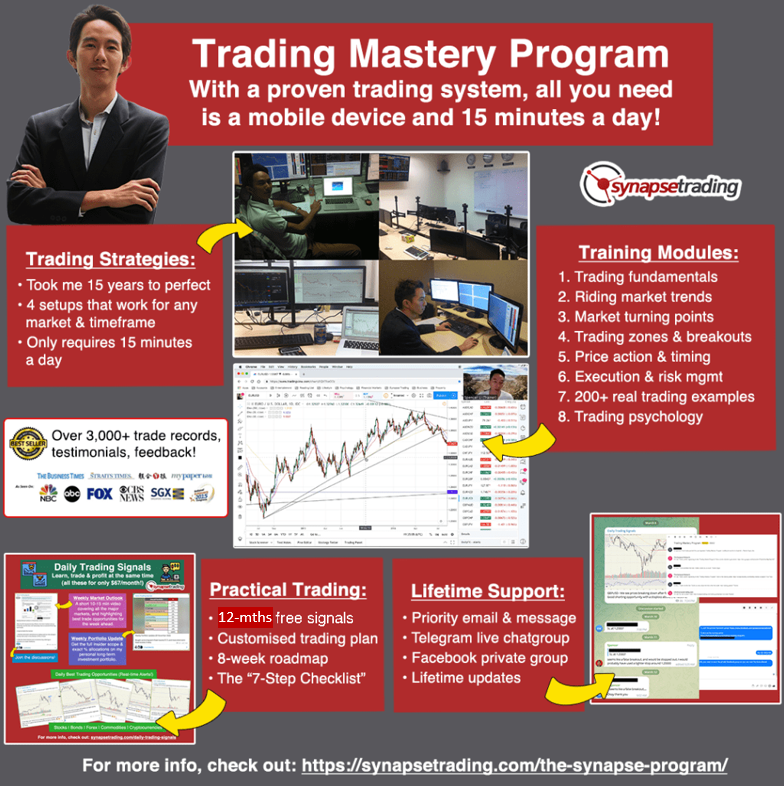 Our flagship mentoring program is suitable for both beginners and advanced traders, covering the 4 strategies which I used over the past 15 years to build up my 7-figure personal trading portfolio.
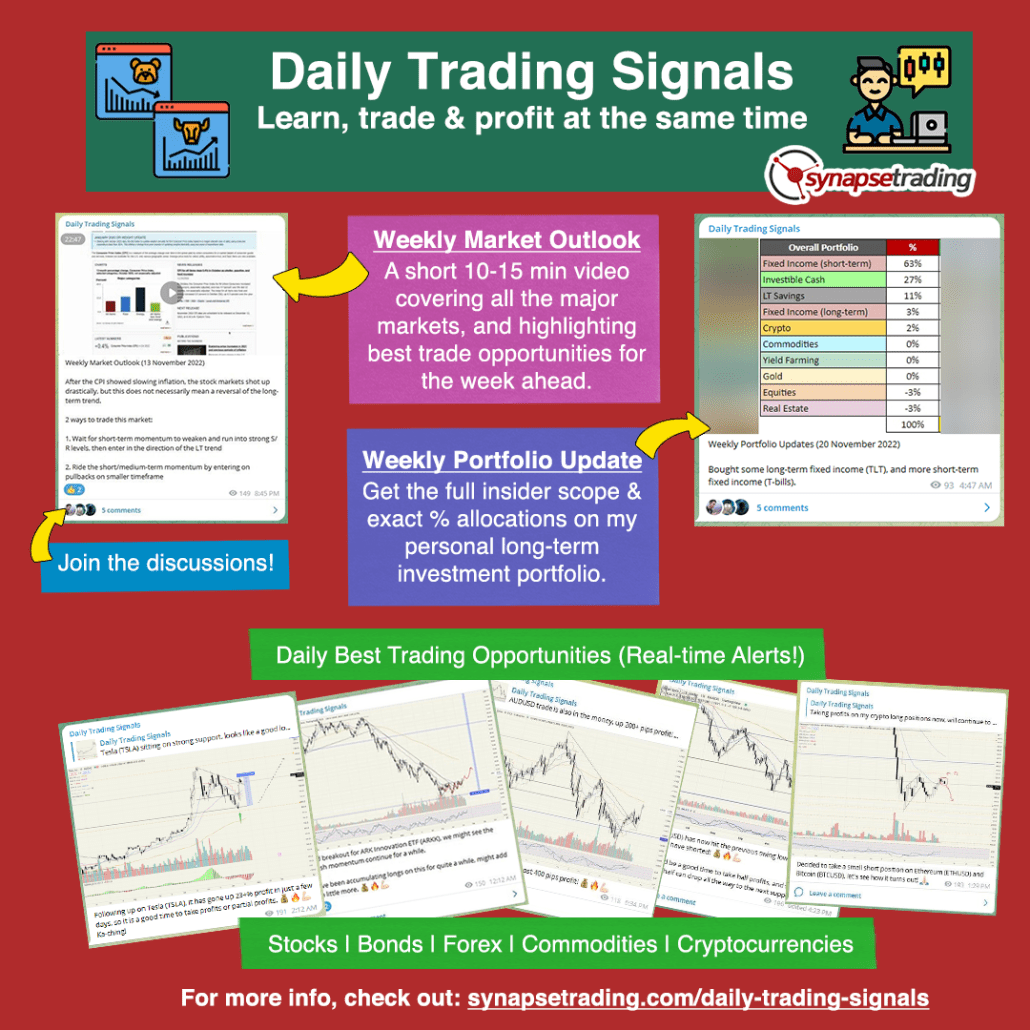 If you're looking for the best trading opportunities every day across various markets, and don't want to spend hours doing the research yourself, check out our private Telegram channel!

Trackbacks & Pingbacks
[…] Trader’s Guide to Trading Psychology (pillar) · Loss aversion in trading · How to cut your losses · Confirmation bias in trading […]
[…] Behavioral Finance and Trading Psychology (pillar) · Overconfidence bias in trading · Confirmation bias in trading · Loss aversion and the disposition […]
[…] Guide to Investing and Trading Psychology (pillar) · Loss aversion in trading · Confirmation bias in trading · How to set a […]
Leave a Reply
Want to join the discussion?Feel free to contribute!