

Hammer Candlestick Pattern: How to Spot It, Confirm It and Size the Trade
Want the daily routine? Get the free 15-Minute Swing Trader’s Checklist. Get it free →
By Spencer Li, CFTe · Last updated: 8 September 2026
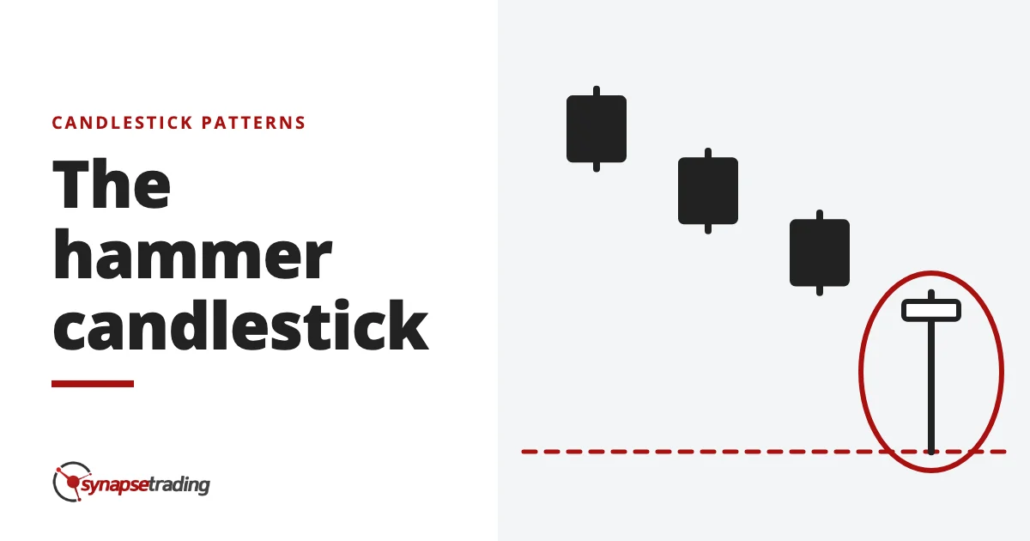
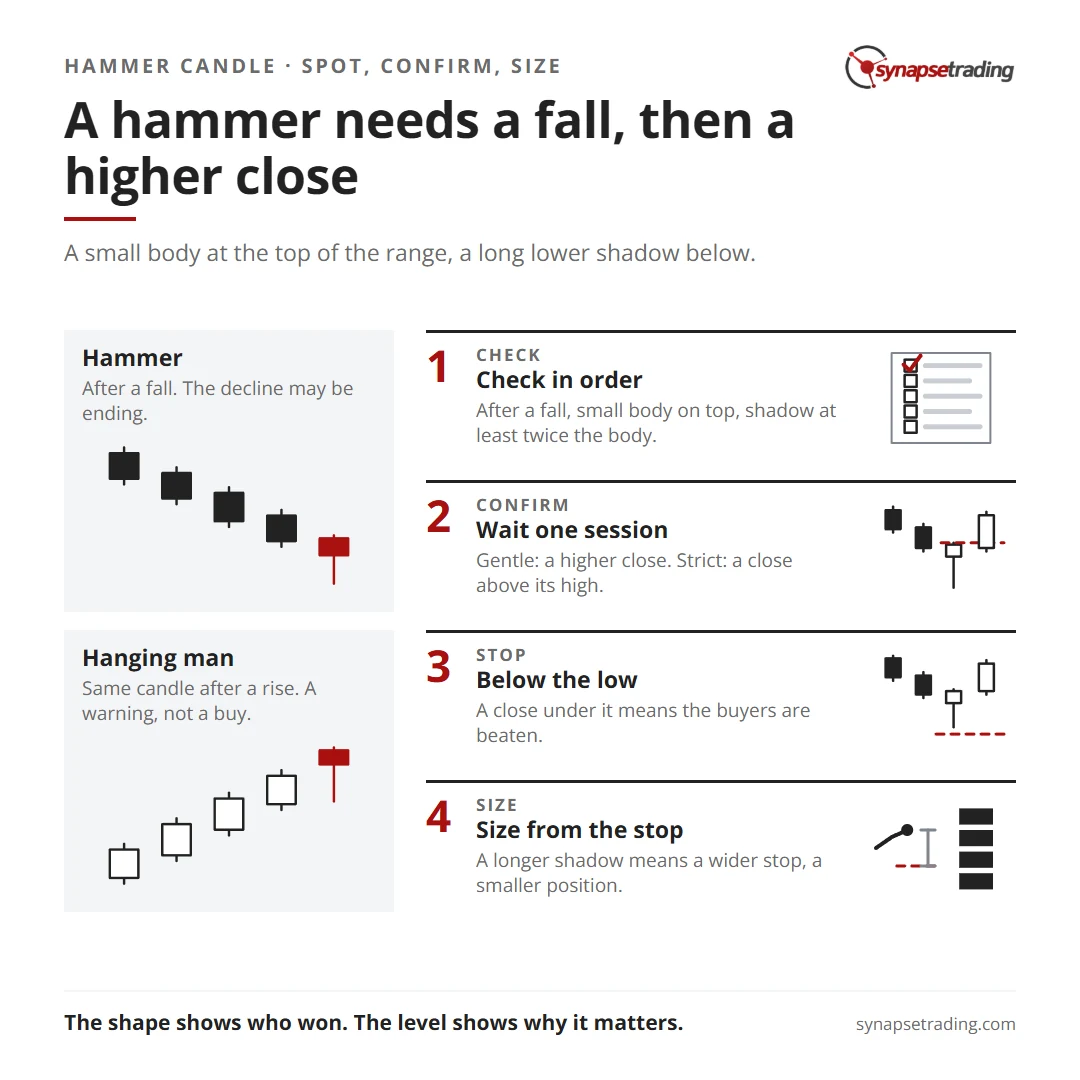
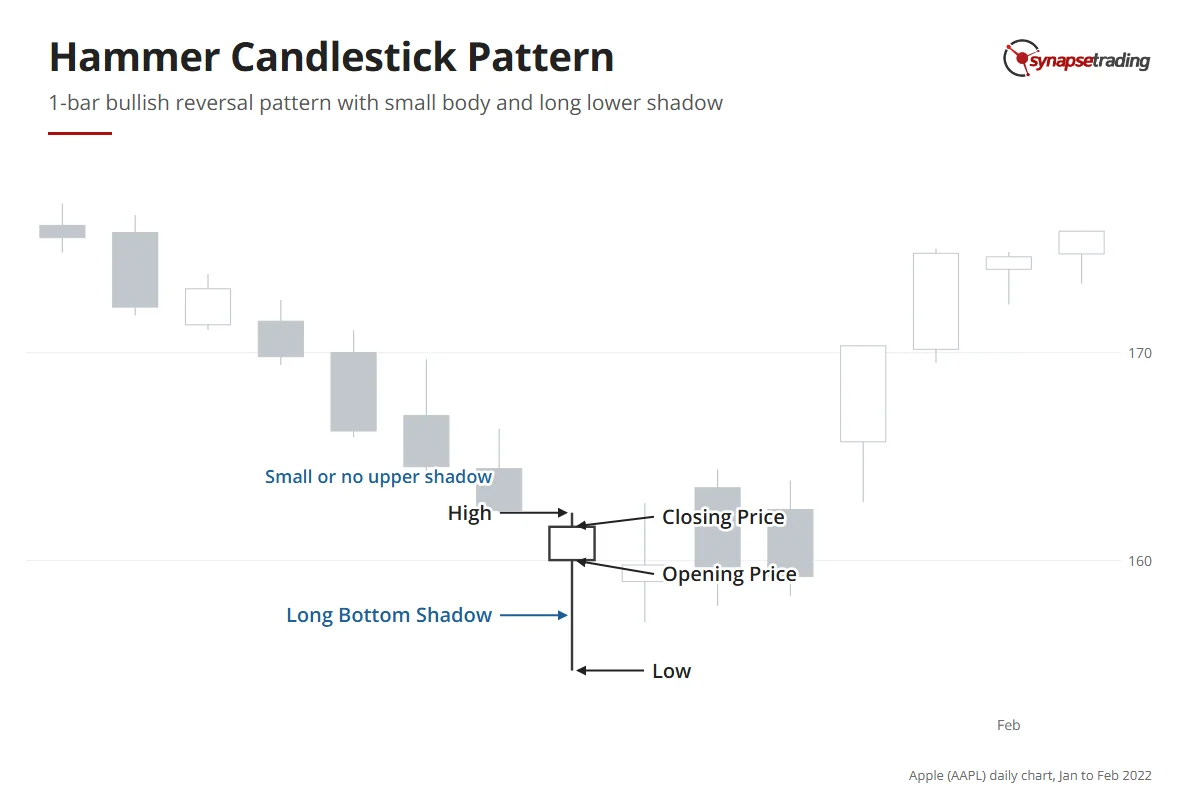
A hammer is a single bullish candle that forms after a fall in price. Its real body, the part between the open and the close, is small and sits at the top of the session’s range. Below it hangs a long lower shadow, at least twice the height of the body, and above it there is little or no upper shadow. The colour of the body matters far less than most guides suggest. The candle tells you that sellers drove price down hard during the session and buyers pushed it all the way back up by the close, which is often the first sign that a decline is running out of sellers. Most traders wait for the next session to close higher before they buy, and they put the stop just below the hammer’s low.
The same candle after a rise is called a hanging man, and it is a warning rather than a buy signal. So before you look at the shape at all, look at what the market did in the weeks before it.
What makes a candle a hammer?
The name is the easy part, since the small body is the head and the long lower shadow is the handle. Steve Nison, whose 1991 book Japanese Candlestick Charting Techniques brought candlesticks to most Western traders, sets out what the candle needs, and it is worth running the checks in order, because each one throws out a lot of candles.
- It comes after a decline. The hammer’s job is to end a downtrend. With no fall before it, there is nothing for it to end.
- The body is small and sits at the top of the range. The open and the close both land near the session’s high, so the whole fight happened below them.
- The lower shadow is at least twice the height of the body. Gregory Morris, in Candlestick Charting Explained, describes the stricter Japanese takuri line, which asks for three times.
- There is little or no upper shadow. A long shadow on top as well means both sides tried and both sides failed.
Colour is the check people argue about most, and it is the one that matters least. Nison treats it as unimportant, and the candlestick course I took in Singapore back in 2009 taught the hammer in either colour. So a hammer can close a little below its open and still be a hammer.
What the course did care about was the next candle. A black hammer followed by a white candle, it noted, has a higher chance of working.
What actually happens inside a hammer?
Who has the worst day when a hammer prints?
Imagine a trader who has held a falling stock for a fortnight. On the morning of the hammer it drops hard, and somewhere near the low their fear finally wins and they sell. By the close, buyers have pushed price back up to where it opened, so they get to watch the stock finish well above their exit, which is a special kind of regret. The short sellers, who sold hoping to buy back cheaper, had the opposite afternoon. A big profit appeared before lunch and was mostly gone by the close.
That is the information in the long lower shadow. Sellers had the whole session and could not hold the lows, and the people waiting to buy lower turned out to be quite a lot of people.
My 2009 course kept asking how two candles would look “if blended together”, squashed into one with the first open, the last close, and the extremes of both. Blend a bullish engulfing pattern, a black candle swallowed by a bigger white one, and out comes a white hammer. So the hammer also hides inside some of the two-candle patterns.
Reading candles well is mostly a habit of checking the same few things every day, and my free 15-minute swing trader checklist is the routine I use to keep that habit.
What does a real hammer look like?
On 2 April 2026, I told viewers of my weekly outlook that we had just bought Dell. It had “held quite well right at this support level here with the pin bar”. A pin bar, in the course I teach, is a long wick rejecting a level, with a small body that closes away from it.
The pin bar on the chart that day was the 31 March candle. Dell had run up more than 50% in about a month, then fell about 17% from its high in four sessions. On 31 March it dropped below its 20-day moving average during the session and closed back above it, with an open and close that were almost equal and a lower shadow covering roughly 70% of the day’s range.
The next session did what the books ask for, opening above the hammer’s body and closing above its high. Then on 2 April, the day I recorded, the whole market opened lower, and Dell went with it. “If it’s able to kind of hold somewhere around here,” I said, it “might have a chance to continue going up”. It held. By 15 April, I told viewers we were up about 8%.
Now, it would be easy to tell this as a textbook trade, and it was not one. The upper shadow was almost a third of the range, more than Nison allows, so strictly that candle was a pin bar with a hammer’s lower half. The RSI, a momentum gauge that runs from 0 to 100, was around 59, nowhere near oversold. And the fall was a pullback inside a strong uptrend rather than the end of a long decline. In my own playbook that makes it a Swing trade, a pullback to the moving average, rather than a Bounce off a selling climax.
What made it worth taking was the level. The shadow dipped under a moving average the stock had been respecting, and the close put price back above it. The shape only told me who won that day. The level told me why it mattered.
How do you confirm a hammer?
A hammer describes a session that has already ended, so all it can tell you is that buyers showed up once, and confirmation is simply a matter of checking whether they come back the next day.
There are two common tests. The gentler one, from my 2009 course, is a candle in the opposite direction the next day, which for a hammer means a higher close. The stricter one is a close above the hammer’s high, wick included.
Dell passed both on 1 April. Plenty of hammers pass neither, and those are the ones that save you the most money by being ignored.
Where does the stop go, and how big should the trade be?
This candle has an odd property, which is that the better a hammer looks, the more expensive it is to trade.
The stop goes just below the hammer’s low, because a close under it means the decline has made a new low and the buyers who built that shadow have been beaten. But the long lower shadow is also exactly the distance from your entry to your stop. So the longer and more convincing the shadow, the wider the stop.
Let me show you with made-up round numbers. Say a stock trading near 100 prints two different hammers on two different weeks, and you buy each one on a close at 101, above its high.
| Hammer A, long shadow | Hammer B, short shadow | |
|---|---|---|
| Low of the hammer | 97.00 | 99.00 |
| Stop, just below the low | 96.80 | 98.80 |
| Risk per share | 4.20, about 4.2% | 2.20, about 2.2% |
| Position size if you risk 1% of the account | about 24% of the account | about 46% of the account |
| Reward to resistance at 108 | 7.00, or about 1.7R | 7.00, or about 3.2R |
A common rule of thumb asks for at least 1.5R, with 3R as the ideal. So Hammer A only just passes, while Hammer B, the uglier candle, offers the ideal. The deep shadow that makes Hammer A look so convincing is the same shadow that makes it a worse trade, unless the next resistance is a long way off.
Personally, I size from the stop and never the other way round. The risk stays fixed, and the position shrinks to fit the shadow.
If you would rather do this checking once a day than all day, the free 15-minute swing trader checklist is the routine I run myself.
Why does a hammer fail?
In June 2026, a trader on Reddit’s r/Daytrading asked: “Saw a beautiful bullish hammer candle but it wasn’t respected why?” They were trading Bitcoin. Price had been moving up when the candle printed, and from the next candle it “went down like crazy”.
It is a fair question. The answer is in where the candle sat. After a rise, Nison would call that candle a hanging man, so its first job was to warn, and in that sense it did its job. That is the most common failure of all, the right shape in the wrong trend.
The second failure is momentum. One of Nison’s own hammer examples failed because the session before it was a long black candle with no shadows, a sign of strong selling, and the hammer had broken an old support. His advice was to read a hammer in the context of what came before it, and to wait for confirmation. A fast, heavy decline can print a perfect hammer and keep falling for another week, which is how bottom pickers get wiped out.
The third is the market itself. Nison noticed that hammers turn up often on weekly copper charts, and he suggested studying which candles work best in the market you trade. I read that as a reason to check a hammer against your own market’s history first.
I should also be honest about my own records. As at 29 August 2026, 215 of my 473 closed trades carried a setup tag, swing, break, bounce or turn, but none of those tags records which candle triggered the entry. So I can tell you about Dell, and one good trade proves very little.
FAQ
Is a hammer candlestick bullish or bearish?
It is bullish. It forms after a fall and warns that the decline may be ending. Most traders treat it as a signal only once the next session closes higher.
What is the difference between a hammer and a hanging man?
Both have a small body near the high and a long lower shadow. After a fall it is a bullish hammer, and after a rise it is a bearish hanging man.
Does a red hammer still count?
Yes. Nison treats the colour of the body as unimportant. The colour and close of the next candle matter more.
How do you confirm a hammer?
Wait for the next session. A higher close is the gentler test, and a close above the hammer’s high is the stricter one.
Where do you put the stop loss on a hammer?
Just below the hammer’s low. Size the position from that distance, so a longer shadow means a smaller position.
Have you ever bought a hammer that turned out to be a hanging man? And when you size a hammer trade, do you start from the stop or from the number of shares? Let me know in the comments.
For every pattern in one place, read The Definitive Guide to Candlestick Patterns. The upside-down version of this candle is the inverted hammer, the bodiless version is the dragonfly doji, and its bearish twin is the hanging man. For the wider picture, start with my free trading guides.

If you would like to learn more about all the different candlestick patterns, also check out: “The Definitive Guide to Candlestick Patterns”
And if you want a routine that spots these candles without hours at the screen, grab the free 15-minute swing trader checklist.
About the author. Spencer Li is The 15-Minute Trader and the founder of Synapse Trading. He is a Certified Financial Technician (CFTe) with 15+ years of trading, run from 70+ countries. He holds a B.Acc and B.BM from SMU. Every trade he takes is public, dated, losses left in. He teaches low-risk swing trading in 15 minutes a day, one system for any market.
Education, not financial advice. Synapse Trading is not licensed by MAS to advise on investment products. Trading carries risk of loss, and past performance is not indicative of future results.
Want the daily routine? Enter your email for the free 15-Minute Swing Trader's Checklist.
Free 5-page PDF, then occasional trading emails. Education only, not financial advice. Unsubscribe anytime. Kit stores your email in the US: see our privacy policy.
Want to learn the full method? The Trading Mastery Program teaches the 4 strategies I have traded since 2011. It suits beginners and experienced traders.
Rather follow the trades as they happen? Daily Trading Signals is our Telegram channel: my trade ideas with entry, stop and exit, and every trade is public.
Questions about this post? Ask in the free Telegram channel →
Educational content only, not personalised financial advice. Trading carries risk, including loss of capital. Past performance is not indicative of future results. Synapse Trading is not licensed or regulated by MAS.

