• Link to Facebook
  • Link to X
  • Link to Instagram
  • Link to Youtube
  • Link to LinkedIn
  • Link to Mail
Synapse Trading
  • Home
  • About
    • My Background
    • My Trading Journey
    • My Travel Log
    • Media & Interviews
  • Mentoring
    • Trading Mastery Program
    • Results & Testimonials
  • Signals
    • Telegram (Free to join!)
    • Daily Trading Signals
    • Daily Trading Signals (Results)
  • Resources
    • Free Trading Guides
    • Tools & Resources
    • Blog & Infographics
  • Contact
    • Contact Us
    • Partnership Opportunities
  • Click to open the search input field Click to open the search input field Search
  • Menu Menu
Spencer Li

How to Create a Trading Journal (And Discover Your Edge in the Markets)

Trading Tips
how to create a trading journal thumbnail

Have you ever wondered why you keep making the same trading mistakes over and over again?

As you start your trading journey, one very important habit to cultivate is to have a good trading journal, which is why in this blog post, I’m going to share with you how you can start a trading journal and use it to effectively improve your trading results.

If you would like to learn all the essential elements to kickstart your trading journey, also check out: The Beginner’s Guide to Trading & Technical Analysis


How to Create a Trading Journal


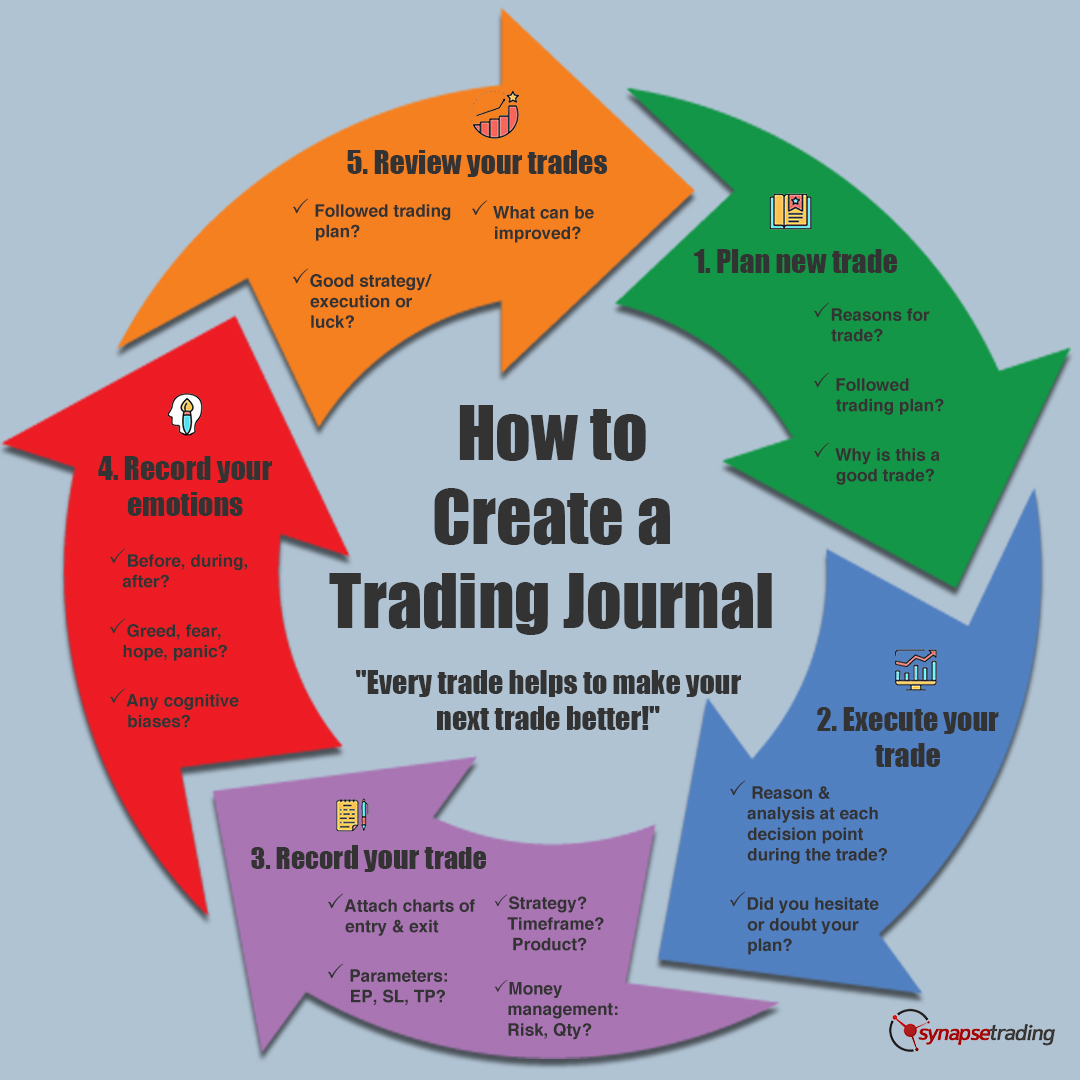
Trading Journal #1 Plan New Trade

The first thing to record is the planning of your new trade.

You should already have a trading plan before you even start trading, but before you actually execute the trade, it is good to record down the trade in your trading journal.

  • Why are you taking this trade?
  • Why is this a good trade?
  • What is the strategy behind it?
  • What is the reason or the rationale for you wanting to take this trade?
  • What are the pro factors? The negative factors?

Everything should be recorded down, basically your whole thought process of your decision-making of how you come about to decide whether you want to take this trade or you want to pass on this trade.

So all that should be recorded down in your trading journal for future reference.


Trading Journal #2 Execute Your Trade

Next is the execution of the trade.

  • What was the reason and analysis of each decision point during the trade?
  • For example, when you’re making the entry, why are you entering at this price?
  • Why not wait a little bit later?
  • Why not enter at a better price or when you are going to exit the trade,
  • Why do you want to take profits?
  • Why not let the trade run further?

All these things should be recorded down in your trading journal.

Basically, why you make every decision along the way.


Trading Journal #3 Record Your Trade

Next, you’re going to record the trade itself in your journal, meaning all the trade parameters.

You’re going to record:

  • What type of trading style was it?
    Was it a long-term trade? A medium-term trade, a short-term trade?
    So that will correspond to whether it’s position trading, swing, trading, or day trading.
  • And what was the product that you traded?
    Was it forex, a stock, an option or a derivative?
  • Next, what was the timeframe?
    Was it on a 5-minute chart, a 1-hour chart, a daily chart, a monthly chart?

These are all the standard perimeters that should be recorded down in your trading journal.

Next up, you should also record down your entry price, stoploss price, and target price. These are the bare minimum parameters that you need to have for each trade.

  • The entry price (EP) is the price that you entered the trade.
  • The stoploss price (SL) is the price that you get stopped out.
    So if it’s a losing trade, and you got stopped out, then you record the price which you got out or if you didn’t get stopped out, you also record down the stoploss price, because that is the price that intended for it to be the stoploss.
  • And lastly, the target price (TP) will be the price that you choose to take profit at.
    If you actually stagger your trade, for example, you take half profits at certain price or decide to trail, and shift your stoploss or different variations of position management.

All this is useful information to see whether the position management strategy that you’re using is actually effective, or maybe it might be too complicated and decreasing the optimal returns that you should be getting.

Next, you should also attach a chart of your entry and exit in your trading journal.

Ideally the chart should be labeled with as many things as possible. Other than your entry and exit, you can label where you shift your stoploss or scale in or out of positions.

You can also choose to label your thought process directly on your chart.

So for example, if you choose to make your journal soft chart-based, then you could also record down most of the information directly on your chart, and then you’ll save a screenshot of it.

It might be easier for you to reference. All you have to do is just look through all the different charts, compilations. All the information is already on the chart.

However, it will not allow you to effectively analyze the data.

If you record it on a spreadsheet instead, then it’s easier if you want to do analytics to review the numbers and your profits.

This is a trade-off. Or you can do both if you have the time.

But the bare minimum you should have is to at least have an attached chart so that when you look at the chart, you can remember what this trade was about.


Trading Journal #4 Record Your Emotions

Lastly, the most important thing is to record down in your trading journal is your emotions throughout the trade.

Many traders tend to neglect this aspect because they think that they just want to record the hard data, so they don’t really record down how they were feeling or why they made this decision.

But trading is an emotional activity.

It’s largely psychological, but your emotions still do play a big role.

A large part of trading is how well you can effectively manage this emotion.

So the first step to understanding or managing the emotions, is to be able to record it down.

For example, when you were taking this trade,

  • Were you feeling fear?
  • Were you afraid that you might miss out the trade or feeling greedy?
  • Or were you feeling hopeful or hesitant because maybe you were previously been burned in your last trade?

All these emotions are very important because subconsciously, they may affect your decision-making.


Trading Journal #5 Review Your Trades

The next segment is how to use these data that you have collected from your trading journal to improve your trading results.

The frequency at which you do your review will depend on your trading style.

If you are doing swing trading, then maybe you can do a review at the end of every week; if you are day trading, then you could do it at the end of every day.

The main point of this review is to look for areas of improvement.

What are some of the things that you should be looking out for?

  • Did you follow your trading plan?
    You should have a trading plan before you even start trading, so you can compare the before and after, (your trading plan versus your trading journal), how closely do they match up?
  • If you deviated from your trading plan, why did it happen?
    Was it because of certain emotions or was it some impulse?
  • So with that, then you need to decide whether it is the plan needs to be improved or whether it is you who needs to improve so that you can be more disciplined to follow the trading plan.

The next level is to go down to each individual trade, for example, for every trade:

  • Why was it a winning trade?
  • Why was it a losing trade?

Just because a trade is a winning trade doesn’t necessarily mean that it was a perfect trade or you did everything correctly because there’s an element of chance.

Even if you broke all your trading rules and you traded horribly, there’s still a chance that you might end up with a winning trade, but that doesn’t necessarily reflect your ability to trade.

And it definitely doesn’t mean that you should replicate this behavior in the future.

It’s important to not just see the trade as winning trade equals good trade and losing trade equals bad trade, but to understand the underlying reasons for why it was a winning trade and why it was a losing trade.

For losing trades, was it due to poor execution or was it due to market conditions?

So similar to the idea put forth earlier, just because a trade was a losing trade doesn’t necessarily mean that it was a bad trade because you can do everything perfectly and executed everything according to plan and it could still turn out to be a losing trade simply because no trading strategy is 100%.

Even if your trading strategy is 70%, there is still a 30% chance that the trade will be a losing trade, even if you did everything correctly.

The key thing is to see how closely you follow your plan, whether you execute everything according to your plan.

As I said earlier, it’s a matter of reviewing everything and seeing whether the plan needs to be improved and changed, or whether it is you who needs to improve your discipline, such that you can be less emotional and be able to execute the plan which you have come up with.

And that is the key to being a good trader.


Summary of Trading Journal

So to sum up, I’ve shared with you 2 main segments of the trading journal.

The first was all the things that you need to record in your trading journal. (Parts 1 to 4).

That’s how you can create a good trading journal.

The second part is how you actually use this information to improve your trading results. (Part 5).

So remember that all successful traders, even professionals, they keep a trading journal.

And in fact, this is quite a standard practice for many of the funds and financial institutions, especially for some that I used to work at.

It was common practice that they want all the traders to have a trading journal so that when you are reviewing it with your manager or your bosses, there’s a record and it actually helps them understand your trading style and your trading decisions on a day-to-day basis.

Even if you are trading on your own, it’s actually very important to have this trading journal because you will be able to better understand yourself as well.

Only you will be able to figure out your strengths and your weaknesses.

So having this trading journal gives you a window into your own trading psyche and allow you to fine tune your trading strategies and thus, improve your trading results.

For all new traders out there, do you currently have a trading journal and for seasoned traders, how useful is a trading journal when you were starting your trading journey?

Let me know in the comments below!

0 Comments/by Spencer Li
https://synapsetrading.com/wp-content/uploads/2021/03/how-to-create-a-trading-journal-thumbnail.jpg 720 1280 Spencer Li https://synapsetrading.com/wp-content/uploads/2019/10/logo.jpg Spencer Li2021-03-14 18:42:142022-08-10 05:10:18How to Create a Trading Journal (And Discover Your Edge in the Markets)
Spencer Li

Is the Stock Market Heading for a Correction? (While Bitcoin Surges…)

Market Analysis
is the market heading for a correction thumbnail

After the sharp run-up in stocks from last year’s March lows, some people are starting to wonder if the market has got a bit too bubbly.

In this post, we will compare the different stock indices, as well as some other products, to see if there are any good opportunities.


The Meteoric Rise of Bitcoin

Meteoric Rise of Bitcoin

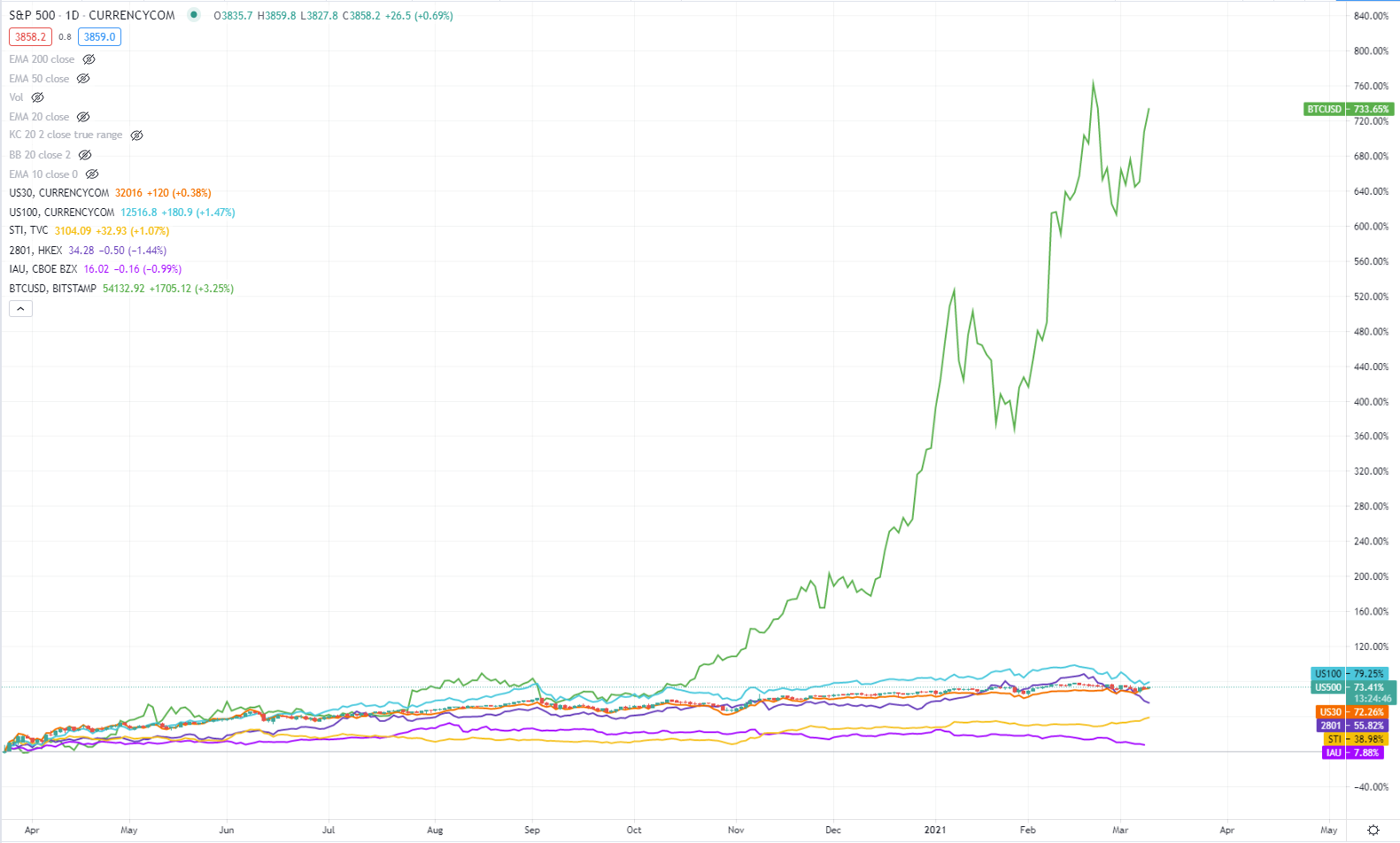
When placed on the same scale, the epic 700+% returns on Bitcoin (BTC/USD) dwarfs everything else, and has also provided some of the best returns for my portfolio last year.

Looking at its strong trend, it does look like there are a few more legs for it to go, so I will hold onto it for now.

To see the rest of the products, I will now remove Bitcoin from this comparison.


Overview of Various Markets


Overview of Various Markets


The top 3 you see are the 3 indices of the US stock market, and the one in candles is the S&P 500. The other 2 are the Dow Jones Index and the NASDAQ.

The Nasdaq had the sharpest recovery at the start, but the other 2 recently caught up, especially in the last few weeks where the NASDAQ corrected sharply.

So in terms of percentage recovery, all 3 indices are roughly at the same level.

Next if we look at the line in dark purple (2801), which is one of the China Stock ETFs which I invest in, it had a good run, and just earlier this year it was on par with the NASDAQ.

However, in recent weeks, it has corrected sharply and is now below the 3 US stock indices.

The STI Index (Singapore market) was pretty much lackluster last year, but has picked up in recent months, making it one of the top performing stock markets this year.

The last line on the chart is Gold (one of the Gold ETFs to be specific), and it seemed to have hit its recent peak in August last year.


Will Rising Rates Kill the Stock Market?


Kill the Stock Market


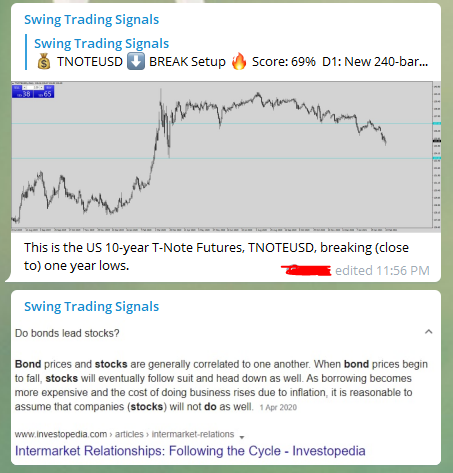
Historically, rising yields have led to recessions, but the lag time could be years, so it’s not like we won’t be able to see it coming as it happens.


Kill the Stock Market 2

Kill the Stock Market 3


Looking at the charts of bond prices (which are an inverse of interest rates), we can see that it peaked around the same time the stock market bottomed (March 2020), and in recent weeks has been dropping faster.

This in itself it not necessarily a bearish indication for stocks, because it is more of a sign of potential rising inflation, but as long as inflation remains low, then it may not necessarily be bad for stock prices.

Which means the best way is still to check out the charts of the stock indices.


Chart Analysis of S&P 500


Chart Analysis of S&P 500

Chart Analysis of S&P 500 2

In summary, the stock indices are currently trading within a sideways range after a long run-up, so it won’t be surprising if there is some medium-term correction before the trend continues.

Stay tuned for more real-time market updates in our Telegram channel:
?? https://t.me/synapsetrading

0 Comments/by Spencer Li
https://synapsetrading.com/wp-content/uploads/2021/03/is-the-market-heading-for-a-correction-thumbnail.jpg 720 1280 Spencer Li https://synapsetrading.com/wp-content/uploads/2019/10/logo.jpg Spencer Li2021-03-09 17:28:412022-03-08 12:00:43Is the Stock Market Heading for a Correction? (While Bitcoin Surges…)
Spencer Li

How to Craft a Winning Trading Plan (The 7 Key Ingredients)

Trading Tips
How to Craft a Winning Trading Plan 1

How to Write a Trading Plan: The 7 Ingredients (With Template)

Last updated: 3 July 2026 · By Spencer Li, CFTe


A trading plan is a written rulebook that decides, in advance, exactly what you will trade and how, so that when the market opens you only have to execute, not strategize. A complete plan has seven ingredients: your trading style, your timeframe, the product you trade, your risk management rules, your type of analysis, your type of strategy, and your trade-execution rules (entry, stop loss, target). Two bonus ingredients are worth adding once the core is in place: evaluation metrics and a short list of trading-psychology rules. The point of all of this is one thing. It separates the planning phase from the execution phase, so you are not trying to think and trade at the same time.

Here is each ingredient, in the order I would build them, with the numbers and rules that matter most.

What is a trading plan, and why do you need one?

If you have ever tried to start a business, you know you need a business plan: the A to Z of what you will do, the steps, the strategy, all of it on paper before you spend a dollar. Trading is no different. The plan is what you write before the money is on the line, so the decisions are made when you are calm rather than when price is moving and your heart rate is up.

The whole purpose is to separate the execution phase from the planning phase. The moment the market opens, you should be focused on executing a plan you already wrote, not building one on the fly. Try to do both at once and you will not do either one well.

The 7 ingredients at a glance

#IngredientThe question it answersQuick rule of thumb
1Trading styleHow much time can I give this?Lots → day trading · 1-2 hrs/day → swing trading · very little → position trading
2TimeframeWhich chart do I watch?Day → 5m/15m/1h · Swing → 1h/4h/daily · Position → daily/weekly/monthly
3ProductWhat do I trade?Pick one that fits your style and personality (forex, stocks, bonds, commodities, crypto, options)
4Risk managementHow much do I put at risk?~1-2% per trade · keep total open risk under 5% · cap monthly drawdown
5Type of analysisHow do I read the chart?Price action, classical charting, technical indicators (learn all three, combine them)
6Type of strategyWhat kind of setup is this?Breakout, trend-following, counter-trend, or market reversal
7Trade executionWhere exactly do I act?Entry, stop loss, target price (set all three before you click buy)

Ingredient #1: Trading style

The first thing to settle is your preferred trading style, and the main deciding factor is honest: how much time can you actually give this?

There are three main styles. Day trading means going in and out of the market within the day. It suits you if you trade full-time or have plenty of time, and if you genuinely like a fast-paced environment and quick decisions. Swing trading means holding for the medium term, days to weeks, and it fits a part-time trader with an hour or two a day. Position trading means long-term holds that last weeks or months, and it is the most effective choice if you have very little time, because it does not ask you to read charts day to day.

Personally, I teach swing trading, because most people are not full-time and an hour a day is realistic. Pick the style that fits your real schedule, not the one that sounds most exciting.

Ingredient #2: Trading timeframe

Your timeframe (the chart interval you make decisions on) follows directly from your style.

  • Day trading → an intraday timeframe: the 5-minute, 15-minute, or 1-hour chart.
  • Swing trading → the hourly, 4-hour, or daily chart.
  • Position trading → the daily, weekly, or even monthly chart.

Get the pairing right and the rest of the plan gets easier. A swing trader staring at a 5-minute chart all day has effectively become a day trader by accident.

Ingredient #3: Product selection

The third ingredient is the product: the market you choose to specialize in. It could be forex, stocks, bonds, commodities, derivatives, cryptocurrencies, or options, among others.

There are many products, so the job is to find one that suits your trading style, suits your personality, and is something you will genuinely get familiar with. Spreading yourself across everything at once is how you end up knowing none of them well.

Ingredient #4: Risk management

This is the part that decides how you allocate your resources, and it is the ingredient most beginners underbuild.

Start with your starting capital, the amount you begin with, because it sets your trade size and the risk per trade. A common rule is to risk 1 to 2% of your capital per trade. If you start with $10,000 and risk 2%, that is about $200 per trade.

Then there is open risk, which is the part people forget. Open risk is the total you would lose if every position you have open right now got stopped out at the same time. If you risk 1% per trade and hold five trades that all go sour together, you lose 5%. That 5% is your open risk.

Worked example. Risk per trade: 1%. Open positions: 5. If all five stop out at once → 5% gone. Keep open risk under 5% so a single bad day cannot take a large chunk of your capital.

Finally, cap your monthly drawdown. You do not want to lose a big slice of capital in one period, because if this month wipes you out, there is nothing left to trade next month. If a month is going badly, the sensible move is often to step away from the screen and come back to fight the next month.

Ingredient #5: Type of analysis

The next category is the type of analysis you will use. There are three main types: price action, classical charting, and technical indicators.

Each is a deep topic on its own (I have separate tutorials on all three). You should decide which one you will specialize in, but most of the time the right answer is to learn and master all three, because in practice you combine them. That combination is what leads you into your strategies, which is ingredient #6.

Ingredient #6: Type of strategy

Personally, I find that most trading strategies fall under four main categories. Knowing which one a setup belongs to tells you its strengths and weaknesses before you take it.

  • Breakouts are when price breaks to new highs or new lows.
  • Trend-following is finding a way to ride a strong trending market, usually by entering on pullbacks.
  • Counter-trend is targeting extremes, where the market has gone too overbought or too oversold. Pinpointing those is the essence of counter-trend trading.
  • Market reversals are the big turns. They do not happen often, but when one does, you want to catch it, because it changes the major trend.

Every setup you take should map cleanly onto one of these four. If you cannot name which category a trade belongs to, you do not yet understand the trade.

Ingredient #7: Trade execution

The final ingredient is execution, and it comes down to three parameters you must set before you enter: the entry, the stop loss, and the target price.

The trade entry is the price you get in at, decided by the strategy and setup you are using. The stop loss is the price you get out at to protect and limit your loss; decide in advance whether you are using a fixed stop, a trailing stop, or another type, and write it into the plan. The target price is where you take profit if the trade goes your way. Have preset rules for it: how you project a target, and where you scale out or exit fully.

If any of these three is undecided when you click buy, you are not executing a plan. You are improvising.

Bonus ingredients: metrics and psychology rules

Once the seven core ingredients are in place, two extras are worth adding.

Evaluation metrics, so you can measure and improve your trading over time rather than guessing whether you are getting better. And trading-psychology rules, a short list of guardrails to stop the cognitive biases and tilt-driven mistakes that wreck otherwise-good plans.

Where the human edge comes in

Here is the quiet point underneath all seven ingredients. A tool can scan markets, flag setups, and even draft an entry, stop, and target for you. What it cannot do is the thing the plan exists for: make you actually follow the plan when the market is moving and the temptation is to override it. The plan is the easy part to write. Executing it without re-strategizing mid-trade is discipline, and discipline is one of the Five Edges no tool will trade for you.

FAQ

What should a trading plan include?
At minimum, seven ingredients: your trading style, your timeframe, the product you trade, your risk-management rules, your type of analysis, your type of strategy, and your execution rules (entry, stop loss, target). Add evaluation metrics and psychology rules once the core is set.

How much should I risk per trade?
A common rule is 1 to 2% of your capital per trade. Just as important, keep your total open risk (everything you would lose if all open trades stopped out at once) under 5%, and cap your monthly drawdown so one bad month does not end your trading.

What is open risk in trading?
Open risk is the combined loss you would take if every position you currently hold got stopped out at the same time. If you risk 1% per trade across five open trades, your open risk is 5%.

What are the four types of trading strategy?
Breakouts, trend-following, counter-trend, and market reversals. Naming which category a setup falls under tells you its strengths and weaknesses before you take it.

Do I really need a written trading plan?
Yes. The plan’s whole job is to separate planning from execution, so that once the market opens you are only executing decisions you already made calmly, not strategizing under pressure.


Now that you have the seven ingredients, which one is weakest in your current plan? Most traders find it is #4, risk management. Let me know in the comments.

And if you want the full method behind these ingredients, read the pillar: The Definitive Guide to Swing Trading.

Want a plan you can actually run in 15 minutes a day? Grab the free 15-Minute Swing Trading Starter Kit. It is the exact routine I use to scan once a day and trade any market in 15 minutes, with the risk rules already built in.


About the author. Spencer Li is the founder of Synapse Trading and a Certified Financial Technician (CFTe) with 15 years of trading across stocks, forex, crypto, commodities, and bonds. His trade log is public, 404 trades, losses left in. He teaches low-risk swing trading in 15 minutes a day, one system for any market.

Education, not financial advice. Synapse Trading is not licensed by MAS to advise on investment products. Trading carries risk of loss; past performance is not indicative of future results.

Related

Definitive Guide to Swing Trading (pillar) · How to manage risk in trading · Price action vs indicators · Trading psychology rules

0 Comments/by Spencer Li
https://synapsetrading.com/wp-content/uploads/2021/03/How-to-Craft-a-Winning-Trading-Plan-1.jpg 720 1280 Spencer Li https://synapsetrading.com/wp-content/uploads/2019/10/logo.jpg Spencer Li2021-03-07 16:38:372026-07-06 03:22:00How to Craft a Winning Trading Plan (The 7 Key Ingredients)
Spencer Li

How to Profit from a Short Squeeze (aka. Bear Trap)?

Trading Tips
FINAL short squeeze thumbnail

What is Short Selling?

Before talking about what a short squeeze or bear trap is, we first need to understand the concept of short selling a stock.

Normally, investors buy stocks when they expect prices to go up, so that as the stock prices increase, they can then sell the stocks they own at a higher price, and make a profit.

However, what if they expect the stock price to go down?

For example, they might think that the stock price is over-valued, or that the fundamentals are in shambles, and thus feel that in the long-run the stock price should decrease.

How then would they profit from this?

Besides using financial derivatives such as stock options or CFDs, one common method traders use is to borrow the stocks from someone (an investor who owns the stocks), and then sell those stocks in the market.

By selling stocks they do not own (the borrowed stocks), they will need to buy the stocks back to return the stocks to the person who lent it to them.

The idea is that when the time comes to buy back those stocks, the price of the stocks would have fallen, so it would be cheaper for them to buy it back.

Effectively, by “selling high” and then “buying low”, they are able to profit from the difference.

Of course, there are risks involved, like if the stock prices goes up instead going down, then they would be forced to cover (buy back) those borrowed shares at a higher price.

And if a short squeeze happens, they could potentially lose a lot of money.

When you buy a stock, the price cannot go below zero, so the maximum you can lose is your investment.

But with a short position, there is no limit to how high the stock can continue climbing, which means the losses can snowball to more than your original investment, hence the short squeeze (bear trap).


What is Short Selling

What is Short Interest?

Now that we understand the concept of short selling, how do we know which stocks are being heavily shorted? (And have potential for a short squeeze?)

We can look at this statistic called the short interest, which shows the quantity of shares outstanding that are currently sold short, which means the short sellers will need to buy these stocks back at some point of time, or if there is a short squeeze (bear trap).

This number can either be expressed as the absolute number of shares that are currently short, or if it is expressed as a percentage, then it shows how many percent of the total outstanding shares are short.

For example, 5 million shares out of 100 million outstanding shares, or 5% if it is expressed as a percentage.

In general, the short interest gives you a benchmark of the market sentiment for this stock.

If there is a lot of short interest, it means people are generally bearish about this stock, so the fundamentals might be bad or hedge funds are heavily building short positions.

If the short interest reaches an extreme point, such as short interest percentage exceeding 50%, then it could signal that “everyone who has wanted to short has shorted”, and lead to a lack of new sellers.

This could also mean that the stock is ripe for a short squeeze, because if there are little new sellers, all it takes is for new buyers to come in to tips the scales and cause a snowball effect.

If you are looking for this data, stock exchanges usually report short interest monthly for the stocks they list. The NASDAQ publishes a short interest report in the middle and also at the end of every month.


What is Short Interest


For example, these stocks with a very high short interest make them more susceptible to a short squeeze (bear trap), which was what happened when traders on r/wallstreetbets decided team up to push some stocks (Gamestop, AMC, etc) up, triggering a short squeeze on them.

What is a Short Squeeze (Bear Trap)?

A short squeeze happens when a stock jumps sharply, forcing short sellers to buy it in order to prevent even greater losses. Their scramble only adds to the upward pressure on the stock’s price.

A bear trap is a false technical bearish signal for price to continue falling in a down swing on a chart to new lower prices that lures in short sellers. Bear traps catch short sellers chasing a price lower which reverses causing shorts to cover and leads to more buying and momentum to the upside.

A bear trap usually starts with price moving lower sharply and creates expectations of a continued downtrend on the chart. Instead, the price of the chart can go sideways in a range and eventually rally higher causing short sellers to be trapped on the wrong side of the move and to incur losses.

Bear traps are usually short squeezes, when a big rally to the upside happens during a downtrend in a market due to a lack of sellers at lower prices. This combines with the need for short sellers to buy to cover due to the reversal in the market trend creating heat on their positions.

Short squeezes gain momentum as more short sellers are forced to buy to cover their positions at higher prices resulting in increased trading volume on the reversal. The pressure on the short sellers to buy back their positions can be amplified by margin calls, trailing stops, and stop losses being triggered on their trades. The short sellers create buying pressure because they have to buy back the shares or contracts they are short to cover during the swing higher in price. Most short squeezes that are bear traps result in very fast and powerful moves to the upside.

If a stock has a high short interest ratio, and large amounts of shares outstanding as short interest, then a bear trap is more likely to occur. The probability increases further if the market has an extremely bearish sentiment and a large amount of a stock’s float is short.

If sellers get exhausted after a long downtrend, and the market reaches maximum bearish sentiment, and if all these happens at a price level where traders and investors prefer to hold their positions instead of selling, then it could become a strong support level, where a bear trap could be set.

Catalysts for a Short Squeeze (Bear Trap)

As we mentioned earlier, a high short interest will provide the fuel for a short squeeze, but to ignite the flames, we need a trigger, or a catalyst.

This can be a fundamental catalyst like a management change, or a launch of a new product, an expansion, etc, or it could be a technical catalyst like price hitting a key price support level or breaking a new 52-week high, etc.

Either way, the gains triggered by the catalyst need to be significant enough so that the short sellers will panic and race to cover their short positions. Depending on the history of the stock and its volatility, this “critical mass” gain can be as small as 1-2%, or can go up to 5-10% for more volatile stocks.

One way to find fundamental catalysts is to browse newspaper or online sources for press releases, or scheduled events. These could be things like a new product launch, a product safety test report, a transition of management, etc.

The key thing is to look for events that can potentially move the stock price significantly in a short period of time, especially if based on your research, the outcome could turn out very different from what everyone else is expecting.

In short, we are looking for a potential large deviation from the consensus expectations.

Trading the Short Squeeze

Trading a short squeeze or bear trap is not a simple set-it-and-forget-it strategy. This is because short squeezes happen fast.

A short squeeze doesn’t take place over the course of months or years. Most happen over just a couple of days, so if you want to trade the short squeeze, you need to act fast once you see the opportunity, or you could miss the whole event entirely.

The moment the short squeeze starts happening, you need to watch the price movements of the stock very carefully. The idea is to ride the momentum of the price movement for as long as possible.

There might be small pullbacks from profit-taking along the way, and eventually as most of the short sellers are squeezed out, the fuel for the movement runs out, and the momentum will start to fizzle. This is the point where you want to get out as fast as possible before the party ends.

Though trading short squeezes or bear traps can be very profitable, they are also some downsides:

  • The right confluence of events, fuel and catalysts do not happen often
  • The squeeze might not happen if your research is wrong
  • You might miss the move or might not sell out in time

Ultimately, you will need to do a lot of research to find these rare opportunities, but if you get good at it, a handful of such trades a year is all you need to make decent returns.

0 Comments/by Spencer Li
https://synapsetrading.com/wp-content/uploads/2021/03/FINAL-short-squeeze-thumbnail.jpg 720 1280 Spencer Li https://synapsetrading.com/wp-content/uploads/2019/10/logo.jpg Spencer Li2021-03-05 00:47:132022-03-09 12:48:05How to Profit from a Short Squeeze (aka. Bear Trap)?
Spencer Li

5 Biggest Day Trading Mistakes that Beginners Make

Trading Tips
Biggest Day Trading Mistakes that Beginners Make

Day Trading for Beginners: The 5 Mistakes That Blow Up New Traders

Last updated: 3 July 2026 · By Spencer Li, CFTe


New day traders lose to professionals for five repeatable reasons, and none of them is a lack of talent. They trade without a written plan, they skip the practice reps, they hold losers and overtrade and revenge-trade, they scale up their size too fast out of greed, and they go it alone with no mentor or community. Fix those five and you remove most of the ways a beginner blows up an account. The pros I sat next to in a private equity fund, traders moving millions with 20 and 30 years behind them, were not faster or smarter on any single trade. They were just disciplined on all five of these at once, every day, without drama. That consistency is the entire edge.

Here is each mistake, why it kills accounts, and the specific fix I teach.

Why do beginners lose to professional traders?

Back when I was trading professionally in a private equity fund, I sat next to veteran traders with decades of experience moving millions of dollars. I also watched a lot of new traders come and go. The losers were not unlucky. They made the same handful of mistakes, in the same order, over and over.

The difference was never one brilliant trade. The professionals had a plan before the open, took only their best setups, cut losses without arguing, sized up slowly, and shared ideas in a team. The beginners did the opposite on all five counts. So the question is not “how do I find the perfect strategy.” It is “which of these five am I still doing, and can I stop.”

Mistake #1: trading with no solid trading plan

The trading plan is the foundation of everything else. Once the market opens and prices are moving and the charts are flashing, it gets emotional fast. In that state you should be doing one thing only: executing. All your focus and energy goes into clean execution, not deciding what to do.

That only works if the deciding is already done. Before the market opens, before your first trade, your plan should already answer four questions:

  • What you are going to trade (the instrument and the strategy).
  • Where you enter (your trading style and entry trigger).
  • Where you exit (both your stop and your target).
  • How much you risk per trade.

Write those down before the open. Then the moment a trade sets up, there is no fresh decision to make under pressure. You are just executing a plan you wrote when you were calm.

Mistake #2: not enough practice before going live

Think back to learning to drive. You did not get in the car and pull onto the highway. You first learned what each button and lever does, because you cannot steer through traffic and figure out the controls at the same time.

Trading is the same. When the market is in session you want full attention on executing the plan, not on “how do I key in this order” or “which button submits.” If you are fumbling the mechanics, you will fumble the trade.

So get the reps in before real money is at risk. Paper trade or use a virtual account until the whole process, scanning, entering, setting the stop, exiting, is automatic. You are buying familiarity without paying for it in losses. The market will still be there when you are ready.

Mistake #3: the wrong psychology

This is the big one, and it has three faces.

You cannot cut losses. Most of us carry loss aversion, a cognitive bias where losing money hurts more than the equivalent gain feels good. So new traders hold a losing trade even when they know they are wrong. Your plan already has a stop loss level. If you honour it, a loss is small and survivable. If you do not, the loss snowballs and one position can take the account.

You overtrade. Beginners see an opportunity in every wiggle. They are afraid of missing out, so they take everything. Professionals do the opposite: they deliberately filter out as many bad trades as possible and zoom in on only the very best ones. Fewer trades, higher quality, is the professional mentality.

You revenge-trade. You take a loss, and instead of stopping for the day, you try to win it straight back. Now you are not executing a plan, you are trying to “teach the market a lesson.” Every decision after that gets worse. The market does not know you exist, and it will happily take the rest of your account while you are angry at it.

Here is the amateur-versus-professional split laid out plainly:

SituationAmateur reactionProfessional reaction
Trade goes against youHold and hope, move the stopCut at the planned stop, no debate
Many setups on the screenTake most of them (FOMO)Filter hard, take only the best few
Just took a lossTrade bigger to win it backStop, rest, fight another day
A winning streakFeel like a genius, size up fastStay the same size, trust the process

Notice that none of the professional reactions require a better forecast. They require holding your rules when emotion says break them.

Mistake #4: being too greedy and scaling up too fast

Every skill in life is learned step by step. You learn to swim in the shallow end, not by jumping into the deep end. Trading is no different, but greed pushes people to skip the steps.

The pattern is familiar. A new trader makes a little money and starts to feel like a genius. Every trade turns to gold, so they think: if I can make $50 a day, why not size up and make $500, then $5,000? So they keep scaling aggressively.

A veteran trader once told me the thing that stuck with me most: all it takes is one bad trade. It does not matter if you have traded for 10, 20, or 30 years. Break your rules on one oversized position and that single trade can blow up the whole account. You hear these stories all the time, someone makes a fortune, ignores their rules once, and gives it all back.

Do not let greed run the show. You stay in control of the size, not the other way around.

The fix is to scale gradually. A simple rule: scale up by 1.5 times only after a full month of consistency. Trading a $10,000 account and consistent for a month? Move to $15,000. Consistent for another month? Scale by 1.5 again. If your consistency drops, scale back down (say to $10,000) until your confidence returns. The point is gradual, earned increases, not arbitrarily multiplying your size because you had a good week.

Mistake #5: the lone wolf mentality

The last one is going it completely alone. Movies sell you the solo genius trader who ignores everyone, trades alone, makes a fortune, and makes a lot of enemies. It looks great on screen.

Nature tells a different story. Watch any wildlife documentary and wolves hunt in a pack, because that is when they are most effective. The lone wolf, in reality, gets eaten.

Trading in a community works the same way. If you have a mentor and a group of traders, there is no reason to be selfish about it. If you spot a good opportunity and share it, you do not earn less, everyone can take the same trade, and when others find a setup they share it back. When I traded on a professional team, we shared ideas constantly and everyone ended up with more good trades, not fewer. You also learn from each other’s mistakes, which means you avoid making them yourself.

Think in terms of abundance, not scarcity. The market is big enough for everyone at your table.

Where the human edge comes in

A scanner will flag setups for you all day, and these days an AI can summarize any strategy you like in seconds. What none of that supplies is the discipline to cut the loser at your stop, the restraint to skip the trade you want to take, or the patience to scale up over months instead of weeks. The information was never the hard part. Sizing, psychology, and discipline are, and that is the part of trading no tool can do for you. It is why I frame trading around the Five Edges a machine cannot trade on your behalf.

The 5 mistakes, summed up

  1. Trade with a solid plan written before the open.
  2. Practice (paper trade) until the mechanics are automatic.
  3. Build the right psychology: cut losses, do not overtrade, never revenge-trade.
  4. Scale up gradually (1.5x per consistent month), never out of greed.
  5. Trade in a pack, not as a lone wolf. Use a mentor and a community.

FAQ

Why do most beginner day traders lose money?
Not from bad luck or low intelligence. They lose for five repeatable reasons: no written trading plan, too little practice before going live, poor psychology (holding losers, overtrading, revenge-trading), scaling up size too fast out of greed, and trading alone with no mentor or community.

What is the single biggest day trading mistake?
The inability to cut losses. Loss aversion makes new traders hold a losing trade even when they know they are wrong, and an uncut loss can snowball until it takes the whole account. Honour the stop loss in your plan, every time.

Should beginners paper trade before using real money?
Yes. Paper trading or a virtual account lets you make the process, scanning, entering, setting stops, exiting, automatic without risking money. Like learning the car’s controls before driving in traffic, you do not want to learn the mechanics and manage a live trade at the same time.

How fast should I scale up my trading account?
Slowly. A practical rule is to increase your account or position size by 1.5 times only after a full month of consistency, then repeat. If your consistency drops, scale back down until your confidence returns. One oversized trade that breaks your rules can blow up an account no matter how experienced you are.

Do I need a trading community or mentor to succeed?
You do not strictly need one, but going it alone is the harder road. A mentor and a community give you more ideas, faster feedback, and a way to learn from other people’s mistakes instead of paying for every lesson yourself. Sharing a setup does not mean you earn less; everyone can take the same trade.


So those are the five mistakes that take out most beginners before they get going. Which one were you still making? Let me know in the comments.

And if you want the full starting roadmap, read the pillar: The Beginner’s Guide to Trading and Technical Analysis.

Want the system, not just the warnings? Grab the free 15-Minute Swing Trading Starter Kit. It is the exact routine I use to scan once a day and trade any market in 15 minutes, with the plan and risk rules built in.


About the author. Spencer Li is the founder of Synapse Trading and a Certified Financial Technician (CFTe) with 15 years of trading across stocks, forex, crypto, commodities, and bonds. His trade log is public, 404 trades, losses left in. He teaches low-risk swing trading in 15 minutes a day, one system for any market.

Education, not financial advice. Synapse Trading is not licensed by MAS to advise on investment products. Trading carries risk of loss; past performance is not indicative of future results.

Related

The Beginner’s Guide to Trading and Technical Analysis (pillar) · Trading psychology and discipline · How to build a trading plan · Risk management and position sizing

0 Comments/by Spencer Li
https://synapsetrading.com/wp-content/uploads/2021/02/Biggest-Day-Trading-Mistakes-that-Beginners-Make.jpg 720 1280 Spencer Li https://synapsetrading.com/wp-content/uploads/2019/10/logo.jpg Spencer Li2021-02-27 22:15:382026-07-06 01:52:105 Biggest Day Trading Mistakes that Beginners Make
Page 86 of 184«‹8485868788›»

Free Trading Guides

Free Trading Guides

Blog Categories

  • Beginner's Guide
  • Blockchain & Crypto
  • Book Summaries
  • Candlestick Patterns
  • Economics & News Trading
  • Investing & Portfolio Management
  • Living Your Best Life
  • Market Analysis
  • News & Events
  • Price Chart Patterns
  • Promotions
  • Risk & Money Management
  • Stock Trading
  • Testimonials
  • Tools & Resources
  • Trading Psychology
  • Trading Strategies
  • Trading Tips
  • Travel & Lifestyle

Free Trading Guides

Free Trading Guides

Contact Us

Synapse Trading Pte Ltd
Registration No. 201316168H

Whatsapp: +65-8897-1204
Telegram: @iamrecneps
Email: info@synapsetrading.com

Links

Disclaimer
Privacy policy
Terms & Conditions
Contact us
Partnerships

© 2012-2024 Synapse Trading | All rights reserved | - powered by Enfold WordPress Theme
  • Link to Facebook
  • Link to X
  • Link to Instagram
  • Link to Youtube
  • Link to LinkedIn
  • Link to Mail
Scroll to top Scroll to top Scroll to top