

3 Biggest Financial Regrets of Retirees – And How to Avoid Them!
Want the daily routine? Get the free 15-Minute Swing Trader’s Checklist. Get it free →
The 3 Biggest Financial Regrets of Retirees in Singapore (and How to Avoid Them)
Last updated: 7 August 2026 · By Spencer Li, CFTe
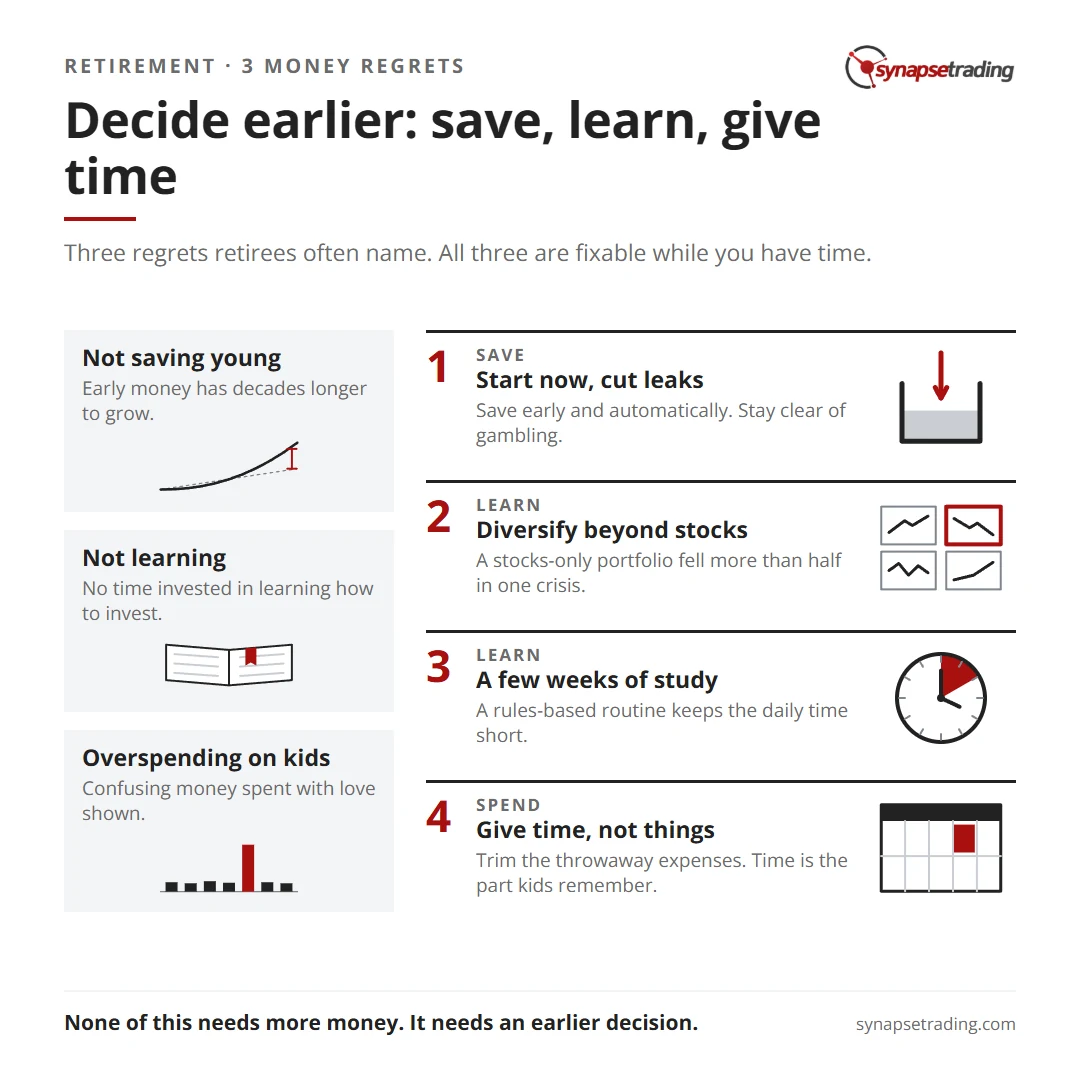
Three money regrets retirees often name: not saving money when they were young, not investing the time to learn how to invest, and overspending on their children. All three are fixable while you still have time. Start saving early so compounding works for you, because $10,000 saved in your twenties grows far more than the same $10,000 saved in your forties or fifties. Spend a few weeks learning to invest across more than just stocks, because a stocks-only portfolio fell more than half in 2008. And spend less on expensive things for your kids and more time with them, because that is the part they actually remember.
The good news: none of these require more money. They require earlier, simpler decisions. Here is each regret, why it happens, and the fix.
Regret #1: Not saving money when young
This is the most common regret, and it is universal. Seniors all over the world say the same thing: I should have started saving earlier.
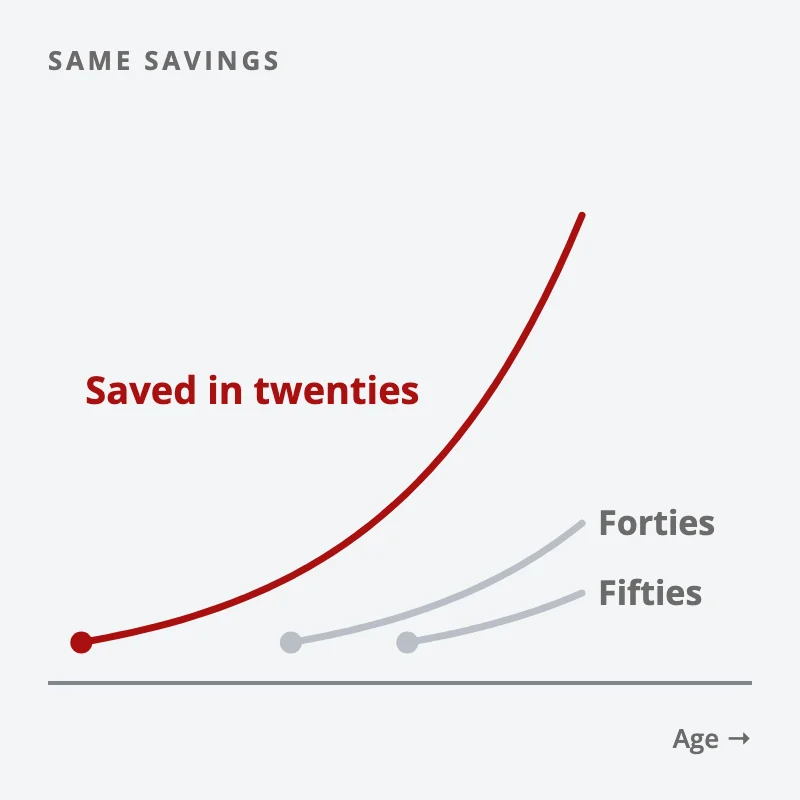
The reason is compounding. Saving $10,000 in your twenties adds up to a lot more than saving $10,000 in your forties or fifties, because the early money has decades longer to grow. The earlier you start, the more time does the work for you.
It also gets harder with age, not easier. Expenses pile up as you get older. Property, health spending, and raising a family take up most of your money. Saving gets a lot harder when the children are begging you for the latest mobile device for their birthdays.
Gambling and entertainment quietly eat away at your nest egg, so stay clear of them. And if you are reading this past your twenties, do not despair. It is never too late to start getting your money habits sorted out.
Regret #2: Not investing the time to learn
Back in the 1980s, investing was genuinely hard to learn without the internet. Today that excuse is gone. Kids these days build a website from scratch without supervision, so you can certainly find a way to learn something that pays you dividends in the long run.
Most people complain about not knowing what to invest in. That is a reasonable complaint. But here is the deeper problem underneath it.
The reason most people cannot invest money is that they do not even invest time to learn how to invest. Time is sacred. Use it wisely, and use it on what matters.
If your entire financial vocabulary is:
- buying blue-chip stocks for the long term
- mutual fund investments
- investment-linked insurance policies (insurance bundled with an investment fund)
then you are missing a large chunk of the pie. A good diversified portfolio holds much more than just stocks. Holding only stocks can be very risky. In the 2008 crisis, the S&P 500 fell about 57% from its 2007 peak. Multi-asset, multi-instrument investing (spreading money across stocks, bonds, forex, commodities, and more) is the norm now.
One more myth worth killing: people assume learning to trade or invest is hugely time-consuming. It is not. Like any skill, it takes practice at first, and a rules-based routine keeps the daily time short.
Here is the part the brochures skip. The tools are now nearly free. A screener will find a setup, a robo-advisor will rebalance a portfolio, an app will track everything. What none of them supply is the judgment to know which risk is worth taking and the discipline to sit out the rest. That judgment is the one piece you actually have to build yourself, and it is the first of the Five Edges that no tool can hold for you.
Regret #3: Spending too much on the children
Many parents look back on their years as young parents and say the same thing: we should have spent less. The bad outcomes are familiar. Spoilt children. Children who expect a lot but contribute little.
This is not about being stingy. It is about spending on the things that last instead of the things that get thrown away. Among the many unnecessary expenses, parents could do well to trim any of these:
- Extra-curricular lessons like ballet, music, or swimming, especially if the child is not enjoying them
- Tuition lessons, since the school system in Singapore is honestly quite robust
- Expensive pre-school education, because they will not remember it anyway
- Expensive holidays, which we do not remember a year later
- Toys that get thrown away three months later
- Expensive meals at fancy restaurants, because food is still food
- Overseas university education, when a local degree can be just as profitable for your child
- Expensive childcare services, when reasonably priced ones do the same job
- A domestic helper, when teaching the kids to take care of the house makes more sense
We sometimes put too high a premium on a university degree. Pay what is fair and reasonable. Do not spend half a million dollars on one.
And here is the real point. Many parents have money but very little time for their children. Ask any child and you will find they would much rather spend time with their parents than have an expensive holiday in Paris, Dubai, or Tokyo.
In hindsight you always know better. So take the advice of our seniors: spend on what really matters, which is your time. What use is all the cool stuff, the premium lessons, and the holidays, if we miss the one thing that truly counts?
The three regrets at a glance
| Regret | Why it happens | The fix | Start when |
|---|---|---|---|
| #1 Not saving young | Compounding is invisible early; expenses pile up with age | Save early and automatically; cut gambling and entertainment leaks | Today, at any age |
| #2 Not learning to invest | “I don’t know what to buy” plus the myth that it takes too much time | Spend a few weeks learning; diversify beyond stocks; then a few minutes a day | After a few weeks of study |
| #3 Overspending on kids | Confusing money spent with love shown | Trim the throwaway expenses; give time instead | Before the habits set in |
How to avoid all three at once
Notice the thread running through every regret. Each one is a trade of a small, early, slightly boring decision for a large, late, painful one. Saving early is boring. Spending two weeks learning to invest is boring. Choosing an evening at home over a flashy holiday is boring. The regret is what arrives when you skip the boring version.
So pick the version your future self will thank you for. Start the savings habit now. Put in the few weeks to learn investing properly, across more than one asset class. And spend on time with the people who matter, not on things they will forget. None of this needs more money. It needs an earlier decision.
FAQ
What is the most common financial regret of retirees in Singapore?
Not saving money when young. It is the single most common regret reported by seniors worldwide, because compounding rewards early savers and expenses only grow heavier with age.
Why does saving early matter so much?
Because of compounding. Saving $10,000 in your twenties grows into far more than the same $10,000 saved in your forties or fifties, since the early money has decades longer to compound.
Is investing only in stocks risky?
Yes. Holding only stocks can be very risky. In the 2008 crisis, the S&P 500 fell about 57% from its 2007 peak. A diversified, multi-asset portfolio spreads that risk.
Does learning to invest take a lot of time?
It takes practice. Like any skill it takes time to learn, and a rules-based routine keeps the daily time short.
How can I avoid these regrets if I am already past my twenties?
It is never too late. Start the savings habit now, spend a few weeks learning to invest beyond stocks, and redirect spending toward time with the people who matter.
The seniors who shared these regrets are not telling you to earn more. They are telling you to decide earlier. Which of the three regrets is the one you would most want to avoid? Let me know in the comments.
And if regret #2 is the one that stings, that is the most fixable of all. Start with the pillar: How to Start Investing and Trading in Singapore: A Beginner’s Guide.
Want the few-minutes-a-day version? Grab the free 15-Minute Swing Trading Starter Kit. It is the exact routine I use to scan once a day and trade any market in 15 minutes, which is the practical answer to regret #2.
About the author. Spencer Li is The 15-Minute Trader and the founder of Synapse Trading. He is a Certified Financial Technician (CFTe) with 15+ years of trading, run from 70+ countries. He holds a B.Acc and B.BM from SMU. Every trade he takes is public, dated, losses left in. He teaches rules-based swing trading in 15 minutes a day, one system for any market.
Education, not financial advice. Synapse Trading is not licensed by MAS to advise on investment products. Trading carries risk of loss; past performance is not indicative of future results.
Related
How to Start Investing and Trading in Singapore
Want the daily routine? Enter your email for the free 15-Minute Swing Trader's Checklist.
Free 5-page PDF, then occasional trading emails. Education only, not financial advice. Unsubscribe anytime. Kit stores your email in the US: see our privacy policy.
Want to learn the full method? The Trading Mastery Program teaches the 4 strategies I have traded since 2011. It suits beginners and experienced traders.
Rather follow the trades as they happen? Daily Trading Signals is our Telegram channel: my trade ideas with entry, stop and exit, and every trade is public.
Questions about this post? Ask in the free Telegram channel →
Educational content only, not personalised financial advice. Trading carries risk, including loss of capital. Past performance is not indicative of future results. Synapse Trading is not licensed or regulated by MAS.

