• Link to Facebook
  • Link to X
  • Link to Instagram
  • Link to Youtube
  • Link to LinkedIn
  • Link to Mail
Synapse Trading
  • Home
  • About
    • My Background
    • My Trading Journey
    • My Travel Log
    • Media & Interviews
  • Mentoring
    • Trading Mastery Program
    • Results & Testimonials
  • Signals
    • Telegram (Free to join!)
    • Daily Trading Signals
    • Daily Trading Signals (Results)
  • Resources
    • Free Trading Guides
    • Tools & Resources
    • Blog & Infographics
  • Contact
    • Contact Us
    • Partnership Opportunities
  • Click to open the search input field Click to open the search input field Search
  • Menu Menu
Spencer Li

What Products & Markets Should I Start Trading?

Tools & Resources
What Products Markets Should I Start Trading

There are many different financial markets and financial products that are available for you to choose from, which sometimes can be too overwhelming.

Personally, I have traded or invested in almost all of them over the years.

In this post, I will give a brief introduction to each market and product, followed by my best picks for beginners.

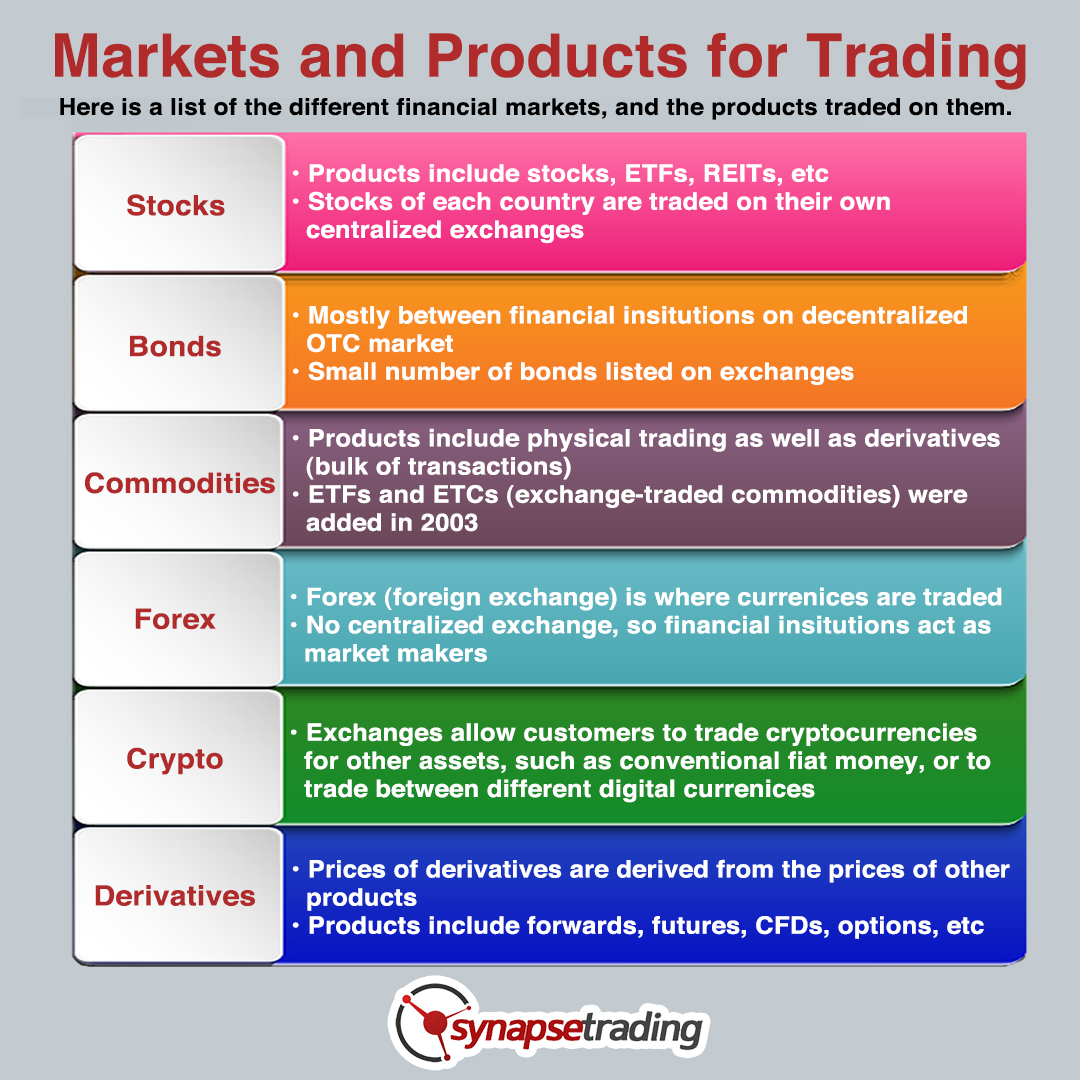
Market and Products for Trading infographic

Markets vs. Products

One major decision you have to make as a trader is to decide what markets and what financial products to trade, since there are many options available.

Do note the distinction between markets and products, as they are two very different things.

The market is where the transactions take place, while the products are what you will be buying and selling in the market.

Overview of Financial Markets

The major financial markets are those for stocks, bonds, commodities, forex, cryptocurrencies, and derivatives.

1. Stock Market

The stocks of each country are traded on their own centralised exchanges, so this means that prices should be the same across different brokers.

The stock exchange will also offer complementary products, such as ETFs (exchange-trade funds) and REITs (real estate investment trusts), which you can trade on the same exchange.

If you are an investor, stocks (or shares as some people call it), are basically ownership in a business/company, so when you buy a stock, you essentially own a small percentage of the company. So you will be hunting for the best businesses at good prices.

If you are a trader, you will be looking for stocks that are more actively traded, so there will be good liquidity and price movements for you to capture. Many traders prefer the US stock market, because it is the largest and has excellent liquidity and low transaction costs.

2. Bond Market

Bonds are loans that are made to businesses (corporate bonds) or to the government (government bonds), on which the lender is obliged to pay back the capital plus interest. As interest rates fluctuate, the prices of the bonds will also change.

Most of bond trading is done by financial institutions on the decentralised OTC (over the counter) market, with a small number of bonds like on exchanges.

Most retail participants buy bonds for investment or to provide stability to their portfolio, but not many people actually trade bonds actively, since price movements are small and hence large funds or large leverage is required.

3. Commodities Market

The commodities market includes metals (gold, silver, platinum), energy (crude oil, natural gas), food (sugar, coffee, cocoa), diamonds, etc.

Although it started out with physical trading, nowadays most transactions are based on financial derivatives.

These derivatives include forwards, futures, swaps, options, CFDs and in 2003, ETFs (exchange traded funds) and ETC (exchange traded commodities) were also added.

For retail traders, the most commonly traded derivative is probably CFDs, due it’s low starting capital requirements and low commissions.

4. Forex Market

Forex, or currencies, refers to the exchange rate between 2 different currencies. If you think that one currency (eg. EUR) is going to appreciate against another currency (eg. USD), you can buy a contract of EUR/USD, which is essentially the same as selling USD to buy EUR. This is no different from what you do when you go to the money changer before you embark on your vacation overseas, albeit in much larger quantities.

There is no centralised exchange for forex, so brokers and financial institutions tend to be market makers, meaning they take the opposite side of any trades that you wish to make. This also means that prices may vary slightly across different brokerages.

Forex is one of the most popular products for new traders, because the market has good liquidity, long trading hours, decent price movements, and low transaction costs even for very small accounts.

5. Crypto Market

Cryptocurrencies, or crypto for short, is a relatively new asset class which is meant to be a sort of global currency, but adoption is still not widespread, although it is growing steadily. From a market perspective, it is pretty much the same as foreign exchange, meaning you can trade it against normal currencies.

There are exchanges that allow you to trade between cryptocurrencies and fiat currencies, and other exchanges that allow you to trade between different cryptocurrencies. Some exchanges allow you to do both.

Due to its lower liquidity (besides Bitcoin, all other products do not have much volume) and quite often erratic price movements, this market is not that good for trading at the moment, although things might change in the future.

6. Derivatives Market

In addition to taking a direct position, there are also financial products that allow you to take an indirect position in the market. These products are pegged to prices of particular markets, and their prices are derived indirectly from these markets.

Hence, they are known as derivatives, and some examples include forward contracts, futures contracts, CFDs, options.

Forwards (or forward contracts) are agreements between a buyer and seller to trade an asset at a future date. The price of the asset is set when the contract is drawn up. Forward contracts have one settlement date—they all settle at the end of the contract.

Futures (or futures contracts) are similar to forward contracts, except that they are traded on an exchange and are settled on a daily basis until the end of the contract. Forward contracts are used primarily by hedgers who want to cut down the volatility of an asset’s price, while futures are preferred by speculators who bet on where the price will move.

CFDs (or contract for difference) are a way to profit from price movements without owning the underlying asset.

Options grant you the right, but not the obligation to buy or sell an underlying asset at a set price on or before a certain date.

These products are quite versatile, so you might have combinations like stock options, Oil CFDs, Gold forwards, bond futures, etc.

What is the Best Product to Trade?

While it might seem confusing because there are too many choices, my advice to new traders is to pick one market and master it before deciding to explore other markets.

Here are some characteristics of good products:

  • Has good liquidity so that you do not see erratic price spikes on the chart
  • Has decent price movement so that you can actually make money from the price movements
    • If you are intraday trading or swing trading, you do not want to pick a slow moving stock which only moves a few % each year
    • If you are swing trading, you also won’t want to trade a penny stock which can fluctuate 10-20% in a day
  • Low transaction costs, even for small accounts
  • Has freely available price data for charting
  • Has good coverage on news, blogs, etc, which will make learning easier

Most new traders will start off with the easiest products like forex, stocks, or CFDs.


thumbnail which are the best trading brokerages software etc for your trading

If you are wondering what brokerage, software & tools to use, also check out: “Best Tools & Resources for Your Trading & Investing”

0 Comments/by Spencer Li
https://synapsetrading.com/wp-content/uploads/2021/06/What-Products-Markets-Should-I-Start-Trading.png 720 1280 Spencer Li https://synapsetrading.com/wp-content/uploads/2019/10/logo.jpg Spencer Li2021-06-18 07:03:422022-12-21 02:50:52What Products & Markets Should I Start Trading?
Spencer Li

How Much Capital Do I Need to Start Trading?

Beginner's Guide
how much capital do you need to start trading


For new traders looking to start out their journey, what is the minimum amount of capital you will need to start trading?

What is the optimal amount of capital you should use to ensure that you take your trading seriously?


how much capital to start trading


The tricky thing about this question is that it varies from person to person, there is no one correct number.

If you ask a multi-millionaire, he will think that starting with $10,000 is too little, but if you asking a student, he will say that $10,000 is his life savings.

So obviously the amount of starting capital will depend on your stage of life and your current net worth.

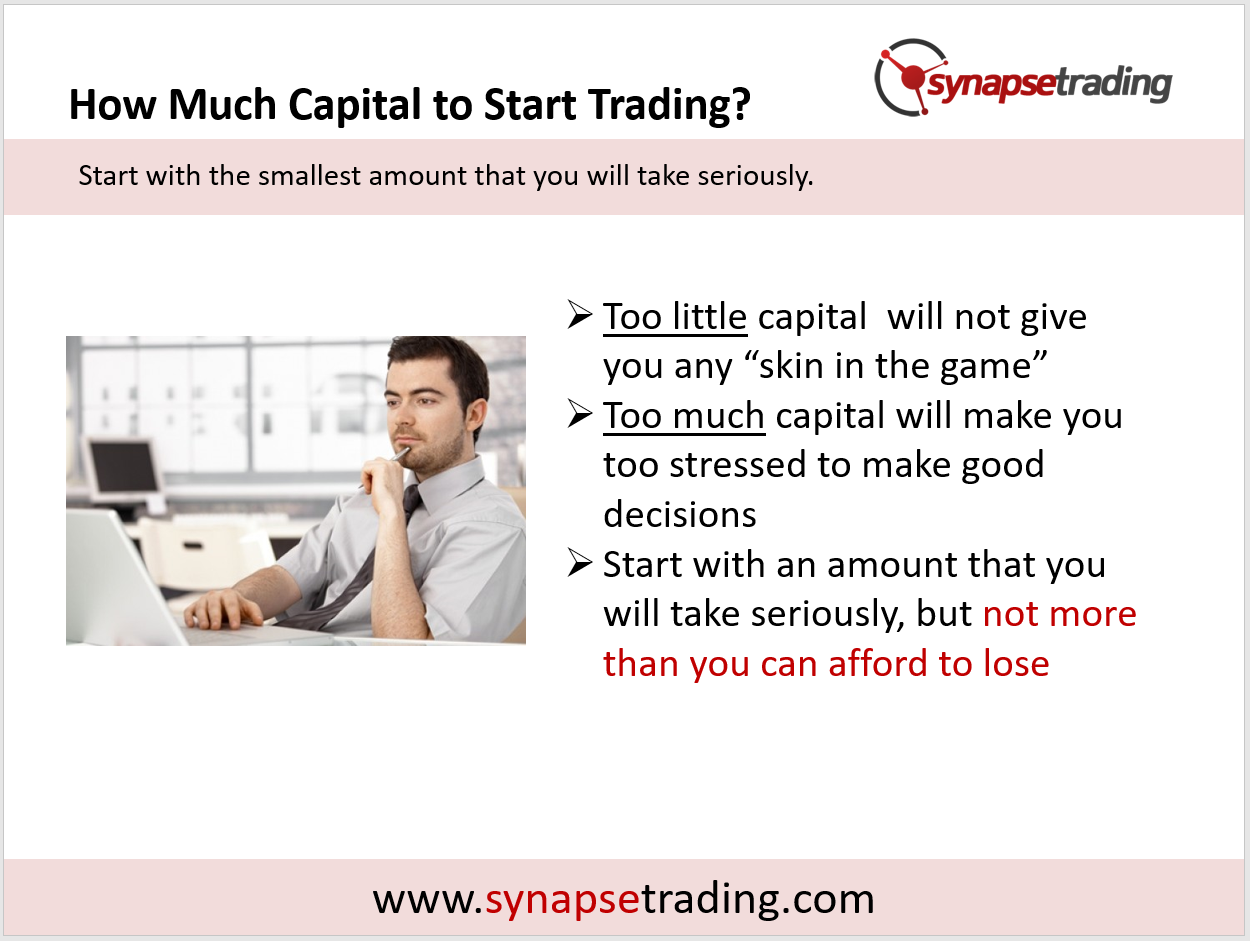
If you have played any game of chance such as poker, you will understand the concept of “skin in the game”.

If the bets are too tiny, no one will take the game seriously, because there is no real risk involved.

Similar to trading, if you capital is too small, and every trade gives you a profit or loss of less than 10 dollars, then you probably won’t take your trading decisions very seriously.

Hence, there needs to be a certain amount of money involved to make you take your trades seriously.

On the other hand, if the bets are too big, for example each bet is a few thousand dollars, you would most likely be too stressed about losing, and not be able to make rational decisions.

Similar to trading, if you start panicking the moment you place a trade, then most likely your trading size is too big.

So we need to tread a fine line to introduce the “right amount” of fear, so that you will take the decisions seriously, but not too much fear that it cripples you.

In conclusion, the answer to this question is quite simple – you should find an amount which is not so large that you cannot afford to lose, yet is not so small that you do not have any “skin in the game”.


thumbnail beginner guide to trading and TA

If you would like to learn how to get started in trading, also check out: “The Beginner’s Guide to Trading & Technical Analysis”

0 Comments/by Spencer Li
https://synapsetrading.com/wp-content/uploads/2021/06/how-much-capital-do-you-need-to-start-trading.jpg 720 1280 Spencer Li https://synapsetrading.com/wp-content/uploads/2019/10/logo.jpg Spencer Li2021-06-18 06:37:512022-12-21 02:52:37How Much Capital Do I Need to Start Trading?
Spencer Li

Should I Start with Trading or Investing?

Beginner's Guide
should you start with investing or trading


The first problem many people face is not knowing whether to use their money for investing or trading.

Since they usually start off with a fixed sum of money, they have to decide on one or the other to start off.


Investing vs Trading

Many people will small sums of money then make the common mistake of “playing it safe”, perhaps after hearing stories of Warren Buffett or about how “risky” trading is, and then decide to just put their money in things like bonds or ETFs, with a low return of 1-5% a year.

The problem with this approach is that unless you have a large amount of money to start with, you will take a whole lifetime just to build a decent-sized portfolio.

For example, if you consistently grow your portfolio at a compounded rate of 3% every year with no losses, it would take you 24 years just to double your portfolio.

And what happens if you get caught in a market crash?

So if you are starting with a small sum of money, it definitely makes more sense to focus on trading at the start, which can give you 3-5% monthly cashflow, which you can then use to grow your long-term investment portfolio faster.


trading income cash generator infographic

As a simple rule, I would suggest for you to focus on trading until you have at least $100,000 capital before you start looking to do investing.

And once you have hit that milestone, you can continue to do both trading and investing, because trading can provide monthly cashflow, while investing can provide long-term passive income, so they both complement each other.


thumbnail beginner guide to trading and TA

If you would like to learn how to get started in trading, also check out: “The Beginner’s Guide to Trading & Technical Analysis”

0 Comments/by Spencer Li
https://synapsetrading.com/wp-content/uploads/2021/06/should-you-start-with-investing-or-trading.jpg 720 1280 Spencer Li https://synapsetrading.com/wp-content/uploads/2019/10/logo.jpg Spencer Li2021-06-18 06:31:462022-12-21 02:54:12Should I Start with Trading or Investing?
Spencer Li

How to Start Trading for Beginners

Beginner's Guide
How to Start Trading for Beginners 1

How to Start Trading as a Beginner: A Simple, Honest Guide

Last updated: 14 June 2026 · By Spencer Li, CFTe


To start trading as a beginner, learn to do one thing well: capture a price move. You buy something, it goes up, you sell higher, and the difference is your profit. That is the whole game in one sentence. Everything else is detail. The detail that actually matters is this: a single trade proves nothing. You only know you can trade once you have placed 50 to 100 of them and still come out ahead, because that is the sample size that separates a real edge from a lucky streak. So the honest path for a beginner is not “find the best stock.” It is to build three things at once: an edge (your analysis), the money management to exploit that edge across many trades, and the mindset to keep doing it without your emotions taking over. Do that, and trading becomes a skill you can repeat. Skip it, and you are just gambling with extra steps.

Here is what each of those three pieces is, and how to start building them.

What does trading actually mean?

Every day, the price of every financial product moves up and down. You hear it everywhere: a stock rallies, oil crashes, one currency strengthens against another. Prices are always in motion.

At its core, learning how to trade is simply being able to make a profit from capturing these price moves.

If you buy a stock and it moves up, and you sell it at a higher price, you have captured that price move and made a profit. Do that multiple times, successfully and repeatedly, and you can make a full-time living from it.

Of course, not every trade will be profitable. Sometimes you get it wrong. That is normal, and it is built into the job. The question is never “was this one trade right?” The question is whether the whole set of trades makes money.

How do I know if my trading actually works?

You count. After 50 to 100 trades, if you are consistently making money, then you might have a winning trading system. Before that, you simply do not have enough data to know.

This is the part most beginners skip, and it is the most important part. One winning trade tells you nothing. Five winners in a row tells you almost nothing. A run of luck looks exactly like skill until the sample gets big enough to tell them apart. Hence, the goal early on is not a fat profit. It is a large enough number of trades, taken the same disciplined way each time, to find out whether your method has an edge at all.

Think of it the way a casino thinks. If you have ever been to one, you know that over the long run you will lose money, because the odds are against you. The casino’s edge on any single bet is tiny. But over a large number of transactions, that tiny edge adds up to huge, reliable profits.

Trading works the same way, just flipped to your side of the table. Your job is to become the house, not the gambler.

The three things every beginner has to build

If you can find an edge through your analysis, exploit it over a large number of trades through money management, and do it consistently without letting your emotions get in the way through mindset, then you have a real chance of becoming successful at trading.

Those three words (analysis, money management, mindset) are the whole curriculum. Here is how they line up against the way most beginners actually behave when they start.

The three pillarsWhat it gives youWhat beginners do instead
Analysis (your edge)A repeatable reason a trade should work, slightly better than a coin flipBuy on a tip, a headline, or a gut feeling
Money management (the math)Survival, so one bad trade cannot wipe out twenty good onesBet big to “make it back” after a loss
Mindset (consistency)The discipline to take the same setup the same way, 100 timesChange the rules mid-trade when emotions spike

Read that right column honestly. Most people who lose money in the markets are not losing because their analysis was wrong. They are losing because they sized too big or broke their own rules under pressure. The edge was never the bottleneck. The execution was.

1. Analysis: find a small, repeatable edge

An edge does not have to be dramatic. The casino’s edge is small. Yours can be too. You need a method (technical analysis is where most beginners start, because price and charts are free and visible to everyone) that puts the odds slightly in your favour. Not 50-50. Just better than the coin flip, repeated enough times.

2. Money management: protect the downside first

This is the boring pillar, and it is the one that keeps you in the game. The point of money management is simple: make sure no single trade can hurt you badly enough to end the experiment. You want to take 100 trades. You cannot do that if trade number 8 takes out half your account. Size each position so a loss is survivable, every time.

3. Mindset: be the same trader on trade 50 as on trade 1

A system only works if you actually follow it. The hard part of trading is rarely the chart. It is sitting through a losing streak without abandoning a method that still has an edge, or resisting the urge to double up when you feel certain. Consistency is the skill. The market pays the trader who does the same correct thing over and over, not the one with the most exciting ideas.

Where the human edge comes in

A platform will show you the price. A scanner will flag a setup in a second. None of that is the hard part anymore, and an AI can do it for free. What no tool will do for you is hold your size down after two losses, or keep you taking the same boring setup for the hundredth time when you are itching to change it. The analysis is the cheap part. The judgment, the discipline, and the patience to run an edge across 100 trades without sabotaging it, that is the part worth learning. It is the first of the Five Edges a beginner has to build, and the one a machine cannot build for you.

FAQ

How much money do I need to start trading?
Less than you think, but the amount matters less than your method. Start with an amount you can afford to lose entirely while you take your first 50 to 100 trades and find out whether your system has an edge. The early goal is data and discipline, not profit.

Can a complete beginner learn to trade?
Yes. Trading is a skill, not a talent. The mechanics (buy, sell, capture the move) are simple. What takes time is building the three pillars: analysis for an edge, money management to survive, and the mindset to stay consistent across many trades.

Is trading just gambling?
It can be, if you bet on single trades with no method. The difference is the edge. A gambler in a casino faces odds stacked against them. A trader with a tested edge and proper money management is trying to be the house, profiting from a small advantage repeated over a large number of trades.

How many trades does it take to know if my system works?
Roughly 50 to 100. One trade, or even five winners in a row, proves nothing, because a lucky streak looks identical to skill until the sample is large enough to tell them apart. Take enough trades the same disciplined way to see the real pattern.

What should I learn first as a beginner trader?
Start with the basics of technical analysis (reading price and charts), then learn position sizing before you risk real money. Mindset is built by actually trading a small, consistent size. Analysis gives you the edge, money management keeps you in the game, mindset lets you repeat it.


So the path is clearer than it looks. Capture price moves, prove your method over enough trades to trust it, and build the three pillars while you do. Which of the three (analysis, money management, or mindset) do you think is your weakest right now? That is usually the one worth working on first.

If you want the full walkthrough, read the pillar: The Beginner’s Guide to Trading and Technical Analysis.

Want a system you can actually follow? Grab the free 15-Minute Swing Trading Starter Kit. It is the exact routine I use to scan once a day and trade any market in 15 minutes, sized so no single trade can hurt you.


About the author. Spencer Li is the founder of Synapse Trading and a Certified Financial Technician (CFTe) with 15 years of trading across stocks, forex, crypto, commodities, and bonds. His trade log is public, 404 trades, losses left in. He teaches low-risk swing trading in 15 minutes a day, one system for any market.

Education, not financial advice. Synapse Trading is not licensed by MAS to advise on investment products. Trading carries risk of loss; past performance is not indicative of future results.


Related

The Beginner’s Guide to Trading and Technical Analysis (pillar) · What is technical analysis? · Risk management and position sizing

0 Comments/by Spencer Li
https://synapsetrading.com/wp-content/uploads/2021/06/How-to-Start-Trading-for-Beginners-1.png 720 1280 Spencer Li https://synapsetrading.com/wp-content/uploads/2019/10/logo.jpg Spencer Li2021-06-18 06:29:132026-07-06 03:04:32How to Start Trading for Beginners
Spencer Li

First Batch of Students from Our Beginner’s Course on Tech Stocks & Crypto!

News & Events
skillsfuture feedback 140621 2

Last weekend, we conducted our first online workshop (SkillsFuture credit-claimable) on the basics of tech stocks and crypto, and it was a very fruitful session.

Thanks for the support! ?

During the session, we learn how to combine technicals and fundamentals to find undervalued tech stocks.

These are exclusive methods used by investment banks, hedge funds and industry insiders, so you won’t find them anywhere online or in books.

Here is some of the feedback and learning points from participants, after our hands-on market analysis session to find trading opportunities in the market.

At only $500 for 2 days of training, it is really a steal! (The value you get is equivalent to those $3000-$4000 courses you find out there, which only cover textbook knowledge.)

If you are keen to learn more using your SkillsFuture credits, you can check out our courses:

  • Beginner’s Course on Trading & Investing
  • Beginner’s Course on Tech Stocks & Crypto

P.S. To ensure optimal learning, we have capped the maximum class size.

Register early to avoid disappointment!

Tech Stocks & Crypto

Tech Stocks & Crypto 2

0 Comments/by Spencer Li
https://synapsetrading.com/wp-content/uploads/2021/06/skillsfuture-feedback-140621-2.png 998 512 Spencer Li https://synapsetrading.com/wp-content/uploads/2019/10/logo.jpg Spencer Li2021-06-15 04:20:492022-03-08 14:58:45First Batch of Students from Our Beginner’s Course on Tech Stocks & Crypto!
Page 83 of 184«‹8182838485›»

Free Trading Guides

Free Trading Guides

Blog Categories

  • Beginner's Guide
  • Blockchain & Crypto
  • Book Summaries
  • Candlestick Patterns
  • Economics & News Trading
  • Investing & Portfolio Management
  • Living Your Best Life
  • Market Analysis
  • News & Events
  • Price Chart Patterns
  • Promotions
  • Risk & Money Management
  • Stock Trading
  • Testimonials
  • Tools & Resources
  • Trading Psychology
  • Trading Strategies
  • Trading Tips
  • Travel & Lifestyle

Free Trading Guides

Free Trading Guides

Contact Us

Synapse Trading Pte Ltd
Registration No. 201316168H

Whatsapp: +65-8897-1204
Telegram: @iamrecneps
Email: info@synapsetrading.com

Links

Disclaimer
Privacy policy
Terms & Conditions
Contact us
Partnerships

© 2012-2024 Synapse Trading | All rights reserved | - powered by Enfold WordPress Theme
  • Link to Facebook
  • Link to X
  • Link to Instagram
  • Link to Youtube
  • Link to LinkedIn
  • Link to Mail
Scroll to top Scroll to top Scroll to top