• Link to Facebook
  • Link to X
  • Link to Instagram
  • Link to Youtube
  • Link to LinkedIn
  • Link to Mail
Synapse Trading
  • Home
  • About
    • My Background
    • My Trading Journey
    • My Travel Log
    • Media & Interviews
  • Mentoring
    • Trading Mastery Program
    • Results & Testimonials
  • Signals
    • Telegram (Free to join!)
    • Daily Trading Signals
    • Daily Trading Signals (Results)
  • Resources
    • Free Trading Guides
    • Tools & Resources
    • Blog & Infographics
  • Contact
    • Contact Us
    • Partnership Opportunities
  • Click to open the search input field Click to open the search input field Search
  • Menu Menu
Spencer Li

Interactive Brokers: One of the Lowest Margin Fees

Promotions, Tools & Resources

Which Broker Has the Lowest Margin Fees? (And How to Actually Minimise Trading Costs)

Last updated: 3 July 2026 · By Spencer Li, CFTe


For most active traders, Interactive Brokers (IBKR) has the lowest margin fees of the major online brokers, a finding that independent reviewer StockBrokers.com has reported in its broker comparisons. Margin fees are the interest your broker charges when you borrow money to trade (trading “on margin”), and they are usually the single most expensive cost a frequent trader ignores. But the cheapest margin rate is not the whole answer. The right broker for you depends on four things together: margin fees, the commission structure (flat fee per trade versus a percentage of trade value), the account minimum to get started, and the range of markets you can actually trade. Pick the broker that wins on the factors you use most, not just the one with the lowest headline number.

Here is how each of those costs works, and how to keep them from quietly eating your returns.

What are margin fees, and why do they matter?

Margin fees are interest. When you trade on margin, you are borrowing money from your broker to take a larger position than your cash alone allows, and the broker charges you interest on that loan for as long as you hold it.

That cost is easy to underestimate because it is not a one-off. A commission is charged once when you enter and once when you exit. Margin interest accrues every day you hold the borrowed position. Hold a leveraged trade for a few weeks, trade frequently, and those daily charges add up far faster than the entry commission you were worried about.

This is why margin fees deserve as much attention as commissions, often more. If you use leverage at all, the broker’s margin rate is a recurring tax on every position you hold.

So which broker has the lowest margin fees?

Interactive Brokers. Independent broker reviewer StockBrokers.com has reported IBKR as having the lowest margin fees among major online brokers, and that has been a consistent advantage of the platform for cost-conscious traders.

Do note that, margin rates move with benchmark interest rates and vary by the size of your balance and your region, so always check the broker’s current published rate before you rely on it. The point is not a fixed number. The point is that if you trade on margin, the gap between the cheapest and most expensive broker compounds on every position you hold.

The four costs to weigh before you open an account

A low margin rate is one factor, not the only one. Here is how the main cost and access factors compare, and who each one matters most to.

FactorWhat it isWatch out forMatters most if you
Margin feesDaily interest on money you borrow to tradeQuoted as an annual rate but charged daily; rises with benchmark ratesUse leverage or hold positions for days or weeks
CommissionsThe charge to place a tradeFlat fee per trade versus a percentage of trade valueTrade often (flat fees win) or trade large sizes (percentages can hurt)
Account minimumThe balance needed to open or keep the accountSome brokers require a minimum; others have noneAre starting out with a smaller account
Investment optionsThe markets you can trade (stocks, bonds, funds, forex, crypto)Some are broad; some specialise in one asset classWant to trade more than one market from one account

Notice the pattern. The “best” broker is the one that is cheapest on the factor you actually use. A flat per-trade commission is a gift if you trade often and a penalty almost never. A percentage-of-value commission can be fine on small trades and painful on large ones. There is no universal winner, only a winner for your style.

Commissions: flat fee or percentage?

Some brokers charge a flat fee per trade. Others charge a percentage of the trade’s value. Which is cheaper depends entirely on how you trade.

If you place many trades, a flat fee per trade is usually the better deal, because the cost does not scale with size. If you place a few large trades, a percentage structure can quietly cost more than you expect. Personally, I would map your own typical trade size and frequency against both structures before you commit, rather than trusting the marketing headline.

Account minimums: lower is better when you are starting

Some brokers require a minimum balance to open an account. Others have no minimum at all. If you are just starting out, a low or no minimum is a real advantage, because it lets you begin small, learn the platform, and scale up as your results justify it, without locking up cash you are not ready to risk.

Investment options: trade more than one market from one place

Some brokers offer a wide range of markets, stocks, bonds, mutual funds, forex, and more. Others specialise in one asset class, such as crypto. If you ever expect to trade more than one market, a broad broker saves you the friction of opening and funding a second account later. One platform, one login, one place your money lives.

Customer service: it only matters when something breaks

Customer service feels minor until the day it isn’t. When an order behaves strangely or you cannot access your account, responsive support, ideally available around the clock, is the difference between a five-minute fix and a stressful afternoon. It is worth a quick check of a broker’s support reputation before you fund the account.

The part the comparison table cannot do for you

A comparison site will tell you which broker has the lowest margin rate in a second. That part is now free. What it will not tell you is whether you should be using margin at all on a given trade, how large to size the position so the leverage does not blow up your account, or when a “cheap” broker is the wrong fit for how you actually trade. The cost table is the easy part. Matching it to your own behaviour, and having the discipline not to let cheap leverage tempt you into oversized positions, is the judgment. That is the human edge no broker comparison can supply for you.

FAQ

Which broker has the lowest margin fees?
Interactive Brokers (IBKR) has been reported by independent reviewer StockBrokers.com as having the lowest margin fees among major online brokers. Margin rates change with benchmark interest rates, so check the broker’s current published rate before relying on it.

What are margin fees?
Margin fees are the interest a broker charges when you borrow money to trade a larger position than your cash allows. The interest accrues daily for as long as you hold the borrowed position.

Are flat-fee or percentage commissions cheaper?
It depends on your trading. A flat fee per trade is usually cheaper if you trade frequently, because the cost does not scale with trade size. A percentage of trade value can cost more on large trades. Match both structures against your own typical trade size and frequency.

Do I need a minimum balance to start trading?
Some brokers require a minimum balance to open an account; others have no minimum. If you are starting out, a low or no minimum lets you begin small and scale up as your results justify it.

Besides fees, what should I look for in an online broker?
Beyond margin fees and commissions, weigh the account minimum, the range of markets you can trade (stocks, bonds, funds, forex, crypto), and the quality and availability of customer support.


Once you have a low-cost broker set up, the next question is what to do with it. If you want the full beginner path, start with the pillar guide: How to Start Trading: A Beginner’s Guide.

Want a simple system to use that account with? Grab the free 15-Minute Swing Trading Starter Kit. It’s the exact routine I use to scan once a day and trade any market in 15 minutes.


About the author. Spencer Li is the founder of Synapse Trading and a Certified Financial Technician (CFTe) with 15 years of trading across stocks, forex, crypto, commodities, and bonds. His trade log is public, 404 trades, losses left in. He teaches low-risk swing trading in 15 minutes a day, one system for any market.

Education, not financial advice. Synapse Trading is not licensed by MAS to advise on investment products. Trading carries risk of loss; past performance is not indicative of future results.


Related

How to Start Trading: A Beginner’s Guide (pillar) · How to Open an Interactive Brokers Account · Best Online Brokers Compared · What Is Margin Trading?

0 Comments/by Spencer Li
https://synapsetrading.com/wp-content/uploads/2019/10/logo.jpg 0 0 Spencer Li https://synapsetrading.com/wp-content/uploads/2019/10/logo.jpg Spencer Li2023-05-06 21:57:202026-07-06 02:43:32Interactive Brokers: One of the Lowest Margin Fees
Spencer Li

Interactive Brokers: Earn Up to 4.33% on Your Uninvested Cash Holdings

Promotions, Tools & Resources

Does Interactive Brokers Pay Interest on Cash? (IBKR Cash Interest Explained)

Last updated: 14 June 2026 · By Spencer Li, CFTe


Yes, Interactive Brokers (IBKR) pays interest on the spare cash sitting in your account, but only on cash that has settled and stayed put for a while, and only above a minimum balance. Accounts holding more than USD 100,000 in long-settled cash earn the full posted interest rate, and smaller accounts earn a rate proportional to their size, so the more idle cash you hold, the closer you get to the full rate. Interest accrues daily and IBKR pays it once a month, on the third business day of the following month. It is automatic. You do not subscribe, click anything, or move your cash into a separate product to receive it. The one thing worth knowing up front: a few currencies are treated differently, and cash held in JPY or RUB can actually earn a negative rate, while some other currencies earn 0%.

So your money does not sit idle between trades. Here is exactly how the interest works, who qualifies for the full rate, and the currency traps to watch.

How does IBKR cash interest work?

IBKR pays interest on “long-settled” cash, which means cash that has cleared and been sitting in your account, not money you deposited yesterday or freed up from a trade that has not settled yet. The idea is simple. While your cash waits between trades, IBKR pays you a yield on it rather than letting it earn nothing.

Two numbers shape what you actually receive:

  • Your balance. Above USD 100,000 of long-settled cash, you earn the full posted rate. Below that, you earn a rate proportional to your balance, so a smaller account earns a smaller slice of the full rate.
  • The posted rate itself. This is set by IBKR and moves with the market, so the headline figure today will not be the figure next year. Always check the live rate on IBKR’s own site rather than any number you read in a blog post, including this one.

Interest accrues daily and is posted monthly, on the third business day of the following month. So the interest you earn across, say, June shows up in your account in early July.

Who qualifies for the full interest rate?

Anyone can earn interest, but the full posted rate kicks in at USD 100,000 of long-settled cash (or the equivalent in another currency). Below that line, you still earn, just at a proportional rate.

Here is the tiered picture in one view.

Long-settled cash balanceWhat you earnNotes
Above USD 100,000Full posted interest rateThe rate IBKR publishes, set by the market
Below USD 100,000A rate proportional to your balanceSmaller balance, smaller slice of the full rate
Held in JPY or RUBCan be a negative rateYou may pay rather than earn on these
Certain other currencies0%No interest credited

Do note that these are policy thresholds IBKR sets, and a broker can change its own policy. Treat the structure as the durable part and the exact rate as the moving part.

What is the auto-swap program?

There is a second, more advanced layer for larger accounts. If you hold both large long and large short cash positions across different currencies, IBKR offers an auto-swap program. You authorize IBKR to execute the forex transactions that net those positions against each other, which improves your overall interest benefit and lowers your interest cost.

This one is not for most retail traders. The auto-swap program is only open to qualifying investors with cash balances of at least USD 10 million or equivalent, or to those who qualify as an Eligible Contract Participant (ECP, a US regulatory category for large or sophisticated market participants). If you are reading this to figure out the interest on a few thousand dollars of idle cash, this layer simply does not apply to you, and that is fine.

The currency trap to watch

Most people assume “interest on cash” can only ever be a good thing. Not always. Cash held in JPY or RUB may receive a negative rate, which means you can be charged rather than paid for holding it. Other currencies may earn 0%.

This matters more than it sounds. If you trade globally through IBKR, your cash can end up parked in a currency you did not consciously choose, simply as the by-product of your last few trades. Personally, I keep an eye on which currency my idle cash is actually sitting in, because the interest treatment follows the currency, not your intentions.

Cash interest vs parking cash in T-Bills

Earning interest on idle cash is the passive, do-nothing option. The active alternative, if you want your spare cash working harder, is to park it in short-dated US Treasury Bills (T-Bills) inside the same IBKR account. T-Bills behave almost like cash because they are so short-dated, but they let you lock in a known yield to maturity rather than a floating cash rate. I walk through the exact steps in how to buy US T-Bills on Interactive Brokers.

Which one is “better” is not really the question. The cash rate is effortless and floating. The T-Bill is a small, deliberate action that fixes your yield. A scanner can tell you both rates in a second. It will not tell you whether your trading plan needs that cash liquid next week, which is the judgment call that decides between them. That judgment, deciding when idle cash should stay liquid and when it should be put to work, is the part no tool trades for you.

Tips from the trading desk

  • The interest is automatic. You do not need to enrol, so there is nothing to set up beyond holding cash in the account.
  • Watch the currency your idle cash sits in, not just the amount. JPY and RUB can turn the interest negative.
  • Remember the settlement delay. Only long-settled cash earns, so freshly deposited or just-freed cash does not start earning immediately.
  • The rate moves. Check IBKR’s live figure rather than trusting any quoted number, including the ones above.

FAQ

Does Interactive Brokers pay interest on uninvested cash?
Yes. IBKR pays interest on long-settled cash (cash that has cleared and been sitting in the account). Balances above USD 100,000 earn the full posted rate, and smaller balances earn a rate proportional to their size.

How much do you need in IBKR to earn the full interest rate?
You need more than USD 100,000 of long-settled cash, or the equivalent in another currency, to earn the full posted rate. Below that threshold you still earn interest, just at a proportional rate.

When does IBKR pay the cash interest?
Interest accrues daily and is paid out monthly, on the third business day of the following month. So a month’s interest appears in your account early in the next month.

Can IBKR cash interest be negative?
Yes, for some currencies. Cash held in JPY or RUB may receive a negative rate, meaning you are charged rather than paid, and some other currencies earn 0%.

What is the IBKR auto-swap program?
It is an advanced program for large accounts. You authorize IBKR to execute forex transactions that net your long and short cash positions to improve your overall interest, but it is only available to qualifying investors with at least USD 10 million in cash, or those who qualify as an Eligible Contract Participant (ECP).


That is the whole picture on IBKR cash interest. If you have not opened the account yet, start with the pillar: Interactive Brokers (IBKR) for Beginners: A Complete Guide.

Want a trading routine that fits around a day job? Grab the free 15-Minute Swing Trading Starter Kit. It is the exact once-a-day process I use to scan and trade any market in 15 minutes.


About the author. Spencer Li is the founder of Synapse Trading and a Certified Financial Technician (CFTe) with 15 years of trading across stocks, forex, crypto, commodities, and bonds. His trade log is public, 404 trades, losses left in. He teaches low-risk swing trading in 15 minutes a day, one system for any market.

Education, not financial advice. Synapse Trading is not licensed by MAS to advise on investment products. Trading carries risk of loss; past performance is not indicative of future results.


Related

Interactive Brokers for Beginners (pillar) · How to buy US T-Bills on IBKR · Deposit and withdraw on Interactive Brokers · Open and set up an Interactive Brokers account

0 Comments/by Spencer Li
https://synapsetrading.com/wp-content/uploads/2019/10/logo.jpg 0 0 Spencer Li https://synapsetrading.com/wp-content/uploads/2019/10/logo.jpg Spencer Li2023-05-06 21:54:442026-07-06 01:59:36Interactive Brokers: Earn Up to 4.33% on Your Uninvested Cash Holdings
Spencer Li

Weekly Market Wrap: FOMC & NFP This Week!

Market Analysis
image first republic and recession 1

For our “Daily Trading Signals”, we have now also included a “Weekly Market Report”, where we provide a weekly deep-dive on the market, including fundamentals, technicals, economics, and portfolio management:

Click here for last week’s market report (24 April 2023)
Click here to subscribe for the latest market report (31 April 2023)
Click here to see the archives of all our past market reports

We cover 3 main markets with a total of 200+ counters, so we will never run out of trading opportunities:

  • Forex, CFDs, commodities, bonds
  • US stocks, ETFs, global stock indices
  • Cryptocurrencies, crypto indices

By covering a broad range of markets, we can focus our attention (and capital) on whichever market currently gives the best returns.

Subscribe for real-time alerts and weekly reports:
👉🏻 https://synapsetrading.com/daily-trading-signals

image first republic and recession 1

Market Recap & Upcoming Week

Last week, the potential of generative AI technology to boost revenues for tech giants like Amazon, Microsoft, and Alphabet created a buzz in the market. Despite the growth slowdown in their cloud-computing services, shares of these companies have outperformed the S&P 500 and Nasdaq Composite. Microsoft’s plans to adopt OpenAI’s ChatGPT technology, Alphabet’s share increase, and Amazon’s AI plans announcement contributed to their stock performance.

On the other hand, Moody’s Investors Service downgraded 11 regional banks, highlighting the increased instability in the banking sector due to higher interest rates and recent bank failures. This exposed weaknesses among regional banks and raised concerns over the commercial real estate market.

In the stock market, S&P 500’s trading at 18 times its 12-month forward P/E estimates has led institutions to reduce exposure to economically-sensitive sectors in anticipation of a potential U.S. recession. Insider buying in the financial sector signals optimism, but analysts urge caution as other factors can influence stock performance. As the first quarter US earnings season unfolds with mixed results, hedge funds have increased their net short position in S&P 500 index futures, showing skepticism about Wall Street’s recovery. However, some analysts argue that equities still offer better returns than bonds and have the potential for earnings growth.

This week, as earnings season marches on, investors will keep a close eye on reports from major companies such as Pfizer, Starbucks, Uber Technologies, AMD, Qualcomm, Apple, Royal Dutch Shell, BP, and ConocoPhillips. Additionally, Berkshire Hathaway’s annual shareholders’ meeting in Omaha, Nebraska, will draw attention to Warren Buffett’s insights and investment strategies.

In terms of economic indicators, updates on the labor market will come in the form of the Job Openings and Labor Turnover Survey (JOLTS), ADP’s National Employment Report, and the April nonfarm payrolls report.

In addition, central to financial discussions this week will be the Federal Reserve’s two-day Federal Open Market Committee (FOMC) meeting, commencing on Tuesday. Market participants will be eager to learn the outcome of Wednesday’s interest rate decision, which is anticipated to be the final rate hike in the current tightening cycle. As these events unfold, investors will be looking for hints on how companies and the economy will navigate the ongoing challenges posed by inflation, interest rates, and potential slowdowns in growth.


Daily Trading Signals (Highlights)

AUDCHF 280423

AUDCHF – Following up, it has hit the first TP with 170+ pips profit! 💰🔥💪🏻

Since price action is still bearish, can consider closing half and letting the other half trail.


EURAUD 280423

EURAUD – Our TP for this has hit with 630+ pips total profit. Congrats to those who took this trade! 💰🔥💪🏻

Price momentum is still strong, so if you want to leave a small position to run you can do so as well.


Trading Signals GBPCAD 250423

GBPCAD – Prices resuming upward move, let’s see how far it can go!


Trading Signals GPBUSD 280423

GPBUSD – Following up, prices are starting to head up after consolidating for the past month or so.


Trading Signals US30 260423

Dow Jones Index (US30) – Good low risk high reward shorting opportunity near the top of the price channel.


Trading Signals WTICOUSD 280423

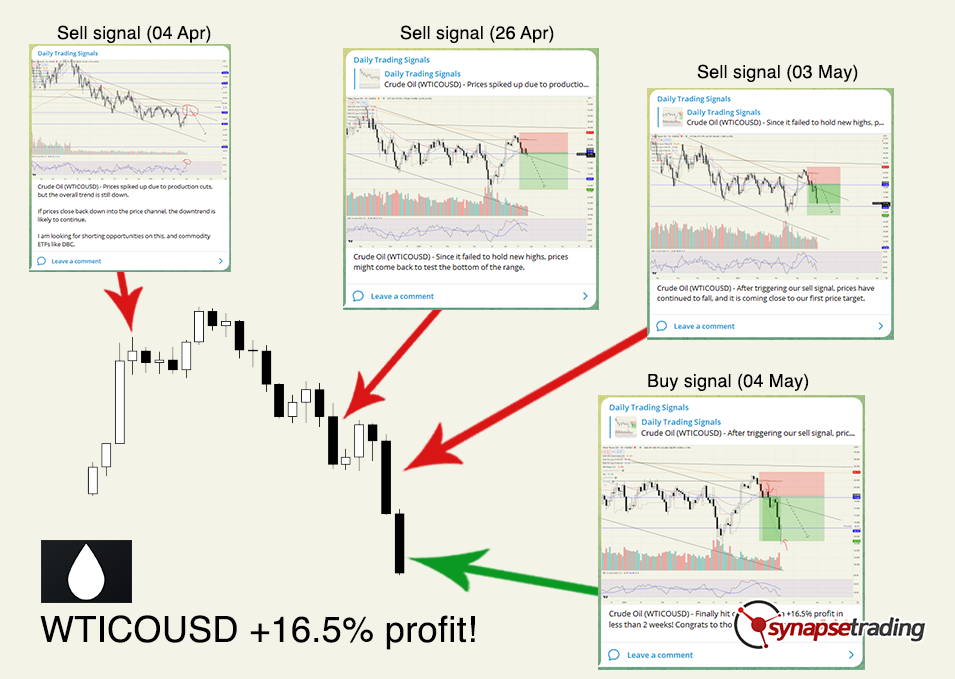
Crude Oil (WTICOUSD) – Since it failed to hold new highs, prices might come back to test the bottom of the range.

0 Comments/by Spencer Li
https://synapsetrading.com/wp-content/uploads/2023/05/image-first-republic-and-recession-1.png 537 781 Spencer Li https://synapsetrading.com/wp-content/uploads/2019/10/logo.jpg Spencer Li2023-05-02 11:36:392023-07-29 23:18:10Weekly Market Wrap: FOMC & NFP This Week!
Spencer Li

Weekly Market Wrap: Mixed Results for Banks Earnings, Tech Next

Market Analysis
pexels expect best 351264

For our “Daily Trading Signals”, we have now also included a “Weekly Market Report”, where we provide a weekly deep-dive on the market, including fundamentals, technicals, economics, and portfolio management:

Click here for last week’s market report (17 April 2023)
Click here to subscribe for the latest market report (24 April 2023)
Click here to see the archives of all our past market reports

We cover 3 main markets with a total of 200+ counters, so we will never run out of trading opportunities:

  • Forex, CFDs, commodities, bonds
  • US stocks, ETFs, global stock indices
  • Cryptocurrencies, crypto indices

By covering a broad range of markets, we can focus our attention (and capital) on whichever market currently gives the best returns.

Subscribe for real-time alerts and weekly reports:
👉🏻 https://synapsetrading.com/daily-trading-signals


pexels expect best 351264

Market Recap & Upcoming Week

Last week, concerns grew about the historical trend of stocks rallying after the Federal Reserve finishes raising interest rates, as earnings growth falters and stocks look expensive relative to history. Elevated inflation may continue to weigh on earnings in the coming quarters.

Microsoft’s Bing is challenging Google in the lucrative search market, raising the cost of retaining this business. This comes as global online advertising is in a slump, and traffic acquisition costs (TAC) reached nearly $49 billion last year.

Tesla’s operating margin declined due to aggressive price cuts and inflation in materials.

The Walt Disney Company is expected to lay off thousands of employees starting next week as part of its cost-cutting initiatives. Economists are predicting a recession later this year as the Federal Reserve raises interest rates, which businesses and consumers haven’t experienced in 15 years.

In other news, Goldman Sachs reported an 18% decrease in first-quarter profit, while Morgan Stanley saw a 19% drop in Q1 profit due to a slowdown in deal-making.

Meanwhile, China surprised economists with strong 4.5% growth in the first quarter despite its housing market crash and a conservative monetary stance.

This week, investors should closely monitor the earnings reports from major tech companies, including Apple, Amazon, Google parent Alphabet, Microsoft, and Meta Platforms, as well as other noteworthy companies like Coca-Cola Company, McDonald’s, Visa, Mastercard, and ExxonMobil, among others.

These reports will provide valuable insights into the performance and future prospects of these industry giants.

Additionally, keep an eye on the Case-Shiller National Home Price Index for February, new and pending home sales for March, and the BEA’s advance estimate for the first-quarter GDP to get a clearer picture of the current state of the economy.

Furthermore, don’t miss the key update on inflation with the Personal Consumption Expenditures (PCE) Price Index—the Federal Reserve’s preferred inflation gauge—for March. This indicator will help assess the extent of inflationary pressures in the economy and potentially influence the Fed’s monetary policy decisions.

Daily Trading Signals (Highlights)

Trading Signals CADCHF 210423

CADCHF – Congrats on hitting the first TP! 💰🔥💪🏻

High chance of another leg down, so can close half and use a trailing SL.


Trading Signals NZDCHF 210423

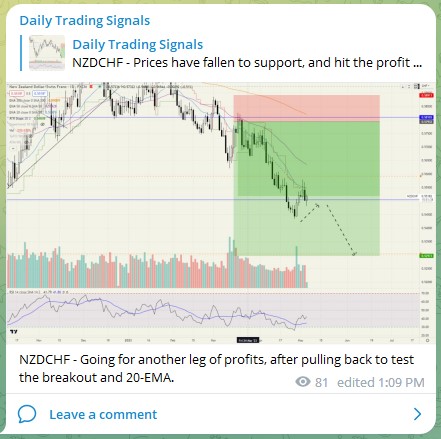
NZDCHF – Prices have fallen to support, and hit the profit target for 287 pips profit! Congrats to those who took this trade! 💰🔥💪🏻


Trading Signals CADJPY 210423

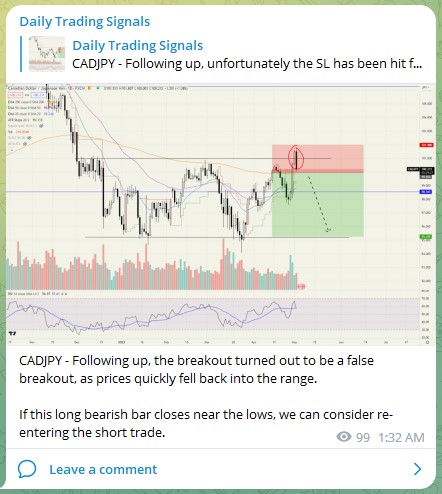
CADJPY – A potential range trading opportunity.


Trading Signals AUDCHF 210423

NASDAQ 100 (US100) – Stocks have been very flat the past 3 weeks, with the trading range here of only roughly 3% from top to bottom.

In addition, the last 5 bar bodies are super tiny and with long shadows, suggesting much indecision.

Will need to wait for a breakout of the range before any trades can be taken.


Trading Signals US100 200423

NASDAQ 100 (US100) – Stocks have been very flat the past 3 weeks, with the trading range here of only roughly 3% from top to bottom.

In addition, the last 5 bar bodies are super tiny and with long shadows, suggesting much indecision.

Will need to wait for a breakout of the range before any trades can be taken.

0 Comments/by Spencer Li
https://synapsetrading.com/wp-content/uploads/2023/04/pexels-expect-best-351264-scaled.jpg 1427 2560 Spencer Li https://synapsetrading.com/wp-content/uploads/2019/10/logo.jpg Spencer Li2023-04-25 18:23:072023-07-29 23:17:20Weekly Market Wrap: Mixed Results for Banks Earnings, Tech Next
Spencer Li

Weekly Market Wrap: Ethereum (ETH) Breaks Above $2000!

Market Analysis
Neuschwanstein Castle German

For our “Daily Trading Signals”, we have now also included a “Weekly Market Report”, where we provide a weekly deep-dive on the market, including fundamentals, technicals, economics, and portfolio management:

Click here for our most recent market report (10 April 2023)
Click here to see the archives of all our past market reports

We cover 3 main markets with a total of 200+ counters, so we will never run out of trading opportunities:

  • Forex, CFDs, commodities, bonds
  • US stocks, ETFs, global stock indices
  • Cryptocurrencies, crypto indices

By covering a broad range of markets, we can focus our attention (and capital) on whichever market currently gives the best returns.

Subscribe for real-time alerts and weekly reports:
👉🏻 https://synapsetrading.com/daily-trading-signals


Neuschwanstein Castle German

[Photo: Neuschwanstein Castle, Schwangau, Germany – See my full travel photo log from trading & travelling!]

Market Recap & Upcoming Week

Last week, the S&P 500 and Dow Jones Industrial Average experienced fluctuations as inflation in March dropped to its lowest level in almost two years, increasing optimism among investors. The March CPI report showed falling energy prices, rising services prices, and a slowdown in food inflation. Investors should keep an eye on durable goods prices as their increase could signal more challenges for inflation.

Gold prices surged to their highest level of the year, reflecting a 13% increase year to date. Despite slowing inflation data, investors anticipate the Federal Reserve scaling back its rate-hiking campaign due to concerns about economic weakness. Used vehicle prices, which spiked in 2020-2021, started to drop in early 2022, but the not-seasonally-adjusted CPI for used vehicles increased by 1.0% in March, suggesting the drop in used vehicle CPI may be over.

Ethereum (ETH) broke to news highs, and the Shapella Upgrade successfully boosted the price of ETH, even though it enabled withdrawals from the Beacon Chain. Staking inflows have risen for four consecutive days, reflecting bullish sentiment towards Ethereum after its shift to a Proof-of-Stake protocol.

Singapore’s economy grew by a mere 0.1% year-on-year in Q1 2023 due to a decline in manufacturing, and the country risks entering a technical recession if growth continues to slow in Q2 2023. JPMorgan, Citi, Wells Fargo, and PNC Financial reported their results, with mixed outcomes for their stocks.

The International Energy Agency (IEA) warned of a larger deficit in the oil market due to surprise production cuts from OPEC’s leading members, which could send crude prices higher and worsen inflation.

In the upcoming week, earnings season will be in full swing, with reports from major companies such as Johnson & Johnson, Bank of America, Netflix, Lockheed Martin, Tesla, Morgan Stanley, IBM, American Express, and Procter & Gamble. Updates on the housing market, inflation readings from the U.K., eurozone, and Japan, and Q1 GDP figures from China will also become available.

Daily Trading Signals 

Here are some of the real-time signals and price alerts that were triggered during the week. There were a lot of profitable forex trades, but the biggest profits came from our trade on Ethereum, which has been up by more than 20%!


Trading Signals ETHUSD 140423

Ethereum (ETHUSD) – Short-term momentum is still very strong, as prices blew past $2,000.

Congrats to all those who took this trade! 💰🔥💪🏻

Can consider taking half profits and continue riding the uptrend.


TP hit ETHUSD

Actually will probably go to $2k soon, so can wait a while more.


Trading Signals BTCUSD 140423

Bitcoin (BTCUSD) – Prices broke out from the symmetrical triangle, and above $30,000, which is an important psychological price level.

Looks like it will continue going higher.


Trading Signals USDCHF 140423

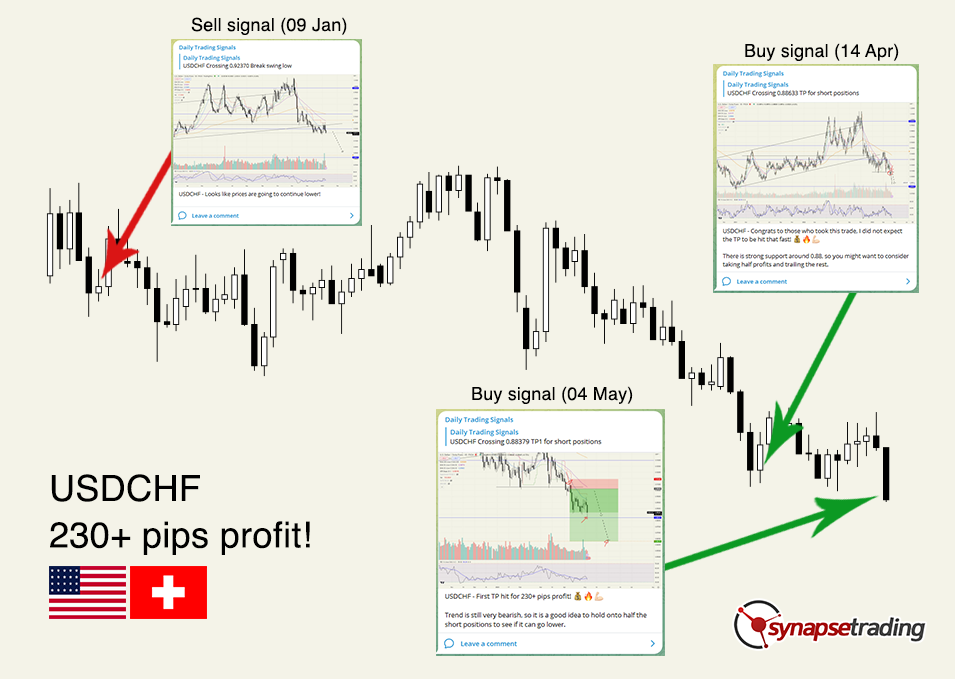
USDCHF – Congrats to those who took this trade, I did not expect the TP to be hit that fast! 💰🔥💪🏻

There is strong support around 0.88, so you might want to consider taking half profits and trailing the rest.


Trading Signals USDSGD 140423

USDSGD – Now that prices have broke down from the bear flag, I won’t be surprised if the prior low gets tested.


Trading Signals US30 120423
Dow Jones Index (US30) – Long shadows near the trendlines have so far led to price rejections and price moving to the opposite side of the price channel.


Trading Signals CHFJPY 140423

CHFJPY – Prices breaking out from a period of consolidation.

0 Comments/by Spencer Li
https://synapsetrading.com/wp-content/uploads/2023/04/P1100814.jpg 1920 2560 Spencer Li https://synapsetrading.com/wp-content/uploads/2019/10/logo.jpg Spencer Li2023-04-15 15:01:042023-07-29 23:16:47Weekly Market Wrap: Ethereum (ETH) Breaks Above $2000!
Page 42 of 184«‹4041424344›»

Free Trading Guides

Free Trading Guides

Blog Categories

  • Beginner's Guide
  • Blockchain & Crypto
  • Book Summaries
  • Candlestick Patterns
  • Economics & News Trading
  • Investing & Portfolio Management
  • Living Your Best Life
  • Market Analysis
  • News & Events
  • Price Chart Patterns
  • Promotions
  • Risk & Money Management
  • Stock Trading
  • Testimonials
  • Tools & Resources
  • Trading Psychology
  • Trading Strategies
  • Trading Tips
  • Travel & Lifestyle

Free Trading Guides

Free Trading Guides

Contact Us

Synapse Trading Pte Ltd
Registration No. 201316168H

Whatsapp: +65-8897-1204
Telegram: @iamrecneps
Email: info@synapsetrading.com

Links

Disclaimer
Privacy policy
Terms & Conditions
Contact us
Partnerships

© 2012-2024 Synapse Trading | All rights reserved | - powered by Enfold WordPress Theme
  • Link to Facebook
  • Link to X
  • Link to Instagram
  • Link to Youtube
  • Link to LinkedIn
  • Link to Mail
Scroll to top Scroll to top Scroll to top