

How to Buy Bitcoin and Crypto in Singapore: A Step-by-Step Guide That Keeps Your Coins Safe
Want the daily routine? Get the free 15-Minute Swing Trader’s Checklist. Get it free →
By Spencer Li, CFTe · Last updated: 26 October 2026
To buy Bitcoin or any other cryptocurrency, you pick the coin, pick a platform, open and verify an account, fund it with ordinary money, place your order, and then decide where the coins will live. In Singapore, the step that matters most comes before any of that, which is checking that the platform is licensed by the Monetary Authority of Singapore. You can do it for free in the MAS Financial Institutions Directory, and it takes about a minute. Start with an amount you could watch fall sharply without losing sleep, because crypto prices do exactly that, and treat the storage step as part of the purchase rather than an afterthought.
What are you actually buying when you buy Bitcoin?
The first Bitcoin block ever created carries a newspaper headline inside it.
It was mined on 3 January 2009, and whoever created it, using the name Satoshi Nakamoto, wrote this line into its data: “The Times 03/Jan/2009 Chancellor on brink of second bailout for banks”. You can still read it on any block explorer today. Nobody knows for certain why it was put there. It does date the block, and it reads a lot like a statement of purpose, a form of money that does not need a bank in the middle to vouch for who owns what.
That is the whole idea of a blockchain. Instead of one bank keeping the ledger, thousands of computers keep identical copies of it, and whoever holds the private key to an address is the only one who can move the coins in it. Ethereum, whose first block was mined on 30 July 2015, took the same ledger idea and turned it into a platform that other applications run on.
There is a quiet irony in how most people buy it now. A coin designed so you would not need a trusted middleman is usually bought through one, and quite often left there. That is not automatically a mistake, but it is worth knowing which of the two you are doing, and the rest of this guide is mostly about that choice.

If you would like to learn more about crypto & DeFi, also check out: “The Ultimate Guide to Blockchain & Cryptocurrencies”
How do you buy crypto, step by step?
The process is surprisingly ordinary. It looks a lot like opening a brokerage account, with one extra decision at the end.
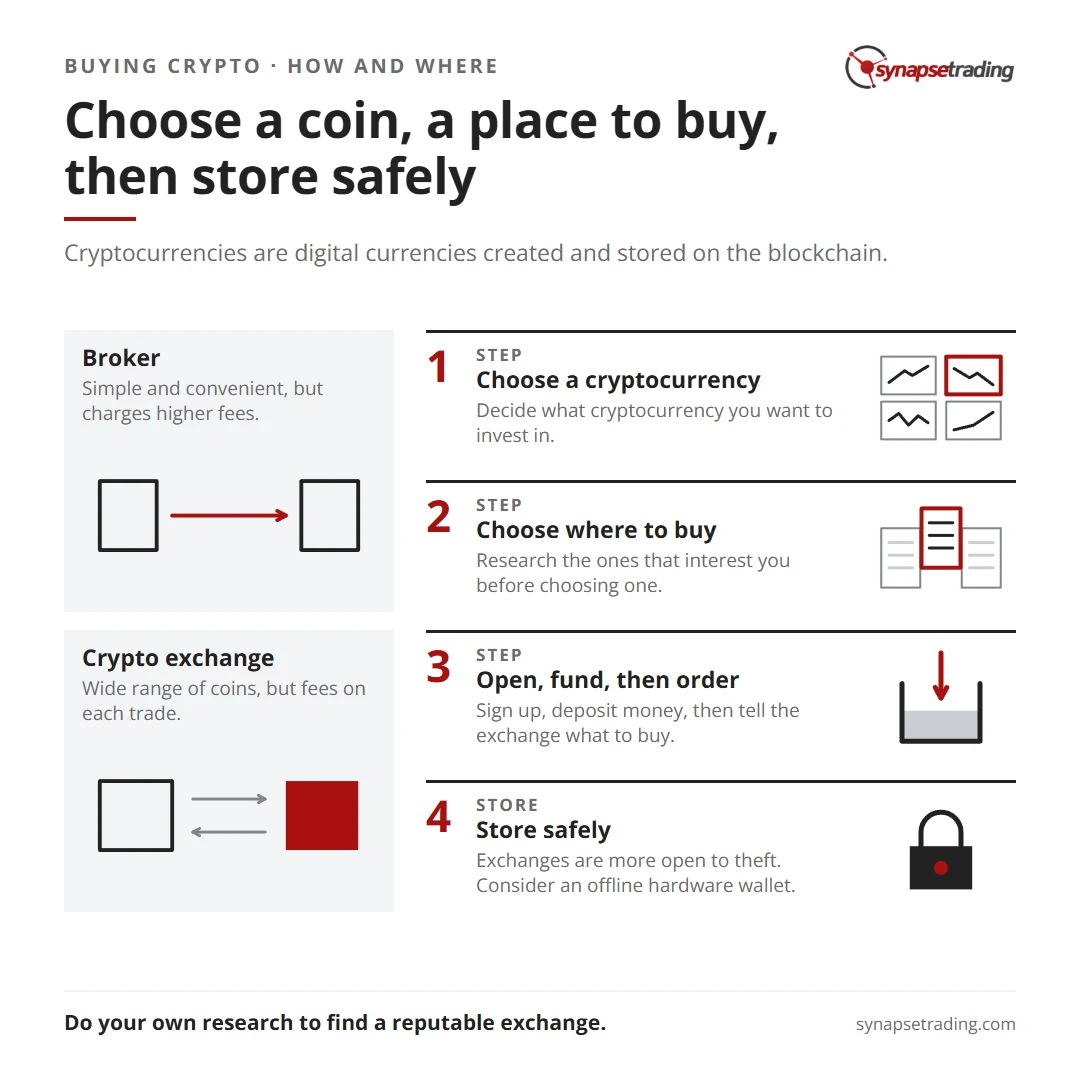
1. Choose the coin
Decide before you fund anything. Bitcoin is the usual first purchase because it has the longest history and the deepest market, and Ethereum is the usual second. I compare the two, and why people argue about the rest, in Bitcoin vs Ethereum vs Dogecoin.
2. Choose a platform, and check its licence
People rush this step. It gets its own section below.
3. Open and verify your account
Expect to upload your ID and proof of address. That is the “know your customer” check every licensed platform runs, and a platform that skips it is telling you something about itself. Turn on two-factor authentication, a second login code on top of your password, before you deposit anything.
4. Fund the account
You deposit ordinary money, Singapore dollars or US dollars, usually by bank transfer. Do note that MAS-licensed platforms are not supposed to accept locally issued credit cards for this, so if one asks for your Singapore credit card, that is worth a second look.
5. Place your order
You choose the coin, the amount and the currency you are paying with. A market order buys at the current price straight away, and a limit order waits for a price you set. For a first purchase, the simple version is fine.
6. Decide where the coins will live
You can leave them on the platform or move them to a wallet you control. This is the step people skip, so it also gets its own section.
If you would like a calm daily routine for whatever you end up holding, my free 15-minute swing trader checklist is the one I use myself.
How do you check a platform is licensed in Singapore?
Imagine handing your savings to a shop because its website looked professional. That is roughly what buying crypto from an unchecked platform is.
In Singapore, a business that lets you buy and sell crypto is a digital payment token service, and MAS licenses it as a payment institution. When I checked the MAS Financial Institutions Directory on 26 October 2026, filtering for major payment institutions licensed for digital payment token services returned 38 results. Do note that MAS counts licences there, and one firm can hold more than one, so the number of separate companies may be a little lower. The check itself is simple. Go to the directory, type in the company’s legal name, and see whether that licence and activity appear against it. If the platform is not there, find out why before you send it a single dollar.
MAS has also changed what a licensed platform may offer retail customers. In November 2023 it announced that providers should not offer incentives to trade, should not offer financing, margin or leverage, and should not accept locally issued credit cards, with the rules coming in from mid-2024. Earlier, in July 2023, it said customer assets must be held in a statutory trust, which keeps your coins legally separate from the platform’s own money if the platform fails. So a sign-up bonus for trading, 10 times leverage on Bitcoin, or a top-up by Singapore credit card are all signs that something does not add up.
Here is the concession, and it matters. A licence tells you who supervises the platform. It does not protect you from the price falling, and it does not protect you from fakes either. The same MAS directory page, on the day I checked it, carried a warning that scammers impersonate MAS-regulated institutions with unsolicited offers of high returns. So check the website address as carefully as the licence, and go to the platform directly, never through a link someone sent you.
Should you use a broker or a crypto exchange?
Two kinds of business will sell you crypto. They get paid differently.
| Broker or app | Crypto exchange | |
|---|---|---|
| How it works | Sells you the coin from its own inventory at a quoted price | Matches your order with other buyers and sellers |
| Coin choice | Usually the big names | Often hundreds |
| Cost | Mostly in the spread between buy and sell prices | A visible trading fee, plus a narrower spread |
| Suits | A first purchase, simple and quick | Someone comfortable with order types |
A broker’s pitch is simplicity, which is a real benefit when you are starting out. An exchange is usually cheaper per trade and offers far more coins, but it asks a little more of you. Most people start with whichever feels less intimidating and move once they understand the costs, which brings us to the cost nobody advertises.
What does buying crypto really cost you?
In November 2021, a trader on Reddit’s r/singaporefi asked about the app they were using to buy coins: “Why is the withdrawal price so high?” They had read that the gap was a spread, and added, “I highly doubt it.”
It is a fair suspicion. The answer is usually the spread. Most apps show two prices, one to buy and a lower one to sell, and the difference is how they get paid. Let me show you with made-up round numbers. Say an app sells you S$1,000 of Bitcoin with a spread of 1% on each side. The moment the order fills, the coins are worth about S$990 if you sold them back, and when you do sell, you give up roughly another 1% on the way out. So the price has to rise about 2% just for you to break even, and an app can advertise “zero fees” while charging every cent of that through the spread.
Hence, before you buy, compare the buy price and the sell price on the same screen at the same moment. The gap between them is the real fee, and it is the easiest number on the screen to miss.
Where should you keep your coins?
Crypto has a saying, “not your keys, not your coins”, and it is more literal than it sounds. Whoever holds the private key controls the coins. Leave them on a platform and the platform holds the key, while you hold a promise from the platform that it will hand the coins back when you ask, which is only as good as the platform itself.
That is fine for a small amount you are actively trading, and the statutory trust rule in Singapore makes the promise sturdier than it used to be. For anything larger that you plan to hold, many people move the coins to a hardware wallet, a small device that keeps the private key offline. The trade-off is that the responsibility moves to you. The wallet comes with a recovery phrase, usually 12 or 24 words, and anyone who has those words has your coins. Lose them, and nobody can reset them for you, which makes them the one piece of paper in your house worth more than the device.
If you would rather not hold coins at all, there are funds that track Bitcoin’s price, which I cover in best Bitcoin ETFs. And if a dollar-pegged coin is what you are after, start with best stablecoins.
How much should you buy?
Less than you think, to start.
In my weekly outlook on 9 October 2025, I explained why I had taken profits on crypto. In my words that week, “crypto does have the tendency to have sharp corrections immediately after breaking new highs”. Five months later, on 18 March 2026, I pointed out that in a risk-off market, “usually crypto is the first to drop”. Both of those are the same lesson from two directions. Crypto moves further and faster than most things people own, in both directions, and the fear on the way down feels very different from the excitement on the way up.
Personally, I would rather wait for a pullback than chase crypto straight after a breakout, which is what I said I would do that week. Sizing works the same way. For a first purchase, a sensible ceiling is an amount you could see halve and still sleep, with a plan written down before you buy for what you will do if it does.
If you want a 15-minute routine that keeps decisions like this out of the heat of the moment, grab my free 15-minute swing trader checklist.
FAQ
Is it legal to buy crypto in Singapore?
Yes. Buying and holding crypto is legal, and platforms that offer it here need a MAS licence. A licence does not protect you from price losses.
How do I check if a crypto platform is licensed by MAS?
Search the company’s legal name in the MAS Financial Institutions Directory. Look for a major payment institution licence with digital payment token service listed as an activity.
Can I buy Bitcoin with a credit card in Singapore?
MAS-licensed platforms are not supposed to accept locally issued credit cards for crypto purchases. A bank transfer is the usual way to fund an account.
What is the cheapest way to buy Bitcoin?
Compare the total cost, which is the trading fee plus the spread between the buy and sell prices. An app that shows no fee can still be the most expensive.
Do I need a hardware wallet?
Not for a small amount you are trading. For larger holdings, a hardware wallet moves control of the private key to you, along with the duty to keep the recovery phrase safe.
How much should a beginner put into crypto?
Only an amount you could watch fall by half without it changing your life. Crypto has a history of sharp falls, often right after new highs.
Which step held you up the first time you bought crypto, or is still holding you up now? And have you ever checked the spread on the app you use? Let me know in the comments.
For the wider picture beyond crypto, start with my free trading guides.
And if you want a routine that takes 15 minutes a day instead of an evening of watching charts, grab the free 15-minute swing trader checklist.
About the author. Spencer Li is The 15-Minute Trader and the founder of Synapse Trading. He is a Certified Financial Technician (CFTe) with 15+ years of trading, run from 70+ countries. He holds a B.Acc and B.BM from SMU. Every trade he takes is public, dated, losses left in. He teaches rules-based swing trading in 15 minutes a day, one system for any market.
Education, not financial advice. Synapse Trading is not licensed by MAS to advise on investment products. Trading carries risk of loss, and past performance is not indicative of future results.
Want the daily routine? Enter your email for the free 15-Minute Swing Trader's Checklist.
Free 5-page PDF, then occasional trading emails. Education only, not financial advice. Unsubscribe anytime. Kit stores your email in the US: see our privacy policy.
Want to learn the full method? The Trading Mastery Program teaches the 4 strategies I have traded since 2011. It suits beginners and experienced traders.
Rather follow the trades as they happen? Daily Trading Signals is our Telegram channel: my trade ideas with entry, stop and exit, and every trade is public.
Questions about this post? Ask in the free Telegram channel →
Educational content only, not personalised financial advice. Trading carries risk, including loss of capital. Past performance is not indicative of future results. Synapse Trading is not licensed or regulated by MAS.

