

Comparison of the new Bitcoin (BTC) ETFs: Which is the Best?

Join our Telegram channel for more market analysis & trading tips: t.me/synapsetrading
Table of Contents
Best Bitcoin ETF: How to Compare Spot Bitcoin ETFs by Fees
Last updated: 3 July 2026 · By Spencer Li, CFTe
For most people, the best Bitcoin ETF is the cheapest credible spot fund, because every one of them holds the same asset (Bitcoin), so the fee is the main thing you actually control. Among the US spot Bitcoin ETFs, the Bitwise Bitcoin ETF (BITB) has the lowest expense ratio at 0.20%, with Ark 21Shares (ARKB) next at 0.21%, and the big-name funds, iShares (IBIT) from BlackRock, Fidelity (FBTC), and VanEck (HODL), clustered at 0.25%. The old Grayscale Trust (GBTC) sits far above the pack at 1.5%. A spot ETF (one that holds actual Bitcoin, not futures contracts) lets you buy Bitcoin exposure through an ordinary brokerage account, with no wallet, no private keys, and no exchange to trust. Personally, after weighing fees against fund size, I hold ARKB and IBIT. Here is how to compare them yourself, so you pick the one that fits you, not the one with the loudest ad.
What is a spot Bitcoin ETF?
A spot Bitcoin ETF is a fund that holds real Bitcoin and trades on a normal stock exchange. You buy it like any share, through the brokerage you already use.
That word “spot” matters. A spot ETF holds the actual coin. A futures ETF (the older kind, like the ProShares BITO that launched first) holds Bitcoin futures contracts instead, which can drift away from the real Bitcoin price over time. The spot funds track Bitcoin much more directly, which is why their approval was the bigger event.
The appeal is simple. You skip the parts of crypto that scare most people: setting up a wallet, guarding a private key (the secret code that controls your coins, lose it and the coins are gone), and trusting a crypto exchange not to collapse. The ETF issuer handles custody. You just hold a ticker.
How did we get spot Bitcoin ETFs? A short timeline
These funds did not appear overnight. The road to approval ran more than a decade.
- 2013: The Winklevoss twins filed the first Bitcoin ETF application. It set the template, and it was rejected.
- 2017 to 2019: A run of SEC rejections, citing market-manipulation worries. ProShares, Direxion, and Bitwise all got turned down.
- 2020 to 2021: The tone shifted under SEC Chairman Gary Gensler. The first Bitcoin futures ETF, ProShares Bitcoin Strategy (BITO), was approved.
- 2022 to 2023: More futures ETFs cleared, but spot funds still stalled over market-oversight concerns.
- 2024: The first US spot Bitcoin ETFs were approved together, the regulatory shift that opened the door to the funds compared below.
So when you hold one of these today, you are holding the end of a long fight, not a brand-new experiment.
What is an expense ratio, and why does it decide the “best” ETF?
The expense ratio is the annual fee a fund charges to hold and run it, written as a percentage of your money in the fund.
A worked example. If an ETF has a 0.20% expense ratio and you put in $100, you pay about 20 cents a year in fees. The fee is taken straight from the fund’s assets, so you never write a cheque, you just earn slightly less than the raw Bitcoin price over time.
Here is why this is the lever that matters. Every spot Bitcoin ETF holds the same thing: Bitcoin. They do not pick better coins or time the market. So if Fund A and Fund B both just hold Bitcoin, the cheaper one wins by default, because the fee is the one number that reliably eats into your return. A lower expense ratio means more of Bitcoin’s move stays in your pocket.
Comparison of the spot Bitcoin ETFs by fee
Below are the US spot Bitcoin ETFs ranked from cheapest to most expensive. Do note that, issuers cut fees and run temporary waivers to win early assets, so always check the current ratio on the issuer’s page before you buy.
| ETF | Ticker | Expense ratio | Notes |
|---|---|---|---|
| Bitwise Bitcoin ETF | BITB | 0.20% | Lowest fee; six-month waiver on the first $1B in assets |
| Ark 21Shares Bitcoin ETF | ARKB | 0.21% | Partnered with 21Shares, a crypto specialist |
| iShares Bitcoin Trust | IBIT | 0.25% | Run by BlackRock, the largest asset manager |
| Fidelity Wise Origin Bitcoin Fund | FBTC | 0.25% | Backed by Fidelity’s custody and platform |
| VanEck Bitcoin Trust | HODL | 0.25% | Established ETF issuer |
| Valkyrie Bitcoin ETF | BRRR | 0.25% | Started at 0.49%, cut to 0.25%; early waiver |
| Franklin Bitcoin ETF | EZBC | 0.29% | Franklin Templeton |
| WisdomTree Bitcoin Fund | BTCW | 0.30% | WisdomTree |
| Invesco Galaxy Bitcoin ETF | BTCO | 0.39% | Invesco plus Galaxy Digital’s crypto desk |
| Hashdex Bitcoin ETF | DEFI | 0.94% | Converted from a futures fund |
| Grayscale Bitcoin Trust | GBTC | 1.50% | Highest fee; longest track record and large asset base |
Two things jump out of that table.
First, the fee range is wide: 0.20% at the bottom, 1.5% at the top. That is a 7x gap for funds holding the same asset. Over years, that difference compounds against you.
Second, GBTC is the odd one out. It was the original Bitcoin trust before it converted to an ETF, and it kept the largest asset base and the longest history. Its 1.5% fee is the price of that legacy. Some long-term holders accept it for the track record. For most new money, the cheaper funds are the obvious starting point.
Why spot Bitcoin ETFs mattered for the market
Beyond your own cost, these funds changed who can buy Bitcoin and how.
They lowered the barrier. No wallet, no keys, no exchange. If you can buy a stock, you can buy Bitcoin exposure. That alone pulls in a large group of investors who were never going to set up a crypto wallet.
They added a layer of legitimacy. Regulatory approval of a spot ETF was a signal that Bitcoin is an investable asset inside the traditional system, not just an internet curiosity. That tends to reduce some of the old skepticism.
They made it easy to size small. You can buy a few shares. You do not have to commit to a whole coin or a minimum exchange order. For a beginner who just wants a small, sensible slice of Bitcoin in a diversified portfolio, that fractional access is the practical win.
None of this removes Bitcoin’s volatility. The wrapper is convenient. The asset inside is still the same swinging asset it always was.
Which Bitcoin ETF is best for you?
There is no single “best” fund, only the best fit for your goal. Here is how I would frame the choice.
- If you are cost-conscious (and most long-term holders should be), start with the cheapest credible fund. BITB at 0.20% leads, with ARKB at 0.21% a hair behind.
- If you want the biggest, most liquid name, IBIT (BlackRock) and FBTC (Fidelity) at 0.25% trade size and a household brand for a basis point or two of fee.
- If track record and asset base matter more to you than fee, GBTC is the legacy option, though you pay 1.5% for it.
Personally, I went with ARKB and IBIT, weighing both the expense ratio and the fund’s market size. ARKB gives me a near-rock-bottom fee, and IBIT gives me the deepest liquidity and the BlackRock name. That is my read for my situation, not a recommendation for yours.
Where the human edge comes in
A comparison table can rank these funds by fee in a second, and you should let it. That part is now free. What the table will not do is decide how big a Bitcoin position belongs in your portfolio, or whether you can sit through a 50% drawdown without panic-selling at the bottom. The cheapest ETF in the world does not help if you size it wrong or bail at the worst moment. Picking the fund is the easy part. Sizing it and holding through the volatility is the judgment, and it is the first of the Five Edges no fund can supply for you.
FAQ
What is the best Bitcoin ETF?
For most investors, the best Bitcoin ETF is the cheapest credible spot fund, since they all hold the same asset. BITB has the lowest expense ratio at 0.20%, with ARKB at 0.21% and IBIT, FBTC, and HODL at 0.25%.
What is the cheapest Bitcoin ETF?
The Bitwise Bitcoin ETF (BITB) has the lowest expense ratio at 0.20%, and at launch it also waived fees for six months on the first $1 billion in assets. Always check the current ratio, as issuers change them.
What is the difference between a spot and a futures Bitcoin ETF?
A spot Bitcoin ETF holds actual Bitcoin, so it tracks the price closely. A futures Bitcoin ETF holds futures contracts instead, which can drift away from the real Bitcoin price over time. The spot funds are the more direct way to hold Bitcoin through a brokerage.
Why is GBTC’s fee so high?
Grayscale’s GBTC was the original Bitcoin trust before converting to an ETF, and it kept the longest track record and a large asset base. Its 1.5% expense ratio is far above its peers; it cut the fee to compete but still sits at the top of the range.
Do I still need a crypto wallet if I buy a Bitcoin ETF?
No. The whole point of a spot Bitcoin ETF is that the issuer handles custody. You buy and sell it like a stock through your brokerage, with no wallet and no private keys to manage.
Which one fits how you invest, the rock-bottom fee or the big-name liquidity? Let me know in the comments.
And if you want the bigger picture on crypto beyond the ETF wrapper, read the deeper guide: The Ultimate Guide to Blockchain and Cryptocurrencies.
Want a simple system for any market, crypto included? Grab the free 15-Minute Swing Trading Starter Kit. It’s the exact routine I use to scan once a day and trade any market in 15 minutes.
About the author. Spencer Li is the founder of Synapse Trading and a Certified Financial Technician (CFTe) with 15+ years of trading across stocks, forex, crypto, commodities, and bonds. His trade log is public: every trade since April 2024, dated, losses left in. He has taught a 15-minute daily trading routine since 2014, one system for any market.
Education, not financial advice. Synapse Trading is not licensed by MAS to advise on investment products. Trading carries risk of loss; past performance is not indicative of future results.
Related
The Ultimate Guide to Blockchain and Cryptocurrencies (pillar) · What is Bitcoin and how does it work · How to invest in crypto for beginners · ETF investing for beginners
Want the daily routine? Enter your email for the free 15-Minute Swing Trader's Checklist.
Free, 5 pages, PDF. You get the checklist, then my occasional trading emails. Education only, not financial advice. Unsubscribe anytime.
Where your details go: Kit, our email provider, stores your email address in the United States. Our contract with Kit lets it use your address only to send our emails, and requires Kit to keep it secure. The United States has no national privacy law like Singapore's, so that contract is the main protection. More in our privacy policy.
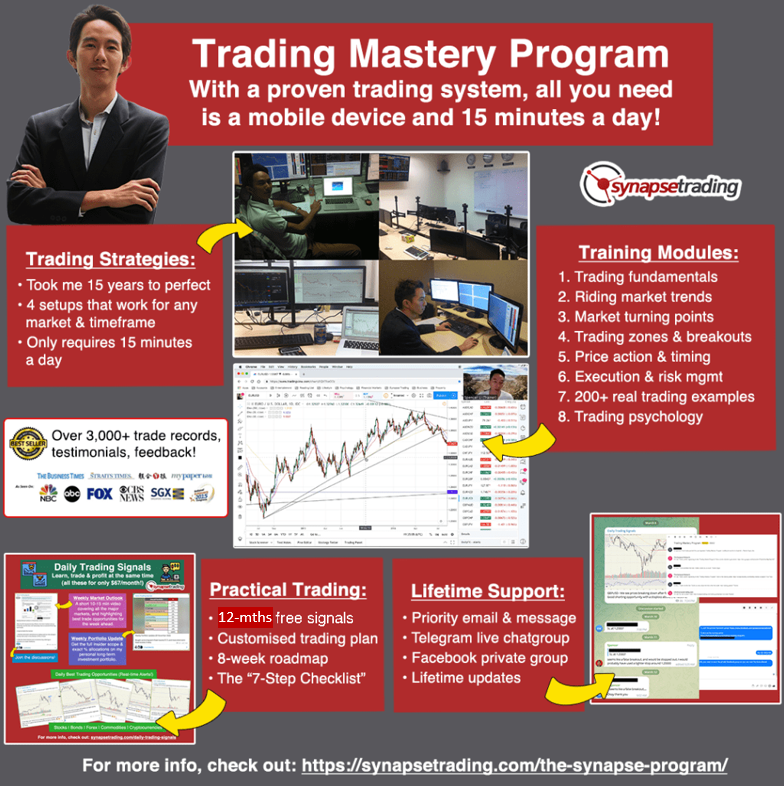 Our flagship mentoring program is suitable for both beginners and advanced traders, covering the 4 strategies which I used over the past 15 years to build up my 7-figure personal trading portfolio.
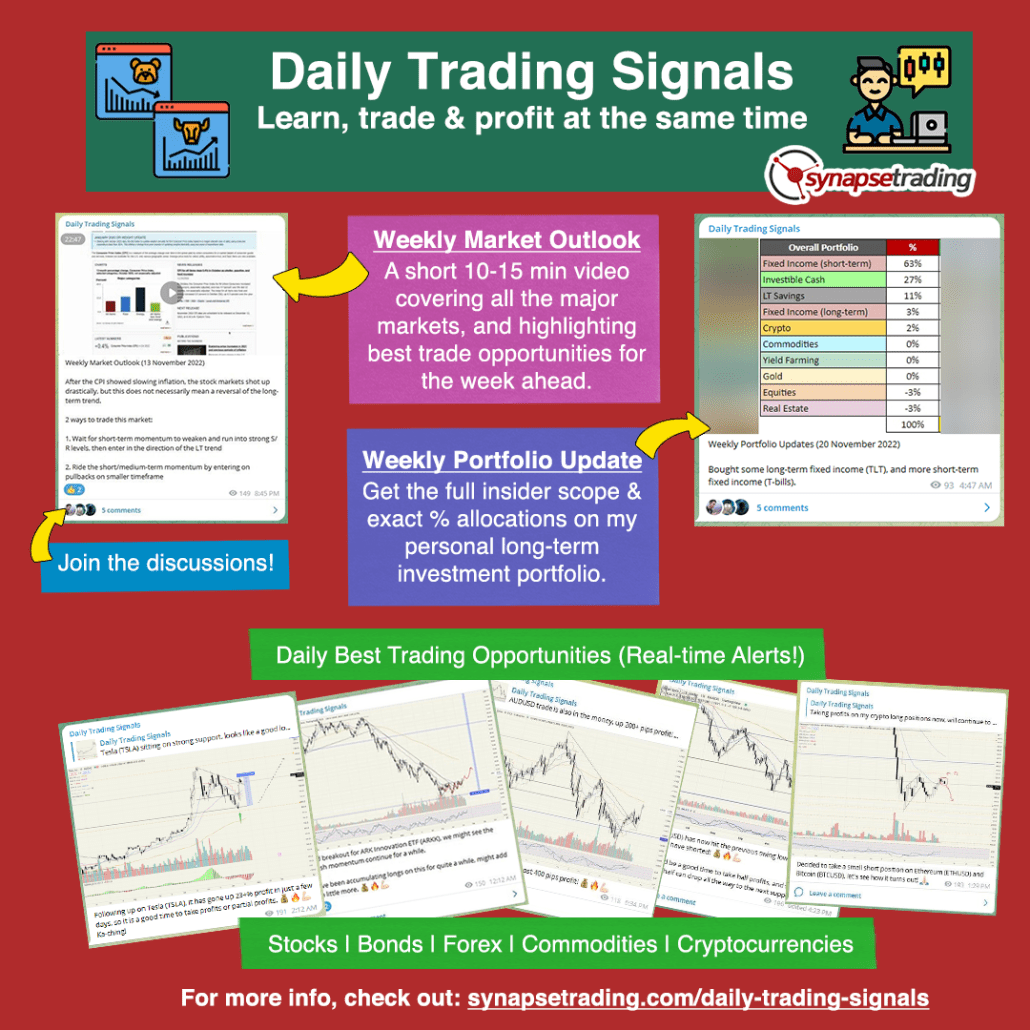 If you're looking for the best trading opportunities every day across various markets, and don't want to spend hours doing the research yourself, check out our private Telegram channel!





Leave a Reply
Want to join the discussion?Feel free to contribute!