
How to Buy US T-Bills on Interactive Brokers, and When They Beat Idle Cash
Want the daily routine? Get the free 15-Minute Swing Trader’s Checklist. Get it free →
By Spencer Li, CFTe · Last updated: 4 September 2026
To buy US Treasury bills on Interactive Brokers, you switch on bond trading permissions and open Trader Workstation. Then you go to New Window, Scanners, Bond Scanner, filter for US Treasury bills, pick a maturity date and place a limit order. A T-bill is a short loan to the US government, lasting 4 to 52 weeks, and you buy it below face value and get the full face value back at maturity.
The harder question is whether it is worth doing at all, because IBKR already pays interest on idle US dollars. On 16 October 2026 a 13-week bill yielded 4.18%, against the 3.38% IBKR was paying on cash on 17 October. The bill won, but by less than you might expect, and your account size decides how much of the gap you keep.
Why does a T-bill never pay interest?
A T-bill is a slightly odd kind of loan. The US government tells you up front that it will never send you a single interest payment, and every week investors still line up to lend it money.
The trick is in the price. TreasuryDirect, the Treasury’s own site, says that when the bill matures “you are paid its face value”. You pay less than that when you buy, so the interest is simply the gap between what you paid and what comes back.
The real numbers make it clearer. On 16 October 2026 the Treasury’s daily table showed the 26-week bill at a discount rate of 4.20%. A 26-week bill runs 182 days, so the price works out like this:
100 − (4.20 × 182 ÷ 360) = about 97.88 per 100 of face value
You pay roughly 97.88, wait 26 weeks, and receive 100. The 2.12 in between is your interest. The Treasury quoted the same bill at a coupon-equivalent yield of 4.35% a year, and that is the figure to hold up against a deposit rate, because it measures the interest against what you actually paid.
Bills come in 4, 6, 8, 13, 17, 26 and 52 weeks. TreasuryDirect adds that you “can hold a bill until it matures or sell it before it matures”, and that second option is what makes bills useful to a trader. Cash parked in one can come back out early.
How do you buy a T-bill in Trader Workstation?
The first hurdle is that the bills are easy to miss. They sit inside a scanner rather than in the usual symbol search, and an account opened for stocks may not have permission to trade bonds at all, so the first order can bounce before you see a price.
- Turn on bond permissions. When a client asked, IBKR replied that “you will need bond trading permissions enabled in your account to trade T-Bills”. You request them in the trading permissions section of your account settings, well before the day you want to buy.
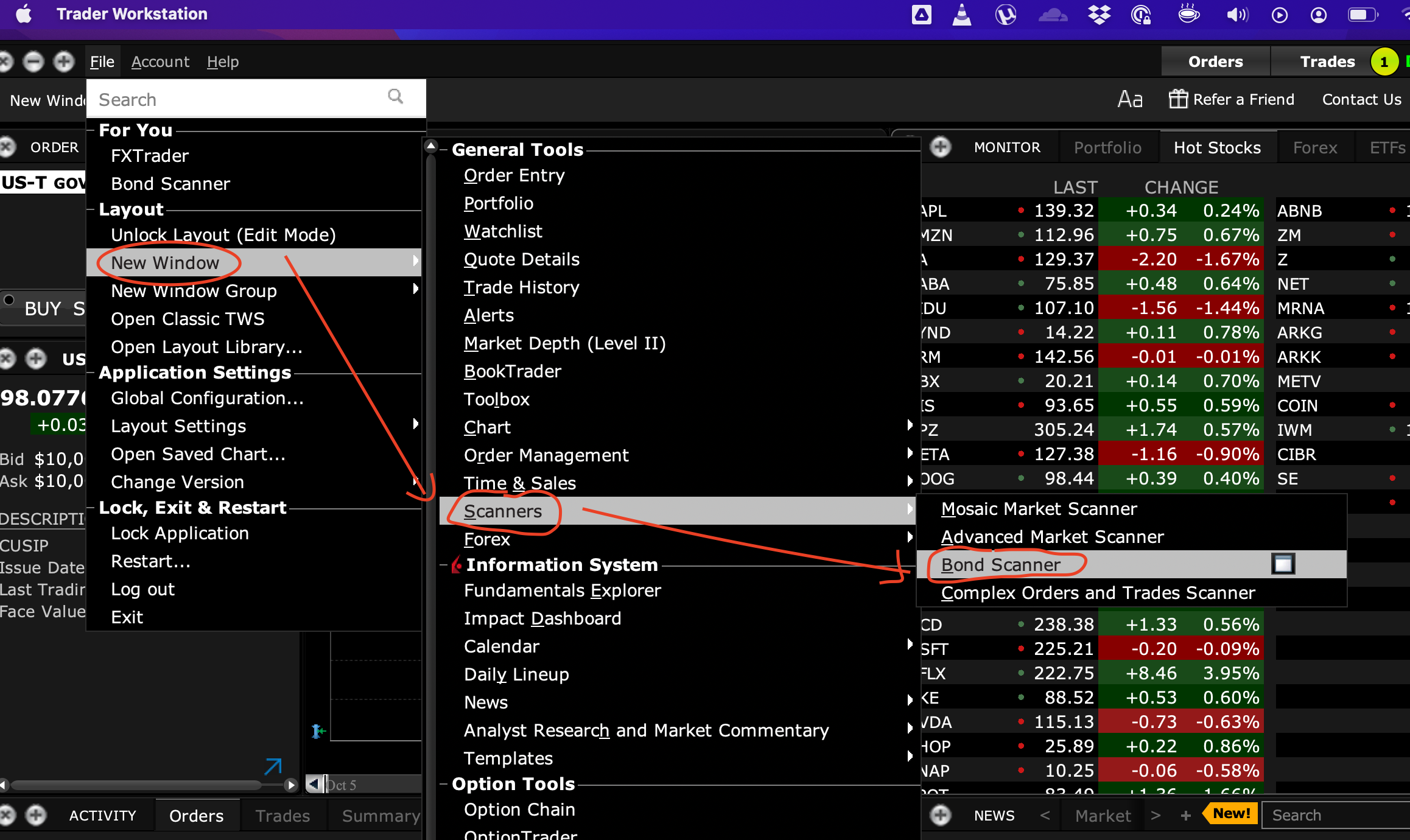
- Open the Bond Scanner. In Trader Workstation, IBKR’s free desktop platform, click New Window at the top left, then Scanners, then Bond Scanner. IBKR says it searches US Treasuries “by type, maturity date range and additional category”.

- Filter for bills. Choose US Treasuries, pick bills as the type and run the search. Every bill on offer appears with its maturity date, the day you get paid face value. Pick the date that lands where you think you will need the cash.
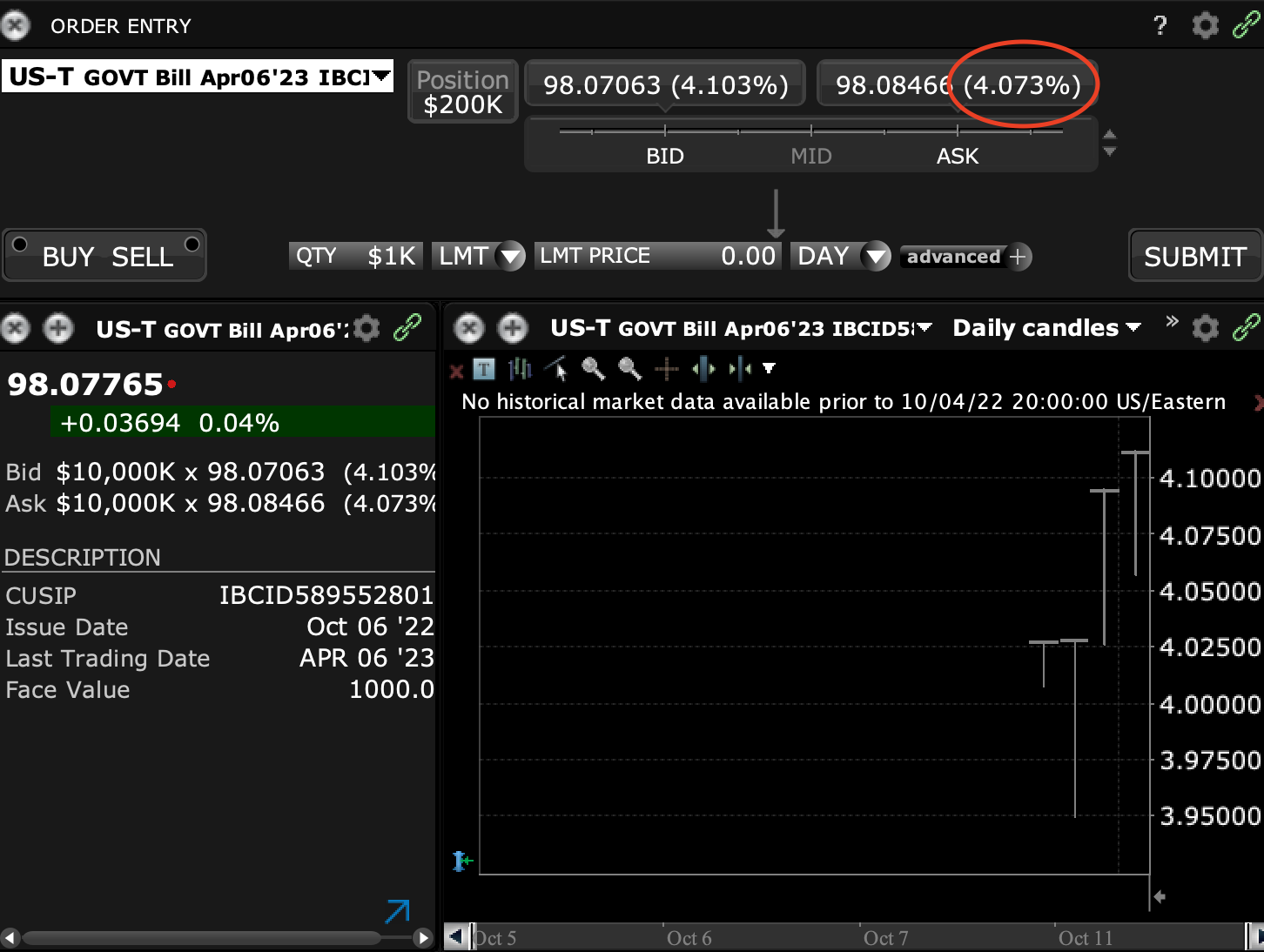
- Check the quantity. Click a bill to load it into the order panel, and Trader Workstation fills in the smallest quantity you can buy. IBKR notes that bonds are typically issued at 1,000 US dollars of face value, so a quantity of 10 means 10,000 of face value.
- Use a limit order. IBKR itself recommends a limit price, because some venues it routes Treasury orders to do not accept market orders. Set the most you will pay, then submit.
Then comes the commission. For US Treasuries IBKR charges 0.002% of face value on the first one million US dollars, with a minimum of USD 5 an order. The percentage only climbs past USD 5 once an order goes above 250,000 of face value, so on nearly every retail order you simply pay the USD 5.
Say you buy a single 1,000 bill with 26 weeks to run. It pays roughly 2.1% of face over those weeks, and the USD 5 fee is 0.5% of face, so about a quarter of your interest is gone before the bill has done anything. Buy 10 bills in one order and the fee shrinks to 0.05%, about a fortieth of the interest.
If you would rather spend your 15 minutes a day on the market than on fee arithmetic, my free 15-minute swing trader checklist is the daily routine I use myself.
Is a T-bill better than leaving cash at IBKR?
Suppose you have US dollars sitting in IBKR between trades. The natural assumption is that they earn nothing, which is close to true at plenty of banks and quite wrong here.
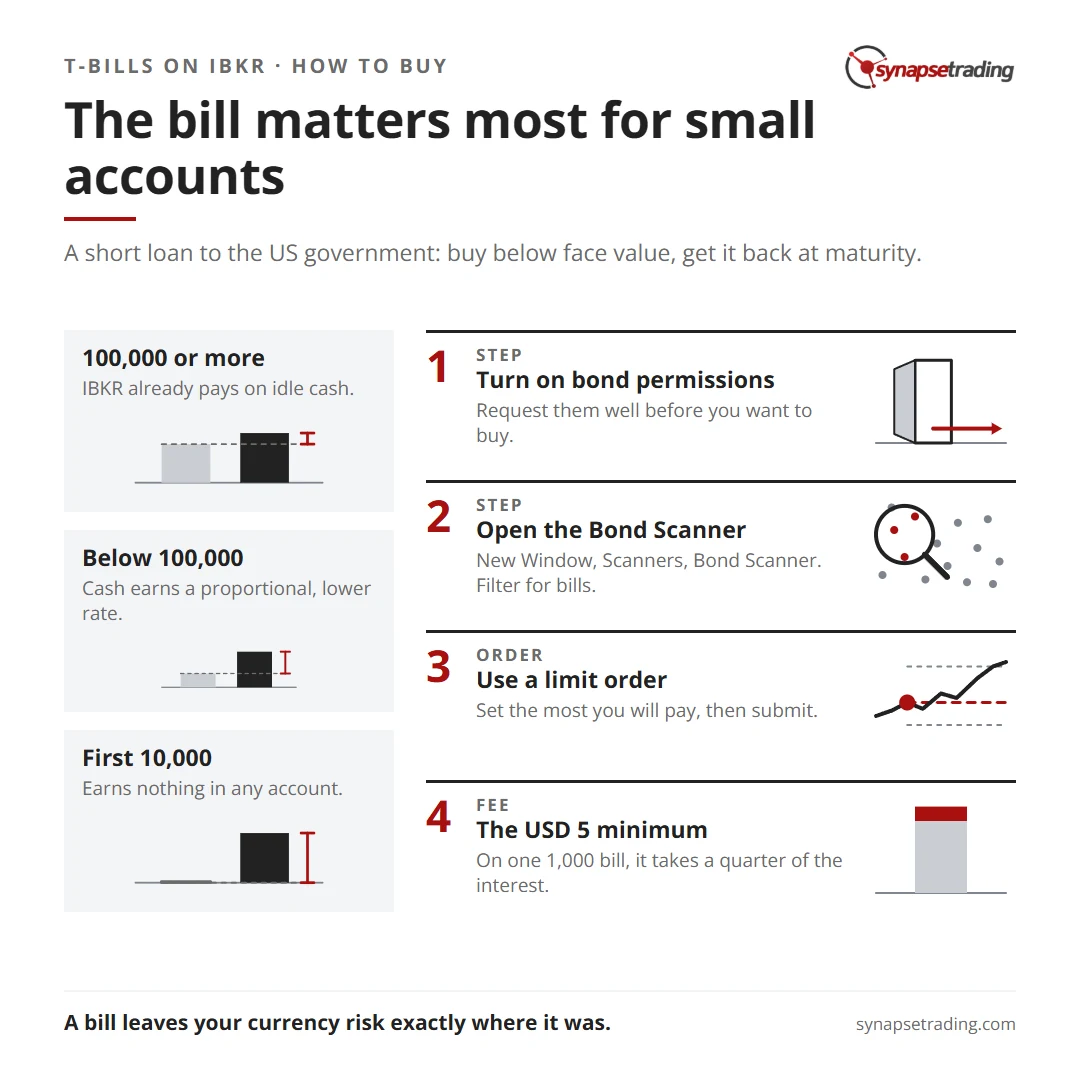
On 17 October 2026 IBKR’s interest page showed 3.38% for IBKR Pro clients on US dollar balances above the first 10,000, and the first 10,000 itself earns nothing. The same page carries a second rule that is easy to skim past, that accounts worth less than 100,000 “will be paid at a rate proportional to” accounts worth more. In plain terms, an account worth 50,000 earns half the rate.
| Your situation | IBKR cash rate, 17 Oct 2026 | 13-week bill, 16 Oct 2026 | What the bill adds |
|---|---|---|---|
| Account worth 100,000 or more | 3.38% | 4.18% | about 0.8 points |
| Account worth 50,000 | about 1.69% | 4.18% | about 2.5 points |
| The first 10,000 of cash, any account | 0% | 4.18% | 4.18 points |
So the bill matters most for exactly the people who think they are too small to bother.
A large account gains about 0.8 of a point by moving its cash into bills. If it rolls one 10,000 order every 13 weeks, four commissions a year cost 0.2% of that money, which takes back about a quarter of the gain. A 50,000 account loses about 2.5 points a year by leaving the cash alone. That is the kind of slow leak people only notice, with some regret, at the end of the year.
Do Singapore investors pay US withholding tax on T-bills?
On 21 December 2025, a trader on Reddit’s r/singaporefi described parking spare US dollars in a T-bill ETF on IBKR, then opening the activity report and finding 30% US withholding tax taken from its payouts. The question that followed was a fair one: “what’s the current meta for holding idle USD without the tax drag?”
The 30% is the IRS default. Publication 515 says that “most types of U.S. source income received by a foreign person are subject to U.S. tax of 30%” and then lists the exceptions. One of them covers interest and original issue discount on “an obligation that is payable 183 days or less from the date of its original issue”, provided the rules that keep the debt out of US taxpayers’ hands are met. Every bill of 26 weeks or less falls inside that line.
The 52-week bill runs past 183 days, so it relies instead on the separate portfolio interest exemption, which needs documentation that the owner is not a US person.
On the Singapore side, IRAS says that for most individuals, overseas income received in Singapore “is not taxable”, and the exceptions include income received through a Singapore partnership.
Whether that fund’s payout should have been withheld at all is a separate question. The same IRS publication has its own rules for funds, and that is where I hand over to a tax adviser, because I teach trading and your own tax position deserves someone who does it for a living.
So the direct bill does answer the tax question. My concession is about the reward. As at 16 October 2026 it came to about 0.8 of a point over IBKR’s own cash rate for a large account. A reader with 100,000 or more sitting idle may fairly decide that rolling bills every quarter is not worth 0.8 of a point.
What about the currency?
For a reader in Singapore, the yield is only half the story, because the money is in US dollars.
On 5 November 2025, in my weekly outlook, stocks were correcting, and gold, silver and crypto were all still above the prices we wanted to buy at. So I told viewers that “it is not a bad idea to sit in cash also”, and the reason was the US dollar, which was rising quite strongly against the Singapore dollar. If it climbed back to its prior resistance, I said, that alone was about a 3% gain on the whole portfolio, “which is not too bad for holding cash”.
The same logic runs backwards just as easily. A bill yielding about 4% a year earns about 1% over 13 weeks, and a 1% fall in the US dollar against the Singapore dollar over those weeks wipes that out completely. The bill takes away the fear of the borrower not paying, and leaves your currency risk exactly where it was.
Converting costs a little too. IBKR charges 0.20 basis points of the trade value on spot currency, with a minimum of USD 2 an order, which is small next to the currency move itself.
I have held T-bills myself in the past, though I do not hold any right now.
When should you sell a bill early?
Mostly when a trade needs the money. Because a bill is so short, its price barely moves.
A rough rule is that the price changes by about the yield change times the years left to run. If yields jumped a full point on a 13-week bill with a quarter of a year to go, the price would drop by roughly 0.25%. That is a terrible week for a bill and a quiet hour for most stocks.
Selling early does cost a second USD 5 commission, and you sell at whatever buyers are bidding that day. So if you know you will need the cash in six weeks, a bill that matures in six weeks saves you both, along with the small relief of having nothing to decide.
How much cash to keep parked is really a sizing question, and the free 15-minute swing trader checklist is the routine I use to keep that decision small.
FAQ
How do I buy US T-bills on Interactive Brokers?
Enable bond trading permissions and open Trader Workstation. Go to New Window, Scanners, Bond Scanner, choose US Treasuries with bills as the type, pick a maturity and place a limit order.
Do I need special permissions to trade T-bills on IBKR?
Yes. IBKR says you need bond trading permissions enabled before you can trade T-bills. You request them in the trading permissions section of your account settings.
How much does IBKR charge to buy T-bills?
IBKR charges 0.002% of face value on the first one million US dollars, with a minimum of USD 5 an order. On most retail orders the minimum is what you pay.
Do Singapore investors pay US withholding tax on T-bills?
IRS Publication 515 exempts interest on obligations payable 183 days or less from issue from the usual 30% withholding, which covers bills of 26 weeks or less. Check your own case with a tax adviser.
Is a T-bill better than IBKR’s interest on cash?
On 16 October 2026 a 13-week bill yielded 4.18%. On 17 October IBKR paid 3.38% on US dollar cash above 10,000 for accounts worth 100,000 or more, and less to smaller accounts, so the bill helps them most.
Can I sell a T-bill before it matures?
Yes. TreasuryDirect says you can hold a bill to maturity or sell it before then. You pay a second commission and sell at the price buyers are bidding that day.
Do you keep your spare US dollars in cash, in bills or in a fund, and did the 10,000 and 100,000 rules change the sum for you? Let me know in the comments.
If you are starting from scratch, read how to open and set up an Interactive Brokers account. The cash side of the same question is in how IBKR pays interest on idle cash. How much of your money belongs in the market at all is covered in my guide to money and risk management, and the rest is in my free trading guides.
And if you want a routine that keeps your trading to 15 minutes a day, grab the free 15-minute swing trader checklist.
About the author. Spencer Li is The 15-Minute Trader and the founder of Synapse Trading. He is a Certified Financial Technician (CFTe) with 15+ years of trading, run from 70+ countries. He holds a B.Acc and B.BM from SMU. Every trade he takes is public, dated, losses left in. He teaches low-risk swing trading in 15 minutes a day, one system for any market.
Education, not financial advice. Synapse Trading is not licensed by MAS to advise on investment products. Trading carries risk of loss, and past performance is not indicative of future results.
Want the daily routine? Enter your email for the free 15-Minute Swing Trader's Checklist.
Free 5-page PDF, then occasional trading emails. Education only, not financial advice. Unsubscribe anytime. Kit stores your email in the US: see our privacy policy.
Want to learn the full method? The Trading Mastery Program teaches the 4 strategies I have traded since 2011. It suits beginners and experienced traders.
Rather follow the trades as they happen? Daily Trading Signals is our Telegram channel: my trade ideas with entry, stop and exit, and every trade is public.
Questions about this post? Ask in the free Telegram channel →
Educational content only, not personalised financial advice. Trading carries risk, including loss of capital. Past performance is not indicative of future results. Synapse Trading is not licensed or regulated by MAS.

