

Interactive Brokers: One of the Lowest Margin Fees
Join our Telegram channel for more market analysis & trading tips: t.me/synapsetrading
Table of Contents
Which Broker Has the Lowest Margin Fees? (And How to Actually Minimise Trading Costs)
Last updated: 3 July 2026 · By Spencer Li, CFTe
For most active traders, Interactive Brokers (IBKR) has the lowest margin fees of the major online brokers, a finding that independent reviewer StockBrokers.com has reported in its broker comparisons. Margin fees are the interest your broker charges when you borrow money to trade (trading “on margin”), and they are usually the single most expensive cost a frequent trader ignores. But the cheapest margin rate is not the whole answer. The right broker for you depends on four things together: margin fees, the commission structure (flat fee per trade versus a percentage of trade value), the account minimum to get started, and the range of markets you can actually trade. Pick the broker that wins on the factors you use most, not just the one with the lowest headline number.
Here is how each of those costs works, and how to keep them from quietly eating your returns.
What are margin fees, and why do they matter?
Margin fees are interest. When you trade on margin, you are borrowing money from your broker to take a larger position than your cash alone allows, and the broker charges you interest on that loan for as long as you hold it.
That cost is easy to underestimate because it is not a one-off. A commission is charged once when you enter and once when you exit. Margin interest accrues every day you hold the borrowed position. Hold a leveraged trade for a few weeks, trade frequently, and those daily charges add up far faster than the entry commission you were worried about.
This is why margin fees deserve as much attention as commissions, often more. If you use leverage at all, the broker’s margin rate is a recurring tax on every position you hold.
So which broker has the lowest margin fees?
Interactive Brokers. Independent broker reviewer StockBrokers.com has reported IBKR as having the lowest margin fees among major online brokers, and that has been a consistent advantage of the platform for cost-conscious traders.
Do note that, margin rates move with benchmark interest rates and vary by the size of your balance and your region, so always check the broker’s current published rate before you rely on it. The point is not a fixed number. The point is that if you trade on margin, the gap between the cheapest and most expensive broker compounds on every position you hold.
The four costs to weigh before you open an account
A low margin rate is one factor, not the only one. Here is how the main cost and access factors compare, and who each one matters most to.
| Factor | What it is | Watch out for | Matters most if you |
|---|---|---|---|
| Margin fees | Daily interest on money you borrow to trade | Quoted as an annual rate but charged daily; rises with benchmark rates | Use leverage or hold positions for days or weeks |
| Commissions | The charge to place a trade | Flat fee per trade versus a percentage of trade value | Trade often (flat fees win) or trade large sizes (percentages can hurt) |
| Account minimum | The balance needed to open or keep the account | Some brokers require a minimum; others have none | Are starting out with a smaller account |
| Investment options | The markets you can trade (stocks, bonds, funds, forex, crypto) | Some are broad; some specialise in one asset class | Want to trade more than one market from one account |
Notice the pattern. The “best” broker is the one that is cheapest on the factor you actually use. A flat per-trade commission is a gift if you trade often and a penalty almost never. A percentage-of-value commission can be fine on small trades and painful on large ones. There is no universal winner, only a winner for your style.
Commissions: flat fee or percentage?
Some brokers charge a flat fee per trade. Others charge a percentage of the trade’s value. Which is cheaper depends entirely on how you trade.
If you place many trades, a flat fee per trade is usually the better deal, because the cost does not scale with size. If you place a few large trades, a percentage structure can quietly cost more than you expect. Personally, I would map your own typical trade size and frequency against both structures before you commit, rather than trusting the marketing headline.
Account minimums: lower is better when you are starting
Some brokers require a minimum balance to open an account. Others have no minimum at all. If you are just starting out, a low or no minimum is a real advantage, because it lets you begin small, learn the platform, and scale up as your results justify it, without locking up cash you are not ready to risk.
Investment options: trade more than one market from one place
Some brokers offer a wide range of markets, stocks, bonds, mutual funds, forex, and more. Others specialise in one asset class, such as crypto. If you ever expect to trade more than one market, a broad broker saves you the friction of opening and funding a second account later. One platform, one login, one place your money lives.
Customer service: it only matters when something breaks
Customer service feels minor until the day it isn’t. When an order behaves strangely or you cannot access your account, responsive support, ideally available around the clock, is the difference between a five-minute fix and a stressful afternoon. It is worth a quick check of a broker’s support reputation before you fund the account.
The part the comparison table cannot do for you
A comparison site will tell you which broker has the lowest margin rate in a second. That part is now free. What it will not tell you is whether you should be using margin at all on a given trade, how large to size the position so the leverage does not blow up your account, or when a “cheap” broker is the wrong fit for how you actually trade. The cost table is the easy part. Matching it to your own behaviour, and having the discipline not to let cheap leverage tempt you into oversized positions, is the judgment. That is the human edge no broker comparison can supply for you.
FAQ
Which broker has the lowest margin fees?
Interactive Brokers (IBKR) has been reported by independent reviewer StockBrokers.com as having the lowest margin fees among major online brokers. Margin rates change with benchmark interest rates, so check the broker’s current published rate before relying on it.
What are margin fees?
Margin fees are the interest a broker charges when you borrow money to trade a larger position than your cash allows. The interest accrues daily for as long as you hold the borrowed position.
Are flat-fee or percentage commissions cheaper?
It depends on your trading. A flat fee per trade is usually cheaper if you trade frequently, because the cost does not scale with trade size. A percentage of trade value can cost more on large trades. Match both structures against your own typical trade size and frequency.
Do I need a minimum balance to start trading?
Some brokers require a minimum balance to open an account; others have no minimum. If you are starting out, a low or no minimum lets you begin small and scale up as your results justify it.
Besides fees, what should I look for in an online broker?
Beyond margin fees and commissions, weigh the account minimum, the range of markets you can trade (stocks, bonds, funds, forex, crypto), and the quality and availability of customer support.
Once you have a low-cost broker set up, the next question is what to do with it. If you want the full beginner path, start with the pillar guide: How to Start Trading: A Beginner’s Guide.
Want a simple system to use that account with? Grab the free 15-Minute Swing Trading Starter Kit. It’s the exact routine I use to scan once a day and trade any market in 15 minutes.
About the author. Spencer Li is the founder of Synapse Trading and a Certified Financial Technician (CFTe) with 15+ years of trading across stocks, forex, crypto, commodities, and bonds. His trade log is public: every trade since April 2024, dated, losses left in. He teaches low-risk swing trading in 15 minutes a day, one system for any market.
Education, not financial advice. Synapse Trading is not licensed by MAS to advise on investment products. Trading carries risk of loss; past performance is not indicative of future results.
Related
How to Start Trading: A Beginner’s Guide (pillar) · How to Open an Interactive Brokers Account · Best Online Brokers Compared · What Is Margin Trading?
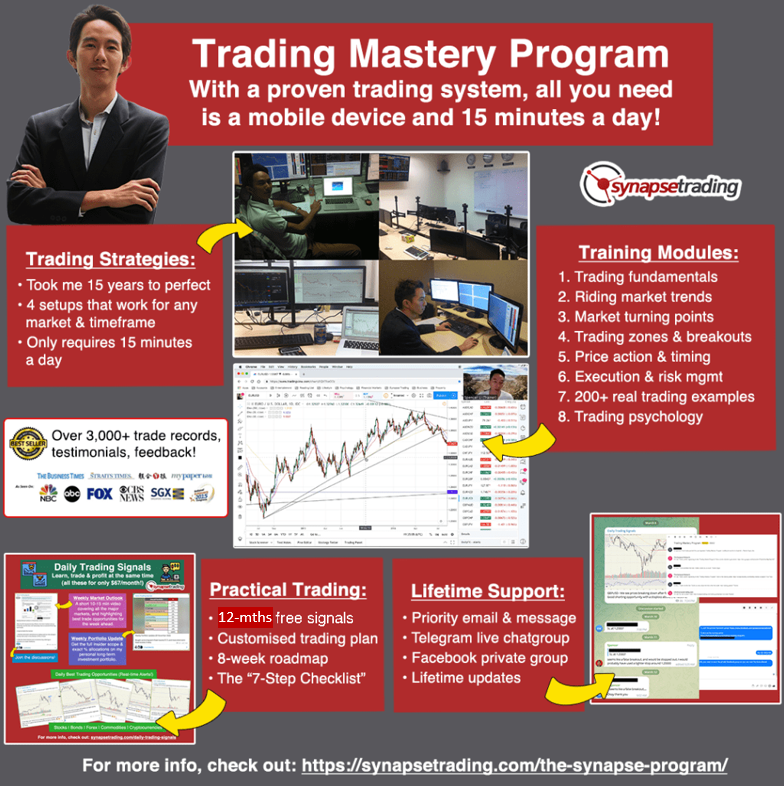 Our flagship mentoring program is suitable for both beginners and advanced traders, covering the 4 strategies which I used over the past 15 years to build up my 7-figure personal trading portfolio.
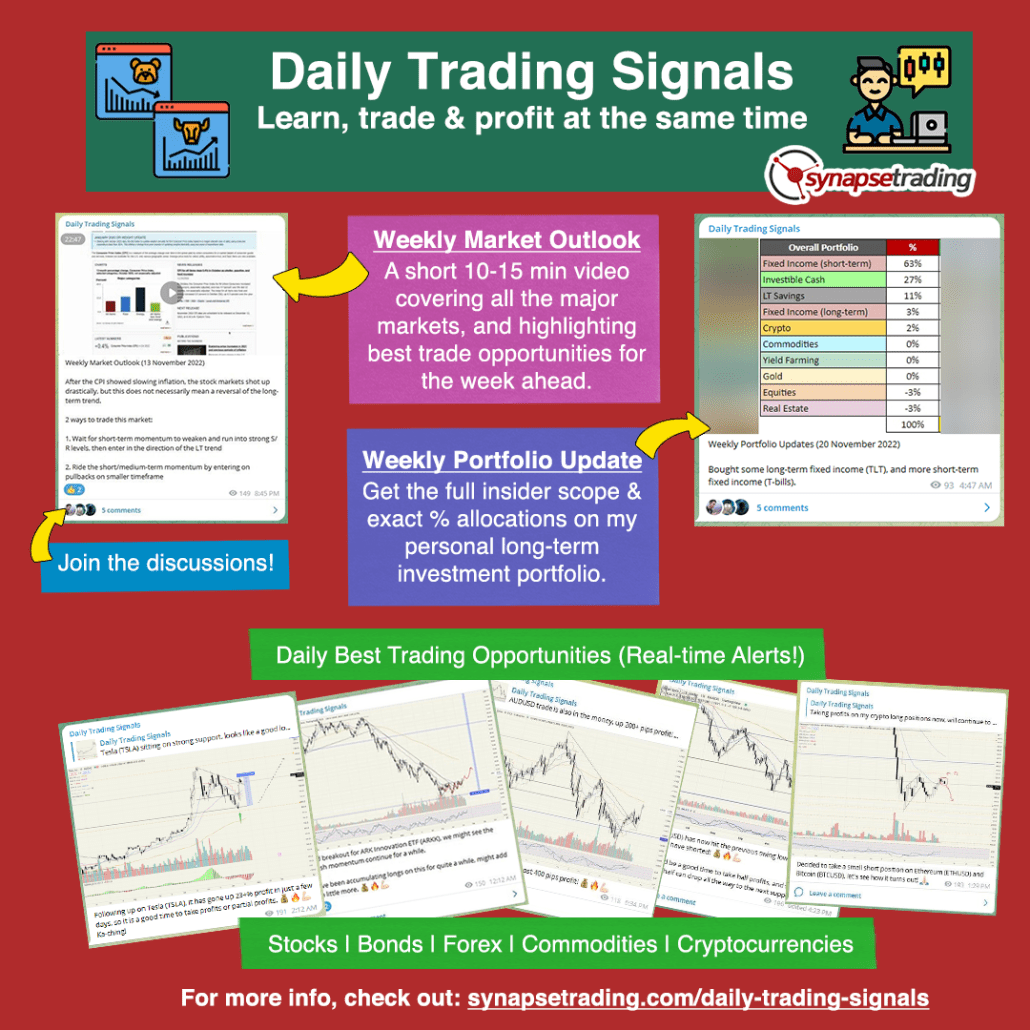 If you're looking for the best trading opportunities every day across various markets, and don't want to spend hours doing the research yourself, check out our private Telegram channel!


Leave a Reply
Want to join the discussion?Feel free to contribute!