• Link to Facebook
  • Link to X
  • Link to Instagram
  • Link to Youtube
  • Link to LinkedIn
  • Link to Mail
Synapse Trading
  • Home
  • About
    • My Background
    • My Trading Journey
    • My Travel Log
    • Media & Interviews
  • Mentoring
    • Trading Mastery Program
    • Results & Testimonials
  • Signals
    • Telegram (Free to join!)
    • Daily Trading Signals
    • Daily Trading Signals (Results)
  • Resources
    • Free Trading Guides
    • Tools & Resources
    • Blog & Infographics
  • Contact
    • Contact Us
    • Partnership Opportunities
  • Click to open the search input field Click to open the search input field Search
  • Menu Menu
Spencer Li

Weekly Market Wrap: 2 More Rates Hikes Coming Up?

Market Analysis
Thumbnail banner weekly market wrap x3

Thumbnail banner weekly market wrap x3


For subscribers of our “Daily Trading Signals”, we now also include a “Weekly Market Report”, where we provide a weekly deep-dive on the market, including fundamentals, technicals, economics, and portfolio management:

Click here for last week’s market report (12 June 2023)
Click here to subscribe for the latest market report (19 June 2023)
Click here to see the archives of all our past market reports

Market Recap & Upcoming Week

Last week, the Federal Reserve raised the Fed Funds rate for the tenth time, resulting in the highest prime rate in almost two decades. The U.S. debt continues to grow, limiting access to capital and damaging the credit rating.

However, the inflation rate in the U.S. softened in May, providing some relief and reducing pressure on the Federal Reserve to continue raising interest rates.

Meanwhile, the People’s Bank of China (PBOC) cut lending rates due to the struggles of the post-Covid recovery, marked by decreased lending and economic credit growth.

The market transitioned into a bull phase, with the S&P 500 entering a bull market and positive investor sentiment prevailing.

The Federal Reserve halted interest rate increases for now but signaled the possibility of two more hikes by year-end.

Looking ahead, investors will closely monitor the Federal Reserve’s decisions, inflation trends, and the ongoing economic recovery to navigate market dynamics and anticipate future monetary policy adjustments.

This week, investors should pay attention to the housing market updates, including building permits, housing starts, and the NAHB’s Housing Market Index. These indicators will provide valuable insights into the health and momentum of the housing sector.

Federal Reserve Chair Jerome Powell’s testimony before Congress will also be a significant event, as it could provide clues about the central bank’s monetary policy direction.

Additionally, the release of S&P Global’s Purchasing Managers’ Index for June will offer valuable data on the overall economic activity and sentiment.

In the corporate landscape, keep an eye on the earnings reports from companies such as FedEx, Accenture, Darden Restaurants, and BlackBerry. These reports will shed light on the financial performance of these companies and provide indications of industry trends. The market will be keen to assess the impact of recent developments and economic conditions on their results.

Overall, this week presents a range of key economic indicators and corporate updates that will shape market sentiments and provide valuable insights into the housing market, economy, and corporate performance.

Daily Trading Signals (Highlights)

We cover 3 main markets with a total of 200+ counters, so we will never run out of trading opportunities:

  • Forex, CFDs, commodities, bonds
  • US stocks, ETFs, global stock indices
  • Cryptocurrencies, crypto indices

By covering a broad range of markets, we can focus our attention (and capital) on whichever market currently gives the best returns.

Subscribe for real-time alerts and weekly reports:
👉🏻 https://synapsetrading.com/daily-trading-signals


Trading Signals AUDNZD 160623

AUDNZD – Following up, price are now at the top of the range, making it a good RR trade for a short.


Trading Signals China Tech ETFs 140623

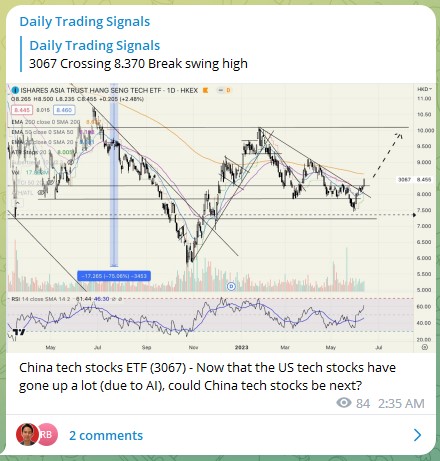
China tech stocks ETF (3067) – Now that the US tech stocks have gone up a lot (due to AI), could China tech stocks be next?

0 Comments/by Spencer Li
https://synapsetrading.com/wp-content/uploads/2023/05/Thumbnail-banner-weekly-market-wrap-x3.png 630 1200 Spencer Li https://synapsetrading.com/wp-content/uploads/2019/10/logo.jpg Spencer Li2023-06-18 01:04:132023-07-29 23:14:28Weekly Market Wrap: 2 More Rates Hikes Coming Up?
Spencer Li

Weekly Market Wrap: CPI and FOMC Coming Up Next Week!

Market Analysis
Thumbnail banner weekly market wrap x3

Thumbnail banner weekly market wrap x3


For subscribers of our “Daily Trading Signals”, we now also include a “Weekly Market Report”, where we provide a weekly deep-dive on the market, including fundamentals, technicals, economics, and portfolio management:

Click here for last week’s market report (05 June 2023)
Click here to subscribe for the latest market report (12 June 2023)
Click here to see the archives of all our past market reports


Market Recap & Upcoming Week

Last week presented a mixture of concerns and optimism in the financial world.

Morgan Stanley strategists painted a bearish picture for US equities, warning of potential corporate earnings falls that could hamper the ongoing rally. This was based on an expected 16% decrease in S&P 500 earnings per share this year, underpinned by a deteriorating liquidity backdrop, slowing revenue growth, and contracting margins.

On the other hand, there were still attractive investment opportunities identified in Japanese, Taiwanese, and South Korean equities, as well as developed-market government bonds and the dollar.

Investors also eyed the Fed’s potential response to the easing of inflation, as predicted by Evercore ISI strategists, which could provide continued support for the stock market.

The financial landscape was also shaped by potential shifts in interest rates and commodity prices.

The strong economic performance has challenged the expected significant interest rate cuts by the Federal Reserve this year, with derivative markets now predicting the Fed’s target rate to reach around 5% by year-end.

In tandem with this, the decreasing global commodity prices offered some relief for central banks in their battle against inflation, though the persistent inflation could still necessitate further rate hikes.

Amid these dynamics, the SEC’s charges against Binance for alleged securities law violations had a noticeable impact on the cryptocurrency market, driving prices down.

The week also saw significant movements in individual stocks, such as Apple reaching its highest price in its stock’s 43-year history, and surprising decisions from global central banks, like the Bank of Canada’s unexpected rate hike.

As we transition into the new week, the focus should remain steadfast on the key economic indicators due for release.

The Labor Department’s consumer prices data set for Tuesday will shed light on the current inflation scenario. This has been a persistent concern for both investors and policymakers alike, and further escalations could prompt market volatility.

Additionally, Wednesday’s producer price data will provide a broader perspective on the state of inflation across various sectors. These figures together will set the stage for the Federal Reserve’s policy meeting conclusions, adding another dimension to the inflation narrative.

The Federal Reserve’s decision on interest rate adjustments will undoubtedly be a highlight of the week. As the market continues to grapple with inflation, a change in the interest rate could significantly influence market sentiments.

A keen eye should also be kept on retail sales and consumer sentiment updates due later in the week, providing insights into consumer spending and confidence amidst current economic conditions.

Moreover, investors should tune into the earnings reports from Oracle, Adobe, Kroger, and Lennar Corporation for a more comprehensive understanding of the corporate landscape and sector-specific performance. These reports could potentially offer hints at market trends to come.


Daily Trading Signals (Highlights)

We cover 3 main markets with a total of 200+ counters, so we will never run out of trading opportunities:

  • Forex, CFDs, commodities, bonds
  • US stocks, ETFs, global stock indices
  • Cryptocurrencies, crypto indices

By covering a broad range of markets, we can focus our attention (and capital) on whichever market currently gives the best returns.

Subscribe for real-time alerts and weekly reports:
👉🏻 https://synapsetrading.com/daily-trading-signals


NZDCAD 080623

NZDCAD – Following up on this trade, it has hit our TP! Congrats to those who followed! 💰🔥💪🏻

Now that prices are in the oversold zone, there is likely a rebound before the next leg down.


EURGBP 080623

EURGBP – This has hit our TP for 163 pips profit, but since the price is still very bearish, you can consider taking half profits and letting the other half run.

Congrats to those who took this trade! 💰🔥💪🏻


Trading Signals AUDNZD 060623

AUDNZD – Prices nearing top of range, and RSI in overbought zone, will watch for bearish price action here to take a short position.

Do note that current short-term price action is very bullish, so there needs to be a few bearish price bars to justify a short-term price reversal.


Trading Signals USDSGD 060623

USDSGD – Prices have hit our first TP, and now looks to be forming a potential bull flag or cup & handle pattern.

If the breakout is successful, there is a good chance for another leg up.


Trading Signals EURAUD 060623

EURAUD – Following up on this trade, prices have started falling, putting this trade in the money, and it is halfway to our TP. 💪🏻💰🔥


Trading Signals BTCUSD 060623

Bitcoin (BTCUSD) – Price dropping back to the support zone after the news of Binance getting sued came out.

Can either wait for the dust to settle, or take the chance to accumulate some long positions and just place a SL below the support zone.

0 Comments/by Spencer Li
https://synapsetrading.com/wp-content/uploads/2023/05/Thumbnail-banner-weekly-market-wrap-x3.png 630 1200 Spencer Li https://synapsetrading.com/wp-content/uploads/2019/10/logo.jpg Spencer Li2023-06-10 14:56:462023-07-29 23:14:49Weekly Market Wrap: CPI and FOMC Coming Up Next Week!
Spencer Li

Weekly Market Wrap: Stock Market Surges on Strong Jobs Data!

Market Analysis
Thumbnail banner weekly market wrap x3

Thumbnail banner weekly market wrap x3


For subscribers of our “Daily Trading Signals”, we now also include a “Weekly Market Report”, where we provide a weekly deep-dive on the market, including fundamentals, technicals, economics, and portfolio management:

Click here for last week’s market report (29 May 2023)
Click here to subscribe for the latest market report (05 June 2023)
Click here to see the archives of all our past market reports


Market Recap & Upcoming Week

The past week in the financial world was marked by key developments across the US and Chinese stock markets, significant corporate milestones, and noteworthy trends in the labor market. Trading was halted on Monday, May 29th, as the US observed Memorial Day, with the New York Stock Exchange, Nasdaq, and US bond market all closed.

Amid this quiet start to the week, chip manufacturer Nvidia made headlines by becoming the sixth US company to reach a $1 trillion market capitalization, largely thanks to the growing demand for its AI-optimized chips. This achievement illustrates the wider market trend of big companies growing bigger, with investors increasingly betting on dominant market leaders.

Conversely, Chinese shares entered a bear market, indicating increasing pessimism about the country’s economic recovery, despite earlier hopes fueled by government efforts to revive the property sector and the lift of strict Covid-19 restrictions.

Meanwhile, the US labor market showed signs of resilience, with job openings reaching a seasonally adjusted 10.1 million in April, despite the recent collapse of Silicon Valley Bank. The US stock market saw significant gains following a strong jobs report that exceeded Wall Street expectations, signalling robust hiring amidst slowing inflation. This, coupled with a late deal to avert a government default, sparked a major uptick in the market.

As we move into the upcoming week, investors should be prepared for a potentially calmer trading period, following last week’s surge in response to a deal to raise the debt ceiling. The week is set to commence with the worldwide developer conference hosted by Apple, where the tech giant is anticipated to reveal new releases.

Market watchers should keep a keen eye on the various economic indicators slated for release in the coming days, including updates on U.S. factory orders, non-manufacturing services, the U.S. trade deficit, and consumer credit data. These figures will provide insights into the health and trajectory of the U.S. economy amid global inflation concerns and recovery from the pandemic.

In terms of corporate earnings, the week will bring reports from an eclectic mix of companies, encompassing various sectors. Names to watch include J.M. Smucker, GameStop, Brown Forman, DocuSign, and Seneca Foods. The performance of these businesses, particularly retail sector players like GameStop, could offer a barometer for consumer sentiment and sector trends.

Daily Trading Signals (Highlights)

We cover 3 main markets with a total of 200+ counters, so we will never run out of trading opportunities:

  • Forex, CFDs, commodities, bonds
  • US stocks, ETFs, global stock indices
  • Cryptocurrencies, crypto indices

By covering a broad range of markets, we can focus our attention (and capital) on whichever market currently gives the best returns.

Subscribe for real-time alerts and weekly reports:
👉🏻 https://synapsetrading.com/daily-trading-signals


Trading Signals DBC 310523

Commodities ETF (DBC) – TP1 has been hit, waiting for TP2 to get hit. Congrats to those who took this trade! 💰🔥💪🏻


Trading Signals SE 020623

Sea Limited (SE) – Great chance to take some profits on the short position after the stock has dropped 22%!

Can continue to hold some for TP2.


Trading Signals US100 310523

NASDAQ 100 (US100) – Prices broke higher than I expected, but now it is even more overbought and we are seeing an island shooting star, so perhaps there might be some pullback.

0 Comments/by Spencer Li
https://synapsetrading.com/wp-content/uploads/2023/05/Thumbnail-banner-weekly-market-wrap-x3.png 630 1200 Spencer Li https://synapsetrading.com/wp-content/uploads/2019/10/logo.jpg Spencer Li2023-06-02 01:39:472023-07-29 23:13:15Weekly Market Wrap: Stock Market Surges on Strong Jobs Data!
Spencer Li

Weekly Market Wrap: Debt Ceiling Fears vs. AI Hype?

Market Analysis
Thumbnail banner weekly market wrap x3

Thumbnail banner weekly market wrap x3


For subscribers of our “Daily Trading Signals”, we now also include a “Weekly Market Report”, where we provide a weekly deep-dive on the market, including fundamentals, technicals, economics, and portfolio management:

Click here for last week’s market report (22 May 2023)
Click here to subscribe for the latest market report (29 May 2023)
Click here to see the archives of all our past market reports


Market Recap & Upcoming Week

Last week, Nvidia’s Q1 fiscal 2023 earnings report exceeded market predictions, resulting in a significant surge in the company’s shares. The strong performance is mainly attributed to Nvidia’s leading position in the production of artificial intelligence chips and a significant increase in demand for its data center products.

As a result, Nvidia’s net income saw an increase from the previous year. Meanwhile, Wall Street was preparing for a potential U.S. default, following Treasury Secretary Janet Yellen’s announcement about the U.S. potentially running out of cash for bill payments. This led to contingency plans to maintain the financial market operations in case of a default.

Furthermore, Treasury yields and mortgage rates reached new multi-year highs, indicating the bond market’s expectation for further rate hikes. The rise in the six-month yield suggests traders are pricing in another rate hike in the coming months. Unlike the previous rate-hike cycle in 2018-2019, which aimed to normalize monetary policy amid relatively lower inflation, the recent rate hikes respond to higher inflation rates. The six-month yield’s highest point in 22 years implies a shift in the market’s perception of the Federal Reserve’s policy direction.

As we head into a holiday-shortened trading week, investors should closely monitor the strength and weaknesses of the various currencies and the stock market. With a strong rebound in the USD, continuous weakness in the Aussie and New Zealand dollars, and strong pound, these shifts in the forex market can significantly influence financial strategies. In addition, the general weakness observed in the stock market last week may continue to affect portfolios.

Moreover, the potential resolution of the debt ceiling in the US could trigger significant market moves. Especially if it isn’t resolved, the surprise could lead to large market movements, so staying alert to this development is crucial.

In addition, investors should keep an eye on key economic indicators and corporate earnings. With the release of reports like the Case-Shiller National Home Price Index, FHFA House Price Index (HPI), the Job Openings and Labor Turnover Survey (JOLTS), and the Labor Department’s nonfarm payrolls report, understanding the current state of the housing and labor markets in the US is essential. Furthermore, updates on inflation and unemployment rates in the eurozone will give valuable insights into its economic health.

Lastly, earnings reports from Salesforce, HP, Broadcom, Dollar General, Lululemon Athletica, Macy’s, and Dell Technologies will provide key insights into the performance of these companies and, by extension, the sectors they operate in.

Daily Trading Signals (Highlights)

We cover 3 main markets with a total of 200+ counters, so we will never run out of trading opportunities:

  • Forex, CFDs, commodities, bonds
  • US stocks, ETFs, global stock indices
  • Cryptocurrencies, crypto indices

By covering a broad range of markets, we can focus our attention (and capital) on whichever market currently gives the best returns.

Subscribe for real-time alerts and weekly reports:
👉🏻 https://synapsetrading.com/daily-trading-signals


NZDUSD 260523

NZDUSD – Our patience has finally paid off, and prices are now falling rapidly. Congrats to those who held the short patiently! 💰🔥💪🏻


Trading Signals AUDUSD 240523

AUDUSD – Price continue to head down, going to test the previous swing low soon.


Trading Signals USDJPY 240523

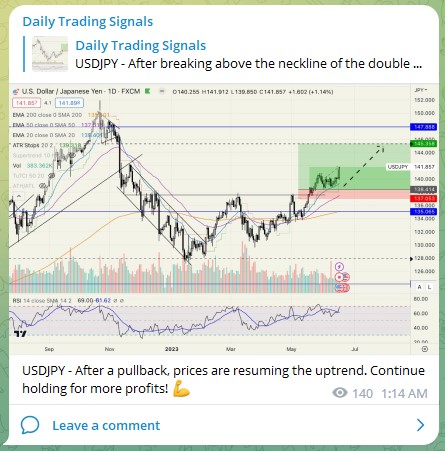
USDJPY – After breaking above the neckline of the double bottom, the RR ratio is good for a long trade.


Trading Signals NZDJPY 240523

NZDJPY – A range-trading opportunity, can wait for prices to pull back higher for a better entry.


Trading Signals china tech stocks 280523
China tech stocks (3067) – Looks like the rally has stalled, we will need to see if the final support level of around $7.25 holds.

0 Comments/by Spencer Li
https://synapsetrading.com/wp-content/uploads/2023/05/Thumbnail-banner-weekly-market-wrap-x3.png 630 1200 Spencer Li https://synapsetrading.com/wp-content/uploads/2019/10/logo.jpg Spencer Li2023-05-28 04:55:432023-07-29 23:12:35Weekly Market Wrap: Debt Ceiling Fears vs. AI Hype?
Spencer Li

Explaining the Debt Ceiling: What Happens in A Default?

Economics & News Trading
Thumbnail Explaining the Debt Ceiling

What Is the Debt Ceiling, and What Happens If the US Defaults?

Last updated: 3 July 2026 · By Spencer Li, CFTe


The debt ceiling is the legal cap on how much the US Treasury can borrow to pay for spending Congress has already approved. When borrowing nears the cap, Congress has to vote to raise or suspend it, or the government runs out of room to pay its bills. If the ceiling is breached and the US defaults, the Treasury would have to prioritise some payments over others, interest rates would likely spike, the bond market and stock market could panic, and credit agencies could downgrade US debt. The good news: an actual default has never happened, because Congress has raised the ceiling more than 70 times since 1960, usually after some political brinkmanship and a last-minute deal. The risk that gets priced into markets is rarely the default itself. It is the uncertainty in the weeks before the deal.

Here is what the debt ceiling is, why the US debt got so big, what a real default would do, and whether the ceiling should exist at all.

What is the debt ceiling and why does it matter?

The debt ceiling is the maximum amount the US Treasury is legally allowed to borrow to meet obligations the government has already committed to.

The mechanics are simpler than the headlines suggest. The government raises money through taxes and other revenue. When spending runs ahead of revenue, you get a gap. That gap is bridged by borrowing, which adds to the national debt. But the borrowing is not unlimited. Congress sets a legislative cap on it, and that cap is the debt ceiling.

When the debt nears the cap, Congress has to step in and either suspend or raise it, which gives the Treasury permission to keep borrowing. That back-and-forth between spending, borrowing, and a legislative vote is the whole debt ceiling drama in one sentence.

Do note that, the ceiling does not authorise new spending. It authorises borrowing to pay for spending Congress already voted for. That distinction is the source of most of the confusion in the news cycle.

Where did the debt ceiling come from?

The debt ceiling is not a recent invention. It dates back to 1917, when Congress created it to set an upper limit on how much federal debt the US government could pile up.

It has not stayed put. As the economy grew and the government’s financial commitments grew with it, the ceiling has been raised many times. Congress has lifted the bar more than seventy times since 1960, and each hike signalled a fresh need for borrowed funds. By the early 2020s, both the national debt and the ceiling sat above $31 trillion.

Why is the US debt so high?

The US national debt is the product of several forces stacking on top of each other over decades: tax cuts that lowered revenue, sustained overspending, expensive crises, and large mandatory programmes. Between 2009 and 2023, the national debt nearly tripled.

Here are the main drivers:

  • Tax cuts that reduced revenue. Major tax cuts, from the Reagan-era cuts in the 1980s through the cuts under the Trump administration, lowered federal revenue. They were aimed at stimulating growth, but the side effect was less money coming in.
  • Government overspending. Long military campaigns, such as the wars in Iraq and Afghanistan, carried huge immediate costs plus long-term obligations like veterans’ healthcare and disability benefits.
  • Crisis spending. The 2008 recession forced enormous spending to rescue failing institutions. The Covid-19 pandemic forced massive stimulus to support businesses and individuals. Both strained the budget further.
  • Mandatory programmes. Social Security, Medicare, and Medicaid are a large, growing share of the budget, driven up by an ageing population and rising healthcare costs.
  • Defence. The US spends more on its military than any other country, which is a substantial slice of total expenditure.

No single cause explains the debt. It is the sum of all of these, compounding over time.

What happens if the debt ceiling is breached?

If the US fails to raise the ceiling in time and defaults on its obligations, the consequences are severe and spread well beyond Washington. Here is what would likely unfold.

The government has to prioritise payments. With the law mandating that programmes like Social Security and Medicaid continue, the Treasury would be forced to decide what gets paid and what gets delayed, potentially suspending programmes people rely on.

Interest rates spike. The bond market reacts before any formal default, with yields on short-term debt moving as default risk rises. That can feed through to higher mortgage rates and borrowing costs for households and businesses. Even a brief default could leave the government paying more to borrow afterwards.

Markets panic. A breach could trigger turmoil reminiscent of the 2008 stock market crash. As bondholders sell and rates whip around, the volatility can destabilise markets, made worse by the fact that the US has never actually defaulted, so nobody knows exactly how it plays out.

A run on money market funds. As seen in 2008, a default could spark a run on money market accounts. If a large fund halts redemptions, the panic deepens and may need government intervention to stabilise.

Political instability. Around election seasons, the debt ceiling becomes a partisan weapon, with each side accusing the other of mismanagement. Everyone agrees a default is bad, but how far each side will bend in negotiations is never certain until the deal lands.

Lasting damage to US standing. A default could prompt credit agencies to permanently downgrade US debt, weakening America’s global standing and even challenging the US dollar’s status as the world’s reserve currency. The probability of an actual default has historically been estimated as low, but the potential damage is what makes it a serious concern, especially heading into a slowdown.

What options does the government have to avoid default?

When the Treasury hits the ceiling, it can deploy a set of “extraordinary measures” (accounting manoeuvres that free up borrowing room) to put off an immediate default. These include suspending the issuance of certain types of debt and redeeming existing investments inside civil service retirement funds.

These measures are a buffer, not a fix. They buy time for Congress to negotiate, like a financial fire drill. But they are limited in size and duration. They can only defer the default. If Congress does not raise or suspend the ceiling in time, the buffer runs out.

Do other countries have a debt ceiling?

Mostly, no. The US version is unusual. A few countries have a statutory borrowing limit, but they set it so high it is never a constraint, or they removed it entirely after it caused too much trouble. Here is how three approaches compare.

CountryHas a debt limit?How it worksCauses political crises?
United StatesYesHard cap that must be raised or suspended by Congress when debt approaches itYes, recurring brinkmanship and near-defaults
DenmarkYes (in name)Statutory limit set deliberately far above actual borrowing needs (around 950 billion DKK, roughly $150 billion USD as of 2021)No, the cap is so high it is never binding
AustraliaNo (abolished 2013)Had a US-style limit, scrapped it after political crises in the early 2010s; now governed by normal budget processesNo, removing it ended the standoffs

Denmark keeps a limit but sets it so far above its needs that it never becomes a flashpoint. Australia had a US-style cap, hit the same brinkmanship the US sees, decided the limit was causing more harm than good, and abolished it in 2013. Since then, Australia’s borrowing has been governed by ordinary budget processes and parliamentary checks rather than a fixed cap. The lesson from both: a debt limit can work as a theoretical safeguard, but only if it is designed so it does not become a source of political contention.

Should the debt ceiling be revoked?

There are two honest sides to this.

In favour of keeping it: the ceiling gives Congress a recurring checkpoint to evaluate the nation’s financial health. Supporters argue this process, contentious as it is, encourages fiscal responsibility and stops unchecked borrowing.

Against keeping it: critics say the ceiling is a relic that fits poorly with a modern economy. They argue it causes needless economic disruption and has become a tool for political brinkmanship rather than genuine fiscal discipline. The recurring crises expose the US to self-inflicted financial wounds and dent its credibility.

A growing number of economists favour reform, ranging from linking the ceiling directly to spending levels (so a separate vote is not needed) to abolishing it outright, which would bring the US in line with most developed countries.

Personally, I do not have a vote in Congress, and as a trader I do not need one. My job is not to be right about whether the ceiling should exist. It is to be positioned for either outcome and to not get shaken out by the noise in between.

How should a trader handle a debt ceiling standoff?

Treat it as a known, scheduled source of volatility, not a reason to predict the headline.

Every debt ceiling fight follows roughly the same arc: a deadline looms, the rhetoric escalates, markets get jumpy, and then a deal arrives close to the wire. The default itself has never happened. That does not mean it never will, but it does mean the tradeable event is almost always the uncertainty before the deal, not the catastrophe everyone fears.

A news feed will scream “DEFAULT” at you on a loop. It will not tell you whether the move is already priced in, how to size a position when volatility is elevated, or whether to simply stand aside until the setup is clean. That judgment is the first of the Five Edges a machine cannot trade for you. The headline is the easy part. Knowing what to do with it is the edge.

So when the next standoff hits, the question is not “will they default?” The question is “what does my system tell me to do right now, and am I sized so a fake panic cannot hurt me?”

FAQ

What is the debt ceiling in simple terms?
It is the legal limit on how much the US Treasury can borrow to pay for spending Congress has already approved. When borrowing nears the limit, Congress must vote to raise or suspend it, or the Treasury runs out of room to pay the government’s bills.

Has the US ever actually defaulted on its debt?
No. The US has never defaulted because of the debt ceiling. Congress has raised or suspended the ceiling more than seventy times since 1960, usually after political brinkmanship and a last-minute deal.

What would happen to the stock market if the US defaulted?
A default could trigger a market panic similar to 2008: bondholders selling, interest rates spiking, possible runs on money market funds, and a credit downgrade of US debt. Even the threat of default tends to raise volatility before any deal is reached.

Does the debt ceiling control how much the government spends?
No. The debt ceiling does not authorise new spending. It only authorises borrowing to pay for spending Congress has already voted for. That is why a fight over the ceiling is about paying existing bills, not approving new ones.

Do other countries have a debt ceiling like the US?
Most do not. Denmark keeps a statutory limit but sets it so high it is never binding, and Australia abolished its limit in 2013 after it caused repeated political crises. The US hard-cap model that forces recurring votes is unusual among developed nations.


So, two questions worth sitting with. First, given the damage a real default would do, should the debt ceiling mechanism be reconsidered? Second, if it is kept, how do we stop the political fights around it from harming the economy it is meant to protect? Let me know in the comments.

If you want the bigger picture on how macro headlines move markets, read the pillar: Macro and Market Cycles: A Trader’s Guide.

Want a calmer way to trade the noise? Grab the free 15-Minute Swing Trading Starter Kit. It is the exact routine I use to scan once a day and trade any market in 15 minutes, headlines or no headlines.


About the author. Spencer Li is the founder of Synapse Trading and a Certified Financial Technician (CFTe) with 15 years of trading across stocks, forex, crypto, commodities, and bonds. His trade log is public, 404 trades, losses left in. He teaches low-risk swing trading in 15 minutes a day, one system for any market.

Education, not financial advice. Synapse Trading is not licensed by MAS to advise on investment products. Trading carries risk of loss; past performance is not indicative of future results.


Related

Macro and Market Cycles (pillar) · How interest rates move markets · Trading market crashes and panics

0 Comments/by Spencer Li
https://synapsetrading.com/wp-content/uploads/2023/05/Thumbnail-Explaining-the-Debt-Ceiling.png 720 1280 Spencer Li https://synapsetrading.com/wp-content/uploads/2019/10/logo.jpg Spencer Li2023-05-21 22:33:432026-07-06 01:52:10Explaining the Debt Ceiling: What Happens in A Default?
Page 40 of 184«‹3839404142›»

Free Trading Guides

Free Trading Guides

Blog Categories

  • Beginner's Guide
  • Blockchain & Crypto
  • Book Summaries
  • Candlestick Patterns
  • Economics & News Trading
  • Investing & Portfolio Management
  • Living Your Best Life
  • Market Analysis
  • News & Events
  • Price Chart Patterns
  • Promotions
  • Risk & Money Management
  • Stock Trading
  • Testimonials
  • Tools & Resources
  • Trading Psychology
  • Trading Strategies
  • Trading Tips
  • Travel & Lifestyle

Free Trading Guides

Free Trading Guides

Contact Us

Synapse Trading Pte Ltd
Registration No. 201316168H

Whatsapp: +65-8897-1204
Telegram: @iamrecneps
Email: info@synapsetrading.com

Links

Disclaimer
Privacy policy
Terms & Conditions
Contact us
Partnerships

© 2012-2024 Synapse Trading | All rights reserved | - powered by Enfold WordPress Theme
  • Link to Facebook
  • Link to X
  • Link to Instagram
  • Link to Youtube
  • Link to LinkedIn
  • Link to Mail
Scroll to top Scroll to top Scroll to top