• Link to Facebook
  • Link to X
  • Link to Instagram
  • Link to Youtube
  • Link to LinkedIn
  • Link to Mail
Synapse Trading
  • Home
  • About
    • My Background
    • My Trading Journey
    • My Travel Log
    • Media & Interviews
  • Mentoring
    • Trading Mastery Program
    • Results & Testimonials
  • Signals
    • Telegram (Free to join!)
    • Daily Trading Signals
    • Daily Trading Signals (Results)
  • Resources
    • Free Trading Guides
    • Tools & Resources
    • Blog & Infographics
  • Contact
    • Contact Us
    • Partnership Opportunities
  • Click to open the search input field Click to open the search input field Search
  • Menu Menu
Spencer Li

My Trading Journey – From Broke to Financially Free in 7 Years!

Living Your Best Life
trading journey thumbnail

My Trading Journey: How I Went From Broke College Student to Trading Full-Time

Last updated: 3 July 2026 · By Spencer Li, CFTe


I started trading as a broke college student working part-time jobs to pay my way through school, and over about 15 years I built it into a full-time living and a teaching business. The short version: I got the formal credentials first (double degree in Accounting and Business Finance, then the Certified Financial Technician (CFTe) qualification and CFA Level 1), realised I did not want a desk-bound banking job, and spent more than 10,000 hours studying charts and backtesting strategies until I had a system I trusted. That system, the one I still use, takes about 15 minutes a day and works on any market. There was no shortcut and no single lucky trade. It was years of reading, screen time, and keeping a public record of my results, losses included.

This is the long version, from the part-time jobs to the speaking tours, and what I would tell you to copy and what to ignore.

Where I started: a broke college student, not a trust fund

I did not come from a well-to-do family. I worked several part-time jobs to pay my way through college, and I knew that if I wanted a different life, I had to earn the skills myself.

At first I assumed the most direct route was a formal degree leading to a high-paying bank job. So I worked hard for it. I got into a strong high school, then into one of the top business universities in Singapore, scored well across the board (top-few-percent SAT range), and on the side became a nationally ranked chess player (7th). In college I took double degrees in Accounting (B.Acc) and Business Finance (B.BM) to build the foundation and research skills to actually understand markets. I made the Dean’s list and picked up a few awards along the way.

Then I noticed the catch. Bankers are paid decently, but you largely sell your time and your soul to the job, with little room to enjoy the money. That is true of most corporate roles. I decided I would rather take on the markets myself than work for the bank.

Learning the hard way: 10,000 hours of books and backtesting

There was no clever hack here. I read hundreds of books on trading and investing (I still log every one on my Goodreads), and I put in well over 10,000 hours studying markets and charts. I backtested almost every strategy, indicator, and system I could get my hands on. The research was thorough to the point of obsessive.

That phase is unglamorous and most people quit during it. Personally, I think that is the real filter. The edge is not a secret indicator. It is the willingness to do the boring repetitions until you genuinely know what works and, more importantly, what does not.

[photo: snapshot of my Goodreads account where I log all my reading]

Getting certified: was the CFTe (and CFA) worth it?

Honestly, yes and no, and it depends on what you want.

I became a globally recognised Certified Financial Technician (CFTe), the technical-analysis qualification awarded by IFTA (the International Federation of Technical Analysts). It normally takes months or years of study to pass. I was also offered a scholarship by the CFA (Chartered Financial Analyst) Institute, cleared Level 1, and then chose to stop, because by then I was close to finishing my own trading system and would rather spend the hours there.

Here is my honest take. The certifications taught me real structure and gave me credibility later when funds and institutions wanted to know I was not just lucky. But a certificate does not make you profitable. Plenty of certified people lose money, and plenty of profitable traders have no letters after their name. Treat credentials as a foundation, not a finish line.

Building the system: why “15 minutes a day” is the whole point

After years of studying, trading, testing, and tweaking, I finished what I call my “15-Minute System.” It mattered to me because of a few specific features:

  • It needs about 15 minutes a day to trade, so I can run it in spare pockets of time.
  • It works on any market: stocks, forex, futures, commodities, crypto, and so on.
  • I only need a mobile phone to get the signals and place the trades, so I can trade anywhere.
  • It does not require me to sit and monitor the screen all day.
  • It is built on predictive price action and behavioural analysis rather than lagging indicators.
  • It targets medium-term moves using four price-action strategies.

That last point is the bit most people miss, so let me explain it plainly. Short-term moves are dominated by computer algorithms, and long-term moves are dominated by fund managers. The medium-term swings in between are where a retail trader actually has room to compete. That is the lane the system trades. (If you want the full pattern set behind it, that lives in the Definitive Guide to Trading Price Chart Patterns.)

What the journey actually looked like, by stage

Here is the path in order, so you can see roughly what came when.

StageWhat I didWhat it taught me
Broke studentPart-time jobs, top-school grades, double degree (Accounting + Business Finance), chess at national levelDiscipline and study habits, not money
Self-studyHundreds of books, 10,000+ hours of charts, backtested almost everythingWhat actually works versus what only sounds clever
CertificationEarned the CFTe; cleared CFA Level 1, then stopped on purposeStructure and credibility, but not profitability on their own
SystemBuilt the 4-strategy, 15-minute, any-market system on price actionA repeatable process beats a clever one-off call
Trading and travelTraded from a phone across 70+ countries and 6 continentsFreedom is the real payoff, not the flex
TeachingMedia features, fund and exchange trainings, global workshopsThe skill compounds when you teach it

Trading while travelling: the freedom was the real reward

Once the system worked, I only needed a phone and an internet connection. So I did the thing I had wanted to do for years and travelled. Over time I made it to 70+ countries and hundreds of cities across six continents, still spending about 15 minutes a day “working.” I keep the photos and routes in a separate travel log if you want ideas.

Alongside the trading, I funnelled profits into longer-term holdings to build more than one income stream: a mix of fixed income, ETFs, tech stocks, REITs, property, and some private businesses. I will be honest about the point of this section, and it is not to brag. I came from a humble background and earned every cent the slow way, so I have no interest in flashy cars, luxury watches, or branded clothes. I do not own a car. I am perfectly happy seeing the world in jeans and sneakers. I am only showing you what is possible if you are willing to do the work. Your version does not need to look anything like mine.

Teaching it: media, funds, and the speaking years

After a while the financial press started covering what I was doing, and the interview requests came in. I fit in around 20 media features around my travel schedule. The Business Times noted that I had “developed [my] own way of reading charts to understand markets,” and Synapse has since reached a large global audience through its articles, videos, and seminars.

That visibility led to funds and financial institutions, including the Singapore Exchange, asking me to share strategies and train their staff. I tried being a “professional trader” inside an institution for a year or two. It was profitable, but I missed the freedom of trading my own accounts rather than being desk-bound.

What I did love was the teaching. It struck me that retail traders rarely get the same quality of training that funds get, so I started running workshops, seminars, and full-weekend courses, and took guest-speaking slots where my schedule allowed. I shared stages over the years with speakers like Chris Gardner (the inspiration for “The Pursuit of Happyness”), Jim Rogers (co-founder of the Quantum Fund), Jay Abraham, Brian Tracy, and prop-trading manager Mike Bellafiore. In 2015 I spoke at the National Achievers Congress in Singapore to a live audience of more than 2,500 people.

[photo: speaking on stage at one of the live events]

My mission now: everything, online, for anyone willing to learn

These days I have stepped back from the constant guest-speaking circuit. The mission did not change, only the format. I took the time to consolidate everything I teach and put it online so anyone, anywhere, can learn it without needing to fly to a seminar.

That means the same system and the same training I used are now available to you directly. The only real question is whether you are ready to start.

One honest caveat: the system is the easy part

Here is the bit a good origin story usually leaves out. The four strategies and the daily routine are learnable. You can absorb the pattern recognition in weeks. The hard part is everything around it: standing aside when there is no clean setup, sizing so a bad run does not hurt you, and following the same boring process on day 400 the way you did on day 1.

A scanner can flag a setup in a second now. It will not supply the judgment to skip the bad one, or the discipline to keep your risk fixed when you are tempted to push. That judgment is the first of the Five Edges no tool can trade for you, and it is the part actually worth learning. The journey above is really just 15 years of building that judgment, one trade at a time.

FAQ

Who is Spencer Li?
Spencer Li is the founder of Synapse Trading and a Certified Financial Technician (CFTe) with around 15 years of trading across stocks, forex, crypto, commodities, and bonds. He keeps a public trade log with losses left in, and teaches a low-risk swing-trading system that takes about 15 minutes a day on any market.

How did Spencer Li get started in trading?
He started as a broke college student working part-time jobs, took double degrees in Accounting and Business Finance, then spent 10,000+ hours self-studying, reading hundreds of books, and backtesting strategies before building his own price-action system.

Is the CFTe certification worth it for traders?
The CFTe (Certified Financial Technician) gives you real structure in technical analysis and credibility with institutions, which is why I pursued it. It does not make you profitable on its own. Treat it as a foundation, not proof you can trade.

What is the “15-Minute System”?
It is a swing-trading approach built on four price-action strategies that targets medium-term market moves. It needs about 15 minutes a day, can be run from a phone, and works across stocks, forex, futures, commodities, and crypto.

Do I need a finance degree or certification to trade?
No. The degree and certifications helped me, but plenty of profitable traders have neither, and plenty of certified people still lose money. The screen time, the process, and the discipline matter far more than the credentials.


So that is the journey, the long way round and with no shortcut hiding in it. The question I will leave you with is the same one I asked myself back when I was broke and reading my first trading book: are you ready to start your own?

If you want the framework behind the system, start with the pillar: The Definitive Guide to Trading Price Chart Patterns.

Want the exact routine? Grab the free 15-Minute Swing Trading Starter Kit. It is the same once-a-day process I use to trade any market in 15 minutes.


About the author. Spencer Li is the founder of Synapse Trading and a Certified Financial Technician (CFTe) with 15 years of trading across stocks, forex, crypto, commodities, and bonds. His trade log is public, 404 trades, losses left in. He teaches low-risk swing trading in 15 minutes a day, one system for any market.

Education, not financial advice. Synapse Trading is not licensed by MAS to advise on investment products. Trading carries risk of loss; past performance is not indicative of future results.


Related

Definitive Guide to Price Chart Patterns (pillar) · The 15-Minute Swing Trading System · Expanding Triangle Strategy · About Synapse Trading

0 Comments/by Spencer Li
https://synapsetrading.com/wp-content/uploads/2021/07/trading-journey-thumbnail.png 720 1280 Spencer Li https://synapsetrading.com/wp-content/uploads/2019/10/logo.jpg Spencer Li2021-07-24 03:57:342026-07-06 03:22:01My Trading Journey – From Broke to Financially Free in 7 Years!
Spencer Li

Analyzing Price Patterns on Multiple Timeframes

Price Chart Patterns
Analyzing Price Patterns on Multiple Timeframes

Another interesting feature of price patterns is how they play out across different timeframes.

For example, if you see a pattern on the current timeframe chart you are using, have you wondered how it would look like on a timeframe which is higher or lower?

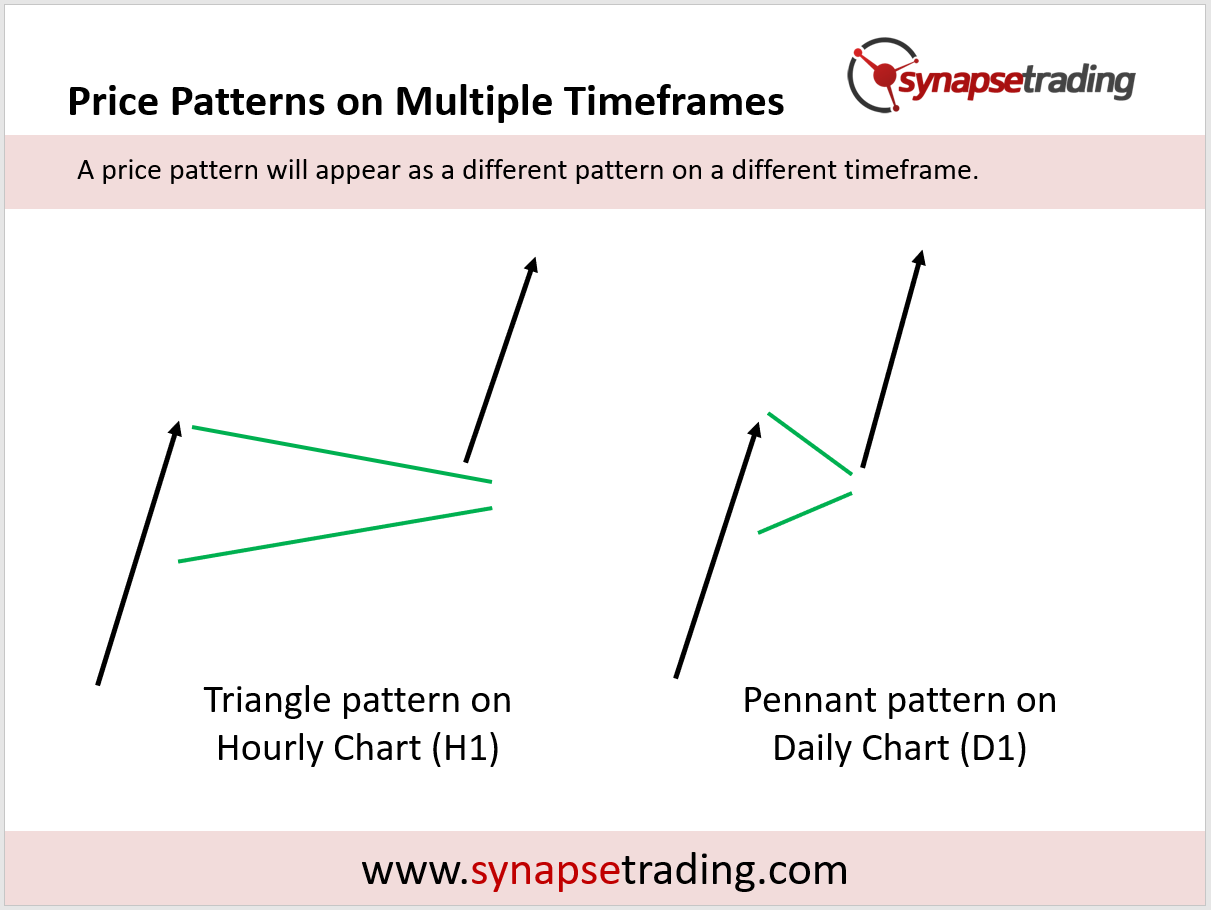
price patterns on multiple timeframes


Looking at the example above, on the left we have a chart which is in the hourly timeframe, and on the right we have the same chart in the daily timeframe.

When you transit from an hourly timeframe to a daily timeframe, what happens is that the prices get “compressed”, because now all those hours are packed into one day.

So in this chart, we see the triangle pattern on the hourly chart get compressed into a pennant pattern on the daily chart.

So you might be thinking, how is this relevant to actual trading?

Well, for starters, this give you more context.

When you are studying the chart pattern on the current timeframe, thinking about how the pattern on the larger timeframe looks like literally gives you a bigger picture, allowing you to strategize your trades better.


thumbnail the definitive guide to trading price chart patterns

If you would like to learn all the different price chart patterns, also check out: “The Definitive Guide to Trading Price Chart Patterns”

0 Comments/by Spencer Li
https://synapsetrading.com/wp-content/uploads/2021/07/Analyzing-Price-Patterns-on-Multiple-Timeframes.png 720 1280 Spencer Li https://synapsetrading.com/wp-content/uploads/2019/10/logo.jpg Spencer Li2021-07-17 21:33:062022-12-21 02:30:50Analyzing Price Patterns on Multiple Timeframes
Spencer Li

Combining Price Patterns with Classical Technical Analysis & Indicators

Price Chart Patterns
Combining Price Patterns with Classical Technical Analysis Indicators 1

One of the advantages of price patterns is that they are very versatile, allowing you to combine or use them in conjunction with other trading tools or methodologies.

For example, if your main method of analysis is Elliot Wave theory, the continuation price patterns will help you analyse the different consolidation permutations, such as flags, pennants, triangles, etc.

If your main method of analysis is using classical technical analysis methods like trendlines, channels, support & resistance levels, the lines you draw on the chart will quite often encompass various price patterns, and knowing how to identify the patterns will give you an added edge.

If your main method is using technical indicators, then price patterns will help you add a visual dimension to your analysis.

For example, if the current price pattern is a rectangle pattern, then using oscillators might be useful because they can help you trade within the range, but if the pattern is a flag pattern, then you might want to avoid trading against the trend even if the oscillator gives an entry signal.

Another example, if your MACD gives a reversal signal, you can double-check your charts to see if there is any reversal pattern in the works, or any signs that one might be starting to form. So in a sense, they can both act as independent signals for confirmation, since one is mechanical and one is visual.


thumbnail the definitive guide to trading price chart patterns

If you would like to learn all the different price chart patterns, also check out: “The Definitive Guide to Trading Price Chart Patterns”

0 Comments/by Spencer Li
https://synapsetrading.com/wp-content/uploads/2021/07/Combining-Price-Patterns-with-Classical-Technical-Analysis-Indicators-1.png 720 1280 Spencer Li https://synapsetrading.com/wp-content/uploads/2019/10/logo.jpg Spencer Li2021-07-17 21:30:282022-07-18 22:27:03Combining Price Patterns with Classical Technical Analysis & Indicators
Spencer Li

Trading Price Patterns with the Trend

Price Chart Patterns
Trading Price Patterns with the Trend

When looking for price patterns on your chart, it is important to take note of the context in which the patterns appear.

The most important context is probably the trend.

In an uptrend, you want to be looking for continuation patterns, which will give you a good opportunity to get onto the trend, whereas if the trend has been going on for a long time, and you feel that there is a high chance it might be coming to an end soon, then you will want to be looking out for reversal patterns.

For example, if you see a weak reversal pattern (eg. pattern is small relative to the trend) in a strong trend that is relatively new, the odds of a successful reversal are rather slim, so it would be more prudent to continue observing before diving into the trade, or even wait for the reversal pattern to fail and use it as a chance to enter the trend.

trend trading with triangle patterns

Looking at the chart example above of a triangle pattern, although the pattern is technically neutral and can break out in either direction, the odds favour an upside breakout because of the prior uptrend.

Hence when assessing any chart pattern, we need to take into account the prior trend, as well as the context in which the pattern occurs.


thumbnail the definitive guide to trading price chart patterns

If you would like to learn all the different price chart patterns, also check out: “The Definitive Guide to Trading Price Chart Patterns”

0 Comments/by Spencer Li
https://synapsetrading.com/wp-content/uploads/2021/07/Trading-Price-Patterns-with-the-Trend.png 720 1280 Spencer Li https://synapsetrading.com/wp-content/uploads/2019/10/logo.jpg Spencer Li2021-07-17 21:25:512022-12-21 02:29:31Trading Price Patterns with the Trend
Spencer Li

Continuation Price Patterns vs. Reversal Price Patterns

Price Chart Patterns
Continuation Price Patterns vs Reversal Price Patterns

There are 2 categories of price patterns, mainly continuation patterns and reversal patterns.

Continuation patterns, are their name suggests, usually leads to a continuation of the prior price trend.

You are likely to see them in the middle of a trend, when the price is taking a pause, and forms a consolidation to build up the strength for the next leg of movement.

Reversal patterns, on the other hand, usually leads to a reversal or change in the existing trend.

You are likely to see them after a prolonged trend (which has a high chance of coming to an end), when the price is exhausted in one direction and is getting ready to change direction.

Do note that it is much harder to change the direction of an existing trend, hence reversal patterns tend to be larger, and take longer to form and complete.


Here is a slide which gives an overview on all the patterns and how they are classified.

main types of price patterns


Next, let’s dive straight in, and study the different types of price patterns!

Just a quick refresher, there are 2 main types of chart patterns – continuation chart patterns and reversal chart patterns.

Continuation patterns continue the existing trend,

eg. downtrend > price pattern > downtrend,
or uptrend > price pattern > uptrend;

whereas reversal patterns change the existing trend,

eg. downtrend > price pattern > uptrend,
or uptrend > price pattern > downtrend.


The Trend Affects the Type of Patterns

The type of pattern that is formed generally depends on how far the trend has progressed.

If the trend is in the early stages, it tends to be stronger, so you only get small consolidation patterns, such as the bull flag, bear flag, or pennants.

If the trend is in the later stage, you start to see larger patterns, such as the rectangles and triangles (ascending triangle, descending triangle, symmetrical triangle).


Continuation Chart Patterns

The patterns highlighted in blue, such as the rectangle and symmetrical triangle, are considered neutral patterns, meaning they do not have a directional bias, and prices can break out of either side once the pattern is completed.

On the other hand, the patterns highlighted in red have a bearish bias (descending triangle, bear flag), while those highlighted in green have a bullish bias (ascending triangle, bull flag).

HOW TO TACKLE EACH CONTINUATION PATTERN

The main idea behind continuation patterns is that after the pattern is completed, the trend is expected to continue.

Hence, the best strategy involves finding continuation patterns in the middle of strong trends, and waiting for the opportunity to enter the trade once the trend resumes.


THE TREND AFFECTS THE TYPE OF PATTERNS

As we mentioned earlier in the introduction to continuation patterns, the type of pattern that is formed generally depends on how far the trend has progressed.

If the trend is in the early stages, it tends to be stronger, so you only get small consolidation patterns, while as the trend gets weaker, you start to see larger patterns.

Finally, as the trend enters the late stage, we will start to see even more trend uncertainty and volatility, which eventually leads to a reversal.

Some patterns, such as the head and shoulders pattern, will reverse and existing trend, whereas others like the cup and handle pattern kickstarts a new trend from a ranging market.


Reversal-Chart-Patterns


The patterns highlighted in red have a bearish bias (double top, head and shoulders, expanding triangle, rising wedge), while those highlighted in green have a bullish bias (double bottom, inverted head and shoulders, cup and handle, falling wedge).

Reversal patterns usually result in a change in the direction of the trend (bullish pattern reverses downtrend, or bearish pattern reverses uptrend), so if you see a contradicting pattern (bullish reversal pattern in an uptrend, or bearish reversal pattern in a downtrend), then the pattern you see is more likely to be a continuation pattern rather than a reversal pattern.


HOW TO TACKLE EACH REVERSAL PATTERN

The main idea behind reversal patterns is that after the pattern is completed, the trend is end, and change direction. Hence, the best strategy involves finding reversal patterns in the late stage of trends (which are exhausted), and waiting for the opportunity to enter once the current trend ends and a new one begins.


thumbnail the definitive guide to trading price chart patterns

If you would like to learn all the different price chart patterns, also check out: “The Definitive Guide to Trading Price Chart Patterns”

0 Comments/by Spencer Li
https://synapsetrading.com/wp-content/uploads/2021/07/Continuation-Price-Patterns-vs-Reversal-Price-Patterns.png 720 1280 Spencer Li https://synapsetrading.com/wp-content/uploads/2019/10/logo.jpg Spencer Li2021-07-17 20:50:292022-12-21 02:32:49Continuation Price Patterns vs. Reversal Price Patterns
Page 80 of 184«‹7879808182›»

Free Trading Guides

Free Trading Guides

Blog Categories

  • Beginner's Guide
  • Blockchain & Crypto
  • Book Summaries
  • Candlestick Patterns
  • Economics & News Trading
  • Investing & Portfolio Management
  • Living Your Best Life
  • Market Analysis
  • News & Events
  • Price Chart Patterns
  • Promotions
  • Risk & Money Management
  • Stock Trading
  • Testimonials
  • Tools & Resources
  • Trading Psychology
  • Trading Strategies
  • Trading Tips
  • Travel & Lifestyle

Free Trading Guides

Free Trading Guides

Contact Us

Synapse Trading Pte Ltd
Registration No. 201316168H

Whatsapp: +65-8897-1204
Telegram: @iamrecneps
Email: info@synapsetrading.com

Links

Disclaimer
Privacy policy
Terms & Conditions
Contact us
Partnerships

© 2012-2024 Synapse Trading | All rights reserved | - powered by Enfold WordPress Theme
  • Link to Facebook
  • Link to X
  • Link to Instagram
  • Link to Youtube
  • Link to LinkedIn
  • Link to Mail
Scroll to top Scroll to top Scroll to top