

Price Patterns on Multiple Timeframes: How to Read the Bigger Picture
Want the daily routine? Get the free 15-Minute Swing Trader’s Checklist. Get it free →
By Spencer Li, CFTe · Last updated: 26 October 2026
The same price pattern can look completely different on two timeframes, because a higher timeframe packs more price into every bar. A triangle on the hourly chart can turn into a small pennant on the daily chart of the same market, and neither chart is wrong. So before you read a pattern, it helps to look at the timeframe above it, which tells you whether the pattern sits with the bigger trend or against it.
Why does a pattern change shape when you change the timeframe?
Suppose you find a neat triangle on the hourly chart of a stock. Then a friend who only reads daily charts tells you there is no triangle at all, just a tiny pennant after a sharp rise. You are both looking at the same prices. Yet you each see a different pattern.
Both of you are right. On the hourly chart, one bar is one hour. On the daily chart, one bar is a whole trading day, so all of those hourly bars get packed into a single candle. The swings are still there, but they are squeezed into much less space, and a pattern that looked wide and roomy on the hourly chart looks small and tight on the daily.
I call that packing compression. In the chart below, the left side is the hourly timeframe and the right side is the daily timeframe of the same market. The triangle on the hourly chart gets compressed into a pennant on the daily chart. A pennant is basically a small triangle that forms right after a sharp move, which makes it a triangle with the air let out of it.
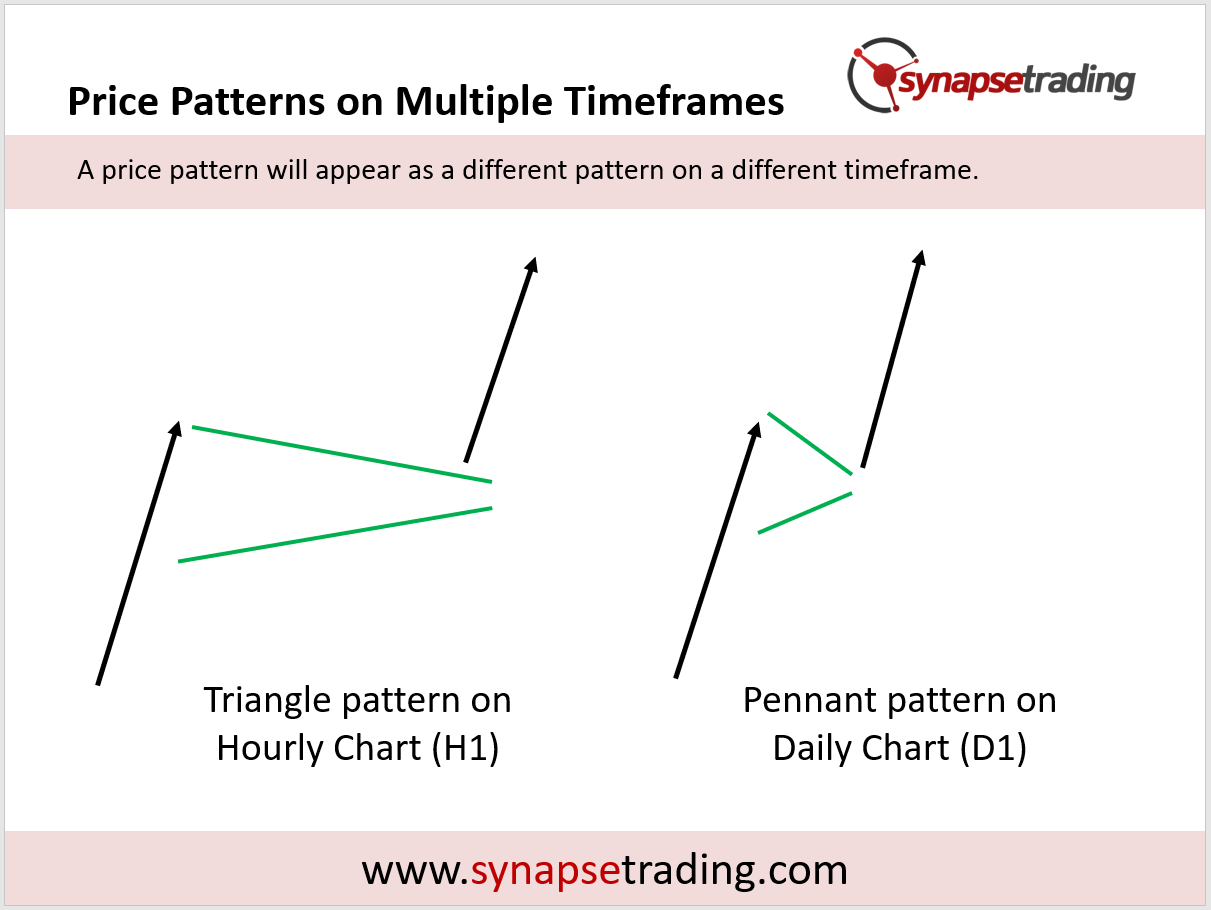
Nothing about the market changed between the two charts. Only the zoom did. Do note that this works in both directions too. A pattern on the daily chart is made of many smaller swings on the hourly, and some of those swings are patterns of their own.
How long is the coast of Britain?
That sounds like a geography question with one answer. It turns out to have no single answer at all, and the reason explains a lot about charts.
Shortly before 1951, the English scientist Lewis Fry Richardson was studying whether the length of a shared border affected the chances of war between two countries. He noticed that Portugal reported its border with Spain as 987 km, while Spain reported the very same border as 1,214 km. Nobody had made a mistake. The two sides had measured with rulers of different lengths, and a shorter ruler follows more of the wiggles, so it adds up to a longer line.
In 1967, the mathematician Benoit Mandelbrot took the idea further in a paper in Science called “How Long Is the Coast of Britain?”. Measure Britain’s coast in 100 km steps and you get roughly 2,800 km. Use 50 km steps and it grows to roughly 3,400 km. So the coastline has no true length, only a length at a given scale. Mandelbrot later built a whole branch of mathematics on shapes like this and called them fractals, and long before he coined the word, he had been studying daily cotton prices going back to 1900.
A timeframe is the ruler you lay over the market. The hourly chart is the short ruler, so it picks up every wiggle and shows you a triangle. The daily chart is the long ruler, so the wiggles disappear and only the pennant is left. Asking which pattern is the real one is a bit like asking for the real length of the coast. The useful question is which ruler suits the trade you are planning.
Picking that ruler, and then sticking to it, is a big part of a calm routine. My free 15-minute swing trader checklist is the one I run each day.
Why does the higher timeframe usually carry more weight?
Alan Farley, in his 2000 book The Master Swing Trader, describes a stock that can show “an uptrend on the daily chart, a bear market on the weekly, and sideways congestion when seen through 60-minute bars.” He gave the mistake that follows a name, the trend relativity error, which is doing your analysis on one timeframe and then trading on another. His description of where it leads is quite dry. “Trades become investments and ex-traders become humbled investors.”
So when two timeframes disagree, one of them has to win. Martin Pring’s view is that “the longer the time frame, the more significant the pattern.” The rules for reading a pattern are the same on any chart, from one-minute bars to monthly ones, he says, and “the only difference is that the battle between buyers and sellers is much larger on the monthly charts.” A weekly triangle has months of buying and selling behind it. A triangle on a five-minute chart might have a single lunch break behind it.
Al Brooks puts the link between timeframes into one sentence. “All pullbacks are small trading ranges on the chart that you are viewing, and all trading ranges are pullbacks on higher time frame charts.” So the sideways mess that worries you on the hourly chart is often just a pause in a trend on the daily, and knowing that changes how anxious you need to feel about it.
This is also why I lean on the bigger picture in my weekly outlooks. In the year-end outlook on 18 December 2025, I said I would be “using the weekly charts” to see the “general direction” the market was heading in and “how strong it is”. And on 7 May 2026, looking at a lithium battery ETF, I said that based on the bigger picture it “kind of looks like a huge bull flag”. In the same breath, I added that as a swing trader I did not want to “sit through any large pullback”. The bigger picture set the direction, and the swing trade still ran on its own, shorter clock.
Do you really need more than one timeframe?
On 12 February 2026, a trader on Reddit’s r/Daytrading asked: “Does anyone successfully trade with only one timeframe?” They accepted that the bigger picture helps sometimes, and wondered whether a single chart could be enough on its own.
It is a fair question, and the honest answer is that some traders do manage with one. Here is a concession with a date on it. In his 2012 book on trading ranges, Al Brooks works off a single chart, a 5-minute chart of the Emini S&P 500 futures with one moving average and nothing else. He spent more than 10,000 hours writing and testing indicators and systems before deciding that they “obfuscate instead of elucidate.” So one chart, read well, can clearly be enough for some people.
But look again at his sentence about pullbacks and trading ranges. Even a trader who watches one chart is still thinking about the timeframe above it. He just does it in his head. He needs no second screen.
Personally, I think the bigger danger for most people runs the other way. Flip through five timeframes before every trade and you will almost always find one that disagrees with you, and then fear and doubt get a vote they did not earn. The second timeframe is there to give you context, and once it starts producing confusion instead, you have gone too far.
How do you read a pattern across timeframes without overdoing it?
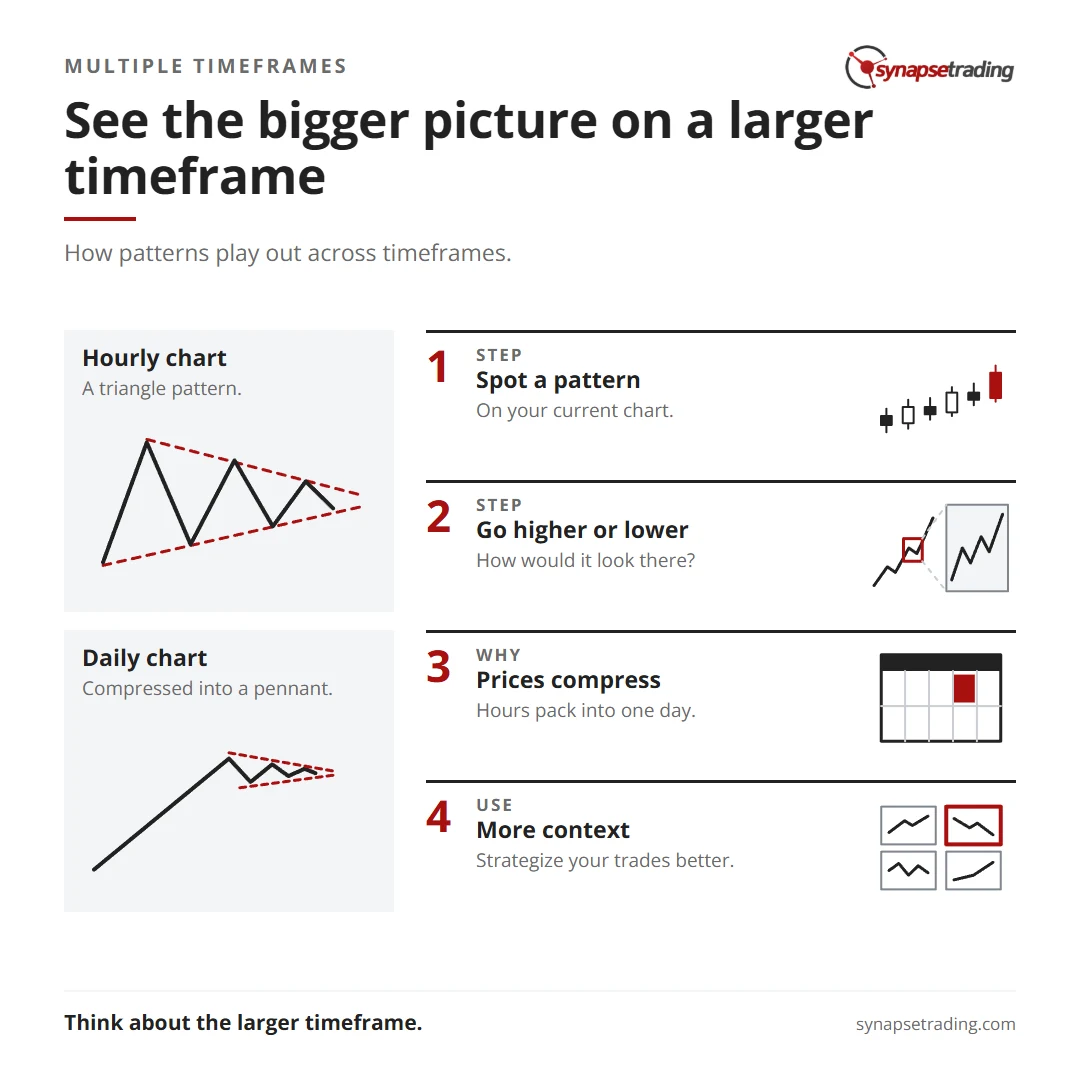
I find it useful to run any pattern through three questions, which is roughly what the summary card above shows.
- What does the timeframe above show? Step up one level and see what your pattern turns into. A triangle that becomes a pennant after a sharp rise is a pause in a strong move, and that is a very different picture from a triangle sitting at the top of a tired trend.
- Is the pattern with the bigger trend or against it? A setup that looks clean on its own can still be fighting the timeframe above it, and this is usually where Farley’s trend relativity error is born. I explain why the prior trend matters so much in trading price patterns with the trend.
- Does the chart match how long you plan to hold? If you plan to hold a trade for days, a pattern on a five-minute chart is mostly noise to you. The pattern worth your attention is the one on the chart that matches how long you intend to stay in the trade.
Answer those three and the pattern usually reads itself, whatever it happens to be called. For the shape that started this post, see my guide to the triangle pattern, and for how a pause differs from a turn, read continuation and reversal patterns.
If you want a short daily routine to go with these questions, the free 15-minute swing trader checklist is the one I use myself.

If you would like to learn all the different price chart patterns, also check out: “The Definitive Guide to Trading Price Chart Patterns”
FAQ
Why does the same chart pattern look different on different timeframes?
Because a higher timeframe compresses price. Each bar holds more time, so a daily bar packs in a full day of hourly bars, and the same swings get squeezed into less space. The pattern looks smaller and tighter, and sometimes it changes name.
Can a triangle become a pennant on a higher timeframe?
Yes. A triangle on the hourly chart can compress into a pennant on the daily chart of the same market. A pennant is a small, tight triangle that forms after a sharp move, so it is the compressed version of the same price action.
Which timeframe matters more when two charts disagree?
Usually the higher one. Martin Pring wrote that “the longer the time frame, the more significant the pattern”, because a pattern on a weekly chart has far more buying and selling behind it than one on a five-minute chart.
How many timeframes should I look at?
There is no magic number. Pring suggests looking at the timeframe above the one you trade for the dominant trend, and Al Brooks manages with a single chart. Past a certain point, more charts mostly add disagreement.
What is timeframe compression in trading?
It is what happens when you move to a higher timeframe and many small bars get packed into fewer, larger ones. The price action stays the same, but the pattern looks tighter and smaller, which is why a shape can change its name across timeframes.
What is the trend relativity error?
It is Alan Farley’s name for doing your analysis on one timeframe and then trading on another. A stock can be in an uptrend on the daily chart and a downtrend on the weekly, so mixing the two leads to trades that make no sense on either.
Which timeframe do you usually read patterns on, and have two of your charts ever told you opposite stories about the same market? Let me know in the comments.
If you are new to patterns, you can start with my free trading guides.
And if you want a daily routine that fits into 15 minutes, grab the free 15-minute swing trader checklist.
About the author. Spencer Li is The 15-Minute Trader and the founder of Synapse Trading. He is a Certified Financial Technician (CFTe) with 15+ years of trading, run from 70+ countries. He holds a B.Acc and B.BM from SMU. Every trade he takes is public, dated, losses left in. He teaches rules-based swing trading in 15 minutes a day, one system for any market.
Education, not financial advice. Synapse Trading is not licensed by MAS to advise on investment products. Trading carries risk of loss, and past performance is not indicative of future results.
Want the daily routine? Enter your email for the free 15-Minute Swing Trader's Checklist.
Free 5-page PDF, then occasional trading emails. Education only, not financial advice. Unsubscribe anytime. Kit stores your email in the US: see our privacy policy.
Want to learn the full method? The Trading Mastery Program teaches the 4 strategies I have traded since 2011. It suits beginners and experienced traders.
Rather follow the trades as they happen? Daily Trading Signals is our Telegram channel: my trade ideas with entry, stop and exit, and every trade is public.
Questions about this post? Ask in the free Telegram channel →
Educational content only, not personalised financial advice. Trading carries risk, including loss of capital. Past performance is not indicative of future results. Synapse Trading is not licensed or regulated by MAS.

