

What is Behavioral Finance?
Join our Telegram channel for more market analysis & trading tips: t.me/synapsetrading
Table of Contents
What Is Behavioral Finance? (And Why It Matters for Traders)
Last updated: 3 July 2026 · By Spencer Li, CFTe
Behavioral finance is the branch of finance that studies why people make irrational money decisions, by combining classical finance (which assumes people act rationally to maximise their own interest) with psychology (which explains the emotions and mental shortcuts that get in the way). Put simply: classical finance tells you what people should do, and behavioral finance tells you what people actually do. The gap between the two is where most trading losses live. Classical models assume humans are rational decision-making machines. In reality, the moment real money is at stake, greed and fear start to cloud judgement, and we fall back on biases like loss aversion, overconfidence, and herd behavior. For a trader, this is not academic. Behavioral finance is the field that explains why you sold at the bottom, held a loser too long, and chased a stock you swore you would not touch.
Here is what it covers, the biases that hit traders hardest, and how to use it.
What does behavioral finance actually mean?
Classical finance is built on a clean assumption: that every market participant is rational and self-interested, weighing odds coldly and always choosing the option with the best expected value. It is a useful model. It is also wrong about humans.
Behavioral finance is the relatively new field that corrects for this. It keeps the math of classical finance but adds the missing variable: the person. It asks why a rational model and real behavior keep diverging, and the answer is always the same. Humans are subject to emotions, flawed thinking, and cognitive biases (systematic errors in how we reason).
If you have ever traded the markets, or even played a game of chance like poker, you already know this in your gut. It is easy to play perfectly when nothing is on the line. Once your own money is at stake, greed and fear take the wheel, and the “rational robot” you were in theory is nowhere to be found.
Classical finance vs behavioral finance
The two are not rivals. They describe different layers of the same problem. One is the ideal; the other is the reality you trade inside.
| Classical finance | Behavioral finance | |
|---|---|---|
| Core assumption | People are rational and self-interested | People are emotional and biased |
| What it describes | What people should do | What people actually do |
| View of the human | A rational decision-making machine | A person subject to fear, greed, and bias |
| Markets are | Efficient, priced correctly | Prone to mispricing from crowd psychology |
| Use to a trader | The benchmark for a good decision | The explanation for your bad ones |
You need both. Classical finance gives you the standard to aim at. Behavioral finance tells you where, and why, you are going to miss it.
The biases that cost traders the most
The whole field can feel abstract until you map it onto your own trade log. These are the cognitive biases (mental shortcuts that systematically distort judgement) that show up most often on a trader’s account.
| Bias | What it is | How it hurts a trader |
|---|---|---|
| Loss aversion | A loss feels worse than an equal gain feels good | You hold losers too long hoping to break even, and cut winners early |
| Overconfidence | Overrating your own skill and information | You oversize, overtrade, and skip your own rules |
| Herd behavior | Following the crowd because everyone else is | You buy the top in a hype rally and sell the bottom in a panic |
| Confirmation bias | Seeking only information that agrees with you | You ignore the warning signs on a position you love |
| Recency bias | Overweighting what just happened | A few wins make you reckless; a few losses make you freeze |
| Anchoring | Fixating on a reference number, like your entry price | You judge a trade by your cost, not by what the chart is doing now |
None of these are signs of being a bad trader. They are the default settings of a normal human brain under financial stress. The job is not to delete them. It is to build a process that does not depend on you overriding them in the heat of the moment.
Why behavioral finance matters for trading
Most traders think their problem is finding better setups. It usually is not. The setups are not the hard part. The hard part is the person executing them.
You can know exactly what to do, a clean entry, a defined stop, a sensible size, and still not do it, because the moment price moves against you, loss aversion whispers to widen the stop, and overconfidence whispers to add. Behavioral finance is the study of those whispers. Once you can name the bias that is talking, you are far less likely to obey it.
This is also where the human edge lives. A model, or an AI, can flag the rational move in a fraction of a second. It cannot feel the fear that makes you abandon that move at the worst possible time, and it cannot rebuild your discipline for you. Knowing the bias is theory. Sitting on your hands while it screams at you is the skill, and it is the part of trading worth actually training.
The practical fix is not willpower. It is structure. A written plan, fixed position sizing, and a mechanical routine exist precisely so that your decisions are made before greed and fear arrive, not during.
How to use behavioral finance in your own trading
You do not need a psychology degree to put this to work. Three steps:
- Name your biases. Read back through your last 20 trades and tag each mistake with the bias behind it. Most traders find the same two or three names keep showing up.
- Build rules that disarm them. If loss aversion is your problem, a hard stop you set before entry removes the in-the-moment decision. If overconfidence is your problem, a fixed risk-per-trade cap removes the temptation to oversize.
- Keep a trading journal. Behavioral finance only helps if you can see your own patterns. A journal turns “I keep doing this” from a vague feeling into a list you can fix.
If you want to go deeper on the psychology side, read the pillar guide: The Complete Guide to Investing and Trading Psychology.
FAQ
What is behavioral finance in simple terms?
Behavioral finance is the study of why people make irrational money decisions. Classical finance says what people should do; behavioral finance explains what they actually do, once emotions and cognitive biases get involved.
What is the difference between classical finance and behavioral finance?
Classical finance assumes people are rational and self-interested. Behavioral finance accepts that people are emotional and biased. One describes the ideal decision; the other describes real behavior, including the mistakes.
What are the most common biases in trading?
The biggest ones are loss aversion (holding losers too long), overconfidence (oversizing and overtrading), herd behavior (buying tops and selling bottoms), confirmation bias, recency bias, and anchoring to your entry price.
Can you overcome behavioral biases in trading?
You cannot delete them, because they are built into how the human brain handles risk. You can reduce their effect by building structure: a written plan, fixed position sizing, hard stops set before entry, and a trading journal that makes your patterns visible.
Why does behavioral finance matter for traders?
Because most trading losses come from how you behave, not from the setups you pick. Behavioral finance explains the emotional mistakes that wreck good plans, which is the first step to building a process that does not depend on you staying calm under pressure.
So, which bias keeps showing up in your own trading? Naming it honestly is the first real edge. Let me know in the comments.
And if you want the full picture on the mental side of trading, read the pillar: The Complete Guide to Investing and Trading Psychology.
Want a process that runs on rules, not emotions? Grab the free 15-Minute Swing Trading Starter Kit. It’s the exact routine I use to scan once a day and trade any market in 15 minutes, with the decisions made before greed and fear show up.
About the author. Spencer Li is the founder of Synapse Trading and a Certified Financial Technician (CFTe) with 15+ years of trading across stocks, forex, crypto, commodities, and bonds. His trade log is public: every trade since April 2024, dated, losses left in. He has taught a 15-minute daily trading routine since 2014, one system for any market.
Education, not financial advice. Synapse Trading is not licensed by MAS to advise on investment products. Trading carries risk of loss; past performance is not indicative of future results.
Related
The Complete Guide to Investing and Trading Psychology (pillar) · How to control your emotions when trading · Risk management and position sizing · How to keep a trading journal
Want the daily routine? Enter your email for the free 15-Minute Swing Trader's Checklist.
Free, 5 pages, PDF. You get the checklist, then my occasional trading emails. Education only, not financial advice. Unsubscribe anytime.
Where your details go: Kit, our email provider, stores your email address in the United States. Our contract with Kit lets it use your address only to send our emails, and requires Kit to keep it secure. The United States has no national privacy law like Singapore's, so that contract is the main protection. More in our privacy policy.
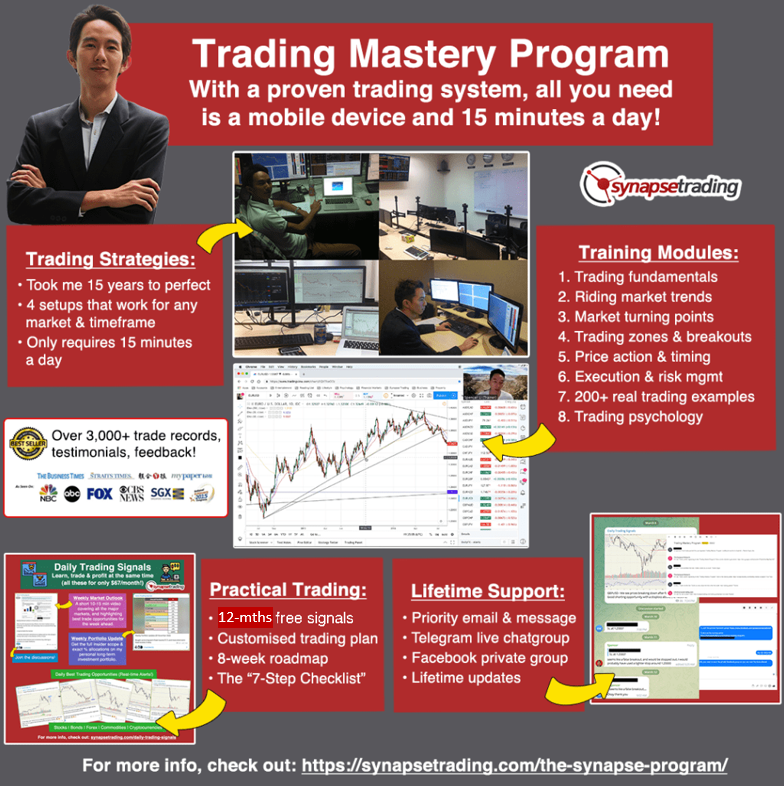 Our flagship mentoring program is suitable for both beginners and advanced traders, covering the 4 strategies which I used over the past 15 years to build up my 7-figure personal trading portfolio.
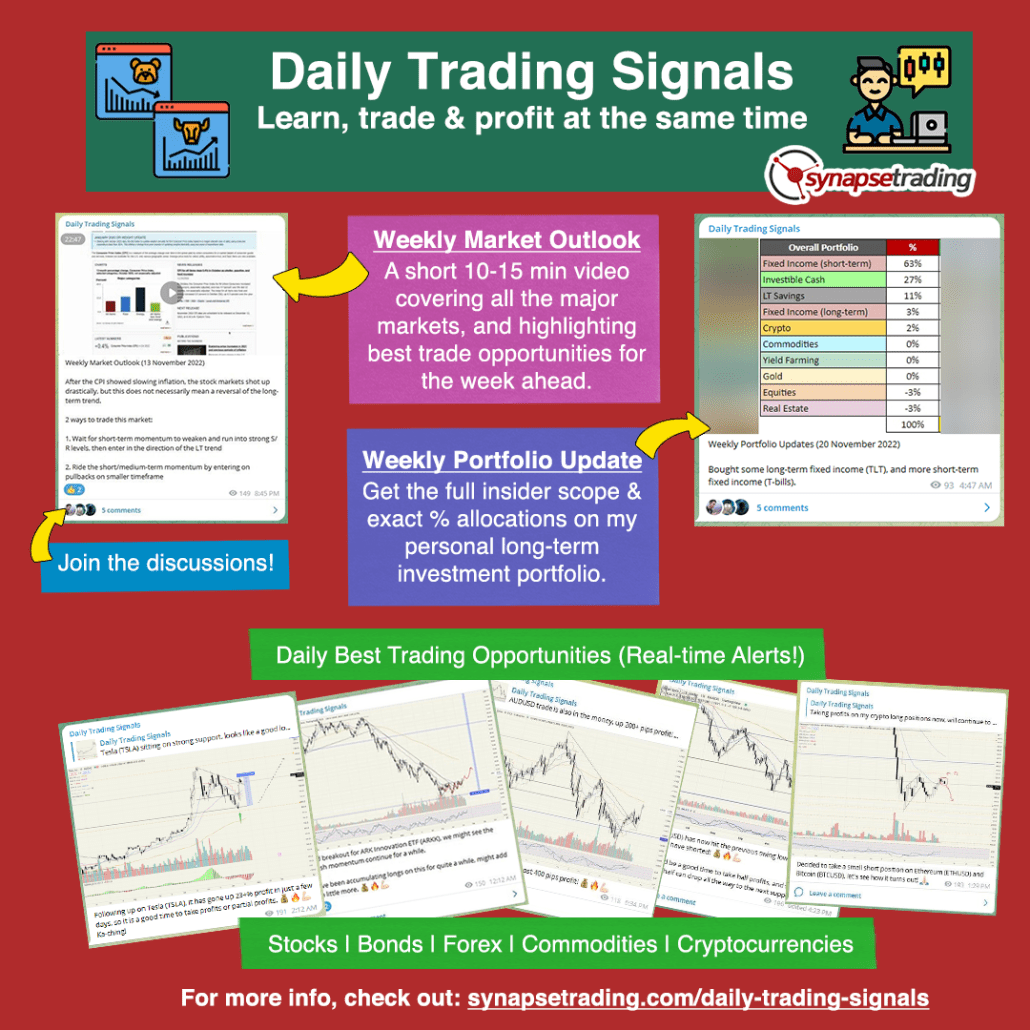 If you're looking for the best trading opportunities every day across various markets, and don't want to spend hours doing the research yourself, check out our private Telegram channel!


Leave a Reply
Want to join the discussion?Feel free to contribute!