

Long-Term Consistency in Trading: How to Make Your Results Repeatable
Want the daily routine? Get the free 15-Minute Swing Trader’s Checklist. Get it free →
By Spencer Li, CFTe · Last updated: 26 October 2026
Long-term consistency in trading means running the same plan the same way on every trade, whether the last one won or lost and whether you feel sharp or rattled. It is a state of mind before it is a result. A trader who can do that on a small account has something repeatable, and only something repeatable is worth scaling. A trader who cannot will find that a bigger account only makes the swings bigger.
I wrote the short version of this in July 2021. The argument has not changed, but it deserves more than the few hundred words I gave it then.
Why does one huge bet lose to a hundred small ones?
Nassim Taleb has a neat way of showing what repetition does. In Fooled by Randomness, he imagines you walking into a Las Vegas casino and putting one million dollars on the roulette table in a single spin. Win or lose, that one result tells you nothing about whether the house has the edge. Now slice the same money into a million one-dollar bets, and what you get back will show the casino’s advantage almost exactly.
The casino does not need to win any particular spin. It only needs to keep spinning, the same way, for a very long time.
The maths behind this is called ergodicity. It explains why one big bet can be a trap even when the odds look friendly. Suppose someone offers you a coin game on your whole account. Heads, your account grows 50%. Tails, it shrinks 40%. On a single toss, the average outcome is a 5% gain, so on paper it looks like a good bet.
Now play it twice and get one of each.
1.5 × 0.6 = 0.9
You are down 10%, even though the coin landed fairly. Keep going for 100 tosses with 50 heads and 50 tails, and you are left with about half of one percent of what you started with. The average was positive the whole time. The typical player still ends up almost wiped out, which is a fairly expensive way to learn the difference between an average and a path.
That is the trap of the “one big bet” mindset in a sentence. When everything rides on each outcome, a few bad ones can end the game before the averages ever get a chance to work.
What does consistency actually mean?
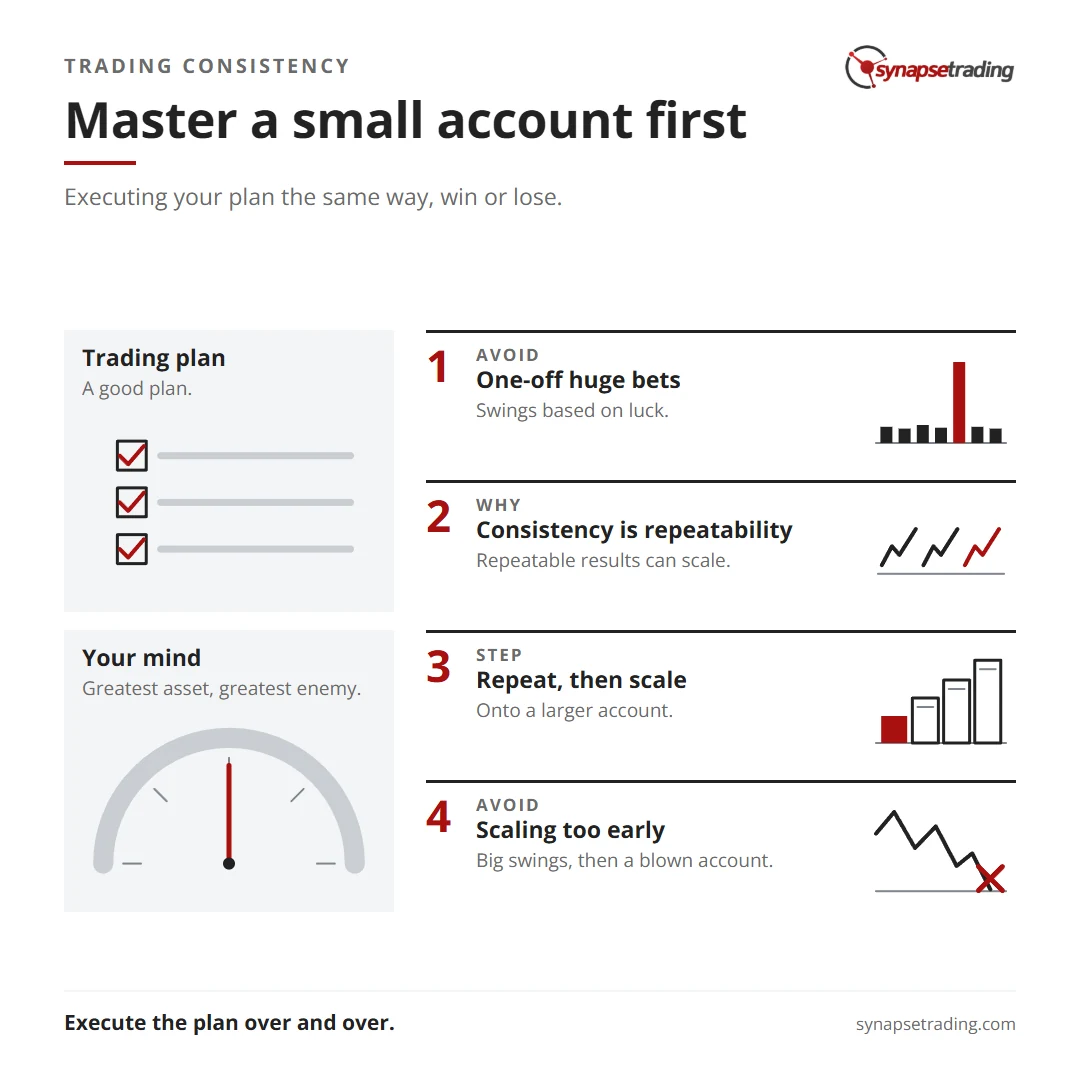
In 2021 I called consistency a state of mind, where despite the outcome of any trade and despite your mental state, you keep executing your plan in the same way. The line I put above it still holds up: “Your mind is your greatest asset, and also your greatest enemy.”
So consistency is not winning every trade, and nobody does. It is repeating the same process on the winners and the losers alike.
Jack Schwager makes the same point in Hedge Fund Market Wizards (2012). One of the 40 lessons he drew from fifteen managers reads: “As long as a trade adhered to a process with a positive edge, it is a good trade, regardless of whether it wins or loses.” That means a win where you broke your own rules is a bad trade that happened to pay. A loss where you followed the plan to the letter is a good trade that happened to cost.
It also means consistency looks rather dull from the outside. For years I told students in our course group that “Trading is actually quite boring”, because once you have learnt everything, it is just executing the same strategies over and over. Most people hear that as a complaint. It is closer to a description of what consistency looks like from the inside.
Why master a small account before a large one?
My 2021 post put the logic in two short lines.
Consistency = Repeatability
Repeatability = Scalability
If you can trade a small account consistently, you can repeat the same performance on a larger one, because the process travels with you. The percentages stay the same. Only the size of each position changes.
If you skip that step and scale up without consistency, you see large swings in the capital of your account, and as I wrote in 2021, it is only a matter of time before you blow the account. That fits the coin game above. More size on an unrepeatable process does not scale your edge. It scales the swings, and swings are what end accounts.
There was a third line in 2021, three dollar signs, and it is the line everyone wants to skip to. You cannot. It only arrives, if it arrives at all, after the first two are true.
If you trade around a full-time job, the easiest way to repeat a process is to make it short enough to do every day, and my free 15-minute swing trader checklist is the routine I use myself.
If you are consistent, should growth not be exponential?
In February 2026, a trader on Reddit’s r/Daytrading asked a fair question: “If one is consistently profitable, shouldn’t one profit exponentially?” Their reasoning was that more capital should mean more profit, at least at first glance.
On paper, they are right, and the two lines above say much the same thing. But my 2021 version wrote the chain with equals signs, as if scaling were plain arithmetic, and it is not. It leaves out the person doing the scaling.
Alexander Elder put the catch well in Come Into My Trading Room in 2002. A backtest can show every statistic you like, but, he wrote, “what if the system delivers five losses in a row, while you trade real money? Nothing in your testing has prepared you for that, but it happens all the time.” The same five losses feel very different at ten times the size. A trader who was calm at the small size can start breaking rules at the big one.
That is why size works as a brake, not just an accelerator. In my weekly outlook on 30 May 2026, talking about a stock that had been jumping around, I told viewers they “might want to reduce the position size” for stocks like that, because they “can really fluctuate a lot”. The rule of thumb is simple even if the exact numbers are personal. A position should be small enough that one loss does not change how you trade the next one.
So the growth is not automatic, and anyone who has scaled too fast knows the feeling. Fear at the bigger size makes you skip the next good setup. Greed makes you add when you should wait. Either one breaks the chain at the very first link.
How do you build consistency in your own trading?
Consistency is built the way any habit is built, by doing the same small thing often enough that it stops needing willpower.
- Write the plan down. A plan in your head cannot be checked. A written one turns “did I follow it?” into a yes or no. My guide to what goes into a trading plan covers the parts.
- Size so that one loss is a non-event. If a single trade can rattle you into changing the plan, the trade was too big. How to work that out for your own account is in my post on position sizing and money management.
- Score the process rather than the profit. At the end of each week, mark every trade on whether you followed the plan. Imagine a month where you lost money but followed the plan on every trade. That month taught you more than a lucky one.
- Stay small until it gets boring. I ask for 100 to 200 trades before judging a system, and that stretch is also when the process becomes a reflex. When executing the plan feels almost dull, you are ready to think about size.
Do note that none of these are technical. They are about behaviour under pressure, which is exactly why so many traders skip them and go looking for a new indicator instead, a hunt I wrote about in the holy grail of trading.
A process is easier to repeat when it is the same few steps every day. The free 15-minute swing trader checklist is the one I run.

If you would like to learn more about trading psychology, also check out: “The Complete Guide to Investing & Trading Psychology”
FAQ
What does consistency mean in trading?
It means executing the same plan the same way on every trade, whether the last trade won or lost. It is about repeating the process, which is different from winning every time.
Why is consistency better than one big win?
One big win can be luck, and luck does not repeat on demand. A repeatable process is what lets the averages work over many trades, and it is the only thing worth scaling.
Why should I master a small account first?
If you can trade a small account consistently, you can repeat the same process on a larger one. If you scale without that, you mostly scale the swings, and big swings are what blow accounts.
Does consistent trading mean no losing months?
No. Losses and losing months are part of any method. Consistency describes how you execute the plan, so a losing month can still be a consistent one.
Is consistency about strategy or psychology?
Both, in that order. You need a sound plan first. After that, the hard part for most traders is following it the same way through losing streaks and good runs alike.
When did you last break your own plan, and was it after a loss or after a win? Let me know in the comments.
If you want the basics laid out step by step, my free trading guides collect them in one place.
And if you want a routine short enough to repeat every day without fail, grab the free 15-minute swing trader checklist.
About the author. Spencer Li is The 15-Minute Trader and the founder of Synapse Trading. He is a Certified Financial Technician (CFTe) with 15+ years of trading, run from 70+ countries. He holds a B.Acc and B.BM from SMU. Every trade he takes is public, dated, losses left in. He teaches rules-based swing trading in 15 minutes a day, one system for any market.
Education, not financial advice. Synapse Trading is not licensed by MAS to advise on investment products. Trading carries risk of loss, and past performance is not indicative of future results.
Want the daily routine? Enter your email for the free 15-Minute Swing Trader's Checklist.
Free 5-page PDF, then occasional trading emails. Education only, not financial advice. Unsubscribe anytime. Kit stores your email in the US: see our privacy policy.
Want to learn the full method? The Trading Mastery Program teaches the 4 strategies I have traded since 2011. It suits beginners and experienced traders.
Rather follow the trades as they happen? Daily Trading Signals is our Telegram channel: my trade ideas with entry, stop and exit, and every trade is public.
Questions about this post? Ask in the free Telegram channel →
Educational content only, not personalised financial advice. Trading carries risk, including loss of capital. Past performance is not indicative of future results. Synapse Trading is not licensed or regulated by MAS.

