

What are Cognitive Biases & Behavioral Biases?
Join our Telegram channel for more market analysis & trading tips: t.me/synapsetrading
Table of Contents
Cognitive Biases in Trading: What They Are and How to Overcome Them
Last updated: 3 July 2026 · By Spencer Li, CFTe
A cognitive bias is a systematic error in thinking that pushes you toward a decision that feels rational but is not. In trading, these biases are why a smart person holds a loser too long, sells a winner too early, or doubles down on a position to prove they were right. The first step to overcoming them is not a new indicator or a better strategy. It is awareness. You cannot correct a thinking error you cannot see. Once you can name the bias you are about to fall into, in the moment it is happening, you can build a simple rule that takes the decision out of your hands. That is the whole game: spot the bias, then pre-commit to a rule so the bias never gets a vote.
Below are the biases that cost traders the most money, what each one looks like at the screen, and the rule that defuses it.
What is a cognitive bias?
A cognitive bias (a systematic, repeatable error in judgment) is a flaw in the thinking process itself, not a lack of information or intelligence. You can have all the right data in front of you and still reach the wrong conclusion, because the deduction process is bent before you even start.
That is what makes biases dangerous in trading. You feel like you are making a logical, rational call. The chart is right there. The numbers are right there. But the conclusion was shaped by a hidden tilt before you ever looked. The trader who “knows” the stock will bounce back has usually decided already. The analysis came afterwards, to justify holding on.
Awareness is the fix because it converts an invisible reflex into a visible choice. You cannot avoid a trap you do not know is there. Once you can spot the situation where flawed thinking tends to show up, you can step around it.
The biases that cost traders the most
Here are the common biases that show up most often at the trading desk, side by side with the rule I use to neutralise each one.
| Bias | What it is | What it looks like in trading | The rule that defuses it |
|---|---|---|---|
| Loss aversion | A loss hurts more than an equal gain feels good | Holding a loser, hoping it comes back, instead of cutting it | Set the stop before you enter, and honour it without negotiation |
| Confirmation bias | Seeking out only the evidence that agrees with you | Reading ten bullish takes and ignoring the bearish chart in front of you | Write down what would prove you wrong before you enter |
| Anchoring | Fixating on one number, usually your entry price | “I will sell when it gets back to what I paid” | Judge the trade on the current setup, not your cost basis |
| Recency bias | Overweighting what just happened | Going all-in after three wins, or freezing after three losses | Size every trade the same way, regardless of the last result |
| Overconfidence | Overestimating your own skill and edge | Sizing up too big because you “have a feel for this one” | Fix position size by a rule, not by conviction |
| Sunk cost fallacy | Throwing good money after bad to justify the first decision | Averaging down on a loser to “fix” the average price | Decide on the position as it is now, as if you held no shares |
| FOMO (fear of missing out) | Chasing a move you already missed | Buying late, near the top, because everyone else is in | If you missed the entry, wait for the next setup; there is always another |
You do not need to memorise every bias in the textbook. You need to recognise the handful that show up in your own trades, again and again, and build a rule for each.
How to overcome cognitive biases in trading
The source teaching here is simple, and it is correct: awareness comes first. But awareness alone is fragile, because in the heat of a live trade your reflexes are faster than your insight. So I run it as three steps.
1. Name the bias. Learn the common ones (the table above is a start) so you can label what is happening to you in the moment. “I am holding this loser because of loss aversion” is a more useful thought than “I think it will bounce.”
2. Pre-commit to a rule. A rule made before the trade, when you have nothing at stake, is worth far more than a decision made mid-trade, when your money and ego are both on the line. The stop goes in before the entry. The size is fixed before the setup. Hence, the bias arrives to find the decision already made.
3. Keep a trade journal. Write down why you entered, why you exited, and how you felt. Over time your own log shows you which biases are personally yours. Mine were loss aversion and the sunk cost fallacy, for years. Yours may be different. The journal is the mirror.
Do note that, the goal is not to feel nothing. You will always feel the pull. The goal is to make sure the pull does not get to touch the order ticket.
Where the human edge comes in
A machine has no ego. It will not hold a loser to avoid the sting of being wrong, and it will not chase a move because it feels left out. So you might think the answer is to automate everything and remove the human. But most traders do not run a fully automated book. They sit in the chair, with discretion, and the discretion is exactly where the biases live.
This is why psychology is one of the Five Edges a machine cannot hand you. A scanner will give you a clean setup in a second. It will not stop your finger from oversizing the entry because the last three trades won. Knowing your own biases, and building the rules that fence them off, is the part of trading no tool does for you. That is the edge worth working on.
FAQ
What are cognitive biases in trading?
Cognitive biases in trading are systematic errors in thinking that lead a trader to make a decision that feels rational but is not. Common examples are loss aversion (holding losers too long), confirmation bias (seeking only agreeing evidence), and FOMO (chasing a move you already missed).
What is the most common bias in trading?
Loss aversion is one of the most damaging and common. Because a loss hurts more than an equal gain feels good, traders tend to hold losing positions far too long, hoping to break even, instead of cutting the loss early.
How do you overcome cognitive biases when trading?
Start with awareness, because you cannot correct a thinking error you cannot see. Then pre-commit to rules made before the trade (set your stop and position size in advance), and keep a trade journal so you can spot which biases are personally yours.
Can you eliminate emotions from trading?
No, and that is not the goal. You will always feel the pull of fear and greed. The aim is to build rules and routines so those emotions do not get to control the actual orders you place.
What is the difference between a cognitive bias and an emotion?
An emotion (like fear or greed) is the feeling; a cognitive bias is the systematic thinking error that the feeling produces. Loss aversion, for example, is the bias; the fear of realising a loss is the emotion behind it.
Which of these biases is yours? Be honest. The one you do not want to admit to is usually the one costing you the most.
For the full picture on the mental side of trading, read the pillar: The Complete Guide to Investing and Trading Psychology.
Want a system that takes the emotion out of the decision? Grab the free 15-Minute Swing Trading Starter Kit. It’s the exact routine I use to scan once a day and trade any market in 15 minutes, with the rules already built in.
About the author. Spencer Li is the founder of Synapse Trading and a Certified Financial Technician (CFTe) with 15+ years of trading across stocks, forex, crypto, commodities, and bonds. His trade log is public: every trade since April 2024, dated, losses left in. He has taught a 15-minute daily trading routine since 2014, one system for any market.
Education, not financial advice. Synapse Trading is not licensed by MAS to advise on investment products. Trading carries risk of loss; past performance is not indicative of future results.
Related
The Complete Guide to Investing and Trading Psychology (pillar) · Loss aversion in trading · How to control your emotions when trading · Building a trading plan
Want the daily routine? Enter your email for the free 15-Minute Swing Trader's Checklist.
Free, 5 pages, PDF. You get the checklist, then my occasional trading emails. Education only, not financial advice. Unsubscribe anytime.
Where your details go: Kit, our email provider, stores your email address in the United States. Our contract with Kit lets it use your address only to send our emails, and requires Kit to keep it secure. The United States has no national privacy law like Singapore's, so that contract is the main protection. More in our privacy policy.
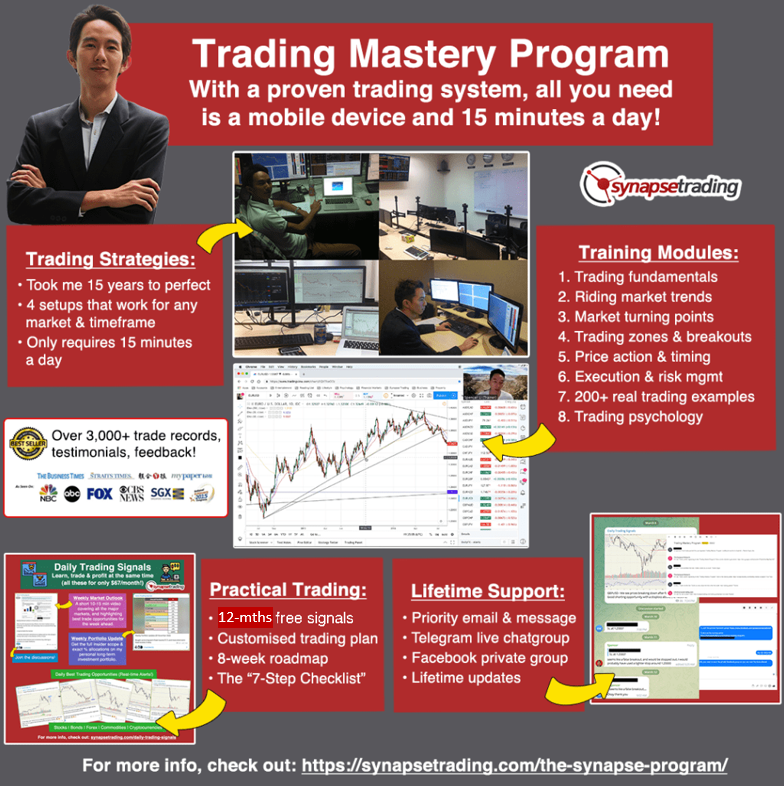 Our flagship mentoring program is suitable for both beginners and advanced traders, covering the 4 strategies which I used over the past 15 years to build up my 7-figure personal trading portfolio.
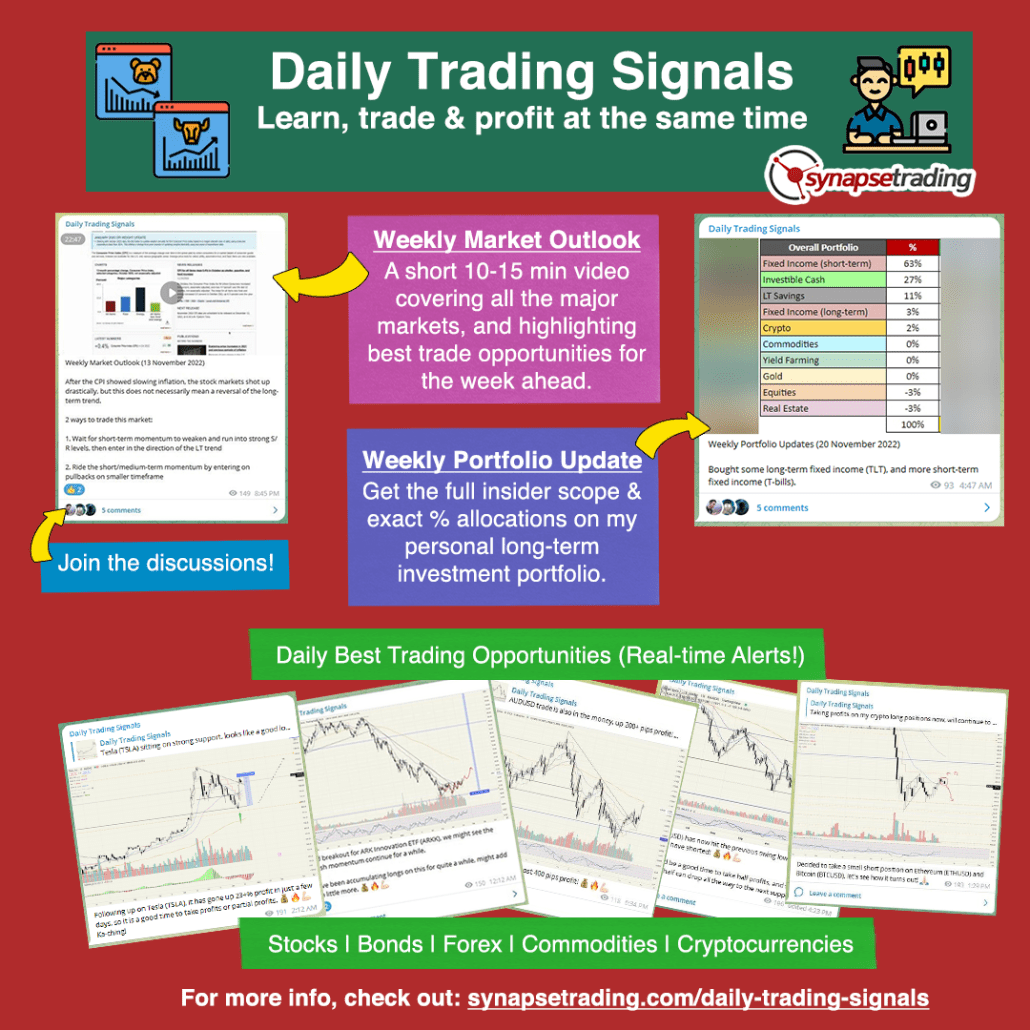 If you're looking for the best trading opportunities every day across various markets, and don't want to spend hours doing the research yourself, check out our private Telegram channel!

Leave a Reply
Want to join the discussion?Feel free to contribute!