• Link to Facebook
  • Link to X
  • Link to Instagram
  • Link to Youtube
  • Link to LinkedIn
  • Link to Mail
Synapse Trading
  • Home
  • About
    • My Background
    • My Trading Journey
    • My Travel Log
    • Media & Interviews
  • Mentoring
    • Trading Mastery Program
    • Results & Testimonials
  • Signals
    • Telegram (Free to join!)
    • Daily Trading Signals
    • Daily Trading Signals (Results)
  • Resources
    • Free Trading Guides
    • Tools & Resources
    • Blog & Infographics
  • Contact
    • Contact Us
    • Partnership Opportunities
  • Click to open the search input field Click to open the search input field Search
  • Menu Menu
Spencer Li

Why Are More & More Singaporeans Switching from Stocks to Forex?

Trading Tips
asd 3

Forex vs Stocks in Singapore: Why Some Traders Switch (and When You Shouldn’t)

Last updated: 3 July 2026 · By Spencer Li, CFTe


Some Singapore traders switch from stocks to forex because forex lets you start with a few hundred dollars, charges no commission, trades 24 hours a day, and gives you enough cheap repetitions to actually learn. Those four things matter most when you are a beginner who needs many small trades to build skill. Forex is not better than stocks in some absolute sense. What changes the outcome is your circle of competence (the set of markets and methods you genuinely understand), not the market itself. So the honest answer is: forex suits the new trader who wants low-cost, high-frequency practice and a schedule that fits around a day job. Stocks suit the trader who wants ownership, dividends, and slower, less leveraged exposure. Below I lay out the real cost differences in a table, the case for forex as a training ground, and the three risk rules I would not start without.

Here is the full breakdown, with the trade-offs left in.

Why are Singapore traders moving from stocks to forex?

The shift started with a real problem on the local exchange. For a stretch in the mid-2010s, the Singapore Exchange (SGX) saw turnover fall and well-known names like Tiger Airways, OSIM, and Eu Yan Sang leave the board. One stockbroker told The Straits Times back then that “stockbroking is looking like a sunset profession now.” New listings dried up too. Across early 2016 the monthly IPO count ran like this:

Month (2016)New IPOs on SGX
April1
May1
June1
July6
August2
November1

(Source: ChannelNewsAsia, 2016. These figures are historical context, not current SGX data.)

With thin volume and a Straits Times Index that drifted sideways, intraday trading on local stocks became hard for the small trader. You needed a large amount of capital to move size in and out, and the liquidity was not always there to do it cleanly.

Forex offered the opposite profile. Deep liquidity, tiny minimum trade sizes, and no commission. For a beginner with a small account, that combination is the draw. The local-stock backdrop has shifted since 2016, but the structural reasons a new trader reaches for forex have not.

Is forex cheaper to trade than stocks?

For a beginner, usually yes, and the gap is mostly about commission and minimum size. Here is the side-by-side I would have wanted when I started.

ForexStocks (typical retail)
Minimum to startFrom around $500Higher; meaningful share lots cost more
Smallest trade size0.01 lots (about $0.10 per pip)One lot or board lot; larger dollar commitment
CommissionOften zero (cost is in the spread)Brokerage commission per trade
Charts and dataUsually freeOften free, sometimes paid for depth
Hours24 hours, 5 days a weekExchange hours only
Economic-event timingPublished in advance on a forex calendarEarnings and news can surprise mid-session

Two lines in that table do the heavy lifting for a new trader. First, zero commission means each trade costs you less in “tuition fees” paid to the market while you are still learning. Second, the 0.01 lot size means you can risk a few dollars per trade and still get real skin in the game. That is the whole point. You want to make many decisions cheaply.

Do note that, “no commission” does not mean “no cost.” In forex the cost lives in the spread (the gap between the buy and sell price). It is smaller for a small trader, but it is still there. Anyone who tells you forex is free is skipping a line.

Is forex harder to trade than stocks?

Not inherently. Some people insist the forex market is tougher than the stock market. I beg to differ. It is your circle of competence that determines your success, not the raw characteristics of the market. If you understand a market and have an edge in it, that is the market you should trade. The difficulty is in you, not in the ticker.

That reframing matters, because it stops you blaming the instrument. A trader who loses in forex and switches to stocks expecting the market to save him usually loses in stocks too. The market was never the problem.

Forex as a training ground: trade small, trade often

The strongest case for forex as a starting point is that it lets you accumulate experience cheaply. Trading is a numbers game. With a properly developed edge, your account carries a positive expectation, and profit becomes the norm over a long enough run of trades. You cannot reach that long run without taking the trades, and forex lets you take them in small size.

A few things I believe here, hard-won:

Start live, not demo. There is an endless debate about live accounts versus demo accounts. My solution is simple. Start with a live account from the beginning, in tiny size. A demo trade and a live trade feel like different sports. Risking real money, even a few dollars, puts you into the reality of the game, and you learn to sit with the risk that is built into trading. Sooner or later you get used to it. You never get used to it on a demo.

Expect to make silly mistakes early, and budget for them. Every trader with real skin in the game has done at least one of these:
– Traded the wrong lot size (1.00 instead of 0.10, so the position is ten times too big).
– Gone short when you meant to go long.
– Placed a trade only to realise the market was closed.

These sound dumb written down. They are completely normal, and small size is exactly why you want to make them with ten cents on the line, not your rent.

Trade around your life, not against it. The 24-hour market means you choose when to trade. If your day job is punishing, you can trade at night, or over lunch, on a schedule that fits your life instead of fighting it. I like what Tom Sosnoff said about learning to trade: “Trade small, trade often.” Forex is built for exactly that.

The 3 steps to manage forex trading risk

Cheap practice without risk control just lets you lose faster. Three rules I would not start without:

  1. Think in percentages, not dollars. Risk a fixed small percentage per trade. Percentages take the emotion out of the dollar amount and keep one bad trade from doing real damage.
  2. Find an edge. Only a genuine edge gives you a profit over the long run. Repetition without an edge is just paying tuition forever.
  3. Stick to one style. Do not try to be everything at the start. Too many new forex traders try to scalp, swing, and trend-follow all at once. Become profitable in one style first. Diversifying across styles can come later, once you have something that works.

That last one is where most beginners go wrong. The market rewards depth in one approach long before it rewards breadth across five.

Where the human edge comes in

A broker can hand you a $500 account and a 24-hour market. A platform can flag the setup and place the order in a second. What neither will do is stop you from sizing the trade too big after three wins, or talk you out of trading the one market you do not actually understand. Cheap repetitions only compound if the judgment behind them is sound. That judgment, knowing your circle of competence and staying inside it, is the first of the Five Edges no tool can trade for you.

FAQ

Is forex better than stocks for a beginner in Singapore?
For a beginner who wants cheap, frequent practice, forex has real advantages: you can start from around $500, trade 0.01 lots, pay no commission, and trade 24 hours a day around a job. Stocks suit traders who want ownership, dividends, and slower exposure. Neither is universally better; it depends on your goals and which market you actually understand.

How much money do I need to start trading forex in Singapore?
You can start with as little as around $500. Most brokers allow 0.01 lot sizes, which works out to roughly $0.10 per pip, so you can risk a few dollars per trade while you learn.

Does forex trading have commissions?
Many forex brokers charge no commission. The cost is built into the spread (the gap between the buy and sell price) instead. So it is cheaper than commission-based stock trading for a small account, but it is not free.

Should I start with a demo or a live account?
Start live, in very small size, from the beginning. A live trade and a demo trade feel completely different. Risking real money, even a few dollars, teaches you to handle the risk that is built into trading, which a demo account cannot.

How do I manage the risk in forex trading?
Three steps: think in percentages rather than dollars, trade only when you have a genuine edge, and stick to one trading style until you are profitable before adding others.


So, forex or stocks? If you are starting out and want cheap repetitions to build skill, forex makes a strong training ground. If you want ownership and a slower pace, stocks have their place. Either way, the deciding factor is your circle of competence, not the market. Which one are you leaning toward, and why? Let me know in the comments.

And if you want the wider picture of how to choose and trade any market with one routine, read the pillar: The Beginner’s Guide to Trading.

Want a routine that fits a day job? Grab the free 15-Minute Swing Trading Starter Kit. It is the exact process I use to scan once a day and trade any market in 15 minutes.


About the author. Spencer Li is the founder of Synapse Trading and a Certified Financial Technician (CFTe) with 15 years of trading across stocks, forex, crypto, commodities, and bonds. His trade log is public, 404 trades, losses left in. He teaches low-risk swing trading in 15 minutes a day, one system for any market.

Education, not financial advice. Synapse Trading is not licensed by MAS to advise on investment products. Trading carries risk of loss; past performance is not indicative of future results.


Related

The Beginner’s Guide to Trading (pillar) · How to start forex trading in Singapore · What is your circle of competence? · Demo vs live trading account

0 Comments/by Spencer Li
https://synapsetrading.com/wp-content/uploads/2016/12/asd-3.png 1080 1080 Spencer Li https://synapsetrading.com/wp-content/uploads/2019/10/logo.jpg Spencer Li2017-01-26 01:04:162026-07-06 03:23:43Why Are More & More Singaporeans Switching from Stocks to Forex?
Spencer Li

How Much Must You Save to Have $1M at Retirement? (The Answer is Surprisingly Low!)

Investing & Portfolio Management
one million at retirement


These days, $1M seems to be the golden figure that everyone aims to attain before retiring. I know there is this great debate about whether $1M is enough, but hey, $1M can get you by for many, many months.

Here’s a table summarizing exactly how much you need to save (or rather, invest) every month, in order to retire with $1M. Using some formulas from my finance 101 class in university,

tableThere you go. I tabulated the figures for easy reference.

It’s one thing to know how much to save monthly, but the real challenge is to get down to doing it.

Here’s 3 tips I have to help you guys attain your own financial goals. They are simple, but you might be surprised how hard they are to actually follow-through with!


TIP 1: SAVE MONEY, REALLY.

Yes, save money. This is so easy to say, but difficult to do.

I remember that in my younger days, after receiving my first paycheck, I went out and quickly spent half of my salary on a ‘gift’ to myself, as a reward for seeing the first stack of cash come into my bank account. I quickly learnt that I did not actually need that gift, and that saving money was very, very difficult, especially since you know that your income is certain!

If there was one piece of advice on how to actually save money, it is this: PAY YOURSELF FIRST! It is surprisingly difficult to get yourself to do this, but you must learn to pay yourself first. Paying yourself first doesn’t mean buying something for yourself; it means moving money out from your paycheck into a savings account or investment account on a regular basis.

Perhaps its tough for the first few months, but new habits take time to form and when you actually get down to it, you see that it is a very useful habit to have. In fact, if you have children, it would be good to start teaching them this from a young age. “Pay yourself first, and then spend what you have left” is a good way to instill financial discipline in the younger generation.

Before you ask “How much do I need to save?”, why don’t we just get down to the first step, which is to actually start saving money?

Once you get in the habit of saving, it because second-nature. After doing so for some time, we can move on to the next tip:

TIP 2: BUILD A TRULY DIVERSIFIED PORTFOLIO

Generally speaking, there are two kinds of investing strategies:

FAST money: trading income, bringing in quick gains.

Trading is the way to quickly build up a portfolio and invest in dividend-yielding counters or REITs. Once you’ve stuck to a simple trading strategy, repeating it over time is bound to yield significant profits, much faster than you would in a fixed deposit or by holding the stock index for 5-10 years.

SLOW money: passive income, bringing in smaller but consistent gains.

For those with lots of money, they can allocate much of their portfolio to more stable assets, like dividend stocks, the stock index (it brings a dividend as well!), or other longer-term bonds.

Most people want to use fast money  all through their life, but it is unrealistic. As we age, we have less and less energy and time to continually engage the markets, so the goal is always to have a large war chest that brings in true passive income.

You might be surprised how few people understand the true meaning of a portfolio. Sometimes, the word ‘portfolio’ brings in the idea that you can only buy 5-10 stocks and hold them over 20-30 years. I beg to differ; in a portfolio, one must be truly diversified across…

  • All asset classes (forex, bonds, stocks, REITs, ETFs, commodities)
  • Time horizons (fixed deposits / buy-and-hold dividend stocks VS trading income)

Learning to do so requires some dedication and bumping your head in the wrong places at first. That’s why I always recommend that beginners take up forex trading; they’ll be exposed to market volatility, intra-day and longer-term trading, and also different asset classes by trading oil, gold, wheat, the stock indices, and bonds. Furthermore, you need as little as $500 to start with, and the cost of failure is very low.


TIP 3: STAY CONSISTENT

It is remarkably difficult to do something simple over and over again.

Want to lose weight? Exercise and eat healthy. But how many people actually keep to this?

Want to become better at socialising? Spend more time with people rather than with your phone or computer. But how many people actually keep to this?

Want to learn to trade? Stick to 1-2 trade setups, and repeat these trades week after week. But how many people actually keep to this?

It is very, very difficult to do what is simple and boring. In fact, it is the boredom that kills most traders!

One thing that experienced traders fail to do that knocks them out of the game is this: they fail to keep reading, reflecting, and honing their craft.

Continuous learning has to be part of your investing plan. After all, most people only want to invest money, but don’t want to invest the time to learn how to be profitable.

How much returns is good returns?

Well, that depends on your goals. There is a trading strategy for every level of returns. A conservative 10-20% returns as a trader is possible and you generally take a lot less risk than someone who wants 100-200% returns a year.

Depending on when you want to retire, you need to find out how much % returns you need a year, and look for a strategy that gets you there.


IT’S BORING, BUT YOU NEED TO TRACK YOUR PROGRESS!

how-muchWith a Google search, I found a useful table to track your progress, credits to businessinsider.sg! Source: BusinessInsider.sg

Suppose you want to save $1M, it’s extremely important to track if you are on target, and see if you need to allocate more funds to fast money or slow money.

If you are proficient with MS Excel, you should be able to come up with a table for your income, expenses, savings, investment returns, and projected net worth by whatever year that you are aiming to retire by.

I hope this article brings you to your feet and gets you started on your quest for financial freedom. Maybe for you, the first step is to actually start saving money! Starting where you are is all you need to do. With every step you take, you’ll be one step closer to your goals.

Cheers! 😀

RESEARCH SOURCES & REFERENCES

businessinsider.sg/compound-interest-monthly-investment-2014-3/
businessinsider.com/retirement-savings-guide-2014-3?_ga=1.199140719.1988080035.1478087095


0 Comments/by Spencer Li
https://synapsetrading.com/wp-content/uploads/2017/01/one-million-at-retirement.jpg 950 1400 Spencer Li https://synapsetrading.com/wp-content/uploads/2019/10/logo.jpg Spencer Li2017-01-11 10:46:472021-03-09 18:35:32How Much Must You Save to Have $1M at Retirement? (The Answer is Surprisingly Low!)
Spencer Li

Top 3 Reasons Why You Should Start Investing in 2017

Investing & Portfolio Management
Copy of Copy of Not allthose who wanderare lost

copy-of-copy-of-not-allthose-who-wanderare-lost

Brexit, Trump, Italy, asset bubbles all over the world… you name it, there’s probably some financial market jitters that keeps most people out of the world of investments.

On the flipside, the financial world often quips about some investment that has made xx% over a certain period of time, trying to entice visitors with a glimpse of the profits possible for anyone. In the world of investing, it is easy to find spectacular returns on hindsight, and salesmen go through great lengths to market what has already happened.

As traders, we live in a constant state of uncertainty. Every trade we make has the possibility of going wrong, and this is taken into account when a decision is made. It is the knowledge of this that gives power to a trader; if he can understand the math behind his investment decision, he can have a positive expectation and a positive traders’ equation.

There are three main reasons why trading is even more attractive these days. Indeed, with advanced technology, there has never been a better time to step into the world of finance, and grab a golden egg while you still can.

GOLDEN EGG 1: TRADING GIVES A HIGHER INTEREST RATE THAN BANKS

fdThe best you can get on a fixed deposit is 0.35% a year in Singapore, as at December 2016.
Source: moneysmart.sg

While inflation is a constant enemy for our savings accounts, most people do not know what to do to combat inflation. The most common quick-fix is to work harder and earn more money. While that does feed us and our families for some time, the need to build a war chest for emergencies becomes more and more real.


How much can you make from trading? Institutional traders bring in a success rate anywhere from 30%-70%. Why is this so?

The greatest insight into the markets that can make you profitable is this: 90% of the time, the odds are 50-50, while 10% of the time, the odds swing 60-40 (slightly in your favor).

That’s right. While most of the time, markets are 50-50, it is those brief moments when the market gives some opportunity, and prices quickly move to take advantage of this opportunity. That means that if you were to buy or sell randomly, you already have a 50% chance of success!

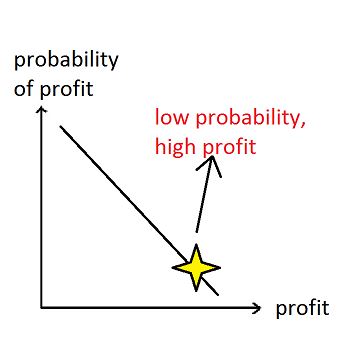
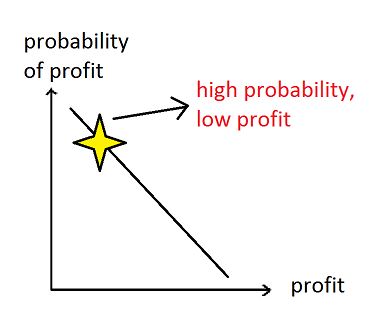
Another insight to know is that a high success rate (hit-rate) brings a lower profit target, while a low success rate brings a higher profit target.

What do I mean by this? Institutions trade using a combination of low-probability and high-probability trades.

Example: 40% (low) success rate, win = +2%, lose = -1%.”

low

In this case, if you were to make 100 of such low-probability trades, you would make +80% on winning trades and -60% on losing trades, bringing a 20% return on capital.

Example 2: 75% (high) success rate, win = +0.5%, lose = -1%

high

In this case, if you made 100 high-probability trades, you made 37.5% on winning trades and -25% on losing trades, bringing +12.5% return on capital.

It is impossible for the market to give high-probability trades with a high profit potential. This would be quickly detected by institutional traders, who have mathematicians, PhD staff, and computer science experts who can quickly make adjustments and profit from it. With hundreds of millions of dollars at stake, these people would do all they can to bring profits for their firm.


That is why if anyone quips that they have a 80-90% success rate, they are probably having many small wins but a few gigantic losses. If you don’t believe me, try trading forex and planting random trades with low profit potential and high loss potential. The numbers indeed prove to be true!

That is also why it is important to understand the traders’ equation. With a reasonable success rate and an appropriate win-loss ratio (or risk-reward ratio, RRR), you would be profitable over the long-run.

I have had days where I ran 7-8 trading losses in a row, but because I trusted in the probabilities, the next 3-4 trades ended up profitable, as long as I stuck to my trade setups and didn’t let the emotions get the better of me.

GOLDEN EGG 2: TRADING DOES NOT REQUIRE LOTS OF CAPITAL

If you have $500 to invest: trade forex.

In the Forex market, you are entitled to ‘get a feel of the game’ by risking a few dollars per trade. By trading the smallest lot size (0.01 lots), you can learn to make a few dollars here, lose a few dollars there, and rack up trading experience and learn to trade ‘live’ without incurring hefty losses.

By learning to make many decisions and experiencing all the different conditions of the market, you would become seasoned enough to trade a bigger size, and fine-tune your own trading strategy.

Many traders discover they have certain characteristics about themselves that hinder success. In trading a ‘live’ account with a small sum of money, they are putting in some skin in the game, and getting used to the ups and downs of their account.

The best part about forex is that there are no commission charges. The broker makes money from the bid-ask spread, which is the difference between the buy/sell price, and most brokers charge reasonable spreads, allowing you to trade with almost negligible transaction cost.

If you have $3000 to invest: explore stock CFDs.

Stock CFDs have low commissions and can be bought in small quantities – a few thousand dollars can allow you to have a portfolio of 5-10 stock positions.

For people with less time and more money, stock CFDs can be a great way to learn to deal with commissions, spreads, fee structures, and the whims and fancies of the stock market.

The stock market is only open during working hours, unlike the forex market. Someone who is interested to take longer-term positions may be open to trading stock CFDs, risking small amounts of money, and yet racking up trading experience.

Some people quip that the forex market is more difficult to trade than the stock market. I beg to differ, because it is your circle of competence that determines your success, not the actual characteristics of the market.

If I were to ask you to drive a Formula 1 race car, you probably would kill yourself within the next few hours or so. However, if you were progressively taught how to drive the race car, it doesn’t become dangerous, and because of the progressive nature of your learning, the high speeds don’t come as a shock to you.

f1Driving this car is dangerous, only if you are not trained.
Source: wallscorner.com

Many people get shocked at the speed by which forex markets move during the Non-Farm Payroll Announcements and FOMC Interest Rate Announcements; prices can move 10-50 times faster than normal during those crazy periods! However, with practice, these sessions can become a profitable time for traders with experience and proper risk management.

If you have $10,000 to invest: trade everything.

People with more money have the luxury of trading a combination of stocks, forex, commodity, bonds, and index trades. These can be accessed through any decent forex broker, and you’ll be surprised to find that most forex brokers let you trade forex, oil, gold, the Dow Jones Index, the S&P, the bond markets, wheat, corn, natural gas, and more. These of course come with higher margin requirements, but exploring all the asset classes makes you a seasoned, well-rounded investor that can take any market condition.

Sideways in the forex market? Maybe there is a trending opportunity in the oil market. There’s always something to trade if you have the experience and know where to look.

However, in my opinion, the greatest investment is Golden Egg 3.

GOLDEN EGG 3: TRADING BOOKS ARE CHEAP AND EASY TO FIND

John Murphy: Technical Analysis of the Financial Markets. One of the great trading classics that builds a strong foundation.

John Murphy’s book on technical analysis reveals the fundamental nature of financial markets. Prices move in patterns and cycles, and understanding history helps you to cope with what is to come.

In my trading journey, I’ve read more than 200 books, and found only about 11 of them that are useful in my trading career. These books were either borrowed from the library, or bought only for $30-$50 a book, which is a very good price (since stock commissions can be $15-$25 already!).

Buying a few good trading books can completely change your destiny.

If you are starting out, why not invest in 3-5 good trading books, before getting your hands wet in the financial markets? These books would build a strong foundation, and you would start off with a better understanding of why things happen.

bookSome of the more famous online bookstores.
Source: Company websites

Amazon.com and bookdepository.com provide great options and they ship almost anywhere in the world. Personally, I found that bookdepository has the more exotic books, but it is a little pricey (yet still worth it since you can’t find the books easily!)

Second-hand books: Carousell if you live in Singapore! If you’re lucky you can find good books at a discounted price. Even though the books may be a little dusty and yellowed, it’s the content that you want to really absorb. You can always find what you want if you search hard enough!

TRADING & INVESTING EDUCATION IS WITHIN OUR GRASP

If you are still thinking about it, here’s why you should pick up investing education:

  • Historical chart data is free (we used to need to pay in the 1990s and 2000s)
  • Free resources are available
  • Books are cheap and easy to find
  • Starting cost is as low as $500
  • Cost of failure is low
  • Experience can be racked up with very little capital
  • There is a market for every type of investor

And most of all, it can bring higher returns in the long-run than placing your capital in the bank account. Sure, you might risk losing a couple of dollars at the start, but the cost of ignorance is a lot higher when compounded over the next 5, 10, or 20 years!

Wishing you all the best in your trading journey, and I do hope this article serves as a pump to start you on your quest for investment expertise!

Cheers!


RESEARCH SOURCES & REFERENCES

http://www.moneysmart.sg/fixed-deposit
http://www.lifehack.org/articles/money/15-best-online-bookstores-for-cheap-new-and-used-books.html

0 Comments/by Spencer Li
https://synapsetrading.com/wp-content/uploads/2016/12/Copy-of-Copy-of-Not-allthose-who-wanderare-lost.png 1080 1080 Spencer Li https://synapsetrading.com/wp-content/uploads/2019/10/logo.jpg Spencer Li2017-01-05 03:19:562021-03-09 18:37:27Top 3 Reasons Why You Should Start Investing in 2017
Spencer Li

Credit Suisse Report: Is Your Net Worth Above the Average Singaporean?

Investing & Portfolio Management
123 2

123

Here’s an interesting article I came across during the weekend: according to a Credit Suisse report, the average wealth of Singaporeans is the highest in Asia.

In the report, it states that the average adult has US$276,885 (S$395,000) in wealth, which is 1.4% higher than last year.

“The Global Wealth Report ranked Singapore number 1 in Asia, and when compared to the major economies, Singapore is ranked number 7.”


averageSource: Today Online


This is great news and I’m quite humbled that our tiny nation has managed to achieve this. However, remember that there are two main sources of household assets:

#1: WEALTH FROM FINANCIAL ASSETS

“Financial assets — which include items such as currency, deposits and equities — accounted for more than half of the average wealth per adult in Singapore at US$180,414.”

Wealth from financial assets accounted for >50% of the wealth of a singaporean adult. That means an average Singaporean has $130,000 in cash, foreign currencies, deposits, stocks, and other liquid investments.

Of course, the figure is just an average. I went to Singstat to get a visual of these figures, and here’s what I found: while the growth rates of household assets and liabilities have slowed down dramatically since 2010, net worth continued to climb every single year alongside liabilities!

householdThe growth rate for assets and liabilities slowed down in the past 6 years.
Source: Singstat

I recommend that you click the image above to expand it. Take a look at the details: liabilities have never exceeded assets, but the growth rates have plummeted severely over the past 5 years. It seems that low growth rates in household net worth is going to be the norm.

The average Singaporean has about S$130,000 in financial assets. Cash, stocks, deposits, and foreign currencies included.

That’s a very good figure to have, because most Singaporeans will be able to tide through a 1-2 year period of retrenchment before having to look for sources of income.

What about the statistics on Non-financial assets?

#2: WEALTH FROM NON-FINANCIAL ASSETS

“Non-financial wealth, including assets such as housing, accounted for US$151,239.”

I wanted to find out if this was accurate, and dug deeper to get the data. I decided to do away with Credit Suisse’s claims and check out the figures reported by the statistics department:

householdMost of the wealth is still held in financial assets, rather than in homes.
Source: Singstat

This gives a more accurate figure in my opinion. The data until Q4 2015 reveals that approximately half of every Singaporean adult’s financial wealth came from residential property valuation. The average Singaporean’s wealth in residential property assets could be anywhere from 40-60% of his/her personal wealth.

A casual glance like this might lead you to conclude that Singaporeans are well-protected, wealthy, and financially-savvy.

It is no wonder that even though Singapore has a great number of millionaires as a percentage of population, much of the wealth is held in property. I managed to find statistics on the total assets of Singaporean households, and these are presented in the tables below.

Note: The figures below are in millions of dollars.

householdNot counting CPF & Residential Property, Singaporeans have a lot less liquid assets as a percentage of total assets.
Source: Data from Singstat, Chart generated using MS Excel

In essence, the Singapore as a whole without CPF and Residential Property can be almost 65% poorer on average! That means the true amount of liquid capital that our country commands is much lower than the net worth figures reported. Take note that the data is in millions of dollars and represent the whole nation.

SIDENOTE: DEBT

“The average debt was US$54,768, or 17 per cent of total assets, moderate for a high-wealth country, the report said.”

The average debt was “moderate” for a high-wealth country, and I wanted to understand what this meant. To my pleasant surprise I realized we could actually get the data for our CPF, life insurance, pension funds, shares, liabilities classified by category, and many other statistics from our very own statistics department of Singapore.

excelWith data, in hand, much magic can be performed.
Data Source: Singstat

After downloading their data in XLSX format, I saw that there were several categories for liabilities. They are:

  1. Mortgage loans – to financial institutions
  2. Mortgage loans – to Housing and Development Board (HDB)
  3. Personal loans – motor vehicle
  4. Personal loans – credit cards
  5. Personal loans – education loans, renovation loans, hire purchase loans, loans for investments etc.

After putting them in a pie chart, this is what it looks like:

pieMortgage loans in both categories take up 75% of liabilities Singaporeans have.
Source: Data from Singstat, Chart generated using MS Excel

It was interesting that much of household assets include residential property, while much of household liabilities also include residential property. It’s understandable that most of the loans would be made with financial institutions since HDB has a fixed loan rate, while the FI’s have variable ones (good news for us in a low interest rate environment).

It is remarkable that credit card loans amounted up to almost the same size as motor vehicle loans!

WHAT ABOUT YOU?

The average adult Singaporean has $130,000 of liquid assets, has 75% of liabilities in housing loans, 19% of liabilities in education/renovation/investment loans, and, unsurprisingly, derives most of his/her wealth from CPF and Residential Property.

What does your balance sheet look like? It’s important to review your own finances periodically and see how they have changed over the years.

Perhaps it’s time for a financial health check-up as we round up and conclude the year 2016. Hope you enjoyed plowing through the numbers like I did!

Cheers!


REFERENCES & RESEARCH SOURCES:

http://www.todayonline.com/business/singaporeans-average-wealth-increases-us277000-credit-suisse-report
http://www.singstat.gov.sg/statistics/browse-by-theme/household-sector-balance-sheet
http://www.singstat.gov.sg/statistics/visualising-data/storyboards/household-sector-balance-sheet
http://www.tablebuilder.singstat.gov.sg/publicfacing/createDataTable.action?refId=1952

0 Comments/by Spencer Li
https://synapsetrading.com/wp-content/uploads/2016/12/123-2.png 1080 1080 Spencer Li https://synapsetrading.com/wp-content/uploads/2019/10/logo.jpg Spencer Li2016-12-21 08:30:072021-03-09 18:37:40Credit Suisse Report: Is Your Net Worth Above the Average Singaporean?
Spencer Li

Exploring the Wonders of Europe: Ireland, Iceland & UK!

Travel & Lifestyle
fb album ireland iceland uk

In October, I embarked on a 2-week trip with my sister to Ireland, Iceland and the UK, and it was an amazing trip! 😀

In 2 days, I will be going for another 2-week trip, this time covering Dubai, South Africa and Lesotho. (Yes, this is a country!)

Of course, I will continue trading as I travel, and continue supporting my students and traders. Stay tuned for my market updates!

To see the full photo albums for this trip, please visit: https://synapsetrading.com/travel-log/


Here are some photos from my last trip:

fb-album-ireland-iceland-uk


Once again, to see the full photo albums for this trip, please visit: https://synapsetrading.com/travel-log/

Enjoy! 😀

0 Comments/by Spencer Li
https://synapsetrading.com/wp-content/uploads/2016/12/fb-album-ireland-iceland-uk.png 954 770 Spencer Li https://synapsetrading.com/wp-content/uploads/2019/10/logo.jpg Spencer Li2016-12-20 03:40:082020-02-13 02:15:54Exploring the Wonders of Europe: Ireland, Iceland & UK!
Page 108 of 184«‹106107108109110›»

Free Trading Guides

Free Trading Guides

Blog Categories

  • Beginner's Guide
  • Blockchain & Crypto
  • Book Summaries
  • Candlestick Patterns
  • Economics & News Trading
  • Investing & Portfolio Management
  • Living Your Best Life
  • Market Analysis
  • News & Events
  • Price Chart Patterns
  • Promotions
  • Risk & Money Management
  • Stock Trading
  • Testimonials
  • Tools & Resources
  • Trading Psychology
  • Trading Strategies
  • Trading Tips
  • Travel & Lifestyle

Free Trading Guides

Free Trading Guides

Contact Us

Synapse Trading Pte Ltd
Registration No. 201316168H

Whatsapp: +65-8897-1204
Telegram: @iamrecneps
Email: info@synapsetrading.com

Links

Disclaimer
Privacy policy
Terms & Conditions
Contact us
Partnerships

© 2012-2024 Synapse Trading | All rights reserved | - powered by Enfold WordPress Theme
  • Link to Facebook
  • Link to X
  • Link to Instagram
  • Link to Youtube
  • Link to LinkedIn
  • Link to Mail
Scroll to top Scroll to top Scroll to top